

What Is the Basic Accounting Equation Explained for Business Owners
At the very heart of all accounting is a surprisingly simple, yet incredibly powerful formula: Assets = Liabilities + Equity. This is the basic accounting equation. It’s the bedrock that ensures your financial records are always in balance and perfectly reflect what’s actually happening in your business.
The Unbreakable Rule of Business Finance

Think of this equation as a fundamental law of your business’s financial universe—it’s a non-negotiable rule that governs your books. On one side, you have your Assets, which is all the valuable stuff your business owns. On the other side, you see exactly how you paid for those assets, either with debt (Liabilities) or with your own investment (Equity). Every single transaction, no matter how small, has to keep these two sides perfectly equal.
This concept isn’t some modern financial invention. It actually dates all the way back to 1494, when an Italian mathematician named Luca Pacioli first documented the double-entry bookkeeping system used by Venetian merchants. This system, built entirely on the accounting equation, changed commerce forever and is still the global standard today.
Why This Equation Matters for Your Business
Getting a handle on this formula is crucial for every business owner, not just the accountants. It acts as the ultimate integrity check for your company’s financial health. When the equation balances, it’s a confirmation that your records are accurate. When it doesn’t, it’s an immediate red flag that an error has crept in and needs to be found.
The accounting equation is the backbone of your balance sheet. It provides a clear and reliable snapshot of your company’s net worth at any specific moment in time.
This powerful formula is the starting point for any real financial analysis. It allows you to:
- Assess Financial Stability: Quickly see how much of your company is financed by debt versus your own stake.
- Make Informed Decisions: Understand the financial impact of taking out a loan or buying a new piece of equipment.
- Ensure Accurate Reporting: Build confidence that your financial statements are correct and compliant.
Ultimately, the accounting equation provides the structure needed to turn raw numbers into strategic business intelligence. The entire system comes to life when you learn how to read a balance sheet, where you’ll see that assets always, without fail, equal the sum of liabilities and equity.
Decoding Your Assets, Liabilities, and Equity
To really get what the basic accounting equation is all about, you have to look beyond the formula. It’s more than just algebra; it’s the story of your business in numbers. Picture a perfectly balanced scale. On one side, you have everything your business owns. On the other, you have all the claims against those things. It always has to be in balance.
Let’s break down what’s on each side of that scale.
What Are Assets in Your Business?
First up, assets. These are all the valuable resources your business owns that will provide some future economic benefit. It’s not just about the cash in your bank account, either. For a service business, assets can look pretty diverse.
- Cash and Equivalents: This is the most straightforward one—the money in your business checking and savings accounts. It’s what you use to pay the bills.
- Accounts Receivable (A/R): This is the money clients owe you for work you’ve already completed. Every single unpaid invoice is an asset on your books.
- Equipment: Think about the tools you use to get the job done. This includes computers, office furniture, or any specialized gear your IT firm or marketing agency relies on.
- Prepaid Expenses: Did you pay for your annual software subscription all at once? The portion you haven’t “used” yet is considered a prepaid asset.
Understanding Your Liabilities
Next, we have liabilities. These are simply what your business owes to other people or companies. Think of them as your financial obligations—the debts you need to pay back. Keeping a close eye on these is crucial for managing your cash flow and avoiding risk.
Liabilities usually fall into two main buckets:
- Current Liabilities: These are debts you need to pay within one year. Common examples include credit card balances, accounts payable (your bills from suppliers), and any short-term loans.
- Long-Term Liabilities: These are obligations that are due more than a year from now, like a multi-year business loan you took out to fund a major expansion.
Defining Owner’s Equity
Finally, we get to equity. Put simply, equity is the net worth of your business. It’s what would be left over for you, the owner, if you sold off all your assets and paid back every single one of your liabilities. It’s your stake in the company.
Equity isn’t a pile of cash; it’s a measure of value. It’s the residual claim on your assets after deducting all debts, reflecting your financial interest in the business’s success.
This is the number that grows when your business is profitable and shrinks when it takes a loss. The whole accounting equation framework ensures that every transaction—every sale, every expense—keeps your books in perfect balance. This is the heart of the double-entry system that makes for accurate financial reporting.
Learning how to read balance sheets is a fantastic next step, since the balance sheet is basically a snapshot of the accounting equation at a specific point in time.
Getting these categories right from the beginning is foundational. Our guide on creating a chart of accounts can help you build that structure correctly. This organization isn’t just for show; it powers the financial ratios you’ll use to make strategic decisions. For context, U.S. Census data shows that service businesses hold roughly $25 trillion in assets, with about 60% financed by liabilities and the remaining 40% by equity. That balance tells a story, and it all starts with this simple equation.
Watching the Equation Work in Real Time
The accounting equation isn’t some static formula you memorize for a test and then forget. It’s a living, breathing tool that reacts to every single financial move your business makes.
Think of it like a perfectly balanced scale. Every transaction you record adds or removes weight from both sides at the same time, making sure it never, ever tips. To really get a feel for its power, you have to see it in action.
This is the core relationship: what your business owns, what it owes, and what you, the owner, have invested in it.
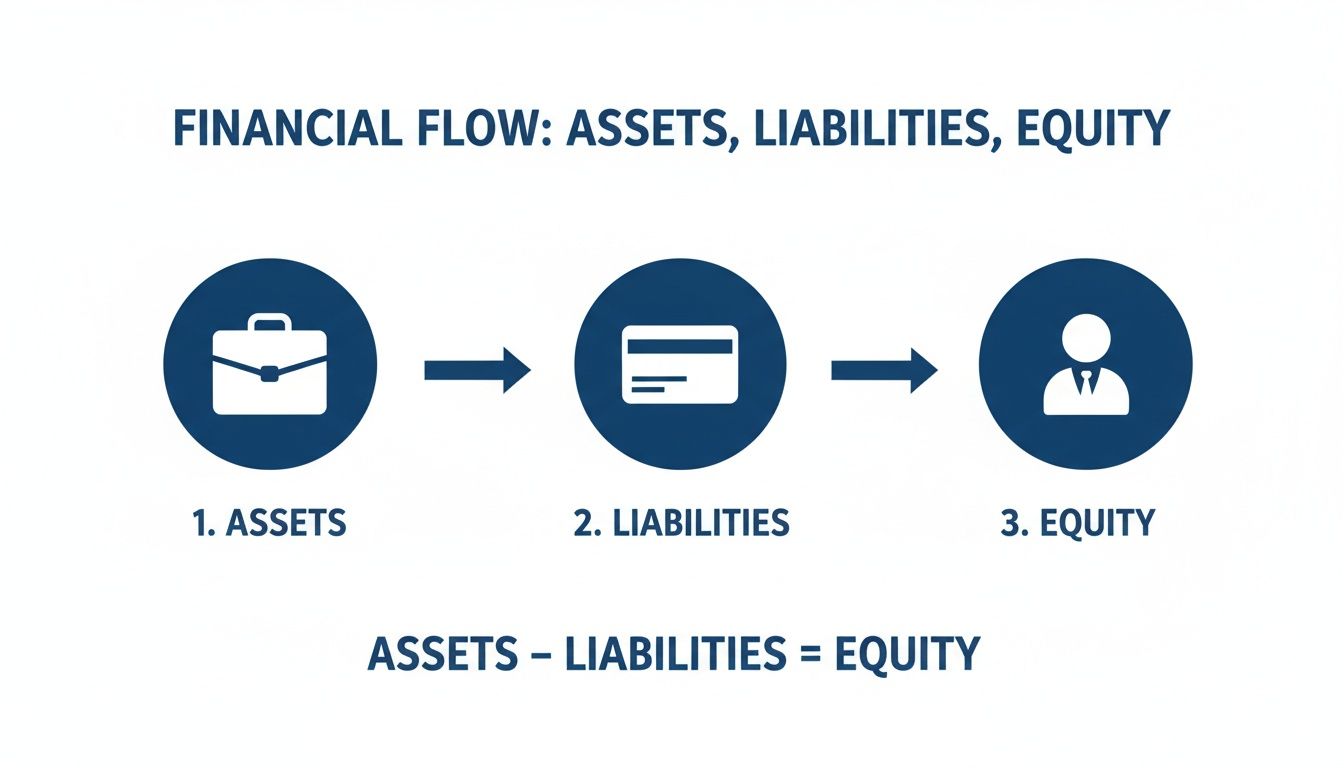
The flow here shows how every resource your business has (its assets) is always claimed by someone—either a creditor (liabilities) or you (equity). Let’s walk through a few common scenarios for a service business to see how this plays out day-to-day.
Transaction 1: Receiving a Client Payment
Imagine your IT consulting firm just wrapped up a project, and the client pays your $5,000 invoice right away. When that money hits your account, two things happen simultaneously.
First, your Cash balance—which is an asset—increases by $5,000. Simple enough. At the same time, that payment is revenue you’ve earned, which boosts your Equity. Specifically, it increases an equity account often called Retained Earnings.
Here’s the impact on the equation:
- Assets: +$5,000 (Cash)
- Equity: +$5,000 (Revenue increases Retained Earnings)
The result? Assets went up by $5,000, and Equity went up by $5,000. The equation is still perfectly in balance.
Transaction 2: Buying Software on Credit
Now, let’s say you need a new project management software subscription that costs $1,200. You buy it from a vendor but arrange to pay the bill next month. You’ve bought it on credit.
In this case, you’ve gained a new resource—the software license. This is an Asset for your business, increasing that side of the equation by $1,200. But since you haven’t paid cash yet, you’ve also created a new debt. This increases your Accounts Payable (a liability) by the exact same amount.
The equation shifts like this:
- Assets: +$1,200 (Software)
- Liabilities: +$1,200 (Accounts Payable)
Once again, both sides of the equation move by the same amount, keeping everything balanced. This two-sided effect is the heart of the system we cover in our guide to double-entry bookkeeping explained.
Transaction 3: Paying Monthly Rent
Finally, the end of the month rolls around, and you need to pay your $2,500 office rent. You wire the money from your business checking account. This transaction reduces both your assets and your equity.
Your Cash (an asset) decreases by $2,500 because the money is gone. Rent is a business expense, and all expenses reduce your net income. That drop in income flows through to your Retained Earnings, which is part of your Equity. So, equity also goes down by $2,500.
Paying an expense is a perfect example of how the equation reflects a decrease in your business’s value. You’ve used one resource (cash) to cover a cost of doing business, which in turn reduces the owner’s overall stake.
Here’s the final effect on the books:
- Assets: -$2,500 (Cash)
- Equity: -$2,500 (Rent Expense reduces Retained Earnings)
The scale stays balanced. These examples prove the accounting equation is more than just a formula—it’s the logical framework that tells the financial story of your business, one transaction at a time.
Uncovering the Story Behind Your Equity
While the basic accounting equation gives you a fantastic snapshot of your business’s financial position, it doesn’t tell the whole story of its performance. It’s like knowing the final score of a game without seeing any of the plays. To see how your day-to-day operations actually impact your net worth, we need to zoom in on the Equity component.
This is where the expanded accounting equation comes in. It breaks down equity into its moving parts, revealing how your hard work directly grows—or shrinks—your stake in the business.
The Expanded Accounting Equation:
Assets = Liabilities + Owner’s Capital + Revenue – Expenses – Draws
This version gives you a much richer look into your business. It connects the activities on your income statement (your revenue and expenses) directly to your balance sheet, finally showing you the “why” behind any changes in your company’s value.
How Each New Element Impacts Equity
The expanded formula introduces three new accounts that are really just temporary pieces of equity. They give you a more granular, real-time look at your business’s financial engine.
- Revenue: This is the money your business earns from selling its services. Every single dollar of revenue you bring in directly increases your equity. Think of it as the primary way you build value in your company.
- Expenses: These are the costs you have to pay just to keep the lights on, from software subscriptions to payroll. Every dollar you spend on expenses decreases your equity. This is exactly why disciplined cost management is so critical to your bottom line.
- Draws (or Dividends): This is the money you, the owner, take out of the business for personal use. A draw is not a business expense; it’s a direct reduction of your ownership stake. It decreases your equity.
This detailed view makes it crystal clear why tracking every transaction matters. It’s not just about getting ready for tax season; it’s about protecting the value you’ve worked so hard to build.
The unwavering balance of this equation is what underpins critical financial health metrics across the globe. For example, revenue boosts equity—in the U.S., service businesses averaged 7.2% net margins, adding $1.3 trillion to equity—while expenses reduce it, all while maintaining that perfect balance. You can dive deeper into how the equation supports key financial ratios by exploring more insights on the accounting equation’s real-world impact.
By understanding this expanded version, you move from simply knowing your net worth to understanding exactly what drives it. Every sale you make and every cost you control tells a crucial part of your financial story.
Avoiding Common Financial Blunders

Knowing the formula is one thing. Applying it perfectly amid the day-to-day chaos of running a business? That’s another challenge entirely. Even tiny mistakes can throw your books way off, leading to skewed reports and poor financial decisions. Steering clear of these common pitfalls is the key to maintaining accurate records.
One of the most frequent errors we see is business owners mixing personal and business expenses. Paying for a family dinner with the company credit card might seem harmless, but it immediately knocks the accounting equation out of balance. It incorrectly reduces your business equity for a non-business cost. This practice, known as commingling funds, creates massive headaches during tax season and makes it impossible to see your true profitability.
Another classic blunder involves large purchases, or capital expenditures. Imagine buying a new high-end server for $8,000. If you record this as a simple one-time expense, you drastically understate your net income for the month and completely miss adding a valuable long-term asset to your balance sheet. The right way is to add the server as an asset and then depreciate its cost over its useful life.
Key Mistakes That Unbalance Your Books
To keep your records clean, you have to watch out for these specific slip-ups. Each one can disrupt the delicate balance of Assets = Liabilities + Equity and give you a misleading picture of your company’s financial health.
- Forgetting to Record Invoices: When you complete a job and send an invoice, your Accounts Receivable (an asset) and your Revenue (which boosts equity) both increase. If you forget to record it, your assets and equity are both understated. Simple as that.
- Miscategorizing Loan Payments: A loan payment isn’t just one transaction—it’s two. Part of it reduces your principal (the Liability), and the other part is interest (an Expense that reduces equity). If you book the entire payment as an expense, you’re inflating your costs and not showing that you’re paying down your debt.
- Ignoring Owner Draws: Taking money out of the business for personal use is not a business expense. It’s a draw, which directly reduces your owner’s equity. If you record it as an expense like “office supplies,” you’re misrepresenting your company’s operational costs and profitability.
The integrity of your financial data relies on consistent and accurate transaction recording. When the basic accounting equation doesn’t balance, it’s not a suggestion—it’s a clear signal that a mistake needs to be found and fixed.
Your best defense against these errors is regular bank and credit card reconciliations. By methodically comparing your books to your bank statements every single month, you can catch discrepancies before they spiral out of control. This simple habit ensures your financial foundation remains solid and reliable.
Achieving Total Financial Clarity
Getting a handle on the basic accounting equation is the first major hurdle. But the real work begins when you start putting that knowledge into practice, day in and day out, to build a business that can weather any storm.
That simple formula, Assets = Liabilities + Equity, is more than just a rule to memorize. It’s your compass for accurate reporting and confident decision-making, turning a pile of raw transaction data into a clear story about your company’s financial health.
For business owners, the goal is always to apply these principles effectively. If you’re looking for more hands-on advice, you can find some great next steps in a practical guide on managing small business finances. Ultimately, the equation isn’t just a rule—it’s the framework for telling your company’s financial story.
Moving from theory to flawless execution is where real growth happens. A balanced equation isn’t just a bookkeeping task; it’s the foundation of a strategic financial asset.
At Steingard Financial, we help you bridge that gap. Our meticulous bookkeeping makes sure your equation always balances, and our expert financial reporting turns that perfectly balanced data into strategic insights you can actually use. We’re here to give you the financial clarity you need to stop guessing and start growing your business on purpose.
Ready to achieve total clarity? Schedule a discovery call with our team today.
Frequently Asked Questions
Even with a solid grasp of the accounting equation, it’s natural for a few questions to pop up when you start applying it to your own business. Let’s tackle some of the most common ones we hear from business owners.
Why Must the Accounting Equation Always Balance?
Think of the accounting equation as the bedrock of your financial records. It has to balance because it’s the core principle of the double-entry bookkeeping system that every legitimate business uses. Every single transaction has two sides to it, creating a self-checking system that keeps your books honest and accurate.
For instance, if you take out a $10,000 business loan, your cash (an asset) goes up, but your loans payable (a liability) also goes up by the same amount. The scale stays balanced. If you buy a new computer with cash, one asset (equipment) increases while another (cash) decreases. It’s a perfect give-and-take that ensures every debit has an equal and opposite credit, which is your first line of defense against errors.
How Does Net Income Affect the Accounting Equation?
This is a great question, and it takes us right back to the expanded equation. Your net income, or profit, flows directly into the Equity side of your financial picture. Remember, revenues increase your equity, and expenses decrease it.
Since Net Income = Revenues – Expenses, a profitable period increases your Retained Earnings. This account is a crucial part of your total Equity and tells the story of how your business is growing its value over time.
On the flip side, if you have a net loss for the month, it will chip away at your Retained Earnings, reducing your overall Equity. This reflects that the business’s value took a hit during that period.
Can a Business Have Negative Equity?
Unfortunately, yes. A business can definitely have negative equity, and it’s a serious red flag. This happens when a company’s total liabilities are greater than its total assets. In accounting terms, this is often called insolvency or having a negative net worth.
How does it happen? Usually, it’s the result of piling up significant losses over time. These losses eat away at any initial capital invested and any retained earnings until the owner’s stake in the business is completely wiped out and goes into the negative. For any business owner, seeing negative equity on the balance sheet is a critical warning sign of severe financial trouble.
Your business deserves financial records that are always accurate and in balance. Steingard Financial provides meticulous bookkeeping and expert reporting to give you total clarity and confidence. Schedule your discovery call with Steingard Financial today to build a rock-solid financial foundation.