

Bookkeeping Cleanup Services A Guide to Restoring Financial Order
A bookkeeping cleanup is a one-time project designed to get your business’s historical financial records corrected, reconciled, and properly organized. Think of it less like routine data entry and more like a deep financial reset. The entire point is to fix past mistakes and turn a chaotic, unreliable set of numbers into a pristine record you can finally trust for making smart decisions.
Why Messy Books Stall Your Business Growth
Imagine trying to build a house on a cracked and crumbling foundation. It doesn’t matter how strong the walls are or how beautiful the design is—the whole structure is at risk. Your business’s financial records are that foundation.
When your books are messy, incomplete, or just plain wrong, every decision you make is built on shaky ground. Hiring new staff, launching a new product, setting your pricing… all of it becomes a gamble.
This is the exact problem that bookkeeping cleanup services are built to solve. It’s a specialized project for business owners who find themselves drowning in financial chaos, usually for one of a few common reasons:
- Rapid Growth: Your business took off faster than your systems could handle, leaving a trail of unreconciled transactions and mismatched reports.
- DIY Accounting Attempts: You managed the books yourself to save money in the early days, but now the complexity has completely outpaced your expertise.
- Unreliable Previous Bookkeepers: The last person you hired left things in a disorganized state, creating more problems than they ever solved.
Before you can know if a cleanup is right for you, it helps to recognize the warning signs. Many business owners live with these issues for so long they start to feel normal, but they are clear indicators that your financial foundation is unstable.
Red Flags That Signal You Need a Bookkeeping Cleanup
This table highlights some of the most common symptoms we see. If any of these sound familiar, it’s a strong sign your books need professional attention.
| Symptom or Red Flag | What It Means for Your Business | Potential Consequence |
|---|---|---|
| Bank accounts haven’t been reconciled in months (or ever). | Your cash balance in your accounting software doesn’t match the bank’s records, so you don’t know your true cash position. | Bounced checks, overdraft fees, and making spending decisions with inaccurate cash data. |
| Your Profit & Loss statement makes no sense. | Revenue and expense categories are mixed up, making it impossible to see where your money is actually coming from and going. | Inability to identify profitable services, cut unnecessary costs, or create a realistic budget. |
| You have a large balance in “Undeposited Funds” or “Ask My Accountant.” | Transactions have been recorded incorrectly and left in default or suspense accounts instead of being properly categorized. | A massively overstated income or a pile of uncategorized expenses, leading to a skewed view of profitability. |
| You’re constantly surprised by your tax bill. | Your books don’t provide a clear picture of your tax liability throughout the year, leading to sticker shock at tax time. | Overpaying on taxes due to missed deductions, or underpaying and facing IRS penalties and interest. |
| You can’t get a loan or line of credit. | Lenders review your financial statements and see inconsistencies, errors, or a lack of professional preparation, deeming you too high-risk. | Stalled growth due to lack of access to capital for expansion, equipment purchases, or inventory. |
Recognizing these red flags is the first step. The goal is to move from a place of financial uncertainty to one of absolute clarity.
From Financial Uncertainty to Absolute Clarity
The fallout from messy books goes way beyond simple frustration. Inaccurate numbers lead directly to flawed business strategies, unexpected tax bills, and stalled momentum. You can’t confidently apply for a loan, bring on investors, or even figure out your true profit margins on a key product. As discussions on topics like Why Is Accurate Payroll Important For A Companys Growth show, financial accuracy is the bedrock of a healthy company, and that’s precisely what a cleanup restores.
A professional cleanup isn’t just about tidiness; it’s about transforming your financial data from a source of stress into your most powerful tool for strategic growth. It provides the clarity needed to steer your business with precision.
This need for clarity is becoming more critical than ever. The global bookkeeping services market is projected to grow from USD 34.46 billion in 2024 to USD 68.33 billion by 2033. This surge is largely driven by small and medium-sized businesses—which make up 90% of businesses worldwide—realizing they need expert help to avoid common pitfalls like reconciliation errors that can trigger major tax penalties.
The True Goal of a Bookkeeping Cleanup
Ultimately, a cleanup project is about shifting your business from a reactive state (always putting out fires) to a proactive one (seizing opportunities). It’s the essential first step before you can benefit from reliable, ongoing financial management.
By investing in a thorough cleanup, you’re not just correcting the past. You’re building a stable, trustworthy foundation for a more profitable and predictable future. If you’re ready to move from disorganized records to strategic financial oversight, our guide on bookkeeping services for small businesses can show you what comes next.
The Cleanup Process From Start to Finish
So, what does a professional bookkeeping cleanup actually look like? It’s not just a frantic dash to fix a few numbers. Think of it more like a meticulous restoration project. We systematically take things apart, inspect every piece, clean and repair what’s broken, and then reassemble it all so the entire engine runs perfectly.
The whole process starts with a diagnostic review. We don’t just dive in and start making changes. First, we need to get a bird’s-eye view of the situation to understand the full scope of the issues—pinpointing where the problems started and how deep they really go. This initial deep-dive lets us build a clear roadmap for your specific business.
This flowchart shows how we take your finances from chaos to clarity through a structured reset.
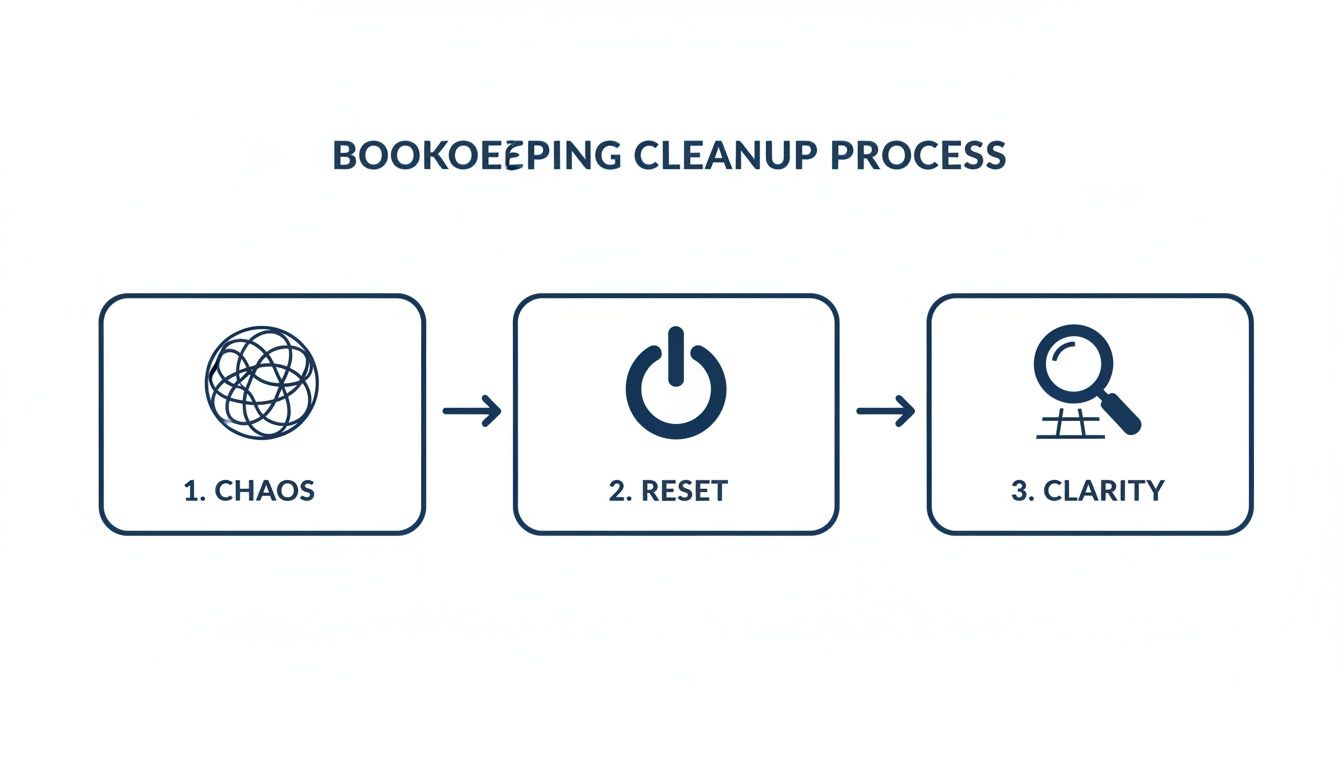
It’s all about creating a clear path from tangled, confusing data to organized, insightful financial information.
Phase 1: Gaining Access and Gathering Intelligence
Once we have a solid plan, the first hands-on phase is all about getting secure access to your financial tools. This usually means accountant-level access to your accounting software (like QuickBooks Online) and connecting to other key systems like your payroll provider (Gusto, for example) and payment processors (Stripe, PayPal, etc.).
At the same time, we start gathering all the necessary documents. This includes:
- Bank and Credit Card Statements: We’ll need every statement for every account covering the entire cleanup period.
- Loan and Line of Credit Statements: These are crucial for making sure your liabilities and interest expenses are recorded correctly.
- Previous Tax Returns: Your past filings give us a baseline and help us spot any differences between what was reported and the current state of your books.
This step is all about establishing a single source of truth before a single correction is made.
Phase 2: The Core Reconciliation Work
Here’s where the real heavy lifting happens. Reconciliation is the process of matching every single transaction in your books to the corresponding entry on your bank and credit card statements. It’s the only way to be absolutely sure your books reflect reality.
It’s not uncommon for a business with 12 months of messy books to have hundreds, or even thousands, of discrepancies. Each one represents a potential error that’s distorting your financial picture.
In this phase, we work through each account, one month at a time. We hunt down and resolve issues like duplicate entries, missing transactions, and incorrect amounts. If you want to learn more about this cornerstone of financial accuracy, we have a detailed guide on how to reconcile bank accounts. The end goal is simple: your cash balance needs to be 100% accurate.
Phase 3: Transaction Categorization and Correction
With everything reconciled, our focus shifts to categorization. It isn’t enough for a transaction to just be in the system; it has to be assigned to the correct income or expense account. A simple misstep—like logging a software subscription under “Office Supplies”—can completely throw off your understanding of where your money is going.
We go through every transaction from the cleanup period to make sure:
- Expenses are correctly classified based on your chart of accounts.
- Income is properly recorded instead of being dumped into a generic “Uncategorized Income” bucket.
- Personal and business expenses are separated, which is non-negotiable for accurate reporting and tax compliance.
- Balance sheet items are handled correctly, like splitting loan payments between principal and interest.
This phase is what transforms your Profit & Loss statement from a confusing mess into a powerful tool for analyzing your business.
Phase 4: Finalizing the Balance Sheet and Reporting
The last leg of the journey involves cleaning up the balance sheet. This means reviewing your Accounts Receivable (A/R) report to write off old, uncollectible invoices and tidying up the Accounts Payable (A/P) report to remove paid bills that are still hanging around. We also double-check all your asset and liability balances to ensure everything is stated properly.
Once all accounts are reconciled, transactions are categorized, and the balance sheet is clean, we generate a final, accurate set of financial statements. This package usually includes a pristine Profit & Loss, Balance Sheet, and Statement of Cash Flows. These documents give you the clean, reliable financial foundation you need to move forward with total confidence.
How Costs and Timelines for Cleanups Are Determined
When you’re facing a financial cleanup, the first two questions are almost always the same: “How much is this going to cost?” and “How long will this take?” There’s no simple, one-size-fits-all answer because every financial mess is unique. The real answer depends entirely on the state of your books.
Think of it like hiring a contractor to fix up a house. A house that just needs a deep clean and a fresh coat of paint is a much faster and cheaper project than one with a leaky roof, foundation cracks, and faulty wiring. Both are “renovation” projects, but the scope of work is worlds apart.
It’s the same with a bookkeeping cleanup service. The final price is based on the complexity and sheer volume of work needed to get your financial engine running smoothly again.
Key Factors That Influence Cleanup Pricing
To give you an accurate quote, any good bookkeeper will start with a diagnostic review to see what they’re working with. A few key variables directly impact the hours required, which in turn determines the cost.
The biggest drivers are:
- Number of Months: The longer your books have been neglected, the more data there is to sift through. Cleaning up three months of records is a sprint; cleaning up three years is a marathon.
- Transaction Volume: A business with 50 transactions a month and two bank accounts is a very different project than one with 500 transactions spread across five accounts and two credit cards.
- Number of Unreconciled Accounts: Every single bank account, credit card, loan, and payment processor (like Stripe or PayPal) that needs to be reconciled adds another layer to the project.
- State of Existing Records: Are your transactions just sitting there uncategorized? Or are they miscategorized? Sometimes, fixing hundreds of incorrect entries takes more detective work than simply categorizing them from scratch.
- Payroll and Sales Tax Complexity: If payroll records are a disaster or sales tax was recorded incorrectly, fixing these high-stakes areas requires a very specific and detailed approach.
The core idea is simple: the cost is a direct reflection of the time and expertise needed to untangle the financial chaos. A small knot is a small investment to fix, while a huge tangle requires a more significant one.
Reframing the Cost as a Strategic Investment
It’s easy to get sticker shock and focus on the upfront cost. But it’s more accurate to see this as an investment in your company’s future. A proper cleanup prevents much bigger, scarier expenses down the line—think IRS penalties, missed tax deductions, or bad business decisions made with faulty data.
The return on this investment is very real. Businesses often turn to outsourced cleanup services, which can range from $250 to over $2,500 per month, because they see a clear ROI. A cleanup can slash error-related losses, often estimated at 5-10% of revenue for companies with neglected books.
Considering that bookkeeping commands a 43.2% share of a global accounting market valued at over USD 688 billion, the demand for clean, reliable financial data is massive. You can learn more about how these costs deliver value in the US market.
Realistic Timelines You Can Expect
Just like the cost, the timeline for a cleanup depends entirely on the scope. A dedicated team can usually move much faster than an in-house person trying to tackle a massive cleanup project on top of their regular duties.
Here are some general timelines to give you an idea:
- Simple Cleanup (1-3 months of records): For a small business with pretty low transaction volume, this can often be wrapped up in 1-2 weeks.
- Moderate Cleanup (6-12 months of records): This is a more intensive project and will likely take anywhere from 2 to 6 weeks, depending on how tangled the transactions are.
- Complex Cleanup (Multiple years of records): Overhauling several years of books is a major undertaking. This can take several months to complete properly and is often broken down into phases.
At the end of the day, a good provider will give you a clear project plan with estimated timelines after they’ve done their initial diagnostic. This makes sure everyone is on the same page and you know exactly what to expect as your books are brought back to life.
Real-World Results of a Financial Cleanup

The real value of a bookkeeping cleanup service isn’t just about getting organized. It’s about the massive, tangible shift it creates in a business. The journey from financial chaos to total clarity is easiest to see through the stories of businesses that have gone through it.
Let’s walk through a few anonymized “before and after” situations that highlight what a difference this makes. These examples show how a proper cleanup gives owners the power to stop guessing and start making smart moves backed by real numbers.
From Unreconciled Chaos to Strategic Clarity
Picture a digital marketing agency that grew way too fast. For nearly two years, all their energy went into landing clients and delivering projects. Their bookkeeping? It got left in the dust.
-
Before the Cleanup: Their books were a complete mess. Bank accounts hadn’t been reconciled in ages, and expenses from countless software tools and ad platforms were just sitting there, uncategorized. The owner had no clue about their cash flow, couldn’t tell which services were actually making money, and was constantly blindsided by a low bank balance. Getting a business loan was just a fantasy.
-
After the Cleanup: We went in and reconciled every single transaction and properly categorized two years of expenses. This produced the agency’s first-ever accurate Profit & Loss (P&L) statement. The owner was shocked to learn their true net profit margin was only 18%, not the 30% they’d been estimating. With this newfound clarity, they immediately adjusted pricing on their low-margin services and successfully secured a $100,000 line of credit to fund their next growth stage.
Recovering Lost Revenue from Integrated Apps
Here’s another classic situation we see all the time: a growing e-commerce store juggling multiple sales channels and payment processors. The way their apps were integrated with their accounting software created a perfect storm of uncategorized sales and duplicate entries.
-
Before the Cleanup: You couldn’t trust their revenue numbers. Sales from one platform were being counted twice, while revenue from another wasn’t being recorded at all. Their balance sheet showed a huge, incorrect balance in an account called “Undeposited Funds,” making it impossible to trust their income statements or plan for inventory.
-
After the Cleanup: The cleanup involved carefully untangling thousands of automated entries, deleting all the duplicates, and correctly mapping each sales channel to the right income account. The result was a clean, reliable balance sheet and P&L. Better yet, the process uncovered $22,000 in revenue that had never been properly recorded, giving their bottom line an instant boost.
To help you visualize the impact, here’s a quick summary of the kind of transformation a business goes through during a cleanup project.
Client Transformation After a Bookkeeping Cleanup
| Financial Area | Before Cleanup (The Problem) | After Cleanup (The Solution and Outcome) |
|---|---|---|
| Financial Reporting | Inaccurate or non-existent reports (P&L, Balance Sheet). | Accurate, timely financial statements for confident decision-making. |
| Cash Flow Visibility | Unpredictable cash flow; constant surprises about bank balances. | Clear understanding of cash position, enabling better planning. |
| Profitability Analysis | Unable to identify profitable vs. unprofitable services or products. | Pinpointed profit drivers, leading to strategic pricing adjustments. |
| Tax Preparedness | Stressful, last-minute scrambles; risk of overpaying or audits. | Clean, CPA-ready books for a smooth tax season and optimized filing. |
| Loan & Investor Readiness | Unable to apply for loans due to unreliable financials. | Investor-ready reports that led to securing a $100,000 line of credit. |
| Operational Efficiency | Wasted time and money trying to make sense of messy data. | Reclaimed hours and reduced financial anxiety for the owner. |
The “after” state isn’t just about having tidy reports. It’s about unlocking the ability to confidently answer the big questions: Can we afford this new hire? Should we invest in that equipment? Is this marketing campaign actually working?
Getting your books in order also lets you implement broader business process optimization strategies across your entire operation. When you trust your numbers, you can build smarter workflows for everything from inventory to payroll. These stories aren’t just about fixing the past—they’re about building a stronger, more profitable future.
How to Prepare for a Cleanup and Choose the Right Partner

Deciding to hire a firm for bookkeeping cleanup services is a huge step toward getting your financial house in order. To make the whole process run smoothly, a little prep work on your end goes a very long way. Think of it like getting ready for a home renovation—the more you organize before the crew shows up, the faster they can get to work and the better the final result will be.
The right partner won’t just patch up your books; they’ll become a trusted advisor who actually understands your business. That’s why the selection process is just as critical as the cleanup itself. Let’s walk through an actionable roadmap, starting with a simple prep checklist and then diving into the essential questions you need to ask any potential provider.
Your Pre-Cleanup Preparation Checklist
Your new bookkeeping partner will need access to specific documents and systems to start their diagnostic review and kick off the cleanup. Getting these items gathered up front will dramatically speed things up.
Here’s a simple checklist of what to have ready:
- Bank and Credit Card Statements: Pull the complete, downloaded PDF statements for all business accounts covering the entire cleanup period. Don’t leave any out—every single account has to be reconciled to zero.
- Accounting Software Access: Be ready to grant accountant-level access to your software (like QuickBooks Online). This lets the team work their magic without needing your personal login details.
- Loan and Line of Credit Statements: Just like bank statements, these are crucial for verifying your liabilities, principal balances, and interest expenses.
- Payroll Reports: If you use a payroll service like Gusto, have your summary reports handy. They’re essential for making sure your wage expenses and payroll liabilities are recorded correctly.
- Previous Tax Returns: Your most recently filed business tax return gives your bookkeeper a critical starting point—a snapshot of your books at that time.
Having these documents ready to go shows you’re serious and helps your chosen partner hit the ground running. A smooth start really sets a positive tone for the entire project.
Vetting Potential Bookkeeping Cleanup Providers
Not all bookkeeping firms are created equal, especially when you’re dealing with a complex cleanup project. You need a partner with proven experience in untangling messy historical records. Asking the right questions in your initial calls is the single best way to separate the true experts from the rest.
Treat this like an interview for a key role in your company, because that’s what it is. Their answers will tell you everything about their expertise, how they communicate, and their overall approach. Vague or uncertain responses are a major red flag.
Here are the essential questions to ask:
-
What is your specific experience with cleanup projects of our size and industry?
A general bookkeeper might be great for day-to-day tasks, but cleanups require a forensic level of detail. Ask them for real examples of similar projects they’ve handled. -
Which accounting software are you certified in?
Expertise with your specific tools matters. If your business runs on QuickBooks Online, you want a team of certified QuickBooks ProAdvisors who know the platform inside and out. -
How will you communicate with us during the project?
A good partner establishes a clear communication rhythm from day one, whether it’s a weekly summary email or a dedicated project channel. You should never be left wondering what’s going on. -
What is your process for handling transactions we need to clarify?
Inevitably, there will be transactions with no clear context. Find out how they manage these questions. Do they use a shared spreadsheet? A client portal? A messy Q&A process can bring the whole project to a halt. -
What are the final deliverables we will receive?
The project should end with a clear set of deliverables. This typically includes a final, reconciled set of financial statements (Profit & Loss, Balance Sheet) and a summary of the major changes made to your books.
Choosing a partner is about more than just technical skill; it’s about finding a team whose process and communication style align with your needs. Trust and transparency are non-negotiable.
Finding the right fit ensures that once your books are clean, you have a reliable partner you can count on for ongoing support. Many businesses that start with a cleanup project transition to monthly services, which makes this initial choice even more critical. To see the long-term benefits, explore our guide on how to outsource bookkeeping for your small business. It will help you see how a great partner can support your growth far beyond the initial cleanup.
Frequently Asked Questions About Bookkeeping Cleanup
Jumping into a bookkeeping cleanup service is a big step, and it’s totally normal to have a few questions. The whole point of this process is to get your numbers clear and trustworthy again, so let’s make sure you have the answers you need right from the start.
We’ve gathered the most common questions business owners ask when they’re thinking about hitting the reset button on their finances.
Cleanup vs. Ongoing Bookkeeping: What’s the Difference?
A lot of people use the term “bookkeeping” to cover everything, but there’s a huge difference between a one-time cleanup and your regular, ongoing services. The easiest way to think about it is like owning a car.
-
Bookkeeping Cleanup: This is the massive engine overhaul. It’s a one-time project to fix everything that’s gone wrong in the past—think miscategorized expenses, bank accounts that don’t match up, and reports that just don’t make sense. The goal is to get the engine running perfectly after it’s been neglected for a while.
-
Ongoing Bookkeeping: This is your routine oil change and tune-up. It’s the consistent, monthly work that keeps the engine in great shape. This includes things like categorizing transactions each week, reconciling accounts every month, and pulling reports so you can see what’s going on. It stops the big mess from ever happening again.
A cleanup tackles all the historical problems, setting a clean slate. Ongoing bookkeeping is the proactive care that keeps your business financially healthy for the long haul.
What Happens After the Cleanup Finishes?
Finishing a cleanup project isn’t really the end—it’s the beginning of a much better financial chapter for your business. Once your past books are accurate, organized, and reconciled, you have a solid foundation you can actually rely on. The natural next step is to move into a monthly bookkeeping plan.
This transition is key because it protects the investment you just made in getting your books clean. Without that consistent upkeep, even the most pristine books can slide back into chaos pretty quickly.
The real goal of a cleanup isn’t just fixing the past. It’s about building a system where financial messes can’t grow in the first place. Ongoing service turns your books from a recurring headache into a valuable tool.
With accurate, current records being managed for you every month, you can finally make smart decisions based on what’s really happening with your money. You’ll always be ready for tax time and feel completely in control of your company’s finances.
Can I Just Do the Bookkeeping Cleanup Myself?
The DIY approach is always tempting, especially for entrepreneurs who are used to wearing all the hats to save a buck. If you’re a very small business with just a month or two of simple errors, you might be able to handle it. But for anything more complicated, it can quickly become a case of being “penny wise and pound foolish.”
A professional bookkeeper brings a few things to the table that are tough to replicate on your own:
- Expertise: They’re trained to find the tricky problems you might not even know to look for, like issues with loan payments, payroll taxes, or sales tax errors. They don’t just fix the surface-level symptoms; they diagnose and correct the root cause of the mess.
- Efficiency: A cleanup that could take you an entire weekend of frustrating, hair-pulling work is often just a few hours for a pro. They have the right tools and a proven process to untangle financial data quickly and correctly.
- Objectivity: An outside expert gives you an impartial look at your finances. They aren’t emotionally attached to past business decisions and can make the necessary corrections to get your books reflecting reality—which is absolutely critical for taxes and for getting a loan.
While doing it yourself seems cheaper at first glance, a professional bookkeeping cleanup service ends up saving you from costly mistakes, frees up dozens of your own hours, and delivers a level of accuracy that gives you true peace of mind.
Ready to turn your messy books into a powerful tool for growth? At Steingard Financial, we specialize in meticulous cleanups that restore clarity and control. Schedule a consultation with us today to get a clear plan for your financial future.