Mastering Cash Flow Projection for Service Businesses
A cash flow projection is simply an estimate of the money moving in and out of your business over a specific period. Think of it as a forecast that shows whether you’ll have enough cash on hand to cover critical expenses like payroll and rent. It’s different from a profit and loss statement, which might show profitability on paper. A cash flow projection reveals your actual liquidity—your real ability to operate day-to-day.
Why Accurate Cash Flow Projection Is a Game Changer

Here’s a hard truth many service business owners learn the tough way: profit on paper doesn’t pay the bills. I’ve seen it happen time and again—a profitable quarter is followed by a crippling cash crunch. This is why mastering your cash flow projection is non-negotiable. It bridges the dangerous gap between what your P&L says you earned and the actual cash sitting in your bank account. Without it, you’re flying blind.
Imagine a growing creative agency that just landed two huge clients. Their profit and loss statement looks amazing, showing record revenue. But one of those clients pays on Net 60 terms, and the other is already 30 days late on their deposit. Meanwhile, the agency has to pay its designers, rent, and software subscriptions this month. Suddenly, that impressive profitability becomes a very misleading metric.
Turning Anxiety into Strategic Confidence
This scenario gets to the heart of the problem: an income statement can show you’re successful, but a cash flow projection shows if you’ll survive. This isn’t just an accounting chore; it’s your financial GPS for making smart, timely decisions. This forward-looking view gives you the data to answer critical growth questions with real confidence:
- Can we actually afford to hire that new project manager next month?
- Should we invest in that marketing automation software now, or wait a quarter?
- What happens if our biggest client pays 30 days late? Will we still make payroll?
- Do we need a line of credit to manage seasonal dips in business?
A reliable cash flow projection turns financial management from a reactive, stressful task into a proactive, strategic advantage. You stop worrying about unexpected shortfalls and start planning for sustainable growth.
The Foundation of Financial Control
Poor cash management is a primary reason why businesses fail. In fact, some studies show it contributes to over 82% of business failures. A solid projection acts as your early warning system, flagging potential cash gaps weeks or even months in advance. This gives you precious time to adjust your strategy. You could offer discounts for early payment, delay a non-essential purchase, or get more aggressive with collections on overdue invoices.
Ultimately, building this forecast is the first real step toward gaining control over your business’s destiny. It provides the clarity you need to navigate challenges, seize opportunities, and build a resilient service business that thrives not just on paper, but in the real world where cash is king.
Assembling Your Financial Puzzle Pieces
A solid cash flow projection isn’t some pie-in-the-sky guess. It’s built brick-by-brick using the hard data already sitting in your bookkeeping software. Think of it like putting together a puzzle; you can’t see the final picture until you find all the right pieces and put them in their place. Our job is to turn that jumble of financial records into an organized, practical foundation for your forecast.
It all starts with a methodical look at your past performance—your sales revenue, your expense patterns, everything. You need to analyze this history and combine it with your strategic goals. This historical data is gold because it reveals seasonal trends, growth rates, and recurring cycles that are crucial for predicting where your cash will be in the future. For a deeper dive on this, you can discover more insights about cash flow management on brex.com.
Uncovering Your Cash Inflows
Predicting the money coming into your business is more than just adding up your invoices. The real story is hidden in your Accounts Receivable (AR) aging report. This report doesn’t just tell you who owes you money; it shows you how and, more importantly, when they actually pay.
Pull up this report in QuickBooks or your accounting software and start looking for patterns. Got clients who reliably pay within 15 days? Fantastic. You can slot their payments into your forecast with high confidence.
But what about that one client who always pays 30 days late, even though your terms are Net 30? Your projection has to reflect that reality, not the due date on paper.
- Reliable Payers: For clients with a solid payment history, you can forecast their cash arriving right around the invoice due date.
- Chronic Late Payers: For the stragglers, be honest with yourself. Adjust your projection to reflect their actual behavior—maybe 45 or 60 days out.
- New Clients: With no payment history to go on, it’s smart to be conservative. Project their payment for the end of the term, or even a bit later.
This kind of detailed analysis is what moves you from wishful thinking to a realistic cash inflow forecast. It’s a key distinction, especially when you consider the difference between cash basis and accrual basis accounting, because your projection is all about when the cash actually hits your bank account.
Mapping Out Your Cash Outflows
Next up is getting a crystal-clear picture of the money flowing out of your business. This means digging into your Accounts Payable (AP) aging report and rounding up all of your fixed and variable expenses. These are the puzzle pieces that represent all your financial obligations.
Start by listing every known, upcoming bill from your AP report. This covers payments to vendors, contractors, and suppliers. But don’t stop there. So many of your expenses will never show up on an invoice.
Your projection needs to account for every single dollar you expect to spend. Forgetting one large, infrequent expense—like an annual insurance premium or a quarterly tax payment—can completely derail an otherwise perfect forecast.
You need a complete list of all your outflows. I find it helps to categorize them just to make sure nothing slips through the cracks.
Common Cash Outflows for Service Businesses
- Payroll: This is usually the biggest one. You have to include salaries, hourly wages, payroll taxes, and benefits contributions. If you use a service like Gusto or QuickBooks Payroll, you can pull reports that show you the exact cash needed for each pay run.
- Recurring Subscriptions: Go through and list all your monthly or annual software fees for things like project management tools, CRMs, and your accounting software.
- Rent and Utilities: These are typically fixed costs and are pretty easy to project accurately.
- Marketing and Advertising: Make sure to include any retainers you pay to agencies or planned ad spend for the month.
- Professional Fees: Budget for any legal, accounting, or consulting services you plan on using.
- Taxes: Always set aside funds for those quarterly estimated tax payments.
By systematically gathering these inputs—the reality of your AR collections and a comprehensive list of all your outflows—you’re replacing assumptions with solid data. This detailed groundwork is the single most important part of building a cash flow projection you can actually rely on to make smart business decisions.
Building Your First Cash Flow Projection Model
Okay, with your financial data in hand, it’s time to roll up your sleeves and build a practical, powerful cash flow projection. This isn’t about getting bogged down in complex financial modeling. We’re talking about creating a simple, clear tool—often just a spreadsheet—that gives you an honest look at your financial future.
The goal is to build a framework you can quickly update weekly or monthly. This keeps you ahead of your cash needs, not reacting to them.
Your model will have three core parts that work together to tell your complete cash story: Cash Inflows, Cash Outflows, and the Cash Summary. Each part answers a simple question: How much money is coming in? How much is going out? And what does that leave us with?
Structuring Your Cash Inflows
First things first, let’s map out the money you actually expect to receive. This is where all that work digging into your Accounts Receivable pays off. Instead of just listing invoice totals, you’ll forecast when you can realistically expect that cash to land in your bank account.
Let’s imagine a small web design agency. Their inflow section wouldn’t just be a list of invoices; it would look more like this:
- Client A Project Deposit: This is a brand new client, so the agency conservatively projects the cash will arrive right on its Net 30 due date.
- Client B Final Payment: This client has a track record of paying about 15 days late. The agency wisely budgets for that cash to arrive 45 days after invoicing, not the stated 30.
- Client C Monthly Retainer: Here’s a reliable, long-term client who always pays via ACH on the 1st of the month. This cash inflow is highly predictable and can be counted on.
This level of detail, based on real-world payment behavior, is what separates a genuinely useful cash flow projection from a simple sales forecast. You’re tracking the timing of cash, not just the promise of it.
The process is pretty straightforward—you’re just pulling information from your day-to-day operations.
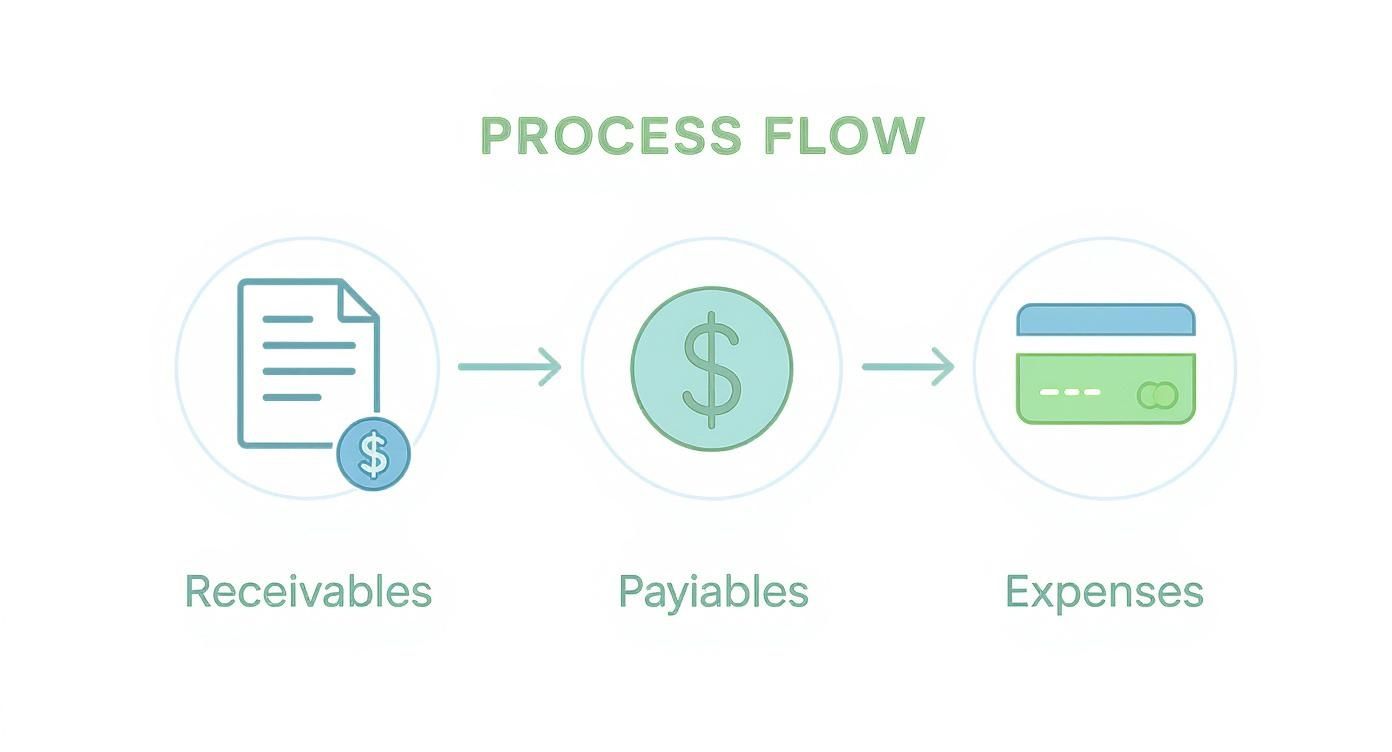
This visual just shows how your everyday transactions—what you bill, what you owe, and your regular expenses—are the direct inputs for a forecast you can trust.
Detailing Your Cash Outflows
Next up, you’ll list every single anticipated expense for the period you’re forecasting. Accuracy here is absolutely crucial. Forgetting even one significant payment can throw your entire projection off course. I find it easiest to group outflows into categories to keep things organized and make sure nothing slips through the cracks.
Back to our web design agency, their outflow categories would include:
- Payroll: The exact cash needed for employee salaries, payroll taxes, and benefits for each pay period. No guesswork here.
- Contractor Fees: Payments due to freelance developers or designers, based on their specific invoice terms (Net 15, Net 30, etc.).
- Software Subscriptions: All those recurring monthly fees for tools like Adobe Creative Cloud, project management software, and web hosting.
- Marketing Spend: The planned budget for things like Google Ads or social media campaigns.
- Rent & Utilities: The fixed, predictable costs that are easy to plug in.
- Quarterly Tax Payments: This is a big one. It’s a critical, often overlooked outflow that you must plan for.
One of the most common mistakes I see is business owners forgetting non-monthly expenses. Annual insurance premiums, software renewals, or professional association dues can create unexpected cash crunches if they aren’t included in your projection.
Creating this complete list removes any ambiguity and gives you a true picture of your financial commitments. It’s also a great chance to gut-check your spending and see if it aligns with your budget.
Calculating Your Cash Summary
The final piece of the puzzle ties everything together. The Cash Summary is where you see the real-time impact of your inflows and outflows on your bank balance. It’s calculated with a simple, rolling formula for each period, whether that’s a week or a month.
Here’s the breakdown:
- Opening Cash Balance: This is the actual amount of cash in your bank account at the start of the period. This number has to be precise, which is why it’s so important to how to reconcile bank accounts regularly.
- Total Cash Inflows: Simply sum up all the cash you projected to receive during that period.
- Total Cash Outflows: Then, sum up all the cash you projected to spend.
- Net Cash Flow: This is the difference between your total inflows and total outflows (Inflows – Outflows). A positive number means more cash came in than went out; a negative number means the opposite.
- Ending Cash Balance: This is your Opening Cash Balance plus your Net Cash Flow for the period. This final number then becomes the Opening Cash Balance for the very next period, creating a continuous, rolling forecast.
By building this simple model, you create a dynamic financial dashboard for your business. You can immediately spot the weeks or months where cash might get tight, giving you time to make proactive decisions instead of constantly reacting to crises. This first cash flow projection is your most important step toward achieving true financial control.
How to Stress-Test Your Financial Forecast
Getting your initial cash flow projection built is a huge milestone, but honestly, it’s just the starting point. A single forecast is nothing more than your best guess—a plan for a future that will almost certainly unfold differently. To make that plan truly useful, you have to stress-test it against reality.
Stress-testing is where you graduate from simply forecasting to actively planning. It’s all about creating different versions of your forecast to see how your cash balance holds up when things don’t go exactly as planned. This is how you spot potential cash gaps long before they turn into emergencies.
Building Scenarios From Best to Worst Case
The best way to stress-test your numbers is to build out three core scenarios. This doesn’t have to be some incredibly complex exercise; the real goal is to bracket the range of what’s possible so you’re ready for anything.
You already have your starting point: your original projection. Let’s call that your “Most-Likely Scenario.” This is your baseline, the one grounded in your historical data and most realistic expectations.
Now, let’s build two more versions:
- Best-Case Scenario: What happens if everything goes perfectly? You land that big project you’ve been chasing, a key client pays 30 days early, and expenses come in just under budget. This isn’t just wishful thinking; it helps you plan for opportunities.
- Worst-Case Scenario: What if a few key things go wrong? Your biggest client pays 60 days late, you unexpectedly lose a monthly retainer, and an urgent, unbudgeted expense pops up. This pessimistic view is your financial fire drill—it shows you exactly where your breaking points are.
Think of it like planning a road trip. Your “most-likely” route is the one Google Maps spits out. The “best-case” is hitting nothing but green lights, while the “worst-case” involves a flat tire during rush hour. You need a plan for all three.
Asking the Tough What-If Questions
To give these scenarios life, you need to ask targeted “what-if” questions that reflect the realities of your business. This is what makes the stress test truly valuable. The idea is to tweak the timing and amounts of your cash inflows and outflows to see the real-world impact on your bank balance.
For a service business, these questions might look something like this:
- What if… our biggest client’s payment is delayed by 30 days? Action: In your worst-case model, just push that cash inflow into the next month’s column.
- What if… we finally land that new retainer we pitched, starting next month? Action: Add that new recurring revenue stream into your best-case model.
- What if… our health insurance premium jumps by 15% at renewal time? Action: Update this cash outflow in your worst-case scenario to reflect the higher cost.
- What if… we offer a 5% discount for early payment and a few clients actually take it? Action: In your best-case model, you’d lower the inflow amount but pull the cash receipt into an earlier period.
A well-executed stress test reveals your financial vulnerabilities. It shows you exactly how much cushion you have (or don’t have) to absorb shocks, giving you the foresight to act before a problem arises.
This kind of planning is critical because perfect forecast accuracy is a myth. For example, a study from EY found that only 28% of companies managed to get their cash forecast within 10% of their actual annual targets. The biggest hurdles are often fragmented data and information delays, which get in the way of real-time visibility. You can discover more insights about these cash forecasting challenges on ey.com.
Turning Insights into Proactive Decisions
The final, and most important, step is to actually use what you’ve learned. Your worst-case scenario isn’t meant to scare you; it’s meant to drive action.
If your model shows a potential cash crunch three months from now if a client pays late, you have a window to do something about it today.
Here’s how to translate those what-ifs into a concrete game plan:
- Identify Your Triggers: Pinpoint the specific events from your worst-case model that would cause the most damage. Is it one huge late payment, or a combination of smaller setbacks?
- Develop a Contingency Plan: For each trigger, what’s your move? If a cash gap appears, your plan might be to draw on your line of credit, get more assertive with A/R collections, or put a non-essential project on hold.
- Make Preemptive Moves: Don’t just wait for disaster to strike. If you know your cash position is fragile, now is the time to apply for that business line of credit—not when you’re desperate. Maybe it means delaying a new hire until your cash reserves are healthier.
By stress-testing your cash flow projection, you turn it from a static report into a dynamic playbook for navigating the future with confidence. You’ll know your limits, understand your risks, and be ready to act decisively.
Common Projection Pitfalls and How to Avoid Them
Even the most buttoned-up cash flow projection can go off the rails if it’s built on faulty assumptions. I see it all the time—especially with newer service businesses. They fall into a few predictable traps that can make their forecast misleading, or worse, completely useless.
The good news is that once you know what to look for, these mistakes are surprisingly easy to sidestep. Think of your projection like a finely tuned instrument; a few wrong inputs can throw the entire melody off-key. Let’s walk through the most common pitfalls and, more importantly, how to fix them.
Assuming Invoices Equal Immediate Cash
This one is, by far, the biggest mistake I see. A business owner looks at their income statement, sees a profitable month with thousands in invoices sent, and breathes a sigh of relief. But an invoice is just a promise of payment, not actual cash in your bank account.
The solution is to ground your forecast in reality, not optimism. Stop plugging in invoice due dates and calling it a day. Instead, pull up your Accounts Receivable (AR) aging report and figure out a realistic collection timeframe based on how your clients actually behave. If a certain client consistently pays 15 days late, your projection needs to reflect that. Hope is not a strategy. For a deeper dive, our guide on accounts receivable best practices can help you really tighten up your collections process.
Confusing Profit with Cash Flow
Profit is an accounting concept. Cash is the fuel that keeps your business running. You can be wildly profitable on paper but still not have enough money to make payroll next week. This cash crunch happens when there’s a major delay between when you recognize revenue and when you actually get paid.
To avoid this, you absolutely must keep your profit and loss statement and your cash flow projection separate. Use the P&L to measure profitability and the overall health of your business. Use your cash flow projection to manage your day-to-day, week-to-week operational liquidity. They tell two very different, but equally important, stories.
Never use your net income figure as a stand-in for your cash flow. They are two different metrics that tell two very different stories about your business.
Overlooking Non-Monthly Expenses
It’s easy to remember the regular monthly bills like rent and software subscriptions. It’s the lumpy, infrequent expenses that tend to blow a hole in an otherwise solid projection. These are the budget-killers that seem to pop up out of nowhere if you haven’t planned for them.
Take the time to make a comprehensive list of every major annual or quarterly bill you have. This is non-negotiable for creating a reliable forecast.
Commonly Forgotten Expenses
- Annual Insurance Premiums: Business liability, E&O, and health insurance renewals can be huge lump-sum payments.
- Quarterly Estimated Taxes: Forgetting to set aside cash for the IRS is a mistake you really don’t want to make.
- Annual Software Renewals: That expensive CRM or design software that bills you once a year can be a real shock if you’re not ready for it.
- Professional Dues & Licenses: These often renew annually and can add up quickly across your team.
The fix is simple, but it takes discipline. Amortize these costs by setting aside a portion of the cash each month. If your annual insurance premium is $2,400, you should be mentally (and physically) setting aside $200 every single month in your cash plan. That way, when the bill arrives, the cash is already allocated and waiting. This proactive approach turns a potential crisis into just another predictable, manageable business expense.
Moving Beyond Spreadsheets to Automated Clarity
A good cash flow projection isn’t a “set it and forget it” task—it’s a living document. The manual spreadsheet you’ve built is an excellent starting point. Honestly, it’s a critical exercise that forces you to understand the financial heartbeat of your business.
But as your service business grows, the time you spend on manual data entry and checking formulas starts to add up. It can quickly become a real drag on your productivity. The goal isn’t just to build a forecast; it’s to evolve from tedious updates to automated financial clarity. This isn’t just about saving a few hours. It’s about minimizing the human errors that inevitably creep into complex spreadsheets and lead to bad decisions.
When to Upgrade Your Forecasting Tools
So, how do you know it’s time to graduate from your trusty spreadsheet? A few clear signs will tell you that your current process is starting to hold you back. If you find yourself spending more than a couple of hours every month just updating your forecast, or if you’re constantly worried about a broken formula throwing everything off, it’s probably time.
Consider upgrading when you start noticing these things:
- It’s a Time Sink: You spend way more time punching in numbers than you do actually analyzing what they mean.
- Version Control is a Mess: Multiple copies of the spreadsheet are floating around, and no one is sure which one has the right numbers.
- No Integration: Your projection doesn’t talk to your bookkeeping software like QuickBooks, forcing you to manually re-enter data you already have.
- Scenario Planning is a Pain: Trying to model best-case and worst-case scenarios is so cumbersome that you just don’t do it.
Upgrading your tools is really about reclaiming your time for strategic thinking. The value isn’t just in the automation itself, but in the higher-level insights you can gain when you’re not bogged down in the details.
The Power of Automated Systems
Modern cash flow projection tools are a game-changer. They integrate directly with your accounting system, pulling real-time data from QuickBooks and payroll platforms like Gusto. This creates a dynamic, self-updating forecast that reflects what’s actually happening in your business right now. These platforms are built to handle complex scenarios easily, letting you see the impact of a late client payment or a new hire in seconds.
There’s a reason the market for these tools is growing so fast. Businesses are seeing how much value there is in using technology to avoid cash crunches and plan more effectively. The global cash flow market, currently valued around USD 0.93 billion, is projected to explode to USD 7.39 billion by 2033. This trend points to a major shift toward automated, predictive financial management. You can read the full research about cash flow market trends on marketdataforecast.com.
Ultimately, what matters most is making forecasting a regular business habit—whether that’s in a spreadsheet or a dedicated app. It builds the financial resilience you need and gives you the foresight to grow your service business with confidence. At Steingard Financial, we help business owners implement and support these systems, ensuring you get the clarity you need to achieve true peace of mind.
Got Questions About Cash Flow Projections?
It’s completely normal to have a few questions when you start building out cash flow projections. Here are some of the most common ones we hear from service business owners, answered simply.
How Often Should I Be Updating This Thing?
For most service-based companies, looking at your forecast weekly is the sweet spot. It’s frequent enough to catch issues before they snowball—like a client payment that’s dragging its feet—but not so often that it becomes a burden.
A quick 15-minute check-in once a week is usually all it takes to update your actual cash position and tweak the forecast with new info. If weekly feels like too much, monthly is the absolute bare minimum to keep it useful.
What’s the Difference Between a Cash Flow Statement and a Projection?
Think of it like driving a car.
A cash flow statement is your rearview mirror—it’s backward-looking. It shows you exactly what cash came in and went out over a previous period, like last month or last quarter. It’s a historical record of what actually happened.
A cash flow projection, on the other hand, is your windshield—it’s forward-looking. It’s your educated guess about the cash you expect to move in and out in the future. The statement tells you where you’ve been; the projection helps you see where you’re going.
Your cash flow statement provides the historical data that makes your cash flow projection more accurate. One informs the other.
My Income Is All Over the Place. How Can I Possibly Forecast It?
Forecasting with irregular income is less about predicting the future with perfect clarity and more about understanding patterns. It’s a common challenge for project-based businesses.
Instead of getting fixated on one good or bad month, zoom out. Look at your sales pipeline, how long it really takes to collect on invoices, and any seasonal trends you’ve noticed over the last 6-12 months. Use that bigger picture to build out your “most likely” scenario. For businesses with variable income, running best-case and worst-case scenarios isn’t just a good idea—it’s essential for staying prepared for the natural ups and downs.
A reliable cash flow projection is the bedrock of smart financial management. If you’re ready to move from guesswork to confident decision-making, the team at Steingard Financial can implement the systems and provide the support you need. Learn more about our bookkeeping and advisory services.