

How to Find Operating Cash Flow The Definitive Guide for Businesses
Let’s be honest, net income doesn’t always paint the full picture of your company’s financial health. It’s an important number, but it’s not the only number. If you really want to check the pulse of your business, you need to look at operating cash flow (OCF).
OCF is the truest measure of the cash your core business operations are actually generating. Think of it this way: Net income gets fuzzy with accounting rules and non-cash expenses, like depreciation. Depreciation might lower your taxable income on paper, but it doesn’t take a single dollar out of your bank account.
Operating cash flow cuts right through that noise. It shows you the real, hard cash your business is bringing in (or spending) from its day-to-day activities.
Why OCF Is Your Business Health Score
A business with strong, positive OCF is a healthy business. It means the company can stand on its own two feet without constantly needing to chase down outside funding. This cash is the lifeblood that fuels everything you do.
With healthy operating cash flow, you can:
- Fund your own growth: Reinvest in new product lines, expand your team, or upgrade your equipment.
- Pay down debt: Lower your financial risk and free up cash by reducing interest payments.
- Build a safety net: Create a cash cushion to handle unexpected downturns or economic rough patches.
This is exactly why smart investors and seasoned business owners obsess over OCF. It answers the most fundamental question of all: Is my business model actually making money? A consistently positive OCF is a powerful signal of operational efficiency and long-term viability.
“A budget should be aligned with a company’s broader strategy. The best results come from collaboration between executive leadership, the finance team, operational managers and department heads. Each team brings unique insights into expected revenue, operational needs and potential risks.”
OCF vs. Net Income at a Glance
It’s easy to confuse operating cash flow with net income, but they tell very different stories about your business. OCF focuses purely on cash movements from your main operations, while net income includes non-cash items and activities outside of your core business.
Here’s a quick breakdown to highlight the key differences.
| Metric | What It Measures | Key Components | Primary Use Case |
|---|---|---|---|
| Operating Cash Flow | The actual cash generated by a company’s core business operations. | Net income, adjusted for non-cash items (like depreciation) and changes in working capital. | Assessing a company’s ability to generate cash to maintain and grow its operations without external financing. |
| Net Income | A company’s total profitability after all expenses, including non-cash items, are deducted. | Revenues, cost of goods sold, operating expenses, interest, taxes, and depreciation. | Evaluating a company’s overall profitability and performance over a specific period. |
Ultimately, OCF gives you a much clearer, more realistic view of your company’s liquidity and short-term financial stability.
The Ultimate Predictor of Financial Stability
The importance of OCF isn’t just some accounting theory—it has real-world consequences. In fact, it’s one of the most reliable predictors of financial distress.
One study of major corporations revealed that a staggering 78% of companies that filed for bankruptcy had negative or declining operating cash flow for at least two straight quarters before they went under.
This statistic really drives the point home. OCF acts as an early warning system, flagging liquidity problems long before they turn into a full-blown crisis. You can learn more about calculating this crucial metric at Indeed.com. This is why knowing how to find and analyze your operating cash flow isn’t just a bookkeeping task—it’s a critical tool for survival and strategic growth.
Calculating OCF with the Indirect Method
If you’re just getting started with finding operating cash flow, the indirect method is almost always the first one you’ll learn. There’s a good reason for that—it’s the standard approach you’ll find in pretty much any publicly available financial statement, making it a must-know for business owners and investors alike.
The whole idea is to start with your net income and work backward to figure out your actual cash position. It makes sense when you remember that net income is based on accrual accounting, which records revenue and expenses when they happen, not necessarily when money moves. The indirect method simply reverses those non-cash items to give you a true picture of your cash.
Reconciling Profit with Cash
The formula at the heart of the indirect method looks like this:
OCF = Net Income + Non-Cash Expenses +/- Changes in Working Capital
Each piece of that formula is there to bridge the gap between what your income statement says you profited and what’s actually in the bank. You start with net income, pulling that number straight from your income statement. It’s your bottom line after all expenses, including the ones that didn’t involve cash, are taken out.
Next, you add back any expenses that lowered your net income but didn’t actually take cash out of your pocket. The classic example here is depreciation. You paid cash for that big piece of equipment when you bought it, but depreciation is just the accounting way of spreading that initial cost out over time. No new cash is leaving the business each year for depreciation, so we add it back to net income.
The Impact of Working Capital
The last piece of the puzzle, and often the most revealing, is adjusting for changes in working capital. This is simply the difference between your current operational assets (like inventory and accounts receivable) and your current operational liabilities (like accounts payable). Shifts in these accounts can have a huge effect on your cash flow.
Think about it from the perspective of a growing e-commerce store:
- Increase in Inventory: You spend $20,000 to stock up for the holiday season. That $20,000 is cash that’s no longer in your bank account, so you subtract that increase from your net income.
- Increase in Accounts Receivable: You land a big corporate client and make a $15,000 sale, but they have 30 days to pay. Your net income looks great, but you don’t have the cash yet. That increase in accounts receivable is subtracted because it’s cash you’re waiting on.
- Increase in Accounts Payable: Your main supplier extends your payment terms to 60 days. This is like getting a short-term, interest-free loan that keeps cash in your business longer. An increase in accounts payable is a source of cash, so it gets added back.
The infographic below lays out the two main ways—indirect and direct—to get to your final operating cash flow number.
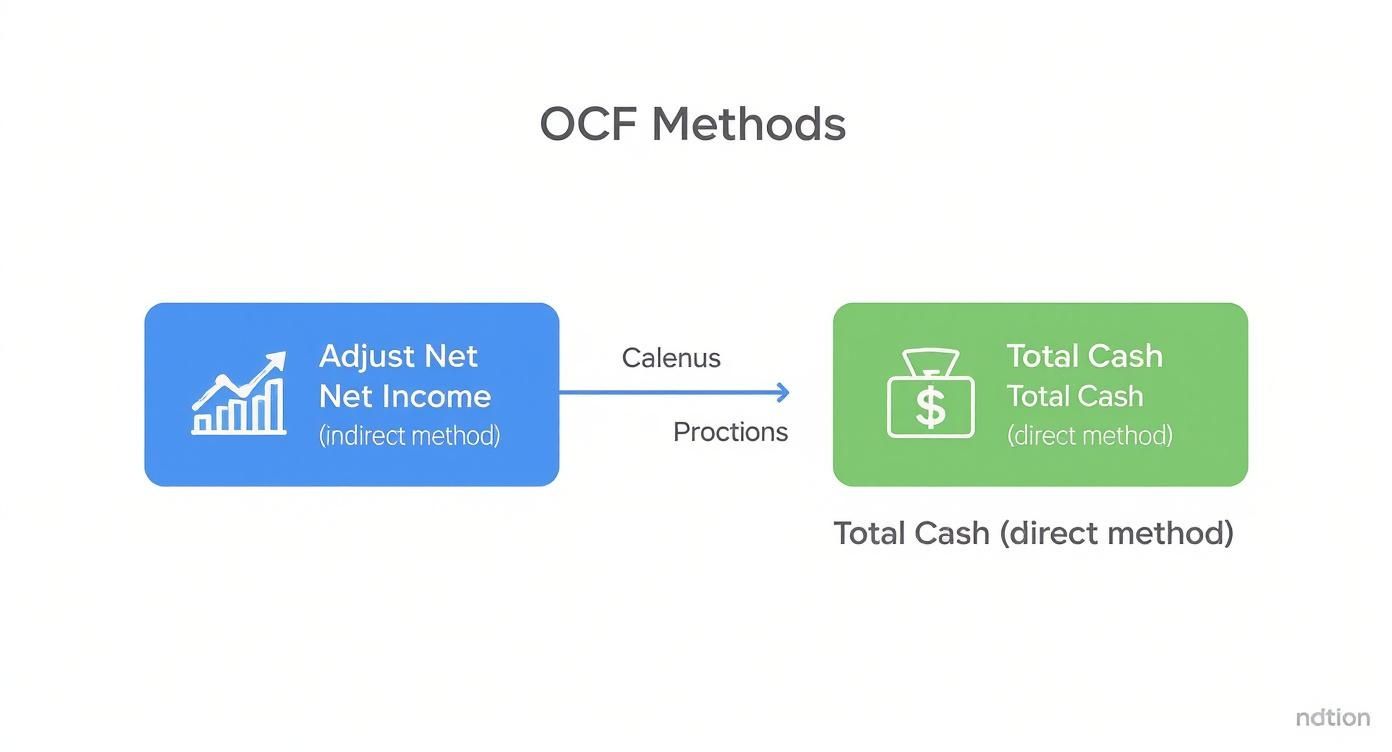
As you can see, the indirect method starts with net income and makes adjustments, while the direct method adds up all the actual cash that came in and out.
By reconciling accrual-based profit with real cash movements, the indirect method provides a clear narrative of how a company’s operational activities are generating or consuming cash. This understanding is vital for accurate financial planning.
There’s a reason this method is so common. It’s been the standard for decades, with studies showing that around 95% of public companies use it. Research has even indicated that businesses using the indirect method can forecast their finances with 40% greater accuracy than those just looking at net income. This whole process of reconciliation is a core part of the difference between cash basis and accrual basis accounting, and getting a handle on it will give you a much stronger grasp of your company’s financial reality.
Using the Direct Method for a Clearer Cash Picture
While the indirect method is common, I find the direct method offers a much more intuitive way to look at your operating cash flow. Honestly, it’s a lot like just looking at your company’s bank statement for a specific period. You’re simply tracking the cash that actually came in and the cash that actually went out. No complex adjustments, just pure cash movement.

The formula is refreshingly straightforward: OCF = Cash from Customers – Cash Paid for Operations. This gives you a crystal-clear picture of your cash movements because it only deals with real cash transactions from your core business. You’re not backing out non-cash items like depreciation; you’re just counting the dollars.
Gathering Your Cash Data
The main hurdle with the direct method is that it demands more detailed record-keeping. Most accounting software, like QuickBooks, is built around accrual-based reporting, so pulling these cash-specific numbers can take a bit more legwork. I can tell you from experience, though, that the clarity it provides is almost always worth the extra effort.
To calculate your OCF this way, you’ll need to sum up two main categories of transactions:
- Total Cash Inflows: This is mainly the cash you’ve collected from your customers. The key word here is collected, not just what you’ve invoiced.
- Total Cash Outflows: This covers all the cash you paid for day-to-day operations. Think payments to suppliers, employee salaries, rent, utilities, and software subscriptions.
A Real-World Consulting Example
Let’s walk through a practical scenario. Imagine you run a small consulting firm and want to figure out your operating cash flow for the last quarter using the direct method.
First, you’d go through your bank deposits and add up all the cash you received from clients. Let’s say you collected a total of $85,000.
Next, you need to tally up all the cash that went out for operations. This means digging into your bank and credit card statements to find these figures:
- Salaries and contractor payments: $45,000
- Office rent and utilities: $9,000
- Software subscriptions (CRM, project management tools): $1,500
- Marketing and advertising expenses paid: $2,500
Now, just add up those cash outflows: $45,000 + $9,000 + $1,500 + $2,500 = $58,000.
With those numbers, the final calculation is simple: $85,000 (Cash In) – $58,000 (Cash Out) = $27,000 (Operating Cash Flow). This $27,000 is the actual, tangible cash your consulting business generated from its core services last quarter.
The direct method gives you an unambiguous answer. It shows you exactly how much cash your operations produced, providing a powerful, real-time indicator of your business’s financial health without any accounting adjustments clouding the picture.
Finding the Right Numbers on Your Financial Statements
Knowing the formulas is a great start, but the real challenge is often tracking down the right numbers. Learning how to find operating cash flow means becoming a bit of a detective, hunting for clues across your company’s three main financial statements.
Let’s break down exactly where to look so you can get the data you need without the headache.

Your journey begins with the Income Statement, which you might also know as the Profit & Loss or P&L. This is where you’ll find your starting point for the indirect method: Net Income. It’s usually the last line item, the famous “bottom line.”
Next, you need to identify any non-cash expenses. The most common one you’ll see is depreciation and amortization. You can usually find this listed as its own line item on the Income Statement or detailed in the operating activities section of the Cash Flow Statement itself.
Navigating the Balance Sheet for Working Capital
Now for what can be the trickiest part: accounting for the changes in working capital. For this, you’ll need to turn to your Balance Sheet. The key is to compare the balance sheets from two consecutive periods—for instance, the end of this quarter versus the end of the last one.
You’ll be looking for changes in a few specific current asset and liability accounts:
- Accounts Receivable: Subtract last period’s balance from the current period’s balance. An increase here means you have less cash on hand than your net income might suggest.
- Inventory: Use the same calculation. If inventory has gone up, it shows that cash was used to buy more stock.
- Accounts Payable: An increase here is a good thing for cash flow. It means you held onto your cash longer, which acts as a source of cash for the period.
Calculating these changes by hand can get tedious, but it’s absolutely essential to get the numbers right. If the data feels messy or unreliable, it might be a sign that you need to take a step back and explore our guide on how to reconcile bank accounts. Clean books are the foundation of any good financial analysis.
Let Your Accounting Software Do the Work
Manually pulling these figures from spreadsheets is a recipe for errors and wasted time. Thankfully, modern accounting software like QuickBooks or Xero automates most of this heavy lifting. The evolution of these tools has been a game-changer. Cloud-based accounting platforms have seen a 320% jump in adoption between 2018 and 2025 because they handle these complex calculations for you.
A 2024 survey even found that companies using automated OCF systems reduced their financial close cycles by an average of 35%. This allows them to react to cash flow changes in days instead of weeks. You can discover more insights about these findings from the Institute of Management Accountants.
Pro Tip: In QuickBooks Online, just run a “Statement of Cash Flows” report. It automatically calculates your OCF using the indirect method, showing you the net income, adjustments for non-cash expenses, and all the changes in your working capital accounts in a clear, organized format.
To make things even easier, I’ve put together a quick reference table to help you find exactly what you need.
Data Location Guide for OCF Calculation
| Required Figure | Primary Financial Statement | Notes and Tips |
|---|---|---|
| Net Income | Income Statement (P&L) | This is your starting point for the indirect method. It’s the bottom line. |
| Depreciation & Amortization | Income Statement or Cash Flow Statement | Find this non-cash expense and add it back to your net income. |
| Changes in Working Capital | Balance Sheet | Compare balances from two consecutive periods (e.g., this quarter vs. last quarter). |
| Cash Received from Customers | Income Statement & Balance Sheet | For the direct method, you’ll need Sales Revenue and changes in Accounts Receivable. |
| Cash Paid to Suppliers/Employees | Income Statement & Balance Sheet | Look at Cost of Goods Sold, Inventory, and Accounts Payable for supplier payments. |
This table should help you quickly pinpoint the source documents for each piece of the OCF puzzle, whether you’re tackling the indirect or direct method.
How to Interpret Your Operating Cash Flow
Getting the operating cash flow number calculated is really just the first step. The real magic happens when you understand what that number is telling you about the health and pulse of your business. A single OCF figure is just a snapshot in time; the real story starts to unfold when you track it over several months or quarters.
A consistently positive OCF is the clearest sign you can get that your core business model is working. It means your day-to-day operations are generating more cash than they’re spending. This is the financial sweet spot every business owner is shooting for. It’s the fuel that lets you grow, pay down debt, or just build up a solid cash cushion for a rainy day.
On the flip side, a negative OCF should get your immediate attention. It’s a warning light that your primary operations are burning through more cash than they’re bringing in. Now, a single negative month isn’t always a catastrophe—especially if you’re a startup investing heavily in inventory or hiring. But if it becomes a trend, it’s a serious red flag that something needs to change.
Beyond Just Positive or Negative
Simply labeling your OCF as “good” or “bad” is too simplistic. You’ve got to dig into the context. A mature, stable company might have a steady, positive OCF. A fast-growing business, however, might show negative OCF because it’s strategically pouring money into its future. The key is always to ask why the number looks the way it does.
For instance, a sudden drop in your OCF could be happening for a few reasons:
- Customers are paying slower: A jump in accounts receivable is a classic cash drain.
- You bought a lot of inventory: Stocking up for a big sales season will tie up your cash.
- You paid your suppliers early: A decrease in accounts payable means cash is leaving your business faster.
When you understand these drivers, you can shift from just watching your cash position to actively managing it. This is the kind of proactive approach that’s crucial for good financial planning, which we cover in our guide to creating a reliable cash flow projection.
Putting Your OCF into Context
To get an even sharper picture, you can compare your OCF to other key numbers. One of the most powerful comparisons is the Operating Cash Flow to Sales Ratio. To get this, you just divide your OCF by your total revenue for the same period.
This ratio tells you how many cents of actual cash your business generates for every dollar of sales. For example, an OCF-to-Sales ratio of 15% means that for every $1 you made in sales, you generated $0.15 in cold, hard cash from your operations.
Tracking this ratio over time is incredibly insightful. A rising ratio is a great sign of improving efficiency in your operations. If it’s declining, it might be pointing to issues with profitability or working capital management that you need to get on top of. It’s a fantastic tool for benchmarking your performance against last quarter or even industry averages.
Common Questions About Operating Cash Flow
As you start to get the hang of calculating operating cash flow, you’ll find a few questions pop up again and again. It’s totally normal. Nailing down these finer points is what separates someone who can just find a number from someone who truly understands what that number means for their business.
Can a Profitable Company Have Negative Operating Cash Flow?
Yes, absolutely. This is one of the most critical, and often surprising, lessons for any business owner. It happens more often than you’d think. A company can look great on paper, with a healthy net income on its Profit & Loss statement, but still be bleeding cash from its operations.
This gap between profit and actual cash is precisely why OCF is such an essential metric. Here are a couple of classic scenarios where this plays out:
- You’re making a ton of sales, but on credit. Your revenue shoots up, and your net income looks fantastic. But if all those sales were made on 60-day terms, your Accounts Receivable balance is getting bigger and bigger, while the actual cash is still sitting in your customers’ bank accounts, not yours.
- You’re stocking up for a big season. Maybe you’re getting ready for the holidays or a summer rush. You make a huge investment in inventory to meet the expected demand. That purchase drains your cash right now, even though you won’t see the revenue from selling that inventory for weeks or months.
The key takeaway here is simple: profit is an accounting measurement, but cash is reality. A profitable business can absolutely run out of money and fail if it isn’t managing its cash flow. OCF shows you that reality, plain and simple.
What Is the Difference Between OCF and Free Cash Flow?
This is another common point of confusion. They sound similar, and they’re related, but Operating Cash Flow (OCF) and Free Cash Flow (FCF) tell you two very different things about your business.
Here’s the easiest way to think about it:
Operating Cash Flow (OCF) is the cash your business generates from its main, day-to-day activities. It’s a pure measure of your core operational strength. Is the fundamental business of what you sell making or losing cash? OCF tells you.
Free Cash Flow (FCF) takes it one step further. It starts with your OCF and then subtracts any cash you spent on big-ticket items—what accountants call capital expenditures (CapEx). This is the money you used to buy, maintain, or upgrade long-term assets like new equipment, company vehicles, or property.
So, FCF is the cash that’s left over after you’ve paid for both your daily operations and your long-term investments. This is the “free” cash that’s truly available to do other things, like pay down debt or distribute to owners. It’s no wonder investors are so obsessed with it.
How Often Should I Review My Operating Cash Flow?
The honest answer depends on the specifics of your business—its size, industry, and current financial stability. But for most small and medium-sized businesses, a monthly review is the sweet spot.
Checking in every month is frequent enough to spot worrying trends before they become full-blown crises. You can catch things like customers starting to pay their invoices more slowly or a sudden jump in operating costs. It lets you keep your finger on the financial pulse without getting bogged down in tiny, day-to-day fluctuations.
At an absolute minimum, you should run the numbers and do a deep dive into your OCF as a non-negotiable part of your quarterly financial review. This makes sure your business stays liquid and that your big-picture strategic plans are grounded in the reality of how much cash your operations can actually generate.
At Steingard Financial, we help you move beyond just the numbers to gain true clarity on your business’s financial health. Our expert bookkeeping and advisory services ensure you have the accurate, timely data you need to make confident decisions. Learn how we can build a scalable back office for your business.