A Practical Guide on How to Reduce Employee Turnover
When an employee decides to leave, the impact goes far beyond their final paycheck. It creates a ripple effect, touching almost every part of your business with financial drains and cultural disruptions you might not see at first glance. Understanding these real costs is the first step toward building a team that’s in it for the long haul.
The True Cost of Employee Turnover and Why It Matters
Let’s be honest, when someone walks out the door, the costs are much higher than just what it takes to find a replacement. It’s a serious issue that warrants a real strategy.
Beyond the Recruitment Ad
The most obvious expense is finding someone new. You’ve got advertising costs, recruiter fees, and the countless hours your team spends sifting through resumes and conducting interviews. But that’s just the tip of a very expensive iceberg.
The real financial pain comes from the less visible areas:
- Lost Productivity: A vacant role means work simply isn’t getting done. Your existing team members have to stretch to cover the gap, which often leads to burnout and a drop in quality.
- Training and Onboarding Costs: Getting a new hire up to speed takes significant time and resources. For the first few months, they are a net cost to the business as they learn the ropes and find their footing.
- Knowledge Drain: When a seasoned employee leaves, they take a huge amount of institutional knowledge with them. We’re talking about the nuanced understanding of processes, clients, and internal dynamics that isn’t written down in any manual. That stuff is invaluable.
The Hidden Cultural Damage
The financial hit is significant, but the damage to your company culture can be even more destructive. High turnover chips away at trust and stability. When people see their colleagues leaving, they naturally start to wonder, “Should I be looking for a new job, too?” This kind of uncertainty can quickly poison morale.
Team cohesion suffers as colleagues constantly have to adjust to new personalities and workflows. Even customer relationships can be strained when their trusted points of contact suddenly disappear, leading to a disjointed and unreliable client experience.
High turnover is a symptom, not the disease. It signals that something fundamental in the work environment—whether it’s management, compensation, or culture—is failing to meet your team’s needs.
A proactive retention strategy is absolutely essential for any business aiming for sustainable growth. This visual breaks down the core phases of a plan that actually works.
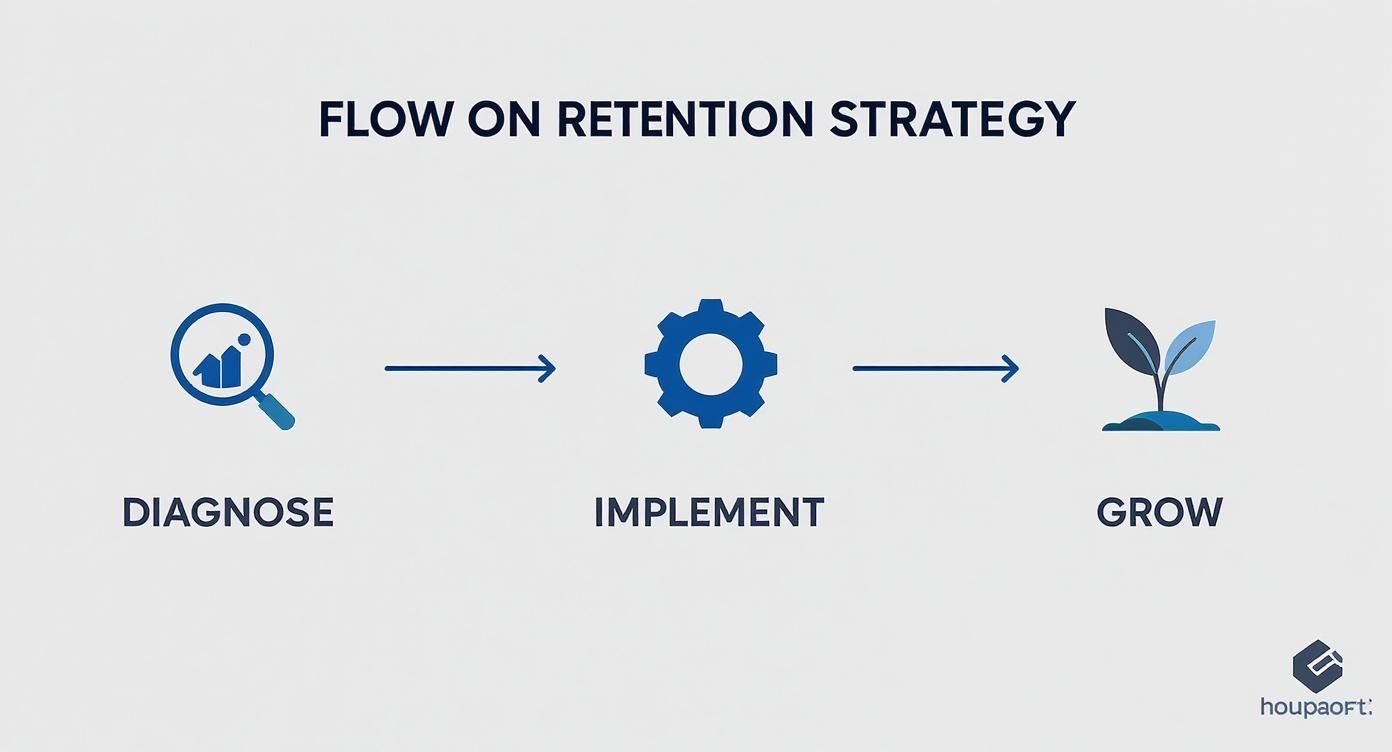
As the flowchart shows, it’s a clear, cyclical process: first, you diagnose the root causes, then you implement targeted strategies, and finally, you focus on long-term employee growth to keep the momentum going.
The Bottom Line Impact
The numbers don’t lie. Globally, the average turnover rate is between 13-17% in key markets, which is a constant drain on resources. The financial burden is steep, with replacement costs estimated at 20% of an employee’s annual salary for most roles. For senior positions, that number can soar up to a staggering 210%.
It’s no surprise that 87% of HR managers list improving retention as a top priority. You can discover more insights about employee turnover statistics on folksrh.com.
To tackle this effectively, we need a plan built on solid principles. Here’s a quick overview of the key pillars we’ll be exploring.
Five Pillars of an Effective Employee Retention Strategy
| Pillar | Objective | Key Actions |
|---|---|---|
| Competitive Compensation | Ensure pay and benefits meet or exceed market standards. | Conduct salary benchmarking, create clear compensation frameworks, and offer robust benefits packages. |
| Strategic Onboarding | Integrate new hires smoothly into the company culture and their roles. | Develop a structured 90-day onboarding plan, assign mentors, and provide necessary tools from day one. |
| Manager Effectiveness | Equip managers with the skills to lead, support, and motivate their teams. | Implement ongoing manager training, provide coaching on feedback delivery, and promote emotional intelligence. |
| Employee Engagement | Foster a positive and supportive work environment where employees feel valued. | Conduct regular engagement surveys, recognize achievements, and encourage open communication channels. |
| Career Growth | Provide clear opportunities for professional development and advancement. | Create transparent career paths, offer learning stipends, and support internal mobility. |
These pillars form the foundation of a workplace where people don’t just work—they thrive.
Ultimately, learning how to reduce employee turnover isn’t just about keeping people. It’s about building a stronger, more profitable, and more cohesive organization from the inside out.
Diagnosing the Root Causes of Your Turnover Problem

Before you can fix your turnover problem, you have to stop guessing and start diagnosing. So many leaders jump to the conclusion that it’s all about pay, but the real reasons people leave are often more complex and hiding just below the surface. To solve the right problem, you need to gather honest, actionable data.
This means moving beyond assumptions and creating systematic feedback loops. By piecing together insights from employees who are on their way out, those who are staying, and your entire team, you can build a truly clear picture of your retention challenges.
Unlocking Insights from Exit Interviews
The exit interview is your last chance to learn from a departing employee. When they’re done right, they can provide invaluable information about your management style, company culture, and compensation. The key is to create a safe space for honest feedback, not just another procedural checkbox to tick.
To get the most out of these conversations, I always recommend having a neutral third party—like an HR representative—conduct the interview. This often helps employees feel more comfortable sharing candid thoughts about their direct manager or team dynamics.
Here are a few powerful questions to get the conversation started:
- What was the primary reason you started looking for a new opportunity?
- Was there a specific event or turning point that influenced your decision to leave?
- What did you value most about working here, and what would you change?
- Did you feel you had the tools, resources, and support needed to succeed in your role?
Analyzing this feedback in aggregate is where the magic happens. One person’s negative experience might be an outlier, but if five people from the same department all point to a lack of growth opportunities, you’ve just found a critical pattern.
The goal of an exit interview isn’t to change someone’s mind—it’s to gather intelligence that will convince the next person to stay. Treat it as a crucial data collection tool for your retention strategy.
Tapping into Your Current Team with Engagement Surveys
While exit interviews are reactive, employee engagement surveys are proactive. Think of them as a real-time pulse check on your organization’s health, helping you spot potential issues before they spiral into resignations. These surveys measure critical factors like job satisfaction, connection to the company mission, and confidence in leadership.
For these surveys to actually work, anonymity is non-negotiable. Employees need to trust that their honest feedback won’t come back to haunt them. You also have to be transparent with the results and—this is the most important part—take visible action based on the feedback you receive.
A common mistake is asking way too many questions, which just leads to survey fatigue. Instead, focus on the key drivers of engagement, such as:
- Recognition: “I feel recognized and appreciated for my contributions.”
- Growth: “I see a clear path for career development at this company.”
- Management: “My direct manager supports my professional growth.”
The data you get from these surveys can be incredibly predictive. For example, a department showing a sudden dip in engagement scores might be at a high risk for future turnover, giving you a chance to intervene before it’s too late.
Proactively Retaining Talent with Stay Interviews
Perhaps the most powerful but underutilized tool is the stay interview. Unlike an exit interview, this is a structured, one-on-one conversation with your current top performers to understand what keeps them here and what might tempt them to leave. It’s a purely proactive retention tool.
These conversations should be informal and forward-looking. A manager might sit down with a key team member and ask things like, “What do you look forward to when you come to work each day?” or “If you had a magic wand, what’s one thing you would change about your role?”
This approach builds trust and shows employees you value them enough to actively work on keeping them. The data confirms just how important this early engagement is. Alarmingly, 54% of voluntary departures happen within the first six months, and 61% of people leave within the first year. It’s no wonder that a growing number of companies (38%) now conduct predictive turnover analyses to get ahead of these issues. You can learn more about these employee retention findings.
At Steingard Financial, our People Advisory services help clients design and implement these crucial feedback systems. We guide you in crafting the right questions, interpreting the data to find meaningful patterns, and turning those insights into a concrete action plan for how to reduce employee turnover.
Building a Retention-Focused Onboarding Experience
An employee’s first 90 days are make-or-break. I’ve seen it time and again: a disorganized, confusing start plants a seed of doubt that’s hard to remove. On the flip side, a structured, welcoming onboarding experience confirms they made the right choice and sets them up for a long, successful run with your company.
This is about so much more than a quick office tour and a stack of HR forms. A truly retention-focused onboarding process is your strategic plan to weave a new person into the fabric of your company culture, clarify what success looks like in their role, and help them score some early wins. When people feel supported and capable from day one, their engagement and loyalty skyrocket.
Beyond the First Day Paperwork
One of the biggest mistakes I see businesses make is treating onboarding as a one-day, check-the-box event. The reality is, real integration doesn’t happen overnight. You have to move past the logistics and get into the cultural and professional parts of their new job. This is how you build a foundation of confidence and belonging that paperwork alone can never provide.
A great process makes sure a new hire understands not just what they’re doing, but why it matters to the team and the company’s bigger goals. When you connect their daily tasks to the mission, they immediately feel like a valuable contributor. That psychological connection is an incredibly powerful defense against early turnover.
To get this right, you have to remove the early friction points. While administrative tasks are necessary, they can be a huge source of frustration for someone just starting out.
A seamless first week is a powerful statement. When payroll is set up correctly and benefits are explained clearly, it tells a new hire that your organization is professional, organized, and truly cares about its people.
This is where your back-office operations become a surprisingly effective retention tool. At Steingard Financial, we make sure the payroll and benefits integrations are handled flawlessly from the get-go. This eliminates a major source of first-week anxiety, letting your new hire and their manager focus on what really matters: getting integrated and making an impact.
Crafting Your 90-Day Onboarding Plan
A solid onboarding plan needs structure, but it also needs to be flexible. It’s all about building momentum through a series of planned check-ins, learning opportunities, and small victories over the first three months.
Here’s what that typically looks like:
- Week One – The Welcome and Foundation: The goal here is simple: make the new hire feel welcome and equipped to succeed. This means their workspace is ready, they’re introduced to key team members, and their manager walks them through a clear 30-day plan with achievable goals.
- Month One – Learning and Early Wins: By now, the employee should be taking on small but meaningful tasks and achieving their first “win.” This is the time for regular one-on-one check-ins with their manager to give feedback, answer questions, and make sure they feel supported.
- First 90 Days – Integration and Contribution: At the end of the first quarter, the employee should be settling into their team’s workflow and contributing with confidence. This is the perfect time for a more formal 90-day review to discuss progress, set goals for the future, and reinforce how valuable they are to the organization.
For a deeper look at building out each stage, check out our guide on employee onboarding best practices to create a program with lasting impact.
This checklist provides a simple framework to ensure everyone involved—the manager, HR, and the team—is aligned on creating a supportive and effective onboarding journey.
Onboarding Checklist for the First 90 Days
| Timeframe | Manager Actions | HR/Admin Actions | Team Actions |
|---|---|---|---|
| First Week | Conduct a 1:1 to set 30-day goals. Explain team workflows. Assign an onboarding buddy. | Confirm payroll & benefits are set up. Provide access to all necessary tools. | Invite to a team welcome lunch. Introduce them to key collaborators. |
| First Month | Hold weekly check-ins for feedback. Assign a small, achievable first project. | Check in on benefits enrollment. Share info on company culture/events. | Include in project meetings & brainstorming. Offer help and answer questions. |
| First 90 Days | Conduct a 90-day performance review. Discuss long-term goals & career path. | Confirm all onboarding tasks are complete. Solicit feedback on the process. | Collaborate on a significant project. Provide peer feedback if requested. |
Using a structured approach like this transforms onboarding from a simple orientation into a powerful retention strategy. It proves to new hires that you are invested in their success, not just for a week, but for the long haul. That initial investment pays for itself many times over in loyalty and performance.
Designing Competitive Compensation and Benefits Packages
While a great culture and strong managers are huge pieces of the retention puzzle, let’s be direct: unfair or uncompetitive pay will always drive good people away. Compensation isn’t just a number on a paycheck. It’s a powerful message about how much you value an employee’s contribution.
Getting your pay structure right is non-negotiable if you’re serious about keeping your team for the long haul. It’s not just about matching what competitors offer, but about creating a transparent, equitable framework that your employees can actually understand and trust. This is how you build a real sense of fairness and show a clear link between performance, growth, and reward.
Moving Beyond Salary Benchmarking
The typical first step for most businesses is salary benchmarking—looking at market data to see what similar roles are paying in your industry and city. This is a critical baseline, but it’s only the beginning.
A truly effective strategy embraces the concept of total rewards. This is the complete package of everything an employee receives, from compensation to all the other benefits. When your people evaluate an offer or consider leaving, they weigh this entire package, not just the base salary.
A modern total rewards package often includes:
- Base Salary: The fixed, foundational pay for the role.
- Variable Pay: Performance-based incentives like bonuses or commissions.
- Health and Wellness: Medical, dental, vision, and mental health support.
- Retirement Savings: A 401(k) plan, ideally with a company match.
- Paid Time Off: Vacation, sick days, and holidays that encourage work-life balance.
- Flexibility: Options for remote or hybrid work and flexible schedules.
This broader approach shows a real commitment to your team’s overall well-being. It shifts the conversation from “What do you pay?” to “How do you invest in your people?”
The Importance of Transparency and Fairness
I’ve seen it time and time again: a major source of employee frustration isn’t just low pay, but the perception of unfairness. When pay decisions seem like they happen behind a mysterious curtain, it completely erodes trust.
The solution is a transparent compensation framework. This means establishing clear salary bands for different roles and levels in your company. It also means defining the criteria for raises and promotions, so employees know exactly what they need to do to move forward.
A transparent pay structure removes the guesswork and bias. It ensures compensation is tied to objective factors like skill, impact, and experience—not office politics. This is fundamental to building a culture of trust and equity.
Of course, designing these packages is only half the battle. Administering them accurately is just as important. A single payroll error or a mistake with benefits enrollment can undo all the trust you’ve worked so hard to build.
This is where meticulous back-office management becomes a core part of your retention strategy. Our team at Steingard Financial ensures your compensation and benefits are administered flawlessly. Our bookkeeping and payroll services give you the clean data needed to analyze your compensation structures. More importantly, we make sure every paycheck is accurate and every benefit is managed correctly, removing a common source of employee frustration.
To learn more about getting this right from day one, check out our guide on how to set up payroll for your small business. A competitive and fair compensation package is one of your most powerful tools—it shows people you value their work and are invested in their financial security.
The Manager’s Role in Driving Employee Retention
If you take just one thing from this guide, let it be this: people don’t leave companies; they leave managers. While things like pay and career paths are definitely part of the equation, the day-to-day relationship an employee has with their direct supervisor is the single most powerful force in their decision to stay or go.
A manager is your company’s culture in human form. They’re the ones who set the team’s tone, translate big-picture goals into daily tasks, and provide the feedback and support everyone needs. When that relationship is strong, employees feel valued, motivated, and secure. But when it’s weak or toxic, even the most exciting job can quickly become unbearable.
Why Managers Are the Linchpin of Retention
Think about just how much influence a manager has. They control workloads, hand out projects, handle performance reviews, and approve time off. Even more importantly, they are the gatekeepers of the team’s psychological safety. A great manager fosters an environment where people feel comfortable asking questions, admitting mistakes, and pitching new ideas without the fear of being shut down or blamed.
This is where a lot of companies stumble. They promote their best individual performers into management roles without giving them the training they need to actually lead people. Being a fantastic engineer or a top salesperson requires a completely different set of skills than being a great coach and mentor.
The data on this is crystal clear. Study after study shows that the relationship between employees and their direct managers is the number one factor influencing turnover. In fact, about 50% of employees who quit their jobs point to their manager as a major reason. It’s a powerful reminder that even with competitive pay, trust in leadership is what truly builds long-term commitment. You can learn more about how leadership impacts retention to see just how deep this connection goes.
From Boss to Coach: Essential Leadership Skills
To really tackle employee turnover, you have to help your managers shift from being taskmasters to being coaches. A boss just delegates and directs; a coach develops and empowers. Making this change happen requires a real investment in leadership training that focuses on a few core skills.
So what does this look like day-to-day? It really comes down to a few key behaviors that great managers practice all the time.
- Providing Consistent and Actionable Feedback: People don’t want to wait for an annual review to find out how they’re doing. Great managers give regular, specific, and constructive feedback in the moment, helping their team members adjust and grow continuously.
- Recognizing Contributions Publicly and Privately: Feeling unappreciated is a fast track to disengagement. Effective leaders make it a habit to acknowledge effort and celebrate wins, whether it’s a quick “thank you” in a one-on-one or a shout-out in a team meeting.
- Supporting Employee Well-being: A manager who genuinely cares about their team’s mental and physical health builds incredible loyalty. This means encouraging people to use their PTO, respecting work-life boundaries, and showing empathy when personal issues come up.
A manager’s job isn’t just to oversee work; it’s to remove roadblocks and create the conditions for their team to succeed. When employees feel their manager is genuinely invested in their success, their own investment in the company deepens.
Implementing Effective Manager Training
Investing in your managers is one of the highest-impact retention strategies you can have. A solid training program isn’t just a one-day workshop; it provides ongoing support and resources.
Here’s a simple framework for building better leaders:
- Focus on Communication: Teach managers how to navigate difficult conversations, actively listen to their team’s concerns, and clearly set expectations. So many workplace problems start with simple miscommunication.
- Train on Performance Management: Give them the tools to set clear goals, deliver helpful feedback, and conduct meaningful performance reviews that feel supportive, not punitive.
- Build Psychological Safety: This is non-negotiable. Provide training on emotional intelligence, conflict resolution, and inclusive leadership to help managers create teams where everyone feels respected and heard.
At Steingard Financial, our People Advisory services are designed to help you build these exact capabilities within your leadership team. We partner with you to develop and implement customized manager training programs that give your leaders the confidence and skills they need to retain top talent. For more resources on this topic, our articles on HR management offer additional valuable insights.
By investing in your managers, you’re not just improving one person’s skills. You’re creating a positive ripple effect that boosts morale, productivity, and loyalty across their entire team, directly addressing one of the most significant causes of employee turnover.
Creating Clear Pathways for Career Growth and Development

Let’s face it: when an employee can’t see a future with your company, they’ll start looking for one somewhere else. A stagnant role is a huge reason talented people walk out the door. Providing clear opportunities for growth isn’t just a perk; it’s a core strategy for keeping your best people.
When you invest in your team’s professional journey, you show them you’re committed to their long-term success. It turns a job into a career, building a kind of loyalty that a paycheck alone just can’t buy. It’s about creating a place where ambition is rewarded and potential is truly nurtured.
Moving Beyond the Traditional Career Ladder
The whole idea of career growth has changed. It’s no longer just about climbing a straight ladder to the next promotion. Today, people value a much wider range of development opportunities that help them build new skills, broaden their experience, and stay excited about their work.
This means you need to think about growth in more than one dimension. Promotions are still important, of course, but they aren’t the only way for someone to advance. A solid development program recognizes and supports all kinds of progress.
This bigger view of growth could include things like:
- Horizontal moves that let an employee get experience in a different department.
- Specialized training that helps them become the go-to expert in their current role.
- Mentorship programs that connect junior staff with senior leaders for guidance.
By offering a variety of pathways, you appeal to a wider range of career goals. That kind of flexibility makes your company a far more attractive place to build a long-term career.
Building Transparent Career Paths
Ambiguity is the enemy of motivation. If your team doesn’t understand what it takes to get to the next level, they’ll often assume it’s impossible or based on office politics. Creating transparent career paths is the perfect antidote.
This means clearly defining the skills, competencies, and experience required for each role in a department. For example, a “Software Engineer II” should know exactly what they need to master to become a “Senior Software Engineer.” This clarity empowers people to take ownership of their own development.
A simple career path framework might include:
- Role Levels: Define distinct levels for each role (e.g., Junior, Mid-Level, Senior, Principal).
- Competencies: Outline the key skills for each level, covering technical skills, communication, and leadership.
- Expectations: Clearly state the performance standards and responsibilities for each level.
When this information is out in the open for everyone to see, it takes the mystery out of promotions and creates a fair, merit-based system for getting ahead.
Employees who see a clear path forward are significantly more engaged. Transparency in career development builds trust and shows that the company is a true partner in their professional growth.
Investing in Skill Development Opportunities
Showing your team a path is one thing; giving them the tools to walk it is another. Offering real, tangible skill-building opportunities is a powerful way to show you’re invested in their future. These can take many forms, tailored to different needs and budgets.
Think about implementing a mix of development programs to support continuous learning. These don’t have to be expensive to be effective.
Some high-impact options include:
- Learning Stipends: Offer a yearly budget for employees to spend on courses, books, or conferences in their field.
- Cross-Functional Projects: Create chances for people to collaborate with other teams, exposing them to new parts of the business.
- Internal Workshops: Encourage your senior team members to lead training sessions on what they do best, fostering a culture of shared knowledge.
These investments pay off in two big ways. First, they upskill your entire workforce, making your organization more capable. Second, they send a powerful message that you are committed to helping your people grow, which is a cornerstone of any effective retention plan.
At Steingard Financial, our People Advisory services help businesses design and implement these crucial growth frameworks. From building compensation bands that align with career levels to developing retention strategies focused on internal mobility, we provide the expertise needed to turn your company into a place where talented people choose to stay and build their careers.
Ready to build a team that’s invested in the long haul? Learn how Steingard Financial can help you develop the retention strategies that reduce turnover and drive sustainable growth. https://www.steingardfinancial.com