

Understanding Profit and Loss Statements for Your Business
If you’ve ever felt like financial documents are just a necessary evil for tax season, you’re not alone. But what if I told you your Profit and Loss (P&L) statement is actually the story of your business’s performance? Think of it less like a stuffy report and more like a report card that answers the most important question of all: “Are we actually making money?”
Your P&L Statement Is Your Business Story
Many business owners get bogged down in the day-to-day and see financials as a chore. But the P&L, sometimes called an income statement, is a powerful guide. It lays out the financial health of your company over a specific time—whether it’s a month, a quarter, or a full year.
It’s a lot like your household budget. You have income coming in from your paycheck, and you subtract all your expenses like rent, groceries, and utilities. Whatever is left over is your personal “profit.” A P&L does the exact same thing for your business, just on a bigger scale.
Here’s a quick look at the main sections of a P&L and the simple questions each one helps you answer about your business’s financial health.
The Three Core Parts of a Profit and Loss Statement
| Component | What It Represents | The Key Question It Answers |
|---|---|---|
| Revenue | All the money your business earned from sales. | “How much money did we bring in?” |
| Expenses | All the costs incurred to run the business. | “How much did we spend to make that money?” |
| Net Income | The final profit or loss after all expenses are paid. | “Did we end up with more money than we started with?” |
Understanding these three core parts is the first step to turning your financial data into a real-world strategy.
The Core Purpose of a P&L
At its heart, a P&L is designed to give you absolute clarity on your profitability. It organizes every dollar that flows in and out of your business to get you to that famous “bottom line.” Without this clarity, you’re essentially flying blind.
You can’t confidently answer crucial questions like:
- Can we actually afford to hire that new team member?
- Is our pricing for this service even profitable?
- Are our marketing dollars bringing in a positive return?
- Where are we overspending, and what costs can we trim?
A P&L statement is a starting point for a conversation about an organization’s accomplishments. It’s not just about the numbers; it’s about the narrative those numbers create about your mission and operational effectiveness.
The P&L provides the data-driven answers you need. When you review it regularly, you start to spot trends, manage costs effectively, and set growth targets you can actually hit. It transforms your financial data from a simple historical record into a strategic tool for the future.
Here is a typical example of a Profit and Loss statement exported from a program like QuickBooks.
As you can see, this statement clearly lays out total income, subtracts the cost of goods sold to find the gross profit, and then lists out all the operating expenses before arriving at the final net income at the bottom.
Breaking Down Your P&L Line By Line
To really get a handle on your profit and loss statement, you have to walk through it from top to bottom. Think of it like reading a story—each line builds on the last, slowly revealing the financial plot of your business over a specific period. Let’s pull back the curtain and look at each piece, one by one.
The basic formula is simple: what you earned, minus what it cost you, equals what you keep.
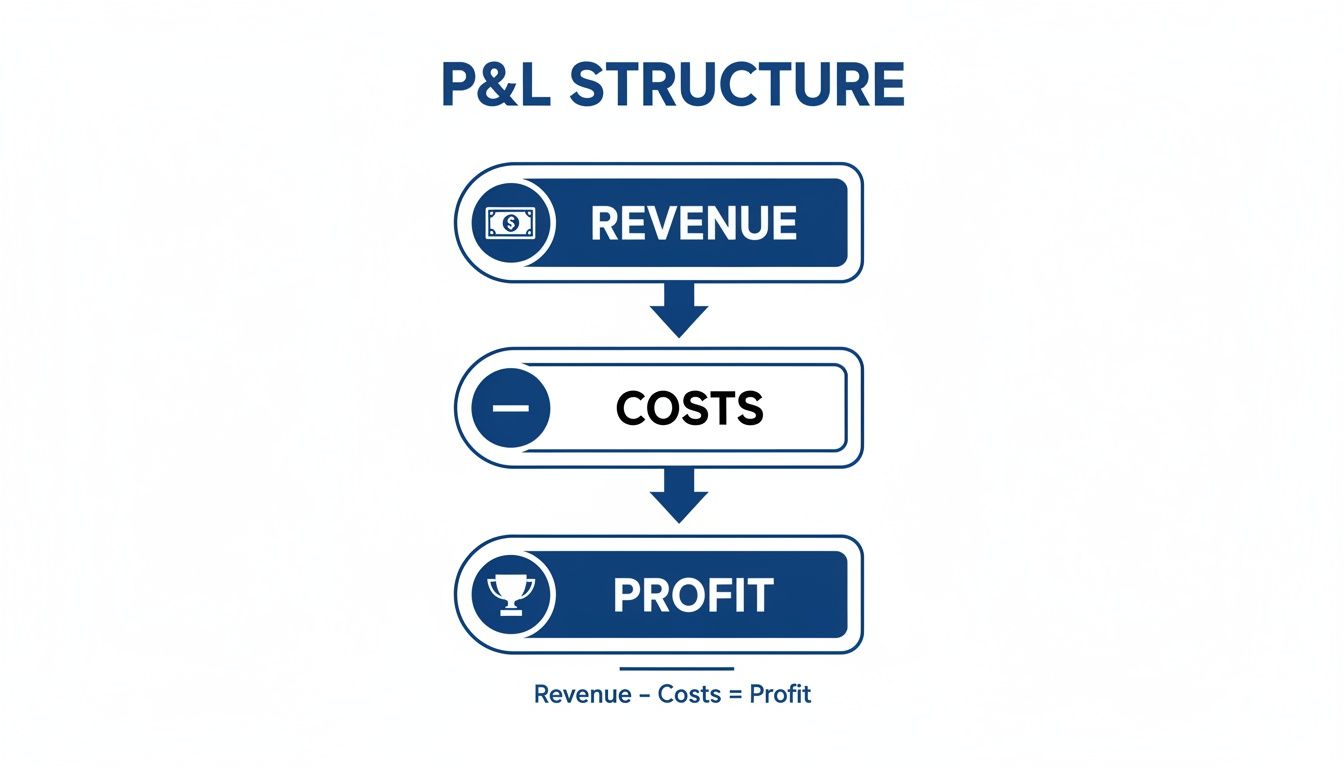
This little roadmap will guide us as we work our way down the statement, starting with every dollar you brought in and ending with what was actually left.
Revenue: The Top Line
The very first number you’ll see on any P&L is Revenue, which is why it’s often called the “top line.” This figure represents the total amount of money your business earned from selling its services or products during that time frame. It’s the starting block for everything that follows.
For a service business, you might see revenue broken down into a few different streams for more clarity. A digital marketing agency, for example, could list its revenue from:
- Monthly Retainer Fees
- Project-Based Work (like a website build)
- Consulting Services
This number is a pure measure of your sales engine’s power before any costs get factored in.
Cost of Goods Sold and Gross Profit
Right after revenue, you’ll find the Cost of Goods Sold (COGS). If you run a service-based business, this will likely be called Cost of Services or Cost of Revenue. This line item is reserved only for the direct costs tied to delivering your services.
COGS are the expenses that simply wouldn’t exist if you didn’t make a sale. They are directly linked to your revenue-generating work.
Here’s an easy way to think about it: if an expense was absolutely essential to perform the service for a client, it belongs in COGS. This could be payments to contractors, the cost of specialized software used for a single project, or the direct labor of employees working on client deliverables.
Once you subtract COGS from your total revenue, you get a hugely important number: Gross Profit.
Revenue – Cost of Goods Sold = Gross Profit
Gross Profit tells you how much money is left over just from selling your services, before accounting for all the other overhead. It’s your first real glimpse into how profitable your core offerings are. A healthy gross profit means you have enough cash to cover the rest of your business expenses.
Understanding Gross Margin
That Gross Profit figure leads to an even more powerful metric: the Gross Profit Margin, which is your Gross Profit expressed as a percentage of Revenue. Tracking your gross margin is critical because it isolates the profitability of your core operations. For context, the U.S. corporate sector’s profits grew from about $786 billion in 2000 to roughly $3.69 trillion in 2023, a massive jump driven by scale and smart margin management.
For a service company, a steady drop of just 3–5 percentage points in gross margin over a few quarters is a major red flag. It often points to pricing pressure or rising labor costs that will chew away at your net income, even if your revenue is going up. You can dig into more data on these trends in detailed economic reports from Statista.
P&L Line Item Examples for a Service Business
To make this more concrete, here’s a quick look at what these sections might contain for a service business like a marketing agency.
| P&L Section | Common Line Items (e.g., for a Marketing Agency) | Purpose |
|---|---|---|
| Revenue | Monthly Retainers, Project Fees, Website Design Income, Consulting Fees | Shows all the money coming in from different service offerings. It’s the starting point for measuring performance. |
| Cost of Goods Sold (COGS) | Freelancer Payments, Ad Spend (if billed to client), Stock Photo Subscriptions, Project-Specific Software | Captures the direct costs of delivering services. These expenses scale up or down with the amount of client work you do. |
| Gross Profit | (Calculated: Revenue – COGS) | Reveals the profitability of your core services before considering general business overhead. |
| Operating Expenses | Admin Salaries, Rent, Utilities, Marketing & Advertising, General Software (CRM, accounting), Professional Fees (legal, accounting) | Lists all the indirect costs needed to keep the lights on. These are the expenses of being in business, regardless of sales volume. |
| Net Income | (Calculated: Gross Profit – Operating Expenses) | The “bottom line.” It shows what’s left after all expenses have been paid—the ultimate measure of your business’s profitability. |
This table helps visualize how every dollar flows from the top of your P&L to the bottom.
Operating Expenses: The Cost of Doing Business
After Gross Profit, your P&L lists all the Operating Expenses (OPEX). These are the indirect costs required to keep the business running, whether you served one client or one hundred. OPEX isn’t directly tied to a specific project but is essential for your day-to-day operations.
These expenses are usually grouped into logical categories. Common ones include:
- Salaries and Wages: For your administrative, sales, and management teams.
- Rent and Utilities: For your office space.
- Marketing and Advertising: Costs to find and attract new clients.
- Software Subscriptions: For general tools like your CRM or accounting software.
- Professional Fees: For your lawyer or accountant.
Getting these categories right is non-negotiable for an accurate P&L. A clean system ensures every dollar is accounted for properly, giving you a true picture of where your money goes. If your accounts are a mess, it’s nearly impossible to analyze your spending. A well-organized setup, like we outline in our guide on how to create a chart of accounts, is the foundation of any reliable financial statement.
Net Income: The Bottom Line
Finally, we arrive at the most famous line on the entire statement: Net Income, also known as the “bottom line.” You get this number by subtracting all of your Operating Expenses from your Gross Profit.
Gross Profit – Operating Expenses = Net Income
Net Income is the final word on your business’s profitability for the period. If it’s a positive number, you made a profit. If it’s negative, you took a loss. This is the ultimate measure of your financial performance, telling you exactly what’s left after every single bill has been paid.
How To Analyze Operating Expenses and Control Costs
Once you know your gross profit, you have a solid handle on how profitable your core services are. But that’s only half the story. Your Operating Expenses (OPEX) tell you what it costs to simply keep the lights on—and this is where you have the most direct control over your bottom line.
Think of this section of your P&L not as a list of bills, but as a roadmap. It shows you exactly where you can improve efficiency and seriously boost your profits. Analyzing OPEX is what moves you from just reading a financial report to actively using it to manage your business.
A great first step is calculating your OPEX ratio. This simple metric measures your operating expenses as a percentage of your total revenue, giving you a crystal-clear indicator of your operational efficiency.
OPEX Ratio = (Total Operating Expenses / Total Revenue) x 100
This ratio tells you how many cents you spend to generate one dollar of revenue. If your OPEX ratio is 40%, it means for every dollar you bring in, 40 cents is going right back out to cover overhead like rent, salaries, and marketing.
Using Ratios to Uncover Opportunities
Calculating your OPEX ratio once is helpful, but the real power comes from tracking it over time. Is the number slowly creeping up? That could be a sign that costs are getting out of hand. Is it going down? Great—that means you’re becoming more efficient.
Your P&L isn’t just a record of the past; it’s a diagnostic tool for the present. When your marketing spend is twice the industry average but isn’t generating qualified leads, your P&L is telling you it’s time to rethink your strategy.
How your OPEX is structured often determines whether revenue growth actually turns into profit. For instance, operating performance can look vastly different across economies. The profit share of nonfinancial corporations in the European Union ranges from a low of 32.2% in France to a high of 74.9% in Ireland. These gaps highlight how local cost structures directly impact profitability.
For service businesses in the U.S., it’s common to keep an eye on key OPEX categories as a percentage of revenue. This includes things like payroll (40–60%), rent (2–10%), and technology (5–15%).
From Analysis to Actionable Cost Control
Once you’ve flagged the high-cost areas, it’s time to act. This doesn’t mean you should start slashing costs everywhere. The goal is to spend smarter, not just less, to get the best possible return on every dollar.
Here are a few practical ways to use your P&L to get costs under control:
- Categorize and Scrutinize: Don’t just settle for a broad “Software” category. Break it down into specific line items like your CRM, project management tool, and accounting software. This level of detail makes it easy to spot redundant subscriptions or tools that aren’t pulling their weight.
- Trend Analysis: Compare your P&L month-over-month and year-over-year. Did your utility bill suddenly spike? Is your budget for professional fees slowly climbing? These trends are your cue to dig deeper and find out why.
- Budget vs. Actual Analysis: To truly control costs, you need to know where you’re veering off plan. This is why it’s so important to get good at mastering budget vs actual variance analysis. This process compares your P&L numbers to your budget, showing you exactly where you overspent (or underspent) and helping you understand the reasons behind it.
- ROI-Based Decisions: Start evaluating every expense based on the return it delivers. If you’re pouring money into a marketing channel that brings in very few qualified leads, it’s probably time to reallocate that budget to one that performs better.
By regularly digging into your operating expenses, you turn your P&L from a static report into a dynamic tool that helps you make strategic decisions. This proactive approach lets you cut waste, optimize spending, and make data-backed choices that will strengthen your bottom line.
Turning P&L Data Into Smart Business Decisions
Your profit and loss statement is more than just a list of numbers; it’s a roadmap for your next big move. Reading your P&L is one thing, but the real magic happens when you translate that raw data into actual business intelligence. This is the moment you stop just recording history and start actively shaping your company’s future.
The key to unlocking these insights is by analyzing three critical profit margins: Gross, Operating, and Net. By calculating and keeping a close eye on these percentages, you can check the health of your business at different levels, spot trends before they turn into problems, and finally make confident, data-backed decisions.
Understanding Gross Profit Margin
Think of your Gross Profit Margin as the first and most important vital sign of your company’s health. It tells you exactly how profitable your core services are before you even think about overhead costs.
The formula is pretty simple:
Gross Profit Margin = (Gross Profit / Revenue) x 100
A consistently high gross margin means you have plenty of cash left over after covering the direct costs of getting the work done. A shrinking margin, however, is a huge red flag. It might be telling you that it’s time to rethink your pricing or find ways to cut back on direct costs, like renegotiating with key contractors.
Analyzing Operating Profit Margin
Next up is your Operating Profit Margin. This metric gets to the heart of how efficiently your entire business is running. It shows how much profit you’re making from your day-to-day business activities after accounting for all operating expenses like rent, marketing, and admin salaries.
Here’s how you calculate it:
Operating Profit Margin = (Operating Income / Revenue) x 100
This number is a fantastic indicator of how effective your management is. If your operating margin is strong, you’re doing a great job keeping those daily costs under control. If it’s weak, it’s a clear sign that overhead is eating away too much of your profit, and it’s time to take a hard look at your spending. You can learn more about how to isolate performance by exploring the differences between cost centers and profit centers in your business.
Evaluating Net Profit Margin
Finally, we get to the Net Profit Margin. This is the ultimate measure of profitability—the true “bottom line.” It shows you what percentage of revenue is left after all expenses, including taxes and interest, have been paid.
The formula is:
Net Profit Margin = (Net Income / Revenue) x 100
A healthy net profit margin means your business model is solid and built to last. If this number is lower than you’d like, it could be a sign that uncontrolled overhead or inefficient operations are dragging down your overall performance.
Net profit can swing wildly from one industry to another, which is why having consistent P&L reports is so critical. For example, some years North American airlines reported regional profits of $11.5 billion, showing just how much industry-wide events can cause massive shifts in financial results. When your P&L is accurate, you can start to model what-if scenarios, like how a 2% dip in revenue or a 5% increase in contractor fees would directly hit your net profit.
Using P&L Insights to Drive Decisions
By tracking these three margins over time, you can stop guessing and start answering critical business questions with confidence.
- When to Hire: Is your gross profit margin high, but your operating margin is suffering because your team is stretched thin? That’s your P&L telling you it might be time to bring someone new on board.
- Pricing Your Services: If your gross profit margin is too low, it’s a clear signal that your pricing might not be high enough to cover the direct costs of your work.
- Making Investments: A consistently strong net profit margin gives you the confidence—and the cash—to invest in new software, marketing campaigns, or equipment to fuel future growth.
To really get the most out of your P&L for future strategies, it’s worth exploring advanced finance FPA data analysis tools for forecasting and scenario planning. These tools help you model different financial futures based on the solid data your P&L provides. When you do this, you turn your profit and loss statement from a simple report into a strategic compass that points the way toward sustainable growth.
Common P&L Mistakes to Avoid
An accurate profit and loss statement is a powerful tool for making smart business decisions. But a P&L that’s full of errors can tell you a dangerously misleading story, pushing you to make the wrong moves based on bad data. The good news is that understanding the most common pitfalls is the first step toward building financial reports you can actually trust.
Most of these mistakes aren’t intentional or the result of complex financial wizardry. They usually come from simple bookkeeping oversights. And once you know what you’re looking for, they’re surprisingly easy to spot and fix.

Let’s walk through the most frequent errors we see service business owners make—and how to get them corrected.
Miscategorizing Expenses
Putting costs in the wrong bucket is probably the most common mistake we see. A classic example is classifying a direct project cost, like paying a freelance designer, under a general operating expense like “Office Supplies.”
It might seem like a small slip-up, but it has a huge impact. It will artificially inflate your Gross Profit, making your core services look more profitable than they truly are. At the same time, it bloats your Operating Expenses, giving you a distorted picture of your real overhead.
Getting your categories right isn’t just a suggestion; it’s non-negotiable if you’re serious about understanding your business’s health. You have to make sure costs tied directly to delivering a service land under COGS, and all the general business costs fall under OPEX.
Mixing Cash and Accrual Accounting
Another regular issue is bouncing between accounting methods. Cash basis accounting is simple: it records money when it actually comes in or goes out of your bank account. Accrual basis accounting records revenue when you earn it and expenses when you incur them, regardless of when the cash moves.
The trouble starts when you mix them. Maybe you record a client’s payment the day it hits your account (cash method) but you don’t record a contractor’s invoice until you pay it weeks later. This mismatch creates a lumpy, inaccurate picture of how profitable you were in any given month or quarter.
The key is consistency. A properly prepared P&L sticks to one method—usually the accrual basis—because it provides a much more accurate view of your financial performance over time.
Failing to Reconcile Accounts Regularly
Your P&L is only as good as the data feeding into it. If you aren’t reconciling your bank and credit card accounts with your accounting software every single month, it’s almost a guarantee that your financial statements are wrong.
Reconciliation is just the process of matching up the transactions in your books to your bank statements, line by line. It’s the only reliable way to catch common problems like:
- Duplicate Entries: Accidentally paying the same bill twice.
- Missed Transactions: Bank fees or automatic payments that never got recorded.
- Data Entry Errors: Simple typos that can throw off your entire report.
When you skip reconciliation, these errors just pile up, making your P&L totally unreliable. A solid month-end closing process, with reconciliation at its core, is the foundation of trustworthy financials. It ensures every number on your statement is verified and correct, giving you the confidence to make critical decisions based on facts, not guesswork.
Putting It All Together for Financial Clarity
So, we’ve walked through how to read and make sense of your P&L statement. But here’s the most important part: the final step is making sure the numbers you’re looking at are actually right. Your data needs to be accurate, on time, and organized in a way that gives you real strategic insights.
This is where a professional financial partner can be a game-changer.
When you move past just entering data and start building sound financial habits, your P&L transforms. It stops being a rearview mirror and becomes a roadmap for the future—a powerful tool for making smart decisions. This shift from reacting to your finances to proactively managing them is what separates thriving businesses from the ones just getting by.
Building a Rock-Solid Financial Foundation
Getting that kind of clarity doesn’t happen by accident; it starts with a solid foundation. A good financial partner helps you put these key pieces in place:
- A Structured Chart of Accounts: This is your financial filing system. When it’s set up right, every dollar goes to the correct category, giving you a true picture of your profitability.
- Meticulous Transaction Management: It sounds tedious, but accurately coding every single expense and revenue item is critical. This prevents the common mistakes that throw your financial reports completely off-kilter.
- Timely Month-End Closes: A disciplined process to close your books each month delivers reliable statements quickly. This means you can act on fresh, relevant data, not information that’s already stale.
These fundamentals are absolutely essential for tracking costs accurately and giving you the real-time visibility you need to lead with confidence. This clean data also feeds into other critical reports. For instance, you can learn more about how to find operating cash flow, another vital sign of your business’s health, which relies on the very same accurate numbers.
The goal is to move beyond financial guesswork and build a scalable back office that supports sustainable growth. When your numbers are dependable, your decisions become more powerful.
This structured approach, often paired with integrated payroll and HR systems, gives you a complete, 360-degree view of your business’s financial engine. If you’re ready to finally achieve this level of clarity and control, it might be time to see how professional support can help build the financial back office your business truly deserves.
Your Top P&L Questions, Answered
Even after you get the hang of reading a Profit and Loss statement, a few questions always seem to pop up. Here are some quick, straightforward answers to the most common ones we hear.
What Is The Difference Between A P&L Statement And A Balance Sheet?
It’s actually pretty simple if you think of it like this: your P&L is a video, and your Balance Sheet is a photo.
The P&L statement is the video. It shows you how your business performed financially over a period of time—a month, a quarter, or a full year. It’s the whole story, from the first dollar of revenue to the last dollar of expense.
The Balance Sheet, on the other hand, is just a snapshot. It captures your financial position—what you own (assets), what you owe (liabilities), and your equity—on one specific day. Both are critical for understanding your business’s health, but they tell very different parts of the story.
How Often Should I Review My Profit And Loss Statement?
For just about every service business out there, looking at your P&L on a monthly basis is the gold standard. It’s the perfect cadence to stay on top of things without getting bogged down.
A monthly review helps you:
- Spot trends as they’re happening, like a sudden jump in costs or a dip in revenue.
- Catch unexpected expenses before they have a chance to get out of hand.
- Make smart, agile decisions with current, relevant numbers.
If you wait until the end of the quarter—or worse, the end of the year—you’re looking at old news. Reviewing your P&L monthly turns it from a historical report into a forward-looking tool that helps you actively steer your business.
Understanding your P&L isn’t just an accounting chore; it’s like having a regular conversation with your business. Monthly check-ins make sure you never miss an important update on its performance and overall health.
Can I Create A P&L Statement Myself Using Accounting Software?
Of course. Modern accounting software like QuickBooks or Xero can generate a P&L statement in just a few clicks. The software does all the hard work of organizing the numbers and putting them into the right format.
But here’s the catch: the report is only as good as the data you feed it. It’s the classic “garbage in, garbage out” problem. If your transactions are miscategorized, accounts aren’t reconciled, or expenses are entered twice, that P&L will be dangerously misleading.
This is where a professional bookkeeper shows their value. It’s not about just clicking the “run report” button. It’s about making sure the underlying data is clean, correct, and structured properly so you can actually trust the numbers you’re using to make big decisions.
Ready to stop guessing and get real clarity on your finances? Steingard Financial offers meticulous bookkeeping, payroll, and advisory services to make sure your P&L is always accurate and ready for action. We build the scalable back office you need to make confident, data-driven decisions. Learn how we can support your growth at https://www.steingardfinancial.com.