 Skip to content
The accounts payable process is simply the system your business uses to manage and pay its bills. But it’s so much more than just cutting checks; it’s a core financial function that makes sure every dollar going out is for a legitimate, approved, and correctly recorded expense.
Deconstructing the Accounts Payable Process
Think of your company’s accounts payable (AP) process as its financial gatekeeper. Its main job is to control the money leaving your business, ensuring you only pay for goods and services you actually ordered and received. A messy AP process is like leaving that gate wide open—inviting errors, paying for the same thing twice, and even leaving you vulnerable to fraud.
A well-run process, on the other hand, is the bedrock of strong cash flow and healthy supplier relationships. It gives you a clear, real-time picture of what your business owes. This function is the direct flip side of accounts receivable, which handles the money your clients owe you. You can dig into the key differences between accounts payable and accounts receivable in our detailed guide.
Why a Solid AP Process Matters
Without a reliable system for handling bills, a service business can get into financial trouble fast. The consequences of poor AP management are real and costly.
Manually processing a single invoice can cost as much as $22.75 when you factor in all the labor, overhead, and time spent fixing mistakes. With nearly 39% of manual invoices containing errors like mismatched amounts or duplicate entries, those costs pile up quickly, straining both your budget and your vendor relationships.
A disciplined AP process gives you several key advantages that protect your business’s financial health:
- Improved Cash Flow Management: Knowing exactly what you owe and when it’s due is critical for accurate financial forecasting and keeping your budget on track.
- Stronger Vendor Relationships: Paying your suppliers correctly and on time builds trust. That trust can lead to better payment terms and more reliable service down the road.
- Enhanced Financial Accuracy: Systematic tracking ensures your financial statements, like the balance sheet and income statement, give you a true picture of your liabilities.
- Fraud Prevention: A process with built-in checks and balances, like requiring approvals and validating invoices, is your best defense against unauthorized or fraudulent payments.
The End-to-End AP Workflow Explained
Understanding the accounts payable process in theory is one thing, but seeing it in action is what really counts. The journey an invoice takes, from the moment it lands on your desk (or in your inbox) to when the payment is sent, is a step-by-step workflow. Get one step wrong, and you could be looking at payment delays, accounting errors, or even a strained relationship with a key vendor.
Think of it as a simple three-part sequence: receive, approve, and pay.
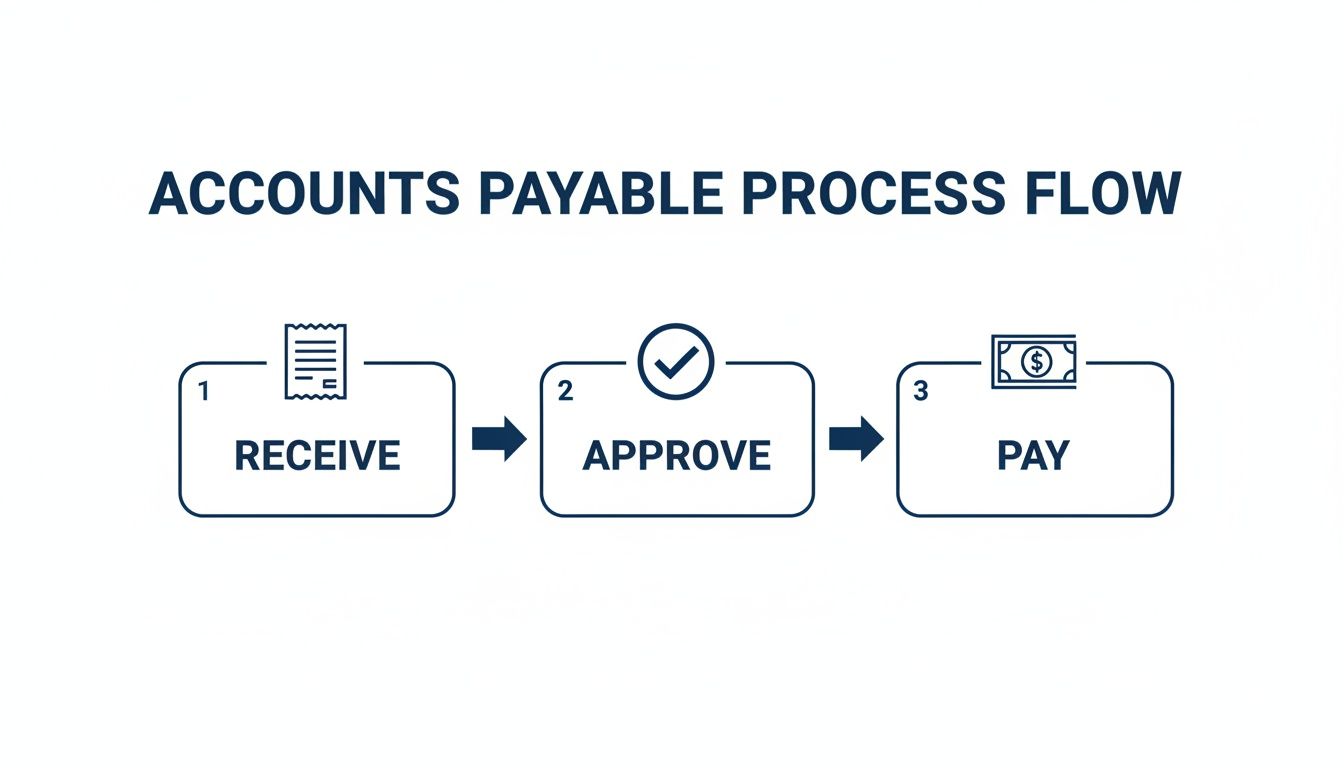
This basic flow keeps your finances in order by making sure every bill is properly vetted before any money goes out the door. Let’s break down what really happens at each stage.
Step 1: Receiving and Capturing Invoices
The whole process kicks off the second an invoice arrives. Bills can show up in a lot of different ways—physical mail, email attachments, or through a vendor’s online portal. The first job is to get all of that information into one central place.
Trying to manually key in data from paper invoices is a recipe for typos and wasted time. A great first move is to standardize how you get this information. For example, using an Invoice Submission Form Template can force consistency right from the start.
Centralizing everything is your first line of defense against lost invoices, a classic headache that leads to late payments and unhappy suppliers.
Step 2: Validating Invoice Details
Just because an invoice is in your system doesn’t mean it’s ready to be paid. Next, your AP team puts on their detective hats to make sure the bill is legitimate and accurate. Honestly, this is where you can prevent some serious financial mistakes.
During this check, the team confirms a few key things:
- Vendor Information: Does the vendor’s name, address, and contact info match what you have on file?
- Invoice Details: Are the invoice number, date, and dollar amounts correct?
- Line Items: Do the services or goods listed on the invoice match what your company actually ordered and received?
For businesses that issue purchase orders (POs), this is where the three-way match comes in. It’s a powerful check where the invoice is compared to both the original PO and the receiving report (the proof of delivery). If all three documents line up, you know the invoice is good to go.
Step 3: Routing for Approval
Once an invoice is confirmed as valid, it needs a green light from the right person. This is the approval stage. Usually, the department manager or budget owner who asked for the service has to sign off on the expense.
Having a clear approval hierarchy is absolutely critical here. A project manager might be able to approve anything under $1,000, but anything more than that might need a director’s signature. This simple rule prevents runaway spending and keeps every payment aligned with the company budget.
Without a structured system, invoices get stuck on people’s desks or buried in email chains, causing major payment delays. Modern tools like QuickBooks can automate this, sending reminders to the right people and showing you exactly where every bill is in the approval process.
Step 4: Coding and Payment Processing
After it’s fully approved, the invoice is in the home stretch. The first part of this final stage is general ledger (GL) coding. This is where you assign the expense to the correct category in your chart of accounts. For a service business, a software bill might get coded to “Technology Expenses,” while a freelancer’s invoice might go to a specific “Client Project Cost” account. Good coding is non-negotiable for accurate financial reports.
Finally, it’s time to pay the bill. Your team will schedule the payment, choose the method (ACH, check, credit card), and send the money. The trick is to pay on time—not too early, not too late. This helps manage your cash flow and lets you grab any early payment discounts your vendors offer. Once paid, the system is updated, and the loop is officially closed on that transaction.
Building a Secure AP Management System
Getting your accounts payable process running smoothly is a great first step, but making it secure is what truly protects your business from the inside out. Without strong safeguards, you’re leaving the door open to everything from accidental duplicate payments to deliberate fraud. Building a secure system isn’t about making things complicated; it’s about creating total clarity around who does what and putting common-sense checks in place.
This all comes down to two core ideas working together: clearly defined roles and solid internal controls. Think of it like a bank vault. The vault is only secure because of the thick steel door and the rule that two different people need separate keys to open it. One without the other just doesn’t work.

Defining Key Roles and Responsibilities
To stop any single person from having too much power over the payment process, you need to assign distinct responsibilities. This is called segregation of duties, and it’s your number one defense against both errors and fraud.
Here’s how the roles typically break down in a well-structured AP department:
- AP Clerk/Specialist: This is your frontline person. They’re responsible for receiving invoices, entering the data, and doing the initial matching against purchase orders and receiving reports.
- AP Manager/Supervisor: They act as the first line of review, checking the clerk’s work, handling tricky vendor issues, and often giving the first level of approval on invoices.
- Department Head/Budget Owner: This is the person who actually requested the service or product. Their sign-off confirms the business got what it paid for and that the expense is a valid one for their department.
- Controller/CFO: This is the final checkpoint. They give the ultimate green light for payment, especially for larger amounts, and make sure the whole process follows company policy.
The core principle is simple: the person who enters the bill cannot be the same one who approves it and pays it. By separating these duties, you create a natural system of checks and balances that keeps everyone honest and accountable.
Implementing Essential Internal Controls
Internal controls are the specific rules you put in place to ensure every payment is legitimate. They turn your security strategy into concrete, daily actions for your team.
The three-way match is the absolute cornerstone of AP control. Before an invoice gets paid, the team confirms that the details on three documents line up perfectly:
- The Purchase Order (PO): What your company agreed to buy and the price you agreed to pay.
- The Receiving Report: Proof that the services or goods were actually delivered as expected.
- The Vendor Invoice: The bill from the vendor requesting payment.
If all three match, you can pay with confidence, knowing the invoice is accurate. When you’re thinking about your AP security, it helps to understand the ideas behind building an effective Information Security Management System, since many of the same concepts of control and verification apply.
Another critical control is setting clear approval authority levels. For instance, a project manager might have the authority to approve any invoice up to $2,500, but anything over that amount requires a director’s signature. This simple rule prevents unauthorized spending and keeps expenses in line with your budget. For a deeper dive into setting up these kinds of safeguards, check out our detailed guide on accounts payable best practices.
How to Measure Your AP Process Performance
You can’t improve what you don’t measure. A smooth accounts payable process might feel efficient, but without hard data, you’re just guessing. To really get a handle on the health of your AP function, you need to track specific Key Performance Indicators (KPIs). These metrics turn vague feelings into real, actionable insights, showing you exactly where you’re winning and where bottlenecks are costing you time and money.
Tracking the right KPIs helps you find hidden problems, make a solid case for investing in automation, and turn your AP department from a simple cost center into a strategic part of your business that protects your cash flow.
Cost Per Invoice
One of the most foundational AP metrics is the Cost Per Invoice. This number tells you the total direct and indirect costs tied to processing a single vendor invoice, from the moment it arrives until it’s paid. Think of it as a price tag for your entire workflow.
To figure it out, just add up all your monthly AP costs—salaries, software subscriptions, overhead—and divide that total by how many invoices you processed that month. A high cost per invoice, which you often see in manual, paper-heavy systems, is a clear red flag that your process is inefficient. Industry benchmarks show that fully automated systems can slash this cost by over 80%.
Invoice Cycle Time
How long does it take for an invoice to make the full journey through your accounts payable process? That’s what Invoice Cycle Time measures. The clock starts the second an invoice is received and doesn’t stop until the payment is officially sent out.
A long cycle time is more than just an annoyance; it can lead to some serious headaches:
- Missed Early Payment Discounts: Lots of vendors offer a small discount, usually 1-2%, for paying ahead of schedule. A slow process means leaving that free money on the table.
- Strained Vendor Relationships: If you’re consistently paying late, it can damage your reputation and might lead to vendors giving you stricter payment terms down the road.
- Increased Risk of Late Fees: Delays can easily result in unnecessary penalty fees that hit your bottom line directly.
Getting this cycle time down is a top priority for any AP improvement project. Shorter cycles are a sign of a more streamlined, predictable, and efficient operation.
Days Payable Outstanding (DPO)
While paying your bills on time is obviously important, paying them too early can put a squeeze on your cash flow. Days Payable Outstanding (DPO) tracks the average number of days it takes your company to pay its vendors after getting an invoice. It gives you a strategic look at how you’re managing your cash.
A higher DPO means your company is holding onto its cash longer, which can then be used for other operational needs. But be careful—a DPO that gets too high might mean you’re paying vendors late, which could harm those important relationships.
The goal isn’t to max out your DPO at all costs, but to find the sweet spot. You want to optimize your payment schedule to hold onto cash as long as you can without getting hit with late fees or missing out on valuable early payment discounts. This KPI gives you the data you need to make those smart financial calls and manage your working capital like a pro.
Essential Accounts Payable KPIs and What They Mean
Beyond these three core metrics, there are several other KPIs that can give you a more complete picture of your AP department’s performance. Monitoring a handful of key indicators helps you diagnose problems before they become crises and ensures your team is running at peak efficiency.
| KPI | What It Measures | Why It Matters |
|---|---|---|
| Invoice Exception Rate | The percentage of invoices that require manual intervention or correction. | A high rate points to unclear processes, data entry errors, or mismatched information, which all slow things down. |
| Early Payment Discount Capture Rate | The percentage of available early payment discounts that your company successfully takes. | This is a direct measure of profitability. A low rate means you’re leaving free money on the table due to slow processing. |
| Invoices Processed Per Employee | The number of invoices a single AP team member can process in a specific period (e.g., per day or month). | This KPI helps you gauge team productivity and capacity, making it easier to plan for growth or justify new hires. |
| Late Payment Rate | The percentage of invoices paid after their due date. | This directly impacts vendor relationships and can lead to late fees, so keeping it low is critical for your reputation. |
By keeping an eye on these numbers, you can turn your accounts payable process from a reactive, paper-pushing function into a proactive, strategic asset for your business.
The Future Is Here With AP Automation
The days of drowning in paper invoices and tedious manual data entry are numbered. That traditional accounts payable process is quickly becoming a thing of the past, making way for technology that turns a once-draining back-office chore into a source of powerful business insights. Modern AP automation software, often with a little help from artificial intelligence (AI), is leading this charge.
Think about it: what if invoices could be read, categorized, and sent for approval without anyone on your team lifting a finger? That’s exactly what automation brings to the table. It takes over the repetitive, low-value work so your people can stop chasing paper and start focusing on what truly drives the business forward—like analyzing spending, sharpening cash flow management, and strengthening vendor relationships.

How Automation Changes the Game
Automating your AP isn’t just about ditching the filing cabinets. It’s about building a smarter, faster, and far more accurate process from the ground up. This happens thanks to a few key technologies that work together to simplify every single step.
The magic often starts with Optical Character Recognition (OCR). This tech is like a digital assistant that reads every invoice and instantly pulls out the important details—vendor name, invoice number, due date, and amount. Just by implementing this one feature, you can nearly wipe out manual data entry, which is hands-down the biggest source of AP errors.
From there, intelligent approval workflows kick in. You can create custom rules to route invoices to the right person automatically. For instance, any marketing bill under $1,000 can go straight to the marketing manager, but anything over $10,000 gets flagged for the CFO. No more chasing signatures.
Finally, the best systems integrate seamlessly with your accounting software, like QuickBooks. Once an invoice gets the green light, it’s automatically recorded and coded in your general ledger. This creates a single, reliable source of financial truth without any extra work. If you’re ready to build a more efficient back office, a good first step is automating the accounts payable process.
The Impact of AI on Accounts Payable
Artificial intelligence takes things even further. Instead of just following pre-set rules, AI-powered systems actually learn and get smarter over time. These algorithms can look at your past invoices to suggest the right GL codes for new ones, spot unusual activity that could be fraud, and even help predict payment timing to fine-tune your cash flow.
A massive shift is underway here. While only 7% of AP departments are using AI right now, a whopping 40% plan to get on board by 2026. Why the rush? The results speak for themselves. Businesses using AP automation have been shown to slash their processing time by 62%, cutting the cycle down from 20.8 to just 7.9 days. On top of that, 68% say they’ve lowered their risk of financial fraud.
By automating routine decisions, AI allows finance teams to operate by exception. Instead of reviewing every single invoice, they can focus their attention only on the outliers—the bills that are flagged for discrepancies or fall outside normal spending patterns.
This fundamentally changes the role of your AP team. They go from being data entry clerks to strategic guardians of the company’s finances.
Tangible Benefits of Adopting Automation
Making the switch from manual to automated accounts payable delivers clear, measurable wins for your whole business. The benefits go far beyond just saving a few hours—we’re talking about stronger financial controls and a crystal-clear view of company spending.
Here are some of the key improvements you can expect:
- Drastically Reduced Errors: When you eliminate manual data entry, you get rid of the typos, accidental duplicate payments, and coding mistakes that can wreck your financial reports.
- Faster Payment Cycles: Automated workflows mean invoices don’t get buried in an email inbox or lost on someone’s desk. Quick approvals lead to on-time payments, which keeps your vendors happy.
- Enhanced Visibility and Control: A central dashboard gives you a real-time look at every invoice. You can see who has it, how long it’s been waiting, and what your cash needs are at a glance.
- Significant Cost Savings: Automation cuts down on labor costs, helps you avoid late fees, and makes it much easier to snag early payment discounts. All of that puts money straight back to your bottom line.
When to Outsource Your Accounts Payable
When you’re just starting out, managing your own accounts payable probably feels straightforward enough. But as your service business grows, that once-simple task can become a serious operational headache. The manual way of doing things that worked for a handful of invoices each month will start to crack when you’re dealing with dozens, creating bottlenecks that quietly eat up your time and money.
Figuring out when you’ve hit that tipping point is key. It’s not just about feeling busy; it’s about seeing clear signs that your current AP process is holding your business back. If your team is spending more time tracking down approvals than doing strategic work, it might be time to think about bringing in an expert.
Telltale Signs You’ve Outgrown In-House AP
So, how do you know you’ve hit the wall? It’s rarely one big event. Instead, it’s a slow pile-up of small problems that you might not even notice until they start messing with your cash flow, vendor relationships, and team morale.
Here are a few clear signs it’s time to look at outsourcing:
- Rising Invoice Volume: Are you handling way more invoices than you were six months ago? As that number goes up, so does the risk of manual errors, paying the same bill twice, and missing deadlines.
- Constant Errors and Delays: If you’re regularly getting hit with late payment fees, missing out on early-pay discounts, or getting calls from unhappy vendors, your process is failing. These little costs add up quickly and can hurt your reputation.
- Lack of Financial Visibility: Can you pull up a report right now that shows exactly who you owe and when it’s due? If your AP data is a mess, you’re making crucial cash flow decisions without all the facts.
- Key Staff Overload: Is one of your key employees—or maybe even you—getting bogged down with AP tasks? When your most valuable people are stuck doing administrative work, your business loses its focus.
The Strategic Benefits of Outsourcing to an Expert Firm
Handing your accounts payable over to a specialized bookkeeping firm like Steingard Financial is more than just getting tasks off your plate; it’s about giving your entire financial operation an upgrade. It’s a strategic move to get access to expertise, better technology, and strong financial controls that would be too expensive and time-consuming to build yourself.
An outsourced partner brings immediate benefits that make your business stronger from the inside. They provide a solution that can grow with you, making sure your back office can handle whatever comes next without missing a beat.
By outsourcing, you’re not just hiring someone to pay bills. You’re adopting a proven, secure, and efficient accounts payable process overnight, complete with expert oversight and best-in-class tools.
Partnering with experts gives you several key advantages:
- Access to Expertise and Technology: You get a team of experienced professionals and access to top automation software without the big upfront cost.
- Improved Internal Controls: A professional firm will set up important controls, like segregation of duties, to protect your business from mistakes and fraud.
- Scalable Support: As your business grows, your outsourced AP function grows right along with it, handling more invoices without any extra effort from you.
- Focus on Your Core Business: When your team isn’t buried in administrative work, they can focus on what they do best: serving your clients and growing the business.
Common Accounts Payable Questions Answered
Even with a clear process mapped out, you’re bound to have questions as you start putting it into practice in your own business. Let’s tackle a few of the most common ones we hear from service business owners. Getting these right can help you sidestep common pitfalls and make smarter financial decisions.
What Is the Most Critical Step?
While every part of the process matters, if I had to pick just one, it would be Invoice Validation and Verification. This is your moment of truth—the point where you confirm a bill is legitimate, the amounts are correct, and you’re not about to pay for something you never received.
Think of it as the gatekeeper for your company’s cash. A strong validation process, especially one that includes a three-way match, is your single best defense against overpayments, duplicate bills, and even outright fraud. It ensures you only pay for what you actually ordered and approved, protecting your cash flow right from the start.
How Can Small Businesses Improve AP Without Expensive Software?
You don’t need a huge budget to make a real difference. Small businesses can drastically improve their accounts payable process just by focusing on clear, consistent procedures.
Here are a few low-cost, high-impact strategies you can implement right away:
- Standardize Invoice Submission: Set up one dedicated email address (like [email protected]) for all vendor bills. This one simple change stops invoices from getting buried in different inboxes.
- Document Approval Hierarchies: Write down exactly who is allowed to approve expenses and for what amounts. This clears up any confusion and keeps the approval process moving smoothly.
- Enforce Segregation of Duties: This is a big one. The person who approves an invoice should never be the same person who makes the payment. It’s a fundamental control that significantly cuts down on the risk of errors and internal fraud.
Even if you’re just using a system like QuickBooks Online, putting these foundational practices in place will create a much safer and more organized workflow.
The core idea is simple: AP and AR are two sides of the same cash flow coin. Accounts Payable (AP) represents the money your business owes to others—your suppliers and vendors. It’s a liability on your balance sheet. In contrast, Accounts Receivable (AR) is the money owed to your business by your clients. It’s an asset.
Getting a handle on both is absolutely essential for keeping your business financially healthy. Understanding this difference is the first step to seeing your company’s complete financial picture.
Is your growing business struggling to keep up with vendor payments and financial reporting? The expert team at Steingard Financial provides meticulous AP management, bookkeeping, and payroll services so you can focus on what you do best. Get the accurate data and dependable support you need to make confident decisions. Learn more and schedule a consultation.