 Skip to content
Think of payroll processing as the engine room of your business. It’s the system that makes sure your team gets paid correctly and on time, every single time, all while keeping you on the right side of the IRS and state tax agencies. This isn’t just about cutting checks; it’s a whole cycle of calculations, withholdings, and filings that directly impacts your team’s morale and your company’s financial stability.
The Core Function Of Payroll In Your Business
At its heart, payroll is the administrative job of managing employee pay. But it’s much more than that—it’s a critical operational function. This process doesn’t just move money from your bank account to your employees’. It also gathers, calculates, and reports essential financial data to various government bodies.
Let’s take a simple example. Imagine you run a small marketing agency. You have a salaried project manager, a designer who works 42 hours one week, and an intern paid a simple hourly wage. Your payroll system has to handle all three correctly: process the manager’s standard salary, calculate the designer’s overtime pay, and figure out the intern’s gross wages—all while withholding the right amounts for federal, state, and local taxes for each of them.
Before we dive deeper into the nitty-gritty of the payroll lifecycle, let’s break down the main pillars of the process. This table gives you a quick snapshot of the essential components that make up a successful payroll system.
The Core Components Of Payroll Processing At A Glance
| Component | What It Involves | Why It Matters |
|---|---|---|
| Data Collection | Gathering all employee info: hours worked, salary, W-4 details, and benefits selections. | Accuracy starts here. Bad data in means incorrect paychecks and tax filings out. |
| Gross-to-Net Pay | Calculating total earnings (gross pay) and then subtracting all taxes and deductions to find the final take-home amount (net pay). | This is the mathematical core of payroll. Getting it wrong leads to unhappy employees and compliance issues. |
| Payment & Taxes | Issuing payments to employees and sending withheld taxes to government agencies (federal, state, local). | This ensures everyone gets paid on time and keeps your business compliant, avoiding penalties. |
| Reporting | Filing required forms like the 941 quarterly report and providing year-end W-2s to employees. | This closes the loop with tax agencies, proving you’ve paid what you owe and reported employee earnings correctly. |
Understanding these four pillars is the first step. Each one has its own set of rules and deadlines, which is why a well-organized process is so important for any business owner.
More Than Just A Paycheck
A solid payroll process touches several key parts of your business. The main activities include:
- Data Collection and Verification: The foundation of everything is getting accurate employee hours, salary details, and tax withholding information. Using the best form builder can make gathering correct employee data much smoother from the start.
- Gross-to-Net Calculation: This is where the magic happens. You start with gross earnings and subtract taxes (like Social Security, Medicare, and income tax) plus any voluntary deductions (like health insurance or 401(k) contributions) to get the final net pay.
- Payment Disbursement: Actually paying your team, whether it’s through direct deposit, old-school paper checks, or modern pay cards.
- Tax Remittance and Filing: Sending the taxes you withheld to the right government agencies and filing all the necessary payroll reports before the deadlines hit.
For most service businesses, payroll is the single biggest expense. That makes accuracy and efficiency completely non-negotiable. An error-free process builds trust with your team and protects your business from expensive compliance penalties.
And this whole function is only getting more complicated. The Global Payroll Complexity Index found a 5% average increase in complexity across the globe. For the first time, the United States broke into the top ten, landing at sixth place after a 17% jump in complexity. Why? Mostly because of the challenge of managing compliance across 51 different state and local tax frameworks. This just goes to show how tough it’s become for business owners to handle payroll on their own. You can read more about these trends in the full GPCI report.
The Three Stages Of A Payroll Cycle
To really get your head around payroll processing, it helps to stop thinking of it as a single, dreaded task. Instead, see it as a continuous cycle with a clear beginning, middle, and end. This cycle repeats every single pay period, making sure everyone gets paid correctly and all your legal boxes are checked.
Breaking it down into three distinct stages pulls back the curtain on the whole process. It shows you exactly where the critical checkpoints are for keeping everything accurate.
This visual gives you a simple, at-a-glance overview of how the payroll flow works.
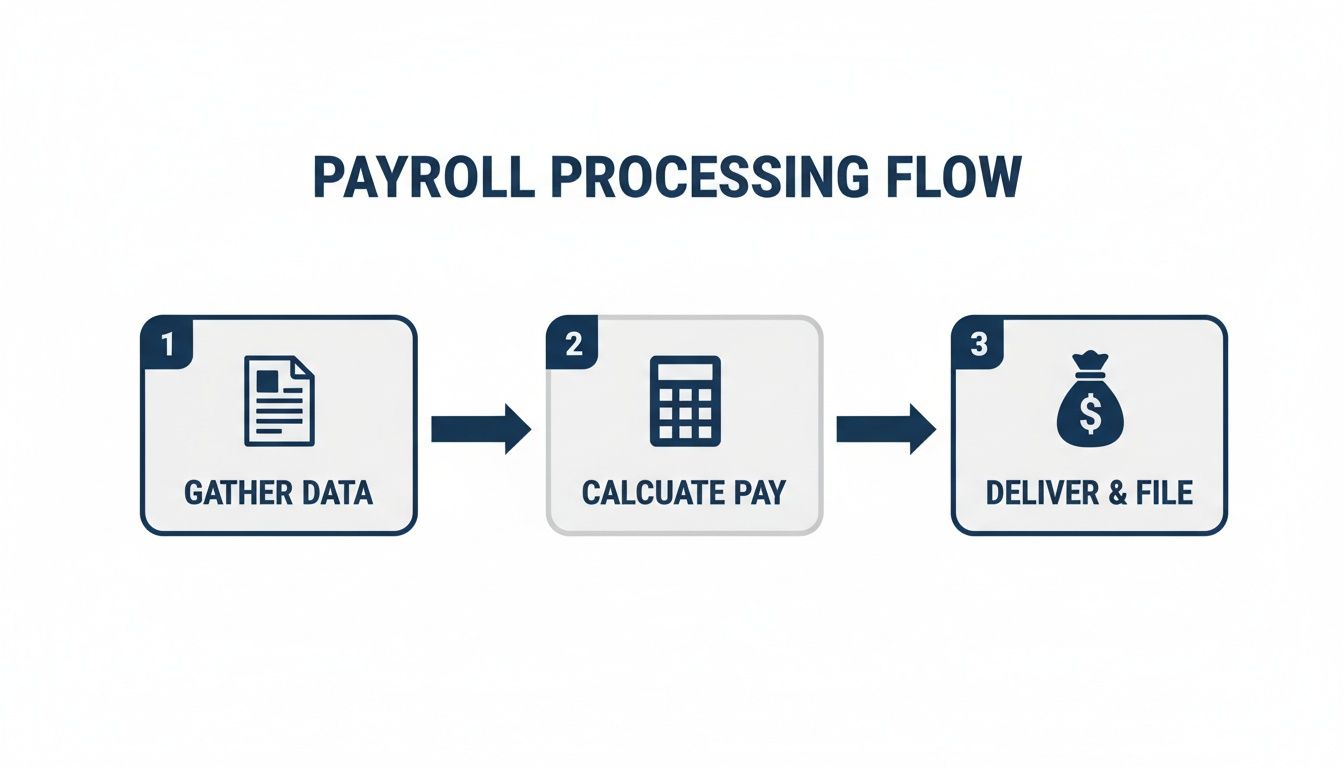
As you can see, payroll is a logical progression. You move from gathering data to crunching the numbers, and finally, to paying people and filing with the government. Getting each step right before moving on is absolutely key.
Stage 1: The Pre-Payroll Phase
This first stage is all about gathering and double-checking the raw data you need to run payroll. Think of it like gathering all your ingredients before you start cooking. If you forget something or use the wrong measurement, the final dish is going to be a disaster. The same goes for payroll—accuracy in this phase is non-negotiable. Any mistake here will snowball through the rest of the process.
Here are the key things you’re doing in the pre-payroll phase:
- Collecting Time Data: This means gathering timesheets from your hourly employees and contractors. For a service business, this is especially important for tracking billable hours on client projects versus non-billable admin time.
- Verifying Employee Information: Did you hire anyone new? Did an employee move, change their bank details, or update their tax withholding on their W-4? All of this info has to be current and correct.
- Reviewing Company Policies: Now is the time to account for things like paid time off (PTO), sick days, or any company holidays that fall within this pay period.
- Processing Variable Pay: This is a big one for service businesses. It includes calculating sales commissions, performance bonuses, or reimbursements for things like travel and other expenses.
Essentially, this stage sets the foundation for everything else. Clean, verified data is the bedrock of an error-free payroll.
Stage 2: The Payroll Calculation Phase
Once you’ve got all your data lined up, it’s time to do the actual math. This is where you take an employee’s gross earnings and turn it into their final net pay—the actual amount that lands in their bank account. It’s a multi-step process involving both additions and, more often, subtractions.
The calculation flow usually looks something like this:
- Calculate Gross Pay: This is the total amount an employee earns before anything is taken out. For a salaried employee, it’s just their annual salary divided by the number of pay periods. For an hourly worker, it’s their hours worked multiplied by their pay rate, plus any overtime.
- Subtract Pre-Tax Deductions: Next, you take out deductions that happen before taxes are calculated, which can lower their taxable income. This includes contributions to a 401(k) retirement plan or premiums for health insurance.
- Withhold Payroll Taxes: Based on the employee’s W-4 form, you calculate and withhold federal, state, and sometimes local income taxes. You also deduct FICA taxes, which cover Social Security and Medicare.
- Subtract Post-Tax Deductions: Finally, you subtract anything that comes out after taxes, like Roth 401(k) contributions or wage garnishments.
The final number you’re left with is the employee’s net pay. This is the core of payroll processing, and it’s where automation through software like Gusto or QuickBooks Payroll becomes a lifesaver.
Example in Action: Let’s say a consultant worked 45 hours in one week at $50/hour. Their gross pay would include 40 regular hours ($2,000) and 5 overtime hours at time-and-a-half ($375), for a total of $2,375. From that amount, you’d subtract their 401(k) contribution, withhold all the necessary taxes, and then issue the final net pay.
Stage 3: The Post-Payroll Phase
The final stage happens after the calculations are done and paychecks have been sent out. This phase is all about compliance, record-keeping, and closing out the books for that pay cycle. Trying to skip these steps can land you in serious hot water with tax agencies.
Key post-payroll tasks include:
- Tax Remittance: The taxes you withheld from employee paychecks aren’t your money to keep. You have to send these funds, along with your share of employer taxes, to the right government agencies (like the IRS) by their deadlines.
- Payroll Reporting: This involves filing the necessary payroll reports, like the quarterly Form 941, to show the government how much you’ve paid in wages and how much you’ve collected in taxes.
- Record-Keeping: Federal law requires you to keep detailed payroll records for at least three to four years. This includes timesheets, proof of payment, tax filings, and W-2s. Secure, organized records are your best friend during an audit.
- Benefits Administration: This just means sending employee contributions for benefits like health insurance or retirement plans over to the providers.
By moving through these three stages—pre-payroll, calculation, and post-payroll—you build a reliable, repeatable system that ensures accuracy and compliance, every single time.
Navigating The Complex World Of Payroll Compliance
Once you get the hang of the basic payroll cycle, you run straight into what is arguably the most critical piece of the puzzle: compliance. This is where simple math transforms into a high-stakes legal function. Getting it wrong doesn’t just mean you have to fix a paycheck; it can quickly escalate into audits, hefty fines, and serious legal trouble.
Think of payroll compliance as the official rulebook for paying your team. The catch is, your company didn’t write it—the federal, state, and even local governments did. Every single dollar you pay an employee is tangled in a web of regulations that dictate how much you withhold, what you chip in as an employer, and exactly when you need to send that money to the right tax agencies.

Federal Payroll Requirements
At the national level, a few core obligations apply to nearly every single employer in the United States. These are the foundational rules you absolutely have to follow, no exceptions.
The most important federal requirements include:
- Federal Income Tax Withholding: You’re required to withhold a portion of an employee’s wages for federal income taxes, based on the information they provide on their Form W-4.
- FICA Taxes (Social Security & Medicare): This is a shared responsibility. You withhold 7.65% from your employee’s paycheck and contribute an additional matching 7.65% out of the company’s pocket.
- FUTA Tax (Federal Unemployment Tax Act): This one’s all on you. It’s an employer-paid tax that helps fund unemployment benefits for workers who have lost their jobs.
These taxes must be deposited with the IRS on a strict schedule, which is usually semi-weekly or monthly depending on your payroll size. You then have to report all these withholdings and payments quarterly. For a closer look at this, check out our guide on how to handle Form 941 electronic filing, a core part of the reporting process.
State And Local Laws Add Complexity
Just when you think you’ve got the federal rules down, state and local laws jump in to add another layer of complexity. This is where payroll processing gets truly challenging, especially for businesses with employees in more than one location.
A business operating in California faces a completely different set of payroll rules than one in Texas, which has no state income tax. This patchwork of regulations is a primary reason why compliance errors are so common.
Many states have their own income tax withholding rules, separate unemployment insurance (SUTA) programs, and unique laws for things like final paychecks, overtime, and paid sick leave. To make it even more interesting, some cities and counties pile on their own local payroll taxes, creating a third tier of compliance you have to manage.
Employees Vs Contractors A Critical Distinction
One of the biggest compliance traps for business owners is misclassifying workers. The IRS has very strict guidelines for determining whether someone is a W-2 employee or a 1099 independent contractor, and it’s a distinction you can’t afford to get wrong.
- W-2 Employees: You have significant control over their work—what they do, how they do it, and when. For these individuals, you must withhold taxes from their pay and cover the employer-side taxes.
- 1099 Contractors: These professionals operate independently. They control their own work and are responsible for paying their own self-employment taxes.
Misclassifying a W-2 employee as a 1099 contractor to sidestep paying taxes is a costly mistake. It can lead to a nasty bill for back taxes, interest, and substantial penalties.
The compliance landscape is always changing. Businesses in North America are a major driver of a 5% global complexity increase, with the U.S. alone seeing a 17% jump. With companies reporting an average of 15 errors per payroll cycle, it’s no wonder that 55% are redesigning their strategies to keep up.
On top of all this, having secure and effective workflows for your payroll activities is crucial for keeping accurate records. Managing payroll’s complexities demands efficient, compliant systems, making a practical guide to HR document management an incredibly valuable resource for any business.
Choosing Your Payroll System: In-House Versus Outsourced
Sooner or later, every business hits a fork in the road with its payroll. Whether you’re a consultant hiring your first team member or a growing agency, you have to decide: how are we going to handle this? This isn’t just a simple admin task—it’s a strategic choice that impacts your time, budget, and legal exposure.
The two main paths are doing it yourself (in-house) or partnering with a dedicated firm (outsourced). There’s no one-size-fits-all answer here. The right choice really comes down to your company’s size, complexity, and the resources you have on hand.
The Case for In-House Payroll
Handling payroll in-house means you or someone on your team takes the reins, typically using software like Gusto or QuickBooks Payroll. The biggest draw here is direct control. You manage every single detail, from entering hours to hitting “approve,” and can make last-minute changes without waiting on anyone else.
This approach can definitely be easier on the wallet, especially for very small businesses with simple needs—think a couple of salaried employees all in the same state. Your main costs are the software subscription and the time it takes to get it all done.
But that time is the real catch. In-house payroll eats up dedicated hours every single pay period. It’s not just about running the numbers; it’s about staying on top of constantly shifting tax laws. All the responsibility for getting it right—and the risk if you don’t—lands squarely on your shoulders.
The Power of Outsourced Payroll
Outsourcing means you team up with experts, like us at Steingard Financial, who manage the entire payroll process for you. Right away, this lifts a massive administrative weight off your shoulders. You and your team get that time back to focus on what actually grows the business: serving clients and finding new opportunities.
The biggest win, though, is tapping into specialized expertise. A good payroll partner lives and breathes this stuff. They are professionals dedicated to keeping up with the tangled web of federal, state, and local tax rules, which dramatically cuts your risk of making expensive mistakes. This is a huge deal, especially now when finding skilled people is a major challenge.
This talent shortage is no joke. A global survey from ADP found that a staggering six in 10 businesses are feeling the heat from staffing issues, pushing them to find smarter solutions. This trend really shines a light on the value of an expert partner who does this work every day. You can learn more about the global payroll landscape from ADP’s research.
Outsourcing isn’t just about saving time; it’s about gaining a strategic partner. A great payroll provider offers guidance, ensures compliance, and delivers the clean financial data you need to make smart business decisions.
Outsourcing becomes a no-brainer for businesses that are growing, have employees in different states, or deal with tricky compensation like commissions and bonuses. To dig deeper into this, check out our guide on the key benefits of outsourcing payroll.
In-House Vs. Outsourced Payroll: A Comparison For Service Businesses
To help you see the differences more clearly, let’s put the two options side-by-side, focusing on what matters most for service-based businesses like yours.
| Factor | In-House Payroll | Outsourced Payroll Partner |
|---|---|---|
| Control | High. You have direct, immediate control over all data and processing. | Shared. You provide data and approvals, but the expert partner executes the process. |
| Time Investment | High. Requires significant internal hours for processing, compliance, and troubleshooting. | Low. Frees up your team to focus on core business functions instead of administration. |
| Expertise & Risk | Internal. All compliance knowledge must be maintained in-house. The risk of errors is entirely yours. | External. You gain access to dedicated payroll experts. The partner shares the compliance burden. |
| Scalability | Limited. Can become a major bottleneck as your team grows or expands into new states. | High. Easily scales with your business, managing growing complexity without added internal strain. |
| Cost Structure | Primarily software subscription fees and the cost of internal employee time. | Typically a predictable monthly or per-employee fee for a comprehensive service. |
Ultimately, the decision is about balancing control with expertise and time. As your service business grows, the complexity of payroll often grows with it, making an expert partner an increasingly valuable asset.
How Payroll Connects To Your Core Business Functions
It’s easy to think of payroll as just another administrative chore—cutting checks and moving on. But that’s a huge oversimplification. Payroll is more like the central nervous system of your business, connecting your financial and human resources functions in ways that are critical for growth. The data generated every pay run is the lifeblood for several other operations, turning an isolated task into a powerful source of business intelligence.
When your payroll system is siloed, you’re flying blind. Your bookkeeping might show one set of labor costs, while your HR team is working with completely different employee data. That disconnect is a recipe for unreliable reports, flawed financial forecasting, and ultimately, poor strategic decisions.
Payroll As The Foundation Of Accurate Bookkeeping
Let’s be honest: for any service business, payroll is one of your biggest expenses. Every time you run payroll, you’re creating essential data that needs to flow directly into your accounting records. A seamless integration between the two isn’t just a nice-to-have; it’s the key to real financial clarity.
When your payroll and bookkeeping systems are actually talking to each other, the benefits are immediate:
- Real-Time Labor Costing: Integrated systems automatically push wage expenses, employer taxes, and benefits costs right into your general ledger. This gives you an accurate, up-to-the-minute view of what your labor is costing you, with zero manual entry.
- Accurate Financial Statements: With that direct data flow, your Profit & Loss statement will always reflect your true labor costs. You get a reliable picture of your company’s profitability month after month.
- Simplified Job Costing: For service-based businesses, this is huge. You can assign payroll expenses to specific client projects, helping you finally understand the true profitability of each job you take on.
Modern platforms are built for this kind of synergy. For example, when you set up QuickBooks Online correctly, its payroll module fits in perfectly. This wipes out the tedious and error-prone job of manually entering and reconciling payroll journal entries.
Bridging The Gap Between Payroll And HR
Payroll data isn’t just for the accountants; it’s a goldmine for your Human Resources functions, too. From hiring and onboarding to retirement, the numbers from each pay cycle inform critical decisions about your people.
When HR and payroll systems are unified, you create a single source of truth for all employee information. This eliminates data discrepancies and ensures that decisions about compensation, benefits, and staffing are based on accurate, current information.
This integration makes several key HR activities much smoother. Think about it: when a new team member is hired, their information can be entered just once and used for both their onboarding paperwork and their payroll setup. No more duplicate data entry.
Other HR functions are directly tied in as well:
- Benefits Administration: Employee contributions for things like health insurance or 401(k) plans are calculated in payroll. That information must be accurately reported and paid out—a task that sits squarely between both departments.
- Compensation Strategy: By analyzing payroll data, HR leaders can benchmark salaries against industry standards, plan for raises, and design bonus structures that actually align with company goals.
- Compliance and Reporting: All that information about employee tenure, compensation, and hours worked is essential for various compliance reports that HR is often responsible for managing.
Platforms like Gusto are brilliant at this, combining payroll, benefits, and HR tools into one clean system. This approach transforms payroll from a simple transaction into a strategic asset that strengthens your bookkeeping, informs your HR strategy, and ultimately supports smarter business growth.
Common Payroll Mistakes And How To Avoid Them
Even with the best systems in place, payroll is one of those areas where small mistakes can snowball into massive headaches. Understanding where things usually go wrong is the first step to building a payroll process that’s not just functional, but rock-solid. A resilient system protects your business and, just as importantly, keeps your team happy and paid correctly.
One of the most common—and costly—errors is misclassifying employees. The IRS draws a very clear line between a W-2 employee and a 1099 contractor, and confusing the two can lead to some serious penalties, including back taxes and fines. You have to look past the job title and really dig into the level of control you have over a worker to get the classification right from day one.
Mishandling Overtime And Wage Laws
Another major tripwire is messing up wage and hour laws, especially when it comes to overtime. Under the Fair Labor Standards Act (FLSA), any non-exempt employee has to be paid 1.5 times their regular rate for hours worked over 40 in a week. If you’re not tracking hours accurately or you’ve wrongly classified someone as exempt, you could be facing expensive lawsuits and back-pay claims.
This is why having a clear, reliable way to track all hours worked is non-negotiable, particularly in service businesses where project hours can change week to week.
A proactive approach is always better than a reactive one. By creating standardized processes for every stage of payroll, from onboarding to offboarding, you create a system of checks and balances that catches errors before they happen.
Preventing Common Payroll Errors
Building a robust payroll process means you have to be intentional about preventing mistakes. Instead of just crossing your fingers each pay period, you can put a few simple strategies in place to safeguard your business and ensure accuracy every single time. A few proactive measures can save you a world of stress and countless hours down the road.
Here are a few actionable tips to help you sidestep the most common issues:
- Establish a Clear Payroll Calendar: Create and share a calendar that spells out firm deadlines for submitting timesheets, getting manager approvals, and final processing. This simple step gets rid of the last-minute scramble, which is where most errors tend to happen.
- Conduct Regular Self-Audits: Set aside time at least once a quarter to review your payroll records. Double-check employee classifications, make sure pay rates match up with employment agreements, and verify that PTO and benefit deductions are being calculated correctly.
- Create Standardized Checklists: Develop detailed checklists for key payroll events, like bringing on a new hire or processing a final paycheck. This makes sure no critical step gets missed and keeps everything consistent, even if your usual payroll person is out of the office.
By putting these best practices into motion, you shift from simply processing payroll to managing it strategically. This builds a stronger foundation, cuts down on compliance risks, and ultimately gives you more confidence in your company’s financial operations.
Frequently Asked Questions About Payroll Processing
Even when you have a good handle on the payroll cycle, questions always pop up. Running a business means dealing with the day-to-day realities of paying your team, and that comes with its own set of practical challenges. Here are a few of the most common questions we hear, with clear answers to help you move forward.
How Often Should I Run Payroll For My Business?
Choosing how often to pay your employees is a foundational decision. The most common schedules are weekly, bi-weekly (every two weeks), semi-monthly (twice a month), or monthly.
For service-based businesses with a lot of hourly staff, weekly or bi-weekly schedules usually make the most sense. It’s simply easier to track variable hours and calculate overtime correctly with a shorter pay period.
Your final choice really comes down to three things: your cash flow, your employees’ preference, and state law. Some states actually mandate how often you have to pay your team, so it’s critical to check your local requirements before locking in a schedule.
What Is The Difference Between Payroll Software And A Payroll Service?
This is a great question because it gets to the heart of having a tool versus having a partner.
-
Payroll Software: Think of this as a digital calculator. Platforms like Gusto or QuickBooks Payroll are fantastic at automating the math. They’ll crunch the numbers, generate pay stubs, and help with tax filings, but you are still the one responsible for entering all the data correctly and making sure you’re compliant.
-
Payroll Service: This is a team of actual people managing the entire process for you, using their own specialized software. A service adds the human oversight and problem-solving that software can’t. They handle compliance, troubleshoot issues when they arise, and give you the peace of mind that everything is done right.
Is It Difficult To Switch Payroll Providers Mid-Year?
Switching payroll providers in the middle of the year is definitely doable, but it has to be done carefully. The biggest challenge is migrating all of the year-to-date payroll data. Every single dollar paid out and every tax withheld for every employee has to be transferred over to the new system perfectly.
Any mistake in that transfer can throw off your tax calculations and create massive headaches when it’s time to prepare W-2s at the end of the year.
Because this process is so detailed and prone to error, we always recommend working with an experienced firm to handle the switch. A professional will manage the data migration meticulously, making sure the transition is smooth and accurate for both you and your employees.
What Are The Most Important Payroll Records To Keep?
Good record-keeping isn’t just a best practice; it’s the law. For compliance, you can’t afford to be disorganized.
The Fair Labor Standards Act (FLSA) requires you to keep specific payroll records for at least three years. This includes basic employee details, hours worked each day and week, total wages, overtime pay, and all deductions.
On top of that, you should keep any documents related to taxes—like copies of your quarterly Form 941 filings and each employee’s Form W-4—for a minimum of four years. Keeping these records organized and accessible is your best defense in an audit and a cornerstone of solid financial management.
Ready to stop worrying about payroll complexities and focus on growing your business? The team at Steingard Financial provides expert payroll and bookkeeping services designed for service businesses like yours. We ensure your team is paid accurately and on time, every time. Learn more at https://www.steingardfinancial.com.