

Mastering the Budget for Small Business
When most people hear the word “budget,” they think about restriction. It’s a word that brings up feelings of limitation, of tracking past mistakes, and of reining in spending. For a lot of service business owners, it’s just a necessary chore.
But what if you thought of your budget differently? What if it wasn’t a restriction, but a roadmap?
A well-built budget is the single most powerful strategic tool you have. It’s not about limiting what you can do; it’s about empowering you to do more. It provides the clarity you need to make smart, data-driven decisions instead of just going with your gut.
Your Budget is a Roadmap to Growth
Your budget is your company’s story, just told with numbers. It’s how you translate your big-picture vision into a concrete, actionable plan.
Want to hire that new project manager in six months? Your budget will show you exactly what revenue goals you need to hit to make it happen comfortably. Thinking about that shiny new project management software? Your budget helps you map out the ROI and plan for the expense without creating a cash flow crunch.
Shifting from Reactive to Proactive
Without a formal budget, you’re essentially driving blind. You’re constantly reacting to things as they pop up—an unexpected tax bill, a client paying late, a sudden opportunity you can’t jump on. Operating this way is stressful and, frankly, it holds your business back.
A proactive budget puts you back in the driver’s seat.
A budget isn’t about predicting the future with 100% accuracy. It’s about creating a plan that is strong and flexible enough to handle the inevitable curveballs of running a business.
This guide is about more than just tracking expenses. We’re going to build a complete playbook that connects your financial plan directly to your day-to-day operations. It’s about creating a system that truly works for your service business.
Here’s a look at what we’ll cover:
- Choosing the right budgeting method for your specific business model—whether that’s zero-based, rolling, or forecast-based.
- Forecasting your cash flow accurately to sidestep surprises and keep healthy cash reserves.
- Setting financial goals that actually mean something and tie directly to your long-term vision.
- Connecting your budget with tools you already use, like QuickBooks and Gusto, to create a seamless workflow.
By the end of this, your finances won’t be a source of anxiety anymore. They’ll be your greatest asset. You won’t just have a budget; you’ll have a clear, reliable roadmap to guide your business toward real, sustainable growth. Let’s get started.
Choosing the Right Budgeting Method
https://www.youtube.com/embed/IIKr2915l2g
Not all budgets are created equal. Far from it. The method you choose to build your financial plan can make or break its usefulness, and picking the right one comes down to your business model, how mature your company is, and just how predictable your revenue is. A budget isn’t just about tallying up what you’ve spent; it’s a strategic tool that has to reflect your day-to-day reality.
Think of it this way: are you just tracking spending, or are you building a roadmap for growth?
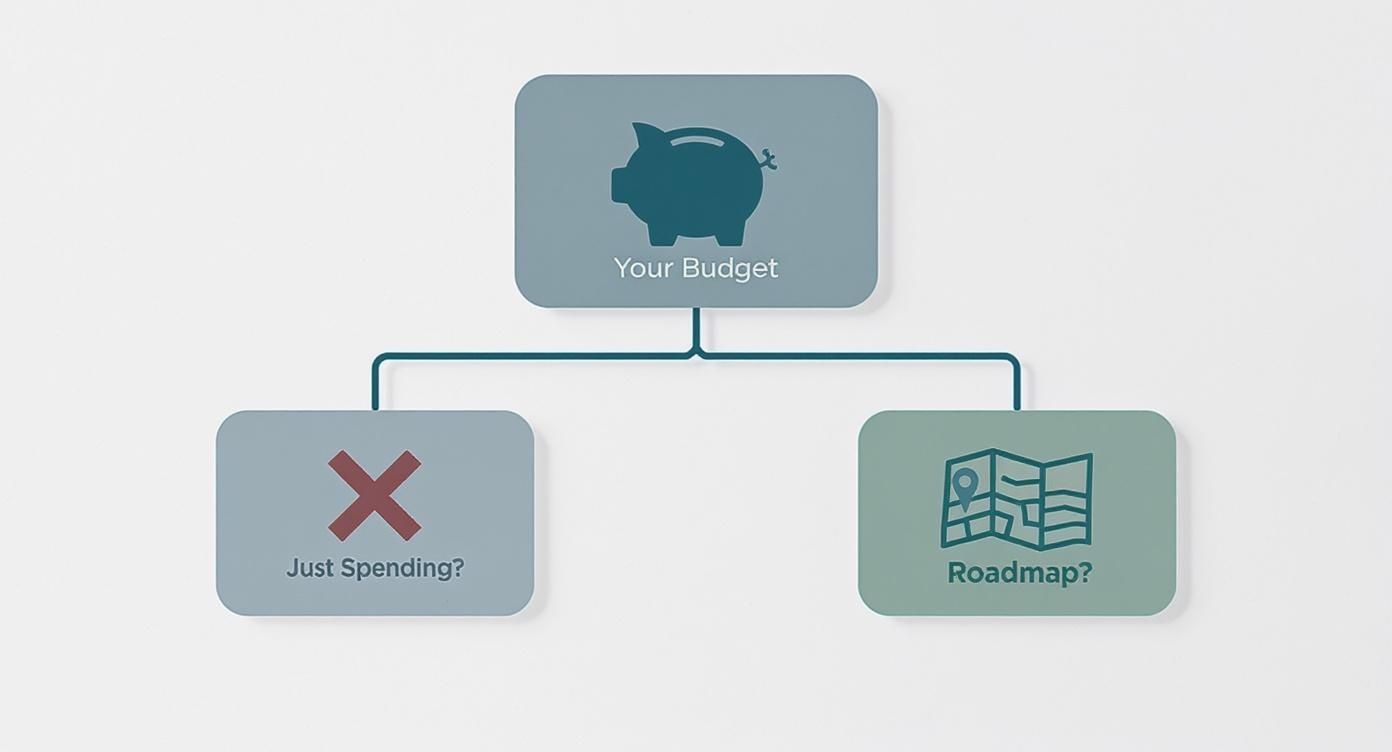
The real power of a budget for a small business comes from being proactive—a guide for future decisions, not just a reactive report card on past spending. Let’s dig into three powerful methods that turn your budget into that growth-focused roadmap.
Zero-Based Budgeting: Justify Every Dollar
Zero-based budgeting (ZBB) is exactly what it sounds like: you start from zero every single time you create a budget. Instead of just rolling over last month’s numbers, every single expense has to be justified from scratch. It forces you to constantly ask, “Do we really need this to succeed right now?”
Picture a small marketing agency building its quarterly budget. With ZBB, the owner wouldn’t just rubber-stamp the same $500 monthly software subscription. They’d have to re-evaluate every tool, questioning if it delivered enough ROI last quarter and if it’s still the best option.
This approach is a game-changer for:
- Aggressive cost control: It’s fantastic for trimming the fat and making sure every dollar has a job.
- Brand new businesses: When you have no historical data, starting from zero is the only logical way to plan.
- Businesses in transition: If you’re pivoting or restructuring, ZBB forces your spending to align with your new goals.
The big drawback? It takes time. A lot of time. But the deep clarity it gives you into your operations often makes the effort completely worth it, especially when cash flow is tight.
Rolling Budgets: Stay Nimble and Look Ahead
A rolling budget, sometimes called a continuous budget, is a living, breathing plan. Instead of a static annual budget you create once and then ignore, you have a 12-month plan that you’re constantly updating. As each month ends, you add a new month to the end of the forecast. This keeps you looking a full year ahead at all times.
Imagine a consulting firm where project timelines are all over the place. A rigid annual budget made in January would be useless by April. A rolling budget lets the owner tweak revenue forecasts and planned costs as new contracts land or projects get delayed, keeping the financial picture realistic.
A static budget is a snapshot in time; a rolling budget is a live video feed of your company’s financial future. It gives you the agility to navigate the inevitable twists and turns of running a service business.
This method is perfect for businesses that need to adapt to market shifts on the fly. It’s the bridge between your long-term strategy and your short-term operational needs.
Forecast-Based Budgeting: Use History to Predict the Future
Forecast-based budgeting leans on your historical data and market trends to predict what’s coming. This is less about justifying every single line item from scratch and more about creating an educated projection based on past performance and what you expect to change.
To do this well, you need a solid grip on your bookkeeping. Understanding the difference between cash-basis and accrual-basis accounting is non-negotiable for accurate forecasts, as it changes when you actually recognize your revenue and expenses.
For a lot of small businesses, funding is a key piece of the forecast. Recent stats show that 56% of small businesses look for funding to cover operating expenses, while 46% want it for expansion. Knowing that small banks approve around 52% of these applications helps you build realistic financing goals into your forward-looking budget.
To help you decide, here’s a quick breakdown of how these three methods stack up for service-based businesses.
Budgeting Method Comparison for Service Businesses
| Method | Best For | Pros | Cons |
|---|---|---|---|
| Zero-Based | Startups, businesses in a turnaround, or any company needing to cut costs aggressively. | Forces deep analysis of every expense; eliminates wasteful spending. | Very time-consuming and can be complex to manage each period. |
| Rolling | Businesses in dynamic or unpredictable industries, like consulting or marketing agencies. | Always forward-looking; highly adaptable to change and improves forecast accuracy over time. | Requires constant attention and updates, which can be a resource drain. |
| Forecast-Based | Established businesses with stable operations and reliable historical data. | Relatively simple and fast to create; good for long-term strategic planning. | Can perpetuate past inefficiencies; may be inaccurate if market conditions change suddenly. |
Ultimately, there’s no single “best” method—only the one that’s best for your business right now. You might even find a hybrid approach works, using ZBB for a major annual reset and a rolling forecast for your quarterly check-ins.
How to Structure Your Budget Categories
This is where the rubber meets the road—where your budget transforms from a concept into a practical tool you can actually use. For a budget to be effective, it needs to mirror how your business actually operates. The single best way to do that? Align your budget categories directly with your accounting software’s chart of accounts.
Think of your chart of accounts as the financial skeleton of your company. It’s the complete list of every single account in your general ledger, covering everything from cash on hand to specific expenses like software subscriptions or payments to contractors. When your budget categories map one-to-one with this structure, tracking your actual spending against your plan becomes almost effortless.
This isn’t just about making life easier. This alignment simplifies everything, from pulling monthly profit and loss statements to getting your ducks in a row for year-end taxes. The goal is to build a system that’s detailed enough to give you real insights but simple enough that you’ll stick with it.
Core Categories for Service Businesses
While every business has its quirks, service-based companies generally share a common financial DNA. Your budget should reflect this, creating a clear separation between the costs of delivering your service and the costs of just keeping the business running.
Here’s a logical way to break things down:
- Cost of Goods Sold (COGS) or Direct Costs: In a service business, you aren’t selling physical inventory. These are the expenses directly tied to earning revenue, like fees for freelance contractors, project-specific software, or sales commissions.
- Operating Expenses (Overhead): These are the fixed costs you have to pay just to keep the lights on, whether you land a new client or not. This bucket holds your rent, utilities, insurance, and salaries for any non-client-facing staff.
- Sales and Marketing: This category is all about client acquisition. Think digital ad spend, SEO services, content creation, your CRM software subscription, and conference fees.
- General and Administrative (G&A): This is your catch-all for essential business functions that don’t fit neatly elsewhere. It usually includes bank fees, accounting and legal services, office supplies, and payroll processing fees.
- Payroll and Benefits: This is often the biggest line item for any service business. It’s more than just wages—it includes gross pay, employer payroll taxes (like FICA), health insurance contributions, and any retirement plan matches.
A well-organized chart of accounts is the bedrock of a useful budget. If your categories are a mess, your financial reports will be too. Getting this structure right from the start is one of the most impactful things you can do for your financial clarity.
Taking a moment to understand why your chart of accounts matters so much is the first step toward building a budget that gives you actionable insights instead of just a page of numbers.
Translating Categories into a Real Budget
Once you’ve defined your core categories, you can start putting real numbers to them. The percentages will naturally vary from one business to another, but looking at a real-world example can help make the whole concept more concrete.
Knowing typical expense allocations can give you a solid benchmark. For instance, data shows that for businesses with employees, 18.8% of the budget often goes to staffing, while operating costs like legal and accounting services eat up around 11%. Marketing usually lands somewhere between 7% and 12% of total revenue.
Let’s see this in action. Here is a simple breakdown for a small consulting firm projecting $10,000 in monthly revenue.
Sample Budget Allocation for a Service Business ($10,000 Monthly Revenue)
| Category | Percentage Allocation | Dollar Amount | Notes |
|---|---|---|---|
| Direct Costs | 30% | $3,000 | Payments to freelance consultants for project work. |
| Payroll (Owner’s Salary) | 35% | $3,500 | Includes owner’s salary and employer payroll taxes. |
| Marketing & Sales | 10% | $1,000 | Covers LinkedIn ads, CRM software, and email marketing. |
| Operating Expenses | 15% | $1,500 | Rent for a small office, software, insurance, and utilities. |
| Profit / Savings | 10% | $1,000 | Intentionally set aside for taxes, savings, or reinvestment. |
This simple table provides immediate clarity. At a glance, the owner knows that for every dollar that comes in the door, 30 cents goes right back out to deliver the service, and 10 cents is pure profit. This is the kind of insight that empowers smart, strategic decisions and turns your budget from a chore into a roadmap for growth.
Using Technology to Simplify Your Budget
In the past, manual spreadsheets were the only game in town for building a business budget. But let’s be honest, they’re a huge pain. They’re prone to errors, take forever to update, and are totally disconnected from what’s actually happening in your bank account. Trying to run your business finances on a spreadsheet is like trying to navigate a new city with a paper map—you might get there eventually, but you’ll probably take a few wrong turns.
Modern tools can completely change this. They turn your budget from a static, dusty document into a dynamic financial command center. When you connect the right software, you create a system that cuts out the manual work and gives you a real-time, crystal-clear view of your financial health.
Building an Automated Financial Workflow
The heart of a modern, efficient budgeting system is the connection between your accounting software and your payroll provider. I’m a big fan of using QuickBooks for accounting and Gusto for payroll. These tools are built to talk to each other, creating a smooth flow of information that keeps your budget accurate with very little effort on your part.
This isn’t just about convenience; it’s a huge strategic plus. It gets rid of duplicate data entry, which is where so many costly mistakes happen. When you run payroll in Gusto, for instance, all that expense data can automatically sync over to QuickBooks. Just like that, one of your biggest budget categories is updated.
This kind of automation is fundamental to good bookkeeping. If you’re just starting to get your financial systems in order, brushing up on some bookkeeping basics for small business is a great first step.
Time-Saving Tactics for Real-Time Data
The real magic of a tool like QuickBooks lies in its automation features, especially bank rules. Instead of sitting down to manually categorize every single transaction that hits your bank feed, you can teach the software how to handle it for you.
For example, you can set up a simple rule that automatically categorizes any payment made to “Adobe Inc.” as a “Software Subscriptions” expense. Done. You never have to touch that transaction again.
This is what a modern accounting dashboard should look like—giving you a quick, at-a-glance view of your financial standing.
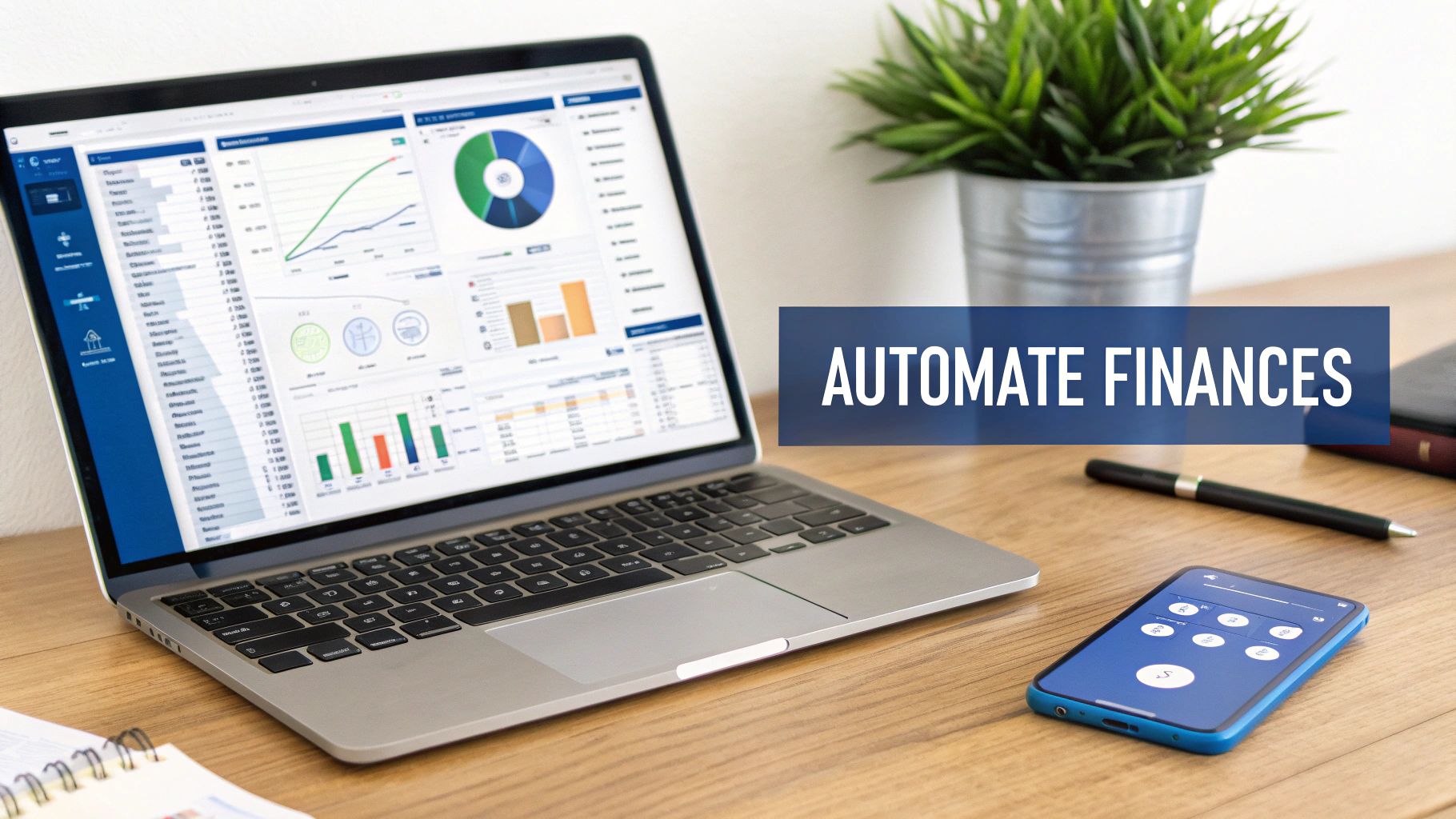
This kind of visual summary lets you spot trends in your income and spending without getting lost in a sea of numbers.
By setting up just a few of these rules, you can automate 80-90% of your transaction coding. This does more than just save you hours every month; it makes sure your financial reports are always built on accurate, real-time data. When you’re ready to run a budget vs. actual report, the “actuals” are already there, perfectly categorized and waiting for you.
By automating these routine financial tasks, you free up your time to focus on what actually moves the needle: analyzing the data and making smart decisions to grow your business.
Leveraging Payroll Data for Accurate Forecasting
Payroll is almost never a simple, fixed number. You’ve got gross wages, employer taxes, benefits contributions, and a host of other variables to consider. Trying to forecast all of that manually is a recipe for a headache.
Thankfully, modern payroll platforms give you detailed reports that make this process incredibly simple. With a platform like Gusto, you can easily pull reports that show you:
- Total Payroll Cost: This isn’t just wages—it includes all employer-side taxes and the cost of benefits.
- Departmental Costs: If you have different teams (e.g., sales, operations), you can see the specific payroll cost for each one.
- Benefit Summaries: Get a clear breakdown of exactly what you’re spending on health insurance, 401(k) plans, and other perks.
This data is pure gold for your budget. You can use these reports to accurately forecast your single largest expense line item for the months ahead. It removes the guesswork and makes your entire financial plan far more reliable.
How to Review and Adjust Your Budget
Let’s be honest: a budget you create in January and don’t look at again until December is completely useless. It’s not a static document you can just file away. Think of it as a living, breathing guide for your business—a tool that helps you navigate the inevitable twists and turns of being an entrepreneur. To keep that tool sharp, you need a regular review cadence.
Without a consistent review process, your budget loses its relevance almost immediately. The plan you made three months ago probably didn’t account for that huge new client you just landed or the unexpected price hike from your key software vendor. A simple, tiered review schedule keeps you making decisions based on today’s reality, not yesterday’s assumptions.
Establishing Your Review Cadence
The key is to match the intensity of the review to the timeframe. You don’t need to do a forensic accounting deep-dive every day, but you also can’t afford to wait a full year to see how things are going. A balanced approach keeps you in the loop without bogging you down.
For most service businesses, this is a rhythm that just works:
- Weekly Cash Flow Check-In: This is your quick, 15-minute pulse check. Glance at your bank balances, see what bills are coming due (accounts payable), and check on outstanding invoices (accounts receivable). The goal here is simple: make sure you have enough cash to cover the next couple of weeks.
- Monthly Budget vs. Actual Analysis: This is where the magic happens. At the end of each month, pull a “Budget vs. Actual” report from your accounting software. This report is your scorecard, showing you exactly where you nailed your targets and where you went off track.
- Quarterly Strategic Forecast Update: Every three months, it’s time to zoom out. Look at the bigger picture. Are the assumptions you made at the start of the year still holding true? Based on the last quarter’s performance, do you need to adjust your revenue goals or expense forecasts for the rest of the year?
Following this rhythm turns budgeting from a dreaded annual task into a powerful, ongoing strategic habit.
The Monthly Budget Review Checklist
Your monthly review is where you’ll find the real insights. This is your chance to ask why the numbers look the way they do. It’s not about judging past performance; it’s about learning from it so you can make smarter moves next month.
When you sit down with that Budget vs. Actual report, here are the core questions to guide your thinking:
- Where were the biggest variances? Zero in on the two or three categories with the largest gap between your plan and reality. Don’t waste time sweating the small stuff.
- Why did these variances happen? Dig in and find the story behind the numbers. Was revenue down because a client paid late, or did a project get pushed back? Did you overspend on software because you upgraded a subscription?
- Are these variances good or bad? Not every surprise is a problem. For example, if your marketing spend was 20% over budget but it drove a 50% increase in qualified leads, that’s not a mistake. That’s a potential success story you need to understand and maybe even replicate.
A budget variance isn’t a grade on a report card; it’s a conversation starter. It’s the data point that prompts you to ask critical questions about what’s really driving your business’s performance.
Finally, you have to decide what to do next. Does a consistent overspend in one area mean you need to cut back, or does it signal that your initial budget was just unrealistic? Adjusting your forecast with this new information is precisely what keeps your budget for small business a relevant and powerful tool for growth.
Common Budgeting Mistakes to Avoid
Knowing where other business owners trip up is half the battle. You can build the most beautiful, detailed budget imaginable, but if it’s based on wishful thinking or ignores a few hard realities, it’s going to fall apart. Let’s look at the most common mistakes I see and, more importantly, how to sidestep them.
Think of this as building a more resilient financial plan. A good budget isn’t just about mapping out a path to success; it’s about making sure you can handle the inevitable detours and bumps in the road.
Forgetting About Taxes
This is, hands down, the biggest one. It’s the mistake that trips up more new business owners than any other. You see healthy revenue coming into the bank account and start making plans, forgetting that a huge chunk of it—often 25-35%—isn’t yours. It belongs to the government.
When you don’t plan for quarterly estimated taxes or a year-end payment, you’re setting yourself up for a massive, and completely avoidable, cash flow crisis. The fix is simple, but it takes discipline.
- Open a separate savings account just for taxes. Name it “Tax Savings” so there’s no confusion.
- Set up an automatic transfer. Every time you get paid, move a set percentage of that deposit into the tax account. Immediately.
- Pretend that money doesn’t exist. It’s not for operations, it’s not for a new computer, and it’s definitely not your profit.
This one simple habit can save you from a world of financial pain. It turns what could be a crisis into just another predictable, manageable business expense.
Don’t let a surprise tax bill sabotage all your hard work. By automatically setting aside funds with every single deposit, you build a financial firewall that protects your operating cash and lets you sleep at night.
Creating a Rigid, Inflexible Plan
Another classic mistake is creating a budget that’s basically set in stone. Your budget needs to be a guide, not a financial straitjacket. If your plan has zero room to breathe, it’s doomed to fail the first time something unexpected happens.
What if a critical piece of equipment dies? Or what if a perfect, time-sensitive marketing opportunity lands in your lap? A budget with no wiggle room forces you into a bad choice: either ignore the problem (or opportunity) or completely blow up your financial plan for the month.
The trick is to build that flexibility in from the very beginning.
- Create a contingency fund: I recommend allocating 5-10% of your total monthly expenses to a miscellaneous or “contingency” line item. This is your “stuff happens” fund.
- Plan for seasonality: If your business has predictable busy and slow seasons, your budget has to reflect that reality. It’s crazy to forecast the same revenue for a dead-slow July as you do for a slammed November. You need to smooth out your spending and ramp up savings to get through those natural lulls.
A flexible budget for small business isn’t a weakness. It’s the sign of a smart, realistic strategy that’s built to survive in the real world.
A Few Common Questions
When you start digging into the details of budgeting, a few specific questions almost always pop up. Let’s tackle some of the most common ones we hear from service business owners.
How Much Should I Pay Myself?
Figuring out your own pay is a huge part of building a realistic budget. You’ve really got two main paths: a fixed salary or an owner’s draw.
A fixed salary is predictable. You run it through payroll just like any other employee, and it becomes a steady, planned expense. An owner’s draw is more like taking money out of the business checking account when you need it or when the cash is there. It’s flexible, but that unpredictability can make it tough to plan around.
Our advice? For the sake of stability, aim to pay yourself a reasonable, consistent salary that covers your personal living costs. This treats your pay as a true business expense, which gives you a much clearer picture of your actual profitability. You can always give yourself an extra draw when you have a fantastic sales month.
What’s the Real Difference Between a Budget and a Forecast?
People often use these terms interchangeably, but they have very different jobs. It helps to think of it like this:
- A budget is your financial plan. It’s the roadmap. You’re setting goals and deciding ahead of time where you want your money to go over a certain period.
- A cash flow forecast is your prediction. This is more of an operational tool that projects the actual cash you expect to see coming in and going out of your bank account. It’s all about timing and helps you spot potential cash crunches or surpluses before they happen.
Your budget sets the target; your forecast tells you if you’re on track to hit it with the cash you’ll actually have on hand.
A budget says, “We plan to spend $1,000 on marketing this quarter.” A forecast says, “Based on when our invoices get paid and when that marketing bill is due, we predict having enough cash to cover that $1,000 expense next month.”
How Can I Possibly Budget with Unpredictable Income?
This is the classic challenge for almost every service business. When your revenue goes up and down, a rigid budget feels useless. The secret is to build a budget that’s flexible.
Start by mapping out a baseline budget using your most conservative monthly income estimate. Think about the absolute minimum you can reliably count on bringing in. This baseline budget should only cover your non-negotiable, must-pay expenses. This is your survival plan.
From there, create different spending plans for better months. For instance, you could decide that any month you beat your baseline income by 20%, that extra cash is automatically allocated to a specific goal—maybe you’ll finally buy that new software, or you’ll beef up your tax savings account. This strategy gives you stability in the slow times and a smart, pre-made plan to capitalize on the good ones.
Ready to stop guessing and start building a powerful financial roadmap for your business? The team at Steingard Financial specializes in creating clear, actionable bookkeeping and payroll systems for service businesses. We help you get your numbers right so you can make confident decisions that drive growth. Learn more about our services.