 Skip to content
You’re good at the work your clients buy. Maybe you run a marketing agency, a design studio, a consulting practice, a repair company, or a wellness business. You know how to deliver results. But then the week ends, and your desk is covered with receipts, unanswered invoices, payroll questions, and a QuickBooks file you’re not fully sure you trust.
That’s a common turning point for small service businesses.
At first, financial admin feels manageable. Then the business grows. More clients mean more transactions. More employees or contractors mean more payroll complexity. More subscriptions, card charges, reimbursements, and tax questions mean more room for mistakes. The work that used to fit into a Sunday afternoon starts spilling into evenings and distracting you from sales, delivery, and hiring.
Modern accounting services for small businesses exist to solve that exact problem. Not just by recording the past, but by helping you run the business with cleaner data, better systems, and fewer surprises.
Why Your Expertise Is Not Enough for Business Growth
A lot of owners hit the same wall.
You may be excellent at client service but still hesitate when you look at your balance sheet. You may know your revenue is rising, yet still feel uncertain about cash flow because credit cards, payroll timing, and unpaid invoices keep moving the target. You may even have software in place and still not feel confident in the numbers.
That gap matters more than many owners realize. The U.S. accounting services industry is projected to reach $157.4 billion by 2026, and 72% of accounting firms reported increased revenue, which signals strong demand from small businesses for outside financial help, according to DocuClipper’s accounting and bookkeeping statistics.
Growth creates different problems
Early on, a business can survive with rough systems. Growth removes that cushion.
A service business usually scales through people, recurring client work, and tighter scheduling. That means your financial system has to answer practical questions quickly:
- Can we afford another hire right now
- Which clients are profitable after labor costs
- Are we behind on collections or just feeling cash pressure
- Is payroll mapped correctly in QuickBooks
- Are we making decisions from current data or last month’s guess
If you can’t answer those questions without digging through spreadsheets, your expertise alone won’t carry the company forward.
Practical rule: If you spend more time fixing records than reviewing decisions, the back office is no longer supporting growth.
Accounting support isn’t only about tax filing or staying organized. It’s about building a system that turns financial activity into usable information. For a service business, that system often needs to connect bookkeeping, payroll, reporting, and people decisions in one flow.
That’s the part many owners don’t set up soon enough.
What Are Small Business Accounting Services Exactly
Think of accounting as building a house. If the foundation is crooked, every layer above it becomes harder to trust. You can paint the walls and decorate the rooms, but the structure still has problems.
That’s why the phrase accounting services for small businesses covers more than one task. It includes the underlying setup, the daily maintenance, the monthly checks, and the strategic interpretation of what the numbers mean.
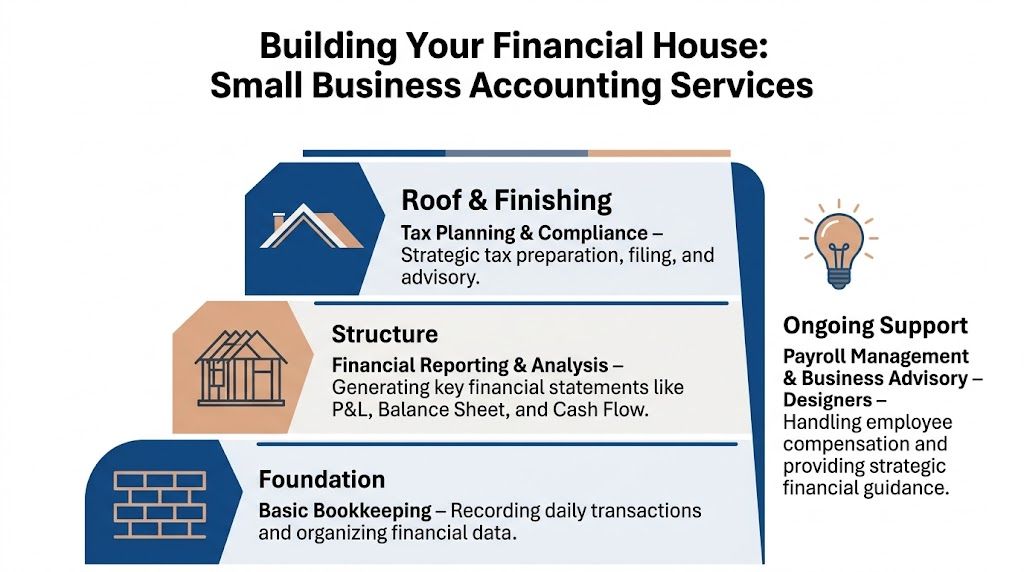
The foundation is bookkeeping
Bookkeeping is the daily record of what happened.
That includes income, expenses, card transactions, vendor bills, payroll entries, loan payments, and transfers between accounts. If those entries aren’t categorized consistently, the reports built on top of them become unreliable.
A good provider doesn’t just “enter data.” They create order. That starts with a clean chart of accounts and clear rules for how transactions should be handled each month.
The frame is reconciliation and reporting
Once transactions are recorded, someone has to verify that the books match reality. That’s what reconciliations do. Your bank account, credit cards, loan balances, and payroll liabilities should tie back to actual statements and platform reports.
If you want a plain-English walkthrough of the process, this guide to bank statement reconciliation is useful because it shows how accountants confirm that your records and bank activity line up.
After that verification step, the business gets monthly financial statements. Usually that means a profit and loss statement, balance sheet, and cash flow view. Those reports tell you whether the business is healthy, not just busy.
The roof is tax and advisory support
Tax work sits higher in the structure because it depends on everything below it being accurate. Clean books make tax planning easier, year-end filing smoother, and conversations with your CPA much more productive.
A fuller accounting relationship can also include advisory support, such as budgeting, cash flow planning, and system design. For service businesses, that often overlaps with payroll and HR workflows because labor is usually one of the biggest moving pieces in the business.
Here’s a simple way to separate the layers:
| Layer | What it does | Why it matters |
|---|---|---|
| Bookkeeping | Records transactions | Keeps raw data organized |
| Reconciliations | Confirms accuracy against statements | Catches mistakes before they spread |
| Reporting | Produces financial statements | Helps you understand performance |
| Tax and advisory | Guides planning and compliance | Supports smarter decisions |
Some firms provide only pieces of that stack. Others handle the full back office. For owners who need ongoing support, it helps to review what a broader bookkeeping service for small businesses typically includes so you can see whether you’re comparing basic data entry or a more complete accounting function.
Clean books don’t just help at tax time. They give you a version of the business you can actually manage.
The Four Pillars of a Healthy Financial Back Office
The back office tends to look boring from the outside. Inside a growing service business, it’s where control lives. If one part breaks, the effects spread quickly. Payroll gets posted to the wrong accounts. Invoices age without follow-up. Reports stop matching reality. Owners delay decisions because they don’t trust the numbers.
The strongest setups usually rest on four pillars.

Bookkeeping and reconciliations
Double-entry bookkeeping sounds technical, but the idea is simple. Every transaction affects at least two accounts, which helps the books stay balanced and exposes mistakes earlier.
This only works well if the chart of accounts is designed with enough detail to reflect how your business operates. According to Unison Globus on small business accounting services, an optimized chart of accounts with 50 to 100 granular categories can lead to 40% faster month-end closes, and proper AP/AR management plus reconciliations can reduce discrepancies by up to 95%.
For a service business, that may mean separating software costs from subcontractor costs, or direct labor from admin payroll, instead of dumping everything into broad buckets.
If your books say “miscellaneous expense” too often, they’re hiding information you’ll need later.
Integrated payroll and People Advisory
Payroll isn’t just a compliance function. It’s where money, people, and operations meet.
When payroll runs through tools like Gusto or QuickBooks Payroll, the accounting side should reflect that structure correctly. Wage expense, payroll taxes, benefits, reimbursements, and contractor payments all need to land in the right accounts. If they don’t, labor reports become noisy and hard to use.
This is also where modern accounting gets more interesting. A provider that understands both payroll integration and People Advisory can help you move past “did payroll run” into questions like:
- Which roles are putting pressure on margins
- Are compensation decisions consistent
- How should benefits and onboarding affect monthly planning
- What staffing changes can the current revenue base support
That’s one reason operational communication matters. As teams coordinate across clients, payroll, and vendors, tools like a cloud-based telephone system for accountants can support faster handoffs and cleaner client communication around time-sensitive financial issues.
Accounts payable and accounts receivable
Accounts payable and accounts receivable are often treated like admin chores. They’re closer to circulation. They determine how cash moves.
If receivables are neglected, your profit on paper won’t help you make payroll. If payables are unmanaged, you may pay too early, miss disputes, or lose track of recurring obligations.
Here’s how this shows up in real life:
Receivables example
A consulting firm finishes projects on time but sends invoices late. Revenue looks healthy, yet cash feels tight because collections are lagging.Payables example
A studio pays every vendor bill the day it arrives, even when the client job tied to that cost won’t be collected for weeks. The books may be accurate, but the cash timing is poor.Integrated example
A bookkeeping team reviews invoice timing, vendor due dates, and payroll cycles together. That gives the owner a clearer cash calendar, not just a list of transactions.
If you want to sharpen this area specifically, practical guidance on accounts payable best practices helps frame AP as a control system rather than a bill-paying task.
Financial reporting you can act on
Reports are only useful if they answer business questions.
A healthy reporting process should help you spot trends in revenue, direct labor, overhead, client profitability, and cash needs without requiring you to decode accounting jargon. For a service business, weekly and monthly views often matter more than annual summaries because staffing and delivery decisions happen in real time.
Some owners don’t need more reports. They need fewer reports that are organized correctly.
A simple reporting package should help you answer:
| Question | Report view |
|---|---|
| Are we profitable this month | Profit and loss |
| What do we own and owe | Balance sheet |
| Why is cash different from profit | Cash flow and working capital detail |
| Is labor in line with revenue | Payroll and margin reporting |
When these four pillars work together, the business gets a back office that supports growth instead of slowing it down.
Beyond Tax-Time The Real Benefits of Year-Round Accounting
Many owners still treat accounting like a year-end cleanup project. That mindset makes every decision harder than it needs to be.
Year-round accounting gives you current information while you still have time to do something with it.

A clean monthly close helps you see whether rising revenue is producing actual margin, whether expenses are creeping upward, and whether a hiring decision is affordable before you make it. For service businesses, that’s especially important because growth often creates cash pressure before it creates breathing room.
According to Intuit’s Firm of the Future annual report, data-driven small businesses report decision-making that is up to 5x faster, and businesses using cloud accounting software see about a 10% productivity boost. The same source says owners value these tools for improved efficiency, time savings, and error reduction.
Better timing, not just better records
The biggest practical benefit of year-round accounting is timing.
If you learn in April that margins slipped in January, you can’t fix January. If you learn in February, you can adjust pricing, staffing, purchasing, or collections before the issue grows. Good accounting shortens the distance between what happened and what you know about it.
That matters when you’re deciding whether to:
- Hire another employee
- Raise prices on underperforming work
- Delay a software purchase
- Change payment terms
- Apply for financing with clean financials in hand
Year-round accounting turns the books from a rearview mirror into a dashboard.
A short overview can also help if you want to see how business owners use reports in practice:
Cleaner books support growth conversations
Lenders, investors, and internal leaders all ask some version of the same question: can they trust the numbers?
If your reports are current, reconciled, and easy to explain, those conversations go more smoothly. If they’re late, inconsistent, or full of reclassifications, growth gets slower because every decision starts with cleanup.
That’s why year-round accounting provides advantages beyond compliance. It supports planning, financing, hiring, and operations all at once.
How to Choose the Right Accounting Partner for Your Business
Price matters. It just shouldn’t be the first filter.
A low-cost provider who leaves you with uncategorized payroll, unreconciled cards, and unclear reports usually becomes expensive later. The better question is whether the firm can support the way your business runs.

According to Hooker CPA’s small business accounting discussion, forums show a 40% failure rate in initial payroll and accounting software setups because of mismatched categories. Those failures can create 15 to 20% higher error rates in AP/AR and reconciliations. That makes cleanup ability and system design far more important than many owners expect.
Questions worth asking in the first meeting
Don’t ask only what software they know. Ask how they use it.
A capable accounting partner should be able to explain how they handle QuickBooks Online, payroll syncs, historical cleanup, and month-end close. If your business runs on Gusto or QuickBooks Payroll, they should understand what happens when payroll categories don’t map correctly into the books.
Use questions like these:
- How do you set up or revise the chart of accounts for a service business
- What’s your process for cleaning up prior months
- How do you reconcile payroll liabilities and benefits
- What reports will I receive each month
- Who reviews the work before reports go out
- How do you communicate when something looks unusual
Look for fit, not just credentials
Industry fit matters because service businesses have recurring patterns that retail, ecommerce, and construction firms may not share. Labor mix, project billing, retainers, subcontractors, and client profitability all affect how the books should be structured.
A good fit often looks like this:
| What to evaluate | What you want to hear |
|---|---|
| Service business experience | They understand labor-heavy models and recurring client work |
| Tech stack comfort | They can work with QuickBooks, Gusto, and related tools |
| Cleanup process | They have a clear method for fixing historical issues |
| Reporting style | They provide reports you can actually use |
| Communication | They respond clearly and on a predictable cadence |
One option owners compare in this category is outsourced accounting for small business, especially when they need a provider that can handle both current bookkeeping and cleanup of older records.
The right partner shouldn’t only close the books. They should make the books easier to understand.
How Steingard Financial Solves These Problems
A common service-business scenario looks like this. Revenue is coming in, payroll is running on time, and the books appear current. But the owner still cannot answer basic growth questions with confidence. Can we afford another hire? Are rising labor costs coming from overtime, benefit changes, or poor scheduling? Which teams or client accounts are producing healthy margins?
Those questions sit in the gap between accounting and people operations.
Steingard Financial addresses that gap by connecting core accounting work with the systems that shape payroll, hiring, compensation, and team reporting. For service businesses using QuickBooks, Gusto, and similar tools, that means transaction coding, reconciliations, accounts payable and receivable, monthly reporting, historical cleanup, and People Advisory support are handled as connected parts of one process.
The practical difference shows up in labor-heavy businesses first. A profit and loss statement can show that payroll increased. It cannot, by itself, explain whether the increase came from new headcount, pay raises, bonus timing, benefit deductions, contractor mix, or payroll items posting to the wrong accounts. People Advisory adds that missing layer so the numbers are easier to use.
Payroll integration works like wiring a control panel correctly. If one switch is mislabeled, the light may still turn on, but you cannot trust what the panel is telling you. The same thing happens when payroll taxes, benefits, reimbursements, and wages do not map correctly into the books. Reports may look finished while key decisions are based on distorted labor costs.
That is why the work usually includes a connected set of fixes and controls:
- Accurate monthly books so reporting starts from reliable numbers
- Payroll posted correctly from Gusto, QuickBooks Payroll, or related systems into the right accounts
- A chart of accounts built for service businesses so labor, overhead, and client-facing costs are separated clearly
- People Advisory support for hiring, compensation, and retention decisions tied to actual financial capacity
- Cleanup of prior periods when older bookkeeping errors are affecting current reports
The result is not just cleaner bookkeeping. It is a clearer operating picture. Owners can see how staffing decisions affect margins, cash flow, and capacity instead of managing finance and people in two separate conversations.
Your Onboarding Checklist for a Smooth Transition
Changing accounting support feels intimidating mostly because owners aren’t sure what they need to gather. In practice, the transition is usually straightforward if you organize a few basics early.
Start with access and records. Your new provider will usually need enough information to understand cash activity, payroll, liabilities, and your existing systems.
A practical checklist looks like this:
- Bank and credit card access or recent statements for each account
- QuickBooks Online access or your current accounting file
- Payroll platform access for Gusto, QuickBooks Payroll, or whichever system you use
- Recent payroll reports including wages, taxes, and benefits
- Open invoices and unpaid bills so receivables and payables can be verified
- Loan and credit documents for outstanding balances and payment schedules
- Prior financial statements if you have them
- Key contacts such as your tax preparer, internal operations lead, or office manager
A smooth onboarding starts with complete access, not perfect records. Your accountant can help fix messy books. They can’t fix what they can’t see.
It also helps to write down anything you already suspect is wrong. Duplicate transactions, uncategorized charges, old unreconciled periods, and payroll mapping problems are all worth flagging at the start.
Frequently Asked Questions About Accounting Services
When is the right time to hire an accounting service
Usually sooner than owners think.
If you’re spending too much time inside QuickBooks, avoiding reconciliations, feeling unsure about payroll, or preparing for a hiring push, that’s a strong signal. It’s also smart to hire support before a growth phase, not after the books become difficult to untangle.
Can’t I just use accounting software myself
You can use the software yourself. Many owners do at first.
But software is a tool, not judgment. QuickBooks and Gusto can record activity, automate workflows, and generate reports. They can’t tell you whether your chart of accounts is structured well, whether payroll is posting cleanly, or whether your reports are reliable enough for decisions. That’s where a service adds value.
What should I expect to pay for small business accounting services
Pricing varies by scope.
Some firms charge hourly. Others use a monthly flat fee. Some price based on complexity, which often depends on transaction volume, number of accounts, payroll needs, cleanup work, reporting expectations, and whether advisory support is included. A solo owner with simple monthly books won’t need the same service level as a multi-employee firm with payroll, benefits, and AP/AR management.
If payroll is part of the picture, the cost conversation should include risk reduction too. According to Paro’s accounting and bookkeeping services overview, outsourcing payroll through platforms like Gusto and integrating it with expert bookkeeping can reduce exposure to compliance penalties by 70 to 85%. The same source notes that manual payroll errors often lead to fines of $5,000 to $50,000.
That doesn’t mean every business needs the most all-inclusive package. It does mean the cheapest option isn’t always the lowest-cost one once cleanup, missed filings, and management time are factored in.
If your business has outgrown DIY bookkeeping or you want accounting and payroll systems that connect cleanly with people operations, Steingard Financial offers bookkeeping, payroll support, cleanup work, and People Advisory services for service businesses across the U.S. It’s a practical next step if you want clearer reporting, fewer back-office headaches, and a setup built to support growth.