 Skip to content
You open the month expecting a routine close. Then you see three numbers that don’t line up.
Your POS says one sales total. Your bank deposits show another. The royalty report due to the franchisor uses a third number because discounts, gift cards, sales tax, refunds, and timing all hit differently. Add an advertising fund contribution, payroll in another state, and a second location using a slightly different expense map, and standard small business bookkeeping stops working fast.
That’s the trap in bookkeeping for franchises. Owners often start with a clean-looking QuickBooks file and assume they’re fine because the bank reconciles. But franchise bookkeeping isn’t judged only by whether the books balance. It’s judged by whether the numbers match the franchise agreement, support royalty reporting, hold up across locations, and stay consistent enough to compare one unit against another.
Franchise Finances Are Not Standard Business Finances
A franchise has more financial rules than an independent business because the books serve more than one audience. The owner needs profitability and cash flow visibility. The franchisor needs consistent reporting. Payroll agencies, lenders, and tax professionals need accurate underlying records. If those records aren’t structured correctly from the start, every momonth-end closeecomes a repair job.
That’s one reason the market for bookkeeping remains so large. The U.S. bookkeeping and payroll services industry generated an estimated $76.5 billion in revenue over the past five years and grew at a 3.1% CAGR, reflecting how important accurate financial management has become across U.S. businesses, including franchises, according to IBISWorld industry data.
Why franchise books break so easily
Most franchise bookkeeping problems come from treating franchise obligations like ordinary overhead. They aren’t. Royalties aren’t just another expense line. Marketing fund contributions aren’t just another bill. Reporting deadlines aren’t just internal admin dates. They connect directly to your franchise relationship.
A franchise also creates a second layer of accounting logic. You’re not only recording what happened. You’re recording it in a way that lets someone compare one unit to another, one week to another, and one operator to another.
Practical rule: If two locations sell the same service but record revenue and overhead differently, your P&L might look tidy while your unit comparisons are useless.
What needs to work from day one
A franchise bookkeeping system has to do a few things at once:
- Track contract-driven fees: Royalties, ad fund payments, and any recurring franchisor charges need clean treatment.
- Support unit-level reporting: Each location has to stand on its own financially before you can trust consolidated results.
- Handle operational reality: POS data, payroll, merchant fees, and bank activity rarely land in the same period perfectly.
- Stay consistent over time: A bookkeeper can’t rename accounts every few months and still expect meaningful trend reporting.
That’s why franchise bookkeeping requires a purpose-built setup, not a generic one. The right system doesn’t just produce reports. It gives owners and franchisors numbers they can act on.
Understanding the Unique Financial DNA of a Franchise
A franchise financial system works like a hub and spoke model. The franchisor sits at the hub. Each franchisee or location sits on a spoke. Money, reports, fees, and obligations flow back and forth between them. If one spoke uses a different structure, the whole wheel starts wobbling.
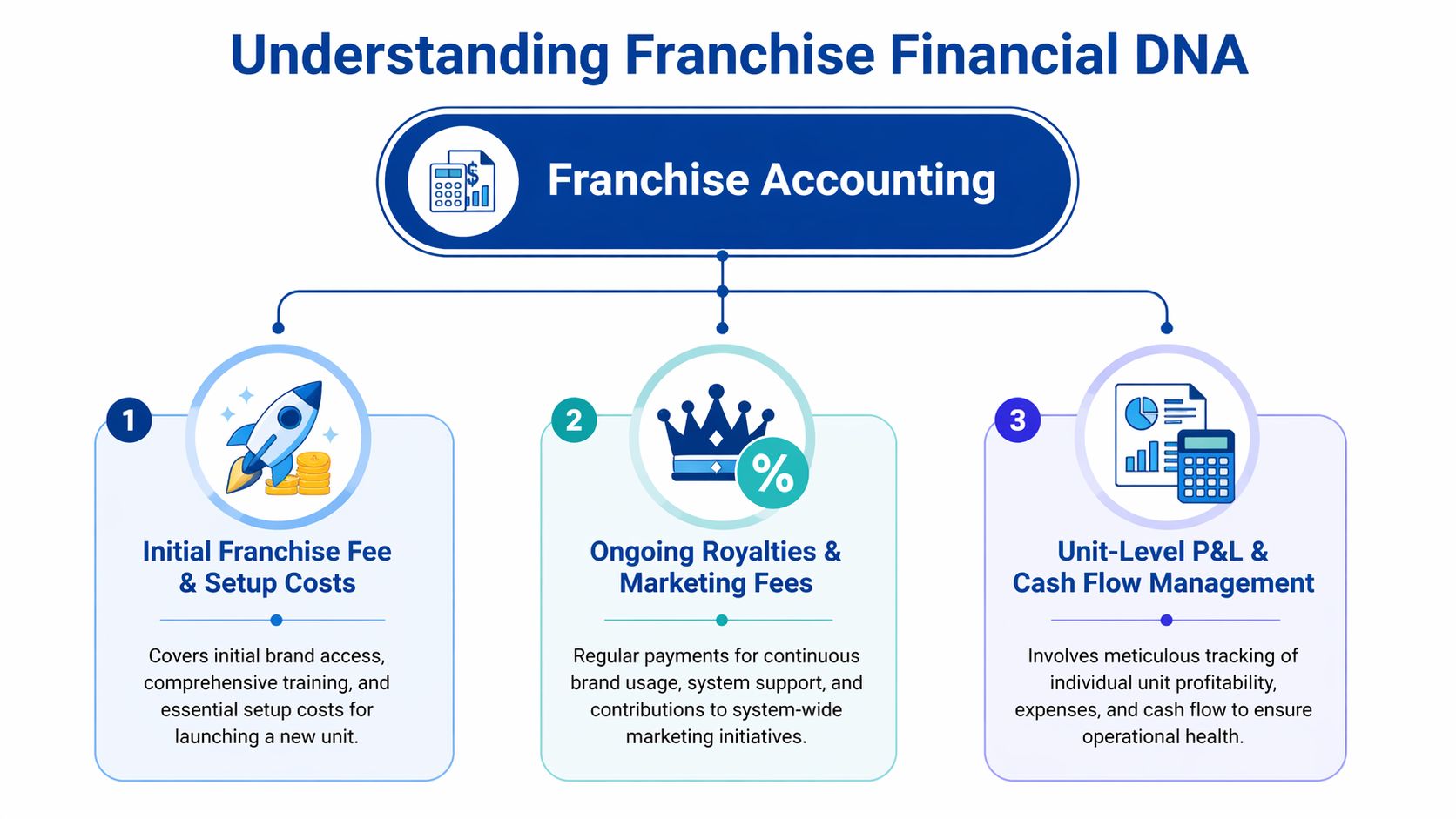
The three money streams that matter most
The first stream is the initial franchise fee and setup costs. This isn’t just opening spend. It usually sits alongside training costs, launch expenses, equipment purchases, and legal setup. If these items get lumped together without a clear accounting policy, the opening balance sheet becomes muddy before the business even stabilizes.
The second stream is ongoing royalties and marketing fees. These are the recurring obligations most owners think about first, and for good reason. They often depend on sales definitions that don’t match everyday intuition. Gross sales for royalty purposes may not equal deposits, and they may not equal what a manager thinks the store “made” that week.
The third stream is unit-level P&L and cash flow management. Within this stream, franchise bookkeeping becomes operational. A location can be busy and still underperform. Another can produce solid margin but strain cash because payroll timing, vendor terms, and owner draws are out of sync.
ASC 606 changes the conversation
Multi-location franchise reporting gets harder because revenue timing doesn’t always line up cleanly. Under ASC 606, franchise operations require specialized revenue recognition to handle timing differences between sales, deposits, and expenses across locations. Without location-level precision, those timing gaps create cash flow visibility issues and make franchisee performance hard to compare accurately, as explained in this discussion of franchise accounting challenges under ASC 606.
That sounds technical, but the day-to-day implication is simple. One location might record a sale when the customer pays at the counter. Another might let a timing lag from the POS import or merchant settlement affect when the transaction reaches the books. Both locations may be profitable. But if they record activity differently, the reports stop being comparable.
A franchise chart of accounts is less like a filing cabinet and more like a measuring system. If every location uses a different ruler, benchmarking is fiction.
Why standardization beats customization
Owners often want to tailor their books to each location’s quirks. That instinct makes sense operationally, but it often hurts reporting. Franchise accounting usually works better when the core structure is standardized and the location-specific detail sits underneath that structure.
That’s where consolidation tools matter. If you’re managing separate entities or units, a resource on bookkeeping software for multiple businesses can help you think through how to organize data across locations without losing reporting consistency.
Use customization sparingly. Standardize revenue buckets, direct costs, labor categories, occupancy, royalties, ad fund charges, and owner-related transactions. Then add location-specific detail only where it improves decisions without breaking comparability.
What good franchise bookkeeping actually looks like
At a practical level, strong franchise books do four things well:
- Separate contract-based charges: Royalties and ad fund items shouldn’t disappear inside general admin expense.
- Preserve location identity: Every transaction should belong to a unit, a legal entity, or both.
- Reconcile across systems: POS, merchant processor, bank, payroll, and accounting records have to tell the same story.
- Produce benchmark-ready reports: If leadership can’t compare units quickly, the bookkeeping structure is wrong.
Franchise finances aren’t complicated because they’re mysterious. They’re complicated because they require consistency across people, systems, and locations.
Structuring Your Franchise Chart of Accounts in QuickBooks
If the chart of accounts is sloppy, every franchise report that comes after it will be sloppy too. QuickBooks can handle franchise bookkeeping well, but only if the file is built around unit reporting and repeatable categories. Most cleanup work I see traces back to one problem. Someone used a standard small business template and tried to patch franchise needs on top of it later.
Start with consistency, not convenience
A franchise chart of accounts should answer two questions fast. What happened, and where did it happen?
The “what” is your normal accounting classification. Revenue, cost of goods sold, payroll, rent, merchant fees, royalties, ad fund contributions, insurance, and so on. The “where” is the unit, class, or entity attached to that activity.
When owners skip standardization, comparisons fall apart. One location books merchant fees under bank charges. Another puts them in overhead. A third nets them against revenue. All three may be internally consistent, but the network can’t benchmark them.
A solid starting point is to keep the account list disciplined and push extra detail into classes, locations, customers, vendors, or memorized reporting filters. If you need a deeper walk-through, this guide on how to create a chart of accounts is a useful reference point.
Franchise-specific accounts to build early
Some accounts show up in almost every franchise file and should exist from the beginning.
| Account Type | Account Name | Description |
|---|---|---|
| Expense | Royalty Expense | Tracks recurring royalty obligations owed to the franchisor |
| Expense | Advertising Fund Contribution | Separates required brand or system marketing payments |
| Expense | Merchant Processing Fees | Captures card processing costs without netting against sales |
| Expense | Software and POS Subscriptions | Holds recurring tech tools tied to operations |
| Other Asset or Intangible Asset | Franchise Fee Amortization | Tracks periodic amortization tied to the franchise fee |
| Expense | Payroll Taxes | Separates employer tax burden from gross wages |
| Expense | Unit Manager Payroll | Helps compare labor structure between locations |
| Expense | Training and Onboarding | Captures team ramp-up costs without burying them in general payroll |
| Expense | Repairs and Maintenance | Keeps operating fixes separate from capital improvements |
That table isn’t a universal template. It’s a backbone. Some concepts need more detail, especially in food service, home services, fitness, or health-related franchises where labor and direct cost behavior differs.
Class tracking versus separate entities
QuickBooks users usually face one structural fork early. Should you use Class Tracking inside one file, or create separate files for each entity or location?
When Class Tracking works
Class Tracking works best when you have one legal entity with multiple locations and relatively straightforward intercompany activity. It’s practical when:
- The ownership structure is simple: One company owns the units.
- Banking is centralized: Cash doesn’t need entity-by-entity segregation.
- Reporting needs are mostly managerial: You want unit P&Ls and department visibility inside one general ledger.
- Intercompany accounting is minimal: You’re not constantly moving costs between entities.
The upside is speed. One file is easier to maintain, and consolidated reporting is built in.
When separate QuickBooks files make more sense
Separate entities usually deserve separate books. That’s especially true when each location has its own legal structure, tax filing obligations, payroll registration, or financing relationship.
Use separate files when:
- Each unit is a separate LLC or corporation
- You need clean entity-level balance sheets
- Payroll and tax registrations differ by entity
- Ownership percentages vary across locations
- Intercompany loans, management fees, or shared expenses are common
The trade-off is administrative complexity. You gain cleaner legal separation, but you also need a reliable consolidation process.
Working rule: If a lender, attorney, or tax preparer would care which entity owns the transaction, that transaction probably belongs in separate books.
A practical setup sequence in QuickBooks
Don’t build the account list in isolation. Build it with reporting in mind.
- Map required reports first: Review the franchisor’s reporting needs and your own monthly dashboard requirements.
- Create a standardized revenue structure: Keep sales categories stable across all units.
- Add franchise-only expense accounts: Royalty expense and ad fund contribution should never be hidden in miscellaneous overhead.
- Decide the unit-tracking method: Use classes, locations, or entity-level files based on legal and operational structure.
- Test one month of sample reporting: If the P&L doesn’t let you compare units cleanly, fix the structure before more data piles up.
A franchise chart of accounts should feel a little boring. That’s a good sign. If it’s changing constantly, the bookkeeping system hasn’t settled into a structure the business can trust.
Navigating Multi-State Payroll and HR Complexity
Payroll gets harder the minute a franchise crosses a state line. It’s no longer just a wage-and-hours process. It becomes a coordination problem between bookkeeping, HR, payroll software, tax registrations, and location oversight.

The scale of that issue is easy to underestimate. 62% of franchisors report franchisees in 3+ states, and simple setup errors can lead to penalties averaging $15,000 per location annually, according to this overview of multi-state franchise bookkeeping issues.
Why payroll errors spread so fast in franchises
A single wrong setting in Gusto or QuickBooks Payroll can affect every pay run after it. State withholding, local tax setup, overtime treatment, worker classification, paid leave policies, and job location mapping all sit upstream of the bookkeeping entry.
That matters because payroll doesn’t just live in the payroll platform. It lands in the general ledger, affects labor reporting by unit, changes job costing, and influences how managers make staffing decisions.
The common failure points usually look like this:
- Wrong work state assignment: Employees get paid under the wrong tax setup.
- Missing state registration: Payroll runs before accounts are properly established.
- Poor location mapping: Labor cost lands in the wrong unit and distorts profitability.
- One-size-fits-all policies: Overtime or leave settings get copied across states when they shouldn’t.
Software helps, but setup discipline matters more
Gusto and QuickBooks Payroll can both support multi-state teams. The mistake is assuming the software will “figure it out” on its own. It won’t. The platform only reflects the rules and structure you give it.
A workable setup usually includes:
- Separate location records: Each unit should have a clear operational identity.
- State-by-state payroll review: Confirm tax accounts, filing obligations, and employee work locations before the first run.
- Department or class mapping: Labor should flow into the books by unit, not just as one payroll lump sum.
- Owner signoff on exceptions: Transfers, remote work, bonuses, and reimbursements need a review path.
For a broader perspective on the issue, this tag page covering what payroll compliance means in practice is a helpful companion.
Where HR and bookkeeping meet
Franchise owners often separate payroll from HR in their heads. That separation causes problems. If onboarding misses a tax form, payroll breaks. If a worker is assigned to the wrong location, unit-level labor reports break. If benefits deductions are set up inconsistently, reconciliation gets messy.
That’s why growing franchise groups need a repeatable handoff between operations, HR, and accounting.
Clean payroll starts before payday. It starts when someone is hired, classified, assigned to a location, and entered into the system correctly.
The video below gives a useful visual overview for owners thinking through payroll process design in a growing business.
A software-agnostic control checklist
The best payroll process isn’t tied to one platform. It’s tied to controls.
Before entering a new state
- Confirm legal entity usage: Know which entity employs the worker.
- Register before processing payroll: Don’t use the first payroll run as a test.
- Define unit coding: Every employee should tie to a location or class from day one.
During each pay cycle
- Review exception reports: Off-cycle payments, reimbursements, and manual checks deserve extra attention.
- Check labor allocation: Make sure gross wages, taxes, and employer costs hit the right unit.
- Reconcile payroll clearing accounts: Don’t leave payroll-related balances sitting unresolved month after month.
After month-end
- Compare payroll reports to the general ledger: Totals should match cleanly.
- Review labor by unit: Big swings often reveal setup errors before compliance problems surface.
- Document policy changes: When a state setup changes, the accounting team should know why.
Multi-state payroll doesn’t fail because owners don’t care. It fails because the process looks simple until a franchise starts scaling.
Mastering Royalty Reporting and Franchise KPIs
Manual royalty reporting creates the kind of problem that hides in plain sight. The math may seem manageable when there are only a few locations, but the process usually depends on spreadsheet exports, email confirmations, hand-built formulas, and delayed reconciliation. That’s fragile.
According to ProfitKeeper’s discussion of franchisor financial data mistakes, manual royalty processing is a top-three mistake for franchisors, and automation can reduce DSO by weeks compared to manual methods.
Why manual royalty calculations fail
Royalties depend on clean source data. If POS sales, refunds, discounts, taxes, deferred revenue items, and banking activity aren’t mapped consistently, the royalty base becomes debatable every month. Then the accounting team spends time proving numbers instead of using them.
Manual workflows also introduce lag. A franchisee submits sales. Someone checks the report. Someone else calculates the invoice. A payment arrives later. Then a reconciliation happens. By the time the process ends, the operating month is old news.
If royalty reporting depends on a spreadsheet that only one person understands, it isn’t a system. It’s a single point of failure.
What automation should actually automate
Automation doesn’t mean buying the fanciest franchise platform and hoping for the best. It means identifying the repetitive steps that should happen the same way every time.
A healthy royalty process usually automates:
- Sales data intake: Pull from POS or approved sales reporting tools
- Rule-based calculation: Apply the correct royalty logic consistently
- Invoice creation: Push charges into accounts receivable without rekeying
- Cash application and reconciliation: Match payments and flag exceptions quickly
- Location-level visibility: Show receivables by unit, not just system-wide totals
For owners who want a plain-English overview of the business logic behind these fees, a guide to royalties for franchises is a useful supplemental read.
The KPIs that matter after the royalty report is right
A royalty report is a control document. It tells you what’s owed. It doesn’t automatically tell you how the system is performing.
That’s where franchise KPIs come in. The best ones are operationally useful and tied back to clean books.
Unit-level profitability
This is the first KPI I’d trust before any other summary metric. If a location can’t produce a believable P&L with direct costs, labor, occupancy, and controllable overhead separated clearly, higher-level analysis won’t help much.
Revenue quality by location
Two units can post similar sales and behave very differently. One may rely on discounting, have heavier refunds, or show inconsistent deposit timing. Revenue quality metrics help identify locations where topline performance is masking weak operations.
Labor efficiency
Payroll is usually one of the biggest controllable costs in a franchise. Owners should watch labor trends with the same discipline they apply to sales. Not just total labor, but labor in relation to each location’s actual activity.
Royalty receivables aging
A franchisor or multi-unit operator needs to know who is current, who is slipping, and where collection friction is starting. Aging by location is far more useful than a single system-wide receivables balance.
What a good month-end package looks like
Strong reporting doesn’t need to be flashy. It needs to answer the same questions every month.
A practical package often includes:
| Report | Why it matters |
|---|---|
| Unit P&L by location | Shows which units are actually performing |
| Consolidated P&L | Gives leadership a top-level view without hiding unit variance |
| Balance sheet | Confirms the business isn’t drifting into messy liabilities or unreconciled assets |
| Royalty report | Ties fee calculations to source activity |
| AR aging for royalties or intercompany charges | Highlights collection issues early |
| Cash flow summary | Explains why profitable months may still feel tight |
| Exception report | Flags unusual transactions, negative balances, or uncategorized items |
The goal is to move from bookkeeping as recordkeeping to bookkeeping as operational control. Once royalties are automated and KPIs are trusted, leaders stop arguing with the numbers and start using them.
Cleaning Up Historical Books and Audit-Proofing Your Franchise
Most franchise books don’t start perfect. They start rushed.
A location opens. Revenue starts coming in. Payroll gets turned on. The owner is busy hiring, marketing, and solving customer problems. By the time someone takes a hard look at the books, the file may contain duplicated deposits, misclassified franchise fees, uncleared payroll items, and months of expenses sitting in vague buckets like miscellaneous or ask accountant.
What a real cleanup includes
Bookkeeping cleanup is not cosmetic. It’s a reconstruction project. The goal is to produce a financial history someone else can trust.
That usually means:
- Reconciling every bank and credit card account so the cash history is complete.
- Reclassifying transactions into a standardized franchise chart of accounts so old periods become comparable.
- Correcting royalty and franchisor-related entries where prior postings blurred operating expense, liability, or timing.
- Reviewing payroll postings and clearing accounts so labor expense aligns with actual payroll activity.
- Cleaning balance sheet leftovers such as suspense items, duplicated assets, old loans, and unexplained owner transactions.
If your books need that level of work, a specialized bookkeeping cleanup service can save a lot of time compared to trying to unwind months of errors manually.
Why cleanup matters beyond accounting
Messy books create real business friction. Lenders hesitate when historical statements don’t reconcile. Buyers discount value when they can’t trust unit economics. Franchisors ask harder questions when reported numbers shift after the fact.
A clean file also supports operations. Once the books are standardized, training store managers and office staff gets easier because everyone works from the same financial definitions. For organizations formalizing internal procedures, resources on compliance training for franchises can help frame how financial and operational training should reinforce each other.
Historical cleanup is where many owners discover they didn’t have a reporting problem. They had a systems problem that reporting kept exposing.
The audit-proofing mindset
“Audit-proof” doesn’t mean nothing will ever be questioned. It means you can show how the number got there.
That requires documentation, repeatable coding rules, and reconciled support behind major balances. If royalty expense moved, you should be able to trace it. If labor jumped in one unit, the payroll and ledger should explain why. If a balance sheet account exists, someone should know what it contains.
A practical audit-proofing checklist includes:
- Monthly reconciliations completed and saved
- Consistent naming and coding conventions
- Support for franchisor-related fees and adjustments
- Documented treatment of unusual entries
- A close process that someone else could follow
Franchise owners don’t need perfect books from the first day. They do need to recognize when cleanup has become urgent. The longer a bad structure stays in place, the more expensive it is to trust your own reports.
When to Outsource Your Franchise Bookkeeping
There’s a point where DIY bookkeeping stops being frugal and starts being expensive. In franchise businesses, that point usually arrives before owners expect it. Not because they aren’t capable, but because the bookkeeping function starts touching too many systems at once. POS, payroll, royalty reporting, multi-location reporting, reconciliations, HR handoffs, and cleanup work all begin to compete for attention.
The broader accounting market points in the same direction. Recent data from Xero shows 73% of accounting practices reported increased profits, with 56% tying that growth to expanded service offerings and 38% to increased automation, according to its State of the Industry report. For franchise owners, that matters because the firms serving them are investing in more complete, more automated support models.
Signs the business has outgrown a basic setup
A few triggers come up repeatedly:
- You’ve expanded into another state: Payroll and compliance complexity rise immediately.
- You’re adding locations: Unit-level reporting needs more discipline than a single file can usually support on autopilot.
- Month-end takes too long: Slow closes usually point to broken workflows or unclear ownership.
- Royalty or franchisor reporting feels manual: Repeated spreadsheet work is a warning sign.
- You’re preparing for financing, a sale, or a review by the franchisor: Clean, defensible books become mandatory.
What outsourcing should change
Good outsourcing should do more than “take bookkeeping off your plate.” It should improve the quality of decisions. That means faster closes, cleaner payroll mapping, clearer unit reporting, more disciplined reconciliations, and fewer recurring errors.
It should also give the owner back the right kind of time. Not empty admin time, but time to focus on staffing, operations, service quality, expansion, and margin control.
The right outsourced partner understands that franchise bookkeeping is not generic bookkeeping with extra accounts added. It’s a specialized reporting function built around consistency, control, and scale.
If your franchise books feel harder to trust each month, it may be time for a stronger system and a team that knows how to run it. Steingard Financial helps service businesses build accurate bookkeeping, payroll, cleanup, and reporting processes that scale with growth, including multi-location and multi-state complexity.