 Skip to content
Think of bookkeeping services for small businesses as your financial co-pilot. They take the jumbled mess of receipts, invoices, and bank statements and turn it into a clear, usable roadmap for growing your company. This isn’t just about recording transactions; it’s about gaining the financial clarity you need to make smart decisions about cash flow, profitability, and your next big move.
Why Smart Bookkeeping Is a Business Superpower
For many business owners, bookkeeping feels like a necessary evil—a tedious chore you have to get through for tax season. They spend countless hours bogged down in spreadsheets or sorting through shoeboxes of receipts, forced to make critical decisions based on a gut feeling instead of actual data. This reactive approach creates huge blind spots, making it nearly impossible to spot a financial problem until it’s already become a major issue.
But smart bookkeeping completely flips that script. It’s not about mind-numbing data entry; it’s about building a reliable, real-time picture of your business’s financial health. Think of it like the foundation of a house. Without a solid, accurate foundation, everything you try to build on top of it—from your sales strategy to your hiring plans—is at risk of collapsing.
From Chore to Strategic Advantage
This is where professional bookkeeping services for small businesses come in. They turn your financial data from a messy liability into a powerful strategic asset. Their job is to make sure every dollar is correctly categorized and every account is perfectly reconciled. It’s a meticulous process, but it’s the essential first step toward unlocking real insights into your business.
When your numbers are accurate and up-to-date, you can finally stop guessing and start strategizing. You gain the ability to spot trends, manage cash flow proactively, and jump on growth opportunities with total confidence.
This growing need for financial clarity is driving massive growth in the industry. The global bookkeeping services market is projected to hit USD 95 billion by 2033, a surge fueled by small and medium-sized businesses looking for efficient ways to manage their finances and scale up. As regulations get more complex, the need for expert guidance becomes even more critical. You can learn more about these bookkeeping market trends to see where the industry is heading.
Ultimately, good bookkeeping gives you freedom. It frees up your time, cuts down on financial stress, and delivers the clear, actionable information you need to steer your business exactly where you want it to go. It transforms a frustrating task into your most reliable tool for long-term success.
What Do Professional Bookkeeping Services Actually Include?
So, what do you really get when you hire a professional bookkeeper? It’s a whole lot more than just data entry. Think of professional bookkeeping as the process of transforming your raw, messy financial data into a clear story—one that helps you make smarter decisions and steer your business in the right direction. It’s about bringing order to financial chaos.
Imagine your bank feed as a jumbled stream of transactions: client payments, software subscriptions, coffee runs, and supply orders all mixed together. One of the most fundamental tasks a bookkeeper handles is transaction categorization, where every single one of those items gets sorted into the right bucket. This isn’t just about being neat; it’s about creating clean data that leads to accurate financial reports. Without it, you’re just guessing where your money is going.
Building a Foundation of Accuracy
Once every transaction has a home, the next critical step is reconciliation. This is where your bookkeeper meticulously compares your business bank accounts, credit card statements, and payment processor records (like Stripe or PayPal) against the entries in your accounting software. The goal is simple: make sure they match, down to the very last penny.
This process is your financial safety net. It confirms that every transaction is accounted for and that no errors—or worse, fraudulent charges—have slipped through the cracks. It gives you the confidence that the numbers you’re looking at are 100% accurate and reliable.
From this solid foundation, a bookkeeper helps manage the lifeblood of your business: your cash flow. This usually involves two key areas:
- Accounts Payable (AP): This is all about managing the bills you owe to your vendors and suppliers. Your bookkeeper makes sure these are paid on time, helping you maintain good relationships and avoid annoying late fees.
- Accounts Receivable (AR): This involves tracking the invoices you’ve sent to clients and following up to make sure you get paid. Solid AR management means cash flows into your business predictably.
These foundational tasks are what empower you to make better decisions for your business.
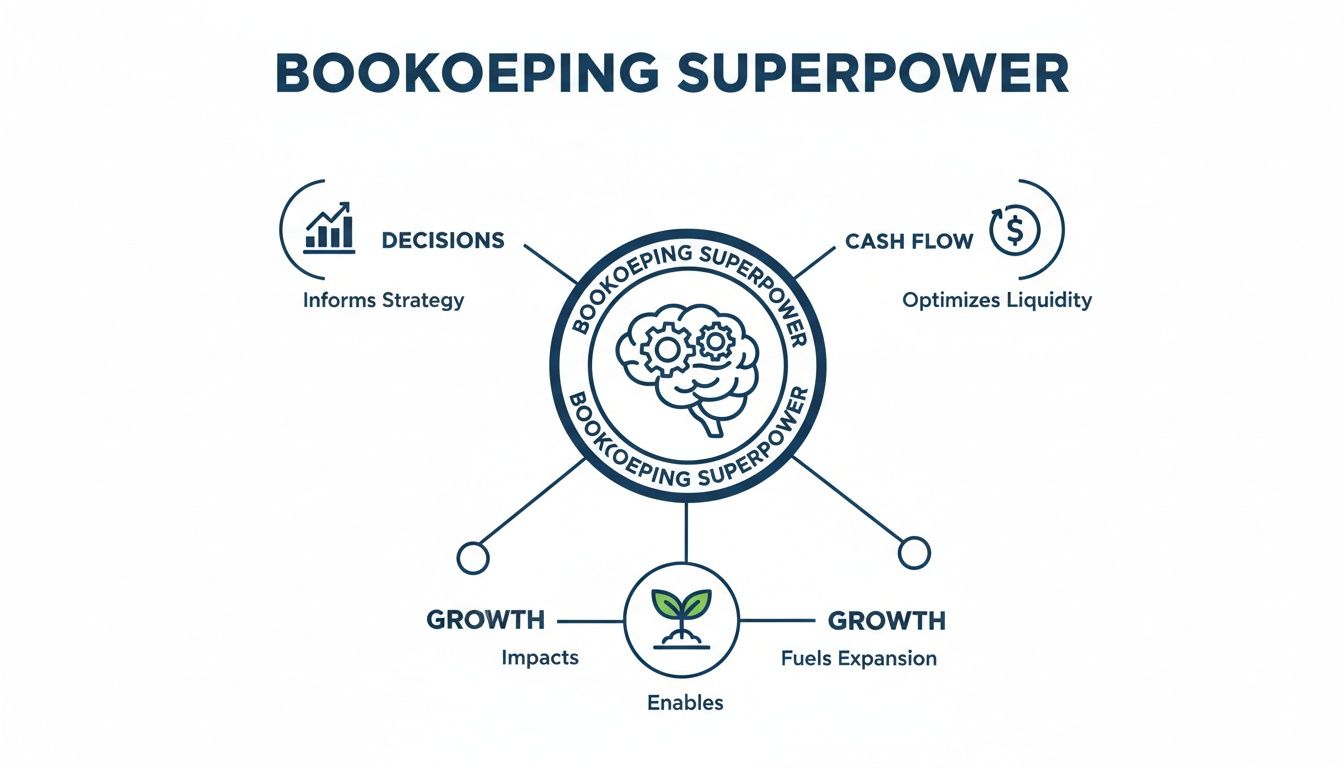
As you can see, good bookkeeping isn’t just a background task—it’s the engine that drives smarter strategy, healthier cash flow, and real, sustainable growth.
Turning Numbers into Meaningful Reports
With everything categorized and reconciled, your bookkeeper can now generate the essential financial statements you need. These aren’t just stuffy documents for your accountant at tax time; they are powerful tools for running your business day-to-day.
To break it down, here’s a look at the core bookkeeping services and what they mean for you.
Key Bookkeeping Tasks and Their Business Impact
| Bookkeeping Service | What It Means for You | Direct Business Impact |
|---|---|---|
| Transaction Categorization | Sorting every expense and deposit into the right bucket. | Gives you a crystal-clear picture of where your money is going. |
| Bank Reconciliation | Matching your books to your bank statements to ensure accuracy. | Catches errors, prevents fraud, and builds trust in your numbers. |
| Accounts Payable (AP) | Managing and paying your bills on time. | Protects vendor relationships and avoids costly late fees. |
| Accounts Receivable (AR) | Tracking invoices and ensuring clients pay you. | Improves cash flow and makes your income more predictable. |
| Financial Reporting | Creating reports like the P&L and Balance Sheet. | Provides the insights needed for strategic planning and growth. |
| Payroll Processing | Paying employees accurately and handling tax withholdings. | Keeps your team happy and ensures you stay compliant with labor laws. |
| Chart of Accounts Setup | Creating the financial filing system for your business. | Lays the groundwork for meaningful, customized reporting. |
These tasks work together to give you a complete and reliable view of your company’s financial health.
The two most important reports you’ll get are the Profit & Loss (P&L) statement, which shows your profitability over a certain period, and the Balance Sheet, which gives you a snapshot of your company’s financial health at a single point in time.
These reports tell the story of your business. They answer critical questions like, “Are we actually making money?” and “Which of our services are the most profitable?”
It’s this level of detail and organization that explains why so many businesses are turning to experts. Small businesses now make up a staggering 70% of all clients in a global bookkeeping market worth over $20.5 billion. The widespread adoption of cloud tools like QuickBooks, which holds a 60% market share, shows a clear move away from old-school, error-prone manual methods.
On top of these core functions, many bookkeeping services also handle payroll, making sure your team is paid correctly and on time while managing all the related tax withholdings and compliance headaches.
They also set up your Chart of Accounts—the customized framework of categories your business uses to organize its finances. A well-structured chart is the backbone of useful reporting. For a closer look, check out our guide on how to create a chart of accounts.
How to Choose the Right Bookkeeping Partner

Finding the right bookkeeping service isn’t like hiring any old vendor; it’s much more like choosing a strategic partner for your business. This relationship has to be built on trust and a real understanding of what you’re trying to achieve. It’s critical to look beyond just the price tag.
The right partner should feel like a natural extension of your team, someone who is genuinely invested in bringing clarity to your finances and helping you succeed in the long run.
Your first step is to check out their expertise. Do they have real, hands-on experience with service-based businesses like yours? A bookkeeper who gets the unique challenges of your industry—like project-based billing or managing payments to contractors—will deliver so much more value than a generalist. Their insights will hit closer to home, and their advice will be practical and ready to use.
Ask the Right Questions
Once you’ve found someone who speaks your industry’s language, it’s time to dig into the nitty-gritty of their process and the tools they use. You need to understand how they operate and if their style meshes with yours. I always recommend creating a shortlist of potential partners and going into those conversations with some pointed questions.
Here are a few essential questions to get you started:
- Technology Proficiency: Are you an expert in QuickBooks Online and payroll platforms like Gusto? You want a firm that knows your software stack inside and out. They can get the most out of its features, making sure everything runs smoothly and efficiently.
- Communication Rhythm: What does your standard communication and reporting schedule look like? Look for a partner who offers a consistent rhythm, like weekly check-ins and monthly financial reviews. You should never be left wondering where your finances stand.
- Reporting and Insights: How do you present financial reports? And more importantly, will you help me understand what these numbers actually mean for my business? The best bookkeeping services for small businesses don’t just hand over data; they give you context and help you interpret it.
Finding the right fit means prioritizing value over the lowest cost. A cheap bookkeeper who makes costly errors or provides zero strategic insight is no bargain. The right investment pays for itself through time saved, mistakes avoided, and opportunities identified.
Evaluating Fit and Value
As you interview potential candidates, really pay attention to how responsive they are and their communication style. Are they easy to talk to? Do they give you clear, direct answers? These early interactions are usually a great preview of what a long-term working relationship will feel like. For a deeper dive, it’s worth exploring the benefits of bringing in a pro when you outsource bookkeeping for your small business.
The global accounting services industry is on track to hit $643.8 billion in 2025, with North America making up 38% of that market. That’s a huge number, and it shows just how much businesses are relying on skilled, tech-focused financial partners.
When you’re weighing your options, understanding the specialized services for accounting and bookkeeping firms can give you a better sense of how they operate behind the scenes. Ultimately, the goal is to find a partner who not only keeps your books pristine but also adds to your strategic vision. That’s the key to unlocking true financial control.
Solving Your Biggest Bookkeeping Headaches
If you’re like most small business owners, a few common financial headaches probably keep you up at night. These issues almost always come from messy or neglected books, creating a cycle of stress that makes it incredibly tough to lead with confidence.
The good news? These problems are completely fixable with the right help. A professional bookkeeper doesn’t just crunch numbers; they deliver real solutions to your most frustrating financial bottlenecks, turning that chaos into clarity.
Problem One: Inaccurate or Messy Books
Did you try to manage the books yourself in the early days? Or maybe a previous bookkeeper left things in a total mess. No matter how you got here, disorganized books are a huge liability that leads to flawed financial reports and, frankly, bad business decisions.
The fix is a dedicated bookkeeping cleanup or catch-up service. Think of it as a complete reset for your finances. We meticulously go through your past transactions, hunt down errors, and get every single entry categorized correctly.
This cleanup makes sure your financial foundation is rock-solid, paving the way for accurate reports you can actually trust. An expert will also take this time to refine your chart of accounts, making future reports far more insightful and tailored to your specific business.
Problem Two: Inconsistent Cash Flow Visibility
One of the biggest anxieties for any owner is that sinking feeling of not knowing how much cash is actually in the bank. When you can’t get a clear picture of money coming in versus money going out, you’re flying blind.
A dedicated bookkeeper solves this by setting up a reliable system to manage your accounts receivable (AR) and accounts payable (AP). They make sure your invoices get out on time and follow up on late payments, keeping cash flowing in.
At the same time, they manage your bills, so you know exactly what expenses are coming up and can avoid any nasty surprises. This proactive management gives you a predictable, real-time view of your cash position.
With clear visibility, you can stop reacting to financial emergencies and start making strategic decisions. You’ll know exactly when you can afford to hire, invest in new equipment, or expand your services.
Problem Three: Complex Payroll and Compliance
Payroll isn’t just about cutting checks. It’s a minefield of tax withholdings, compliance rules, and tight deadlines. One tiny mistake can lead to unhappy employees and scary penalties from the IRS.
Professional bookkeeping services often include integrated payroll management. Using trusted platforms like Gusto or QuickBooks Payroll, they handle it all—from accurate pay calculations and tax filings to onboarding new hires. This takes a massive burden off your shoulders, ensuring your team gets paid right and your business stays compliant with all federal and state laws.
Problem Four: Delayed or Unhelpful Financial Reports
Are you still waiting weeks after the month ends just to see your financial statements? By the time you get them, the information is old news and not very useful for making timely decisions.
The right bookkeeping partner establishes a consistent rhythm for your reporting. At a minimum, you should expect your Profit & Loss and Balance Sheet delivered promptly after month-end. But great firms go a step further, offering weekly updates and tracking key performance indicators (KPIs) for real-time insight. This steady stream of accurate data empowers you to steer your business with confidence.
To get a better sense of a core process behind timely reporting, it’s helpful to understand how to reconcile bank accounts.
Understanding Bookkeeping Service Pricing
Bringing a professional bookkeeper on board is one of the best moves you can make for your business, but it helps to know how the pricing works. The cost isn’t just a number pulled out of thin air; it’s directly connected to how complex your business is and the specific support you need.
Getting a handle on the common pricing models will help you find the perfect fit for your budget and where your business is headed.
The most popular structure you’ll find is a fixed monthly fee. This model is a favorite for a simple reason: predictability. You pay the same amount every month for a clear set of services, like categorizing transactions, reconciling a certain number of accounts, and preparing your standard financial reports.
This is the ideal setup for any business owner who wants to budget with confidence and avoid surprise invoices. The fee is usually calculated based on your average number of monthly transactions and how many bank and credit card accounts need managing.
Factors That Influence Your Cost
While a flat monthly fee is common, what goes into that final number? Think of it like a custom service package—the more you add, the more it will cost.
The key drivers behind the price tag include:
- Transaction Volume: A business juggling 500 transactions a month needs a lot more attention than one with just 50.
- Number of Accounts: Reconciling one bank account and one credit card is straightforward. Managing five of each is a different story.
- Payroll Complexity: The number of employees you have, how often you pay them, and any benefits you offer all play a role in the cost.
- Cleanup and Catch-Up Work: If your books are months (or even years) behind, there will be a separate, one-time project fee to get everything organized and accurate.
- Advisory Services: Basic bookkeeping keeps your records straight. Strategic financial advice, which helps you plan for the future, is an added service with its own value and cost.
The real goal is to stop seeing bookkeeping as just another business expense and start seeing it as an investment. The return you get comes from saved time, avoided errors, and the financial clarity you need to actually grow your business.
When you’re thinking about the cost, it’s helpful to understand how outsourcing can lead to significant cost savings—a concept that applies here, too. The expertise and efficiency you gain often more than make up for the direct cost.
Other pricing models, like hourly rates, aren’t as common for regular monthly work but might be used for special projects or that initial cleanup phase.
A great way to visualize this is by looking at how service packages are often structured.
Sample Bookkeeping Service Tiers
Here’s an example of how a bookkeeping firm might tier its services to fit different types of businesses.
| Service Tier | Typical Inclusions | Best For |
|---|---|---|
| Essentials | Monthly categorization for up to 75 transactions, reconciliation of 2 accounts, standard monthly P&L and Balance Sheet reports. | Freelancers, solopreneurs, or new businesses with low transaction volume. |
| Growth | All Essentials services, plus categorization for up to 200 transactions, reconciliation of 4 accounts, basic payroll for up to 5 employees, and quarterly review calls. | Growing service businesses, small agencies, or consultants with a small team. |
| Pro / CFO Lite | All Growth services, plus unlimited transactions, payroll for up to 20 employees, cash flow forecasting, budget vs. actual analysis, and monthly strategic advisory meetings. | Established businesses, multi-location services, or companies looking for strategic financial guidance alongside their bookkeeping. |
These tiers make it easy to see how services scale with a business’s needs, ensuring you only pay for the level of support you truly need at any given time.
Frequently Asked Questions About Bookkeeping Services
Deciding to bring on a professional bookkeeper is a big step, and it’s natural to have a few questions. Getting straight answers is the best way to feel confident you’re making the right move for your business. We’ve gathered the most common questions we hear from owners just like you to clear things up.
Our goal is simple: give you the information you need to understand the process and see the real value a financial partner can bring to your company.
How Quickly Will I See Results After Starting?
This is always one of the first questions we get, and for good reason—you’re investing in your business and want to see a return. You’ll feel the immediate relief of not having to do the work yourself, but the more concrete results show up in stages.
Within the first 30 to 45 days, you can expect your accounts to be fully reconciled. You’ll also get your first set of accurate, on-time financial reports. This initial period is all about your new bookkeeper getting to know your business and finding a good rhythm. The real strategic value starts to click around the 90-day mark. That’s when you’ll begin seeing clear trends in your reports, allowing you to make smart, proactive decisions based on solid data.
What Documents and Access Do You Need From Me?
Getting started is actually a pretty simple process. To work efficiently, your bookkeeper will need secure, view-only access to a few of your key accounts. Don’t worry—professional firms have secure, established methods for handling all of this information.
Here’s a quick list of what we typically need:
- Bank and Credit Card Accounts: Read-only access to your business bank and credit card portals lets your bookkeeper see transactions as they come in.
- Accounting Software: We’ll need an accountant-user invitation to your software, like QuickBooks Online.
- Payroll System: If we’re handling your payroll, we’ll need access to your platform, such as Gusto.
- Supporting Documents: Things like past tax returns, loan statements, and any existing financial reports help us get the full picture from day one.
The initial setup is a team effort. Getting this information to your bookkeeper quickly helps them build an accurate financial foundation for your business right from the start.
How Is Bookkeeping Different from Tax Preparation?
This is a really important distinction, and it’s one that causes a lot of confusion. Think of it like this: bookkeeping is the year-round training for a marathon, while tax preparation is the actual race day. They are closely related, but they serve two very different functions.
Bookkeeping is an ongoing activity. It’s the daily and monthly work of recording and organizing all your financial transactions. The goal is to produce real-time reports that help you manage your business day-to-day, watch your cash flow, and make informed decisions.
Tax preparation is a specific, year-end event. A tax professional, like a CPA, takes the clean financial statements your bookkeeper has prepared all year and uses them to file your annual tax returns. While your bookkeeper ensures you’re ready for tax season, the tax preparer specializes in tax law to minimize what you owe. You can’t have one without the other—clean books make for a much smoother and less expensive tax season.
Ready to turn your financial chaos into clarity? The team at Steingard Financial is here to provide the meticulous bookkeeping and payroll services that give you the confidence to grow. Get in touch with us today to learn how we can build a scalable back office for your service business.