 Skip to content
If you run a growing service business, your payables process usually starts to break before you admit it has a problem. Invoices sit in inboxes waiting for approval. A vendor statement doesn’t match your books. Someone asks whether a bill was paid, and the answer requires checking email, QuickBooks, and the bank feed. Meanwhile, cash feels tighter than it should, even in months with solid revenue.
That’s the point where accounts payable stops being a back-office chore and starts affecting operations. Late or inaccurate payments don’t just create accounting messes. They weaken vendor trust, distort reporting, and make it harder to plan hiring, payroll, and near-term spending.
A strong accounts payable analyst fixes that. Not by pushing paper faster, but by bringing control to outgoing cash. In some businesses, that means hiring a dedicated person. In others, it means outsourcing the function to a team that already has the process, tools, and oversight in place. The right answer depends on volume, complexity, and how much management attention you want to devote to AP.
Is Your AP Process a Cost Center or a Strategic Asset?
A familiar pattern shows up in service businesses right after a growth spurt. Revenue is up. Clients are paying. The team is busy. But the owner still ends up spending Friday afternoon sorting through unpaid bills, replying to vendors, and trying to figure out why cash on hand doesn’t line up with what the P&L seemed to suggest.
That’s not just an admin problem. It’s a signal that AP is being treated like a basic clerical task when it’s really part of financial management. Every invoice carries timing, coding, approval, and cash flow implications. If those decisions happen inconsistently, the business loses visibility fast.
An accounts payable analyst transforms the role of AP within the company. Instead of reacting to invoices when someone complains, the business gains a structured payment process, clearer aging, and better visibility into what is due now versus what can wait under agreed terms. That shift matters for any owner trying to separate true overhead from spending that supports growth. The distinction is the same one behind cost centers and profit centers.
A weak AP process drains attention. A strong one protects cash and gives management cleaner decisions.
When owners start seeing AP this way, the conversation changes. It stops being “Who can enter bills?” and becomes “Who can manage outgoing cash with discipline?”
Beyond Bookkeeping What an AP Analyst Really Does
A lot of owners hear “accounts payable analyst” and think invoice entry. That’s too narrow. A capable analyst works more like an air traffic controller for outgoing cash. Bills arrive from different sources, with different terms, coding requirements, approval paths, and due dates. The analyst keeps that flow orderly so money leaves the business accurately, on time, and for the right reasons.
Cash flow control
The first strategic job is cash flow optimization. Payment timing matters. Paying everything the day it arrives can create avoidable pressure. Paying too late creates friction with vendors and can trigger fees, service delays, or stricter terms.
That’s where metrics and analysis matter. AP professionals use indicators such as Days Payable Outstanding (DPO) to assess whether the business is holding cash appropriately without damaging supplier relationships. According to Salary.com’s AP Analyst II job description benchmark, analysts use AP data to identify payment trends and cost-saving opportunities, can optimize DPO to free 10 to 15% more working capital, and can help prevent 20% overspend by linking AP reporting to budgeting. The same benchmark notes that vendor consolidation can yield 5 to 8% annual savings.
That’s why AP should connect to a documented accounts payable workflow, not just a person’s inbox habits.
Vendor management
The second job is vendor relationship management. In service businesses, this often gets underestimated because many suppliers aren’t raw-material vendors. They’re software providers, contractors, marketing partners, benefits brokers, equipment lessors, recruiters, and other partners your team relies on every month.
When AP is sloppy, vendors notice before management does. They see duplicate questions, missing remittance details, late payments, or bills sent to the wrong approver. A good analyst gives vendors a reliable point of contact and keeps terms clean. That reliability buys flexibility when you need it.
A practical AP analyst will:
- Clarify terms early: Net terms, discount windows, billing contacts, and approval expectations should be known before invoices pile up.
- Resolve disputes fast: Small discrepancies get addressed before they become account holds or escalations.
- Standardize communication: Vendors should know where invoices go, who approves them, and when they can expect payment.
Financial integrity and fraud prevention
The third job is financial integrity. AP moves far beyond bookkeeping in this area. Outgoing payments are one of the easiest places for mistakes to hide. Duplicate bills, bad coding, changed banking details, missing approvals, and unauthorized spend all show up here first.
A strong analyst puts controls around those risks. They compare documents, verify approvals, review aging, and watch for exceptions. They also make sure AP data supports reliable monthly reporting instead of creating cleanup work after the fact.
Practical rule: If the person paying bills can’t explain why a bill was approved, how it was coded, and whether it matches the underlying obligation, your AP process is too loose.
The best accounts payable analyst doesn’t just process transactions. They create trust in the numbers.
A Day in the Life Core Responsibilities and Tasks
The tactical side of the role is where many businesses realize this work can’t just be “added on” to an office manager, founder, or junior bookkeeper. A real accounts payable analyst handles recurring tasks that affect cash, close quality, and vendor confidence every week.
Daily responsibilities
On a typical day, the analyst starts with invoice intake and review. Bills arrive by email, portal, PDF, or direct sync from vendor systems. Before anything gets scheduled for payment, someone has to confirm the invoice is valid, complete, and coded correctly.
Key daily tasks often include:
- Processing new invoices: Review vendor name, invoice date, due date, amount, and supporting documentation before entry.
- Performing three-way matching: Compare the purchase order, receiving report, and invoice to make sure the bill aligns with what was ordered and received.
- Routing approvals: Send invoices to the right internal approver and follow up when approvals stall.
- Updating cash visibility: Review what’s due soon and what upcoming payments mean for near-term liquidity.
- Reconciling cards and expense-related payables: This keeps card activity from drifting away from the general ledger.
That matching step is one of the most important controls in the whole process. According to HighRadius on AP duties and responsibilities, accounts payable analysts use three-way matching as a core reconciliation technique, and GitLab’s AP process shows intermediate analysts handling daily cash flow updates and credit card reconciliations. The same source notes that automated GL coding aligned with the chart of accounts can reduce month-end close time by 20 to 30%.
Weekly responsibilities
Weekly work is less about intake and more about keeping the AP system honest.
A solid weekly rhythm usually includes:
- Preparing payment runs based on due dates, approved invoices, and available cash.
- Reviewing vendor statements to catch missing invoices, duplicate postings, or unresolved credits.
- Clearing the AP inbox so invoices don’t sit unentered or unapproved.
- Running aging reports to identify overdue obligations and upcoming concentration of cash outflows.
- Following up on exceptions such as pricing differences, unmatched bills, or disputed charges.
Weekly AP aging is especially useful in QuickBooks environments. HighRadius notes that implementing weekly AP aging reports in QuickBooks can cut late fees by 15% while improving vendor relationships.
If AP aging only gets reviewed at month-end, the business is already behind. Good AP management happens before the deadline, not after it.
Monthly responsibilities
Month-end is where an AP analyst proves whether the process has real discipline. If daily and weekly controls were weak, the close turns into cleanup. If the process was tight, month-end becomes verification.
Monthly responsibilities usually include:
| Timing | Core task | Why it matters |
|---|---|---|
| Month-end | Final AP reconciliation | Confirms ledger balances reflect actual obligations |
| Month-end | Accrual support | Captures expenses incurred but not yet invoiced |
| Month-end | Open invoice review | Identifies stale or disputed items that need resolution |
| Month-end | Reporting support | Gives management accurate liabilities and cash commitments |
This is also when the analyst works closely with accounting leadership on coding consistency, cutoff, and chart of accounts discipline. In service businesses, that matters because many expenses don’t come through purchasing systems. They come through decentralized teams making operating decisions quickly. AP is often the last control point before those decisions hit the financial statements.
Key Performance Metrics and Essential AP Tools
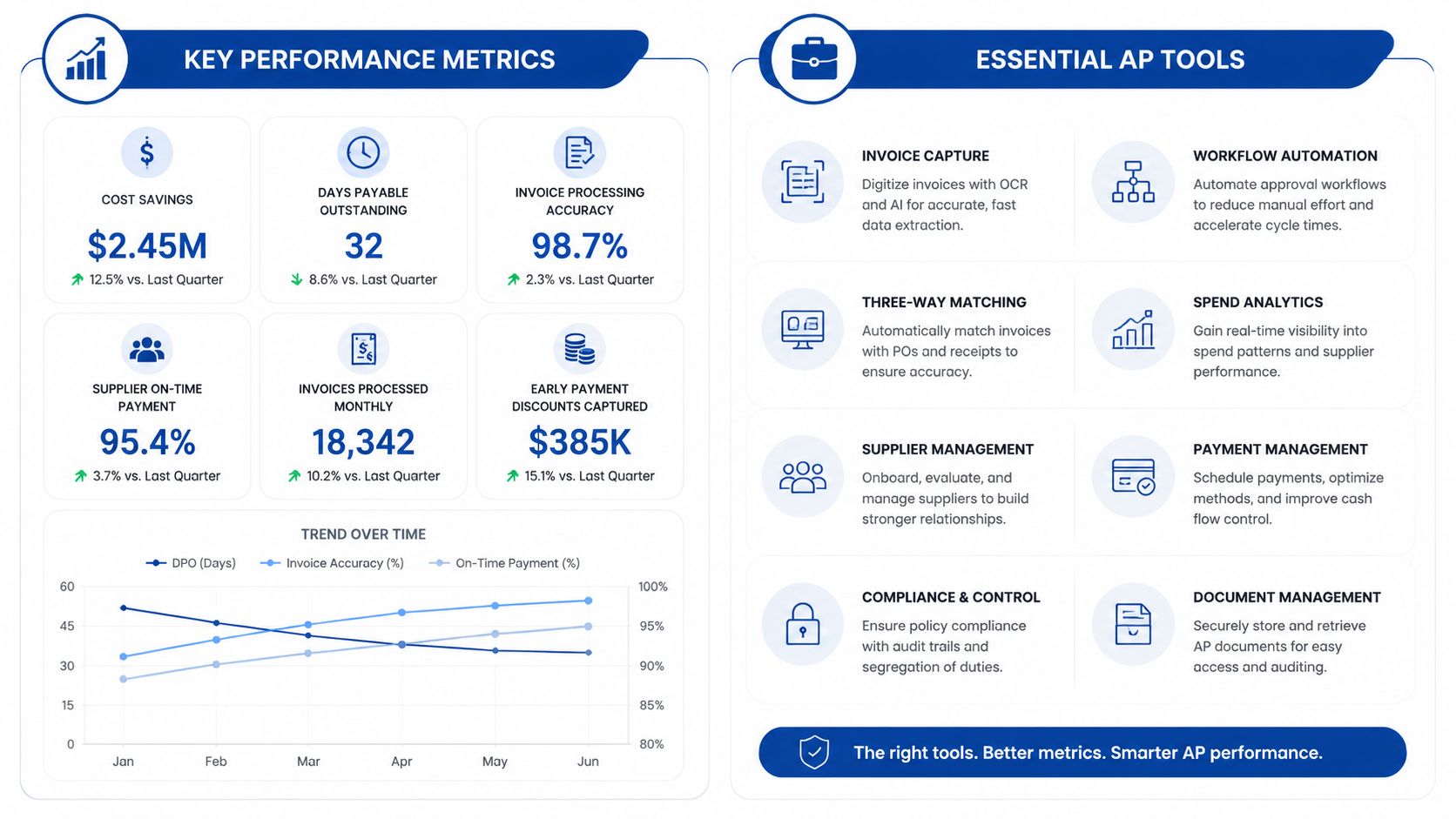
If you want to know whether AP is under control, don’t start with headcount. Start with metrics. A business can have a dedicated AP person and still run a messy process. It can also have a lean team and perform well because the workflow, controls, and tooling are strong.
The KPIs that actually matter
Several AP metrics tell you quickly whether the process is efficient or fragile.
- Days Payable Outstanding (DPO): This measures how long the business takes to pay suppliers on average. The formula used by AP teams is tied to average accounts payable and cost of goods sold, and it helps management balance cash preservation against vendor satisfaction.
- AP cost per invoice: This shows the cost of processing each invoice. According to BILL’s accounts payable KPI guide, top-performing teams operate at $3.62 per invoice versus $15.97 overall.
- Average time to payment: Also from BILL, AP teams range from 3.7 to 12.2 days on this metric.
- Payment error rate: This reveals whether duplicate payments, inaccurate amounts, or misapplied transactions are creeping into the process.
- Late payment percentage: This tells you whether bottlenecks are happening in approvals, cash planning, or invoice capture.
Those numbers matter because they reveal process quality, not just accounting output. When AP cost per invoice is high or payment timing is inconsistent, the business usually has manual handoffs, unclear ownership, or poor system integration.
Tools that support the analyst
A modern accounts payable analyst needs more than an inbox and a check run. The core stack usually includes:
- QuickBooks Online or QuickBooks Desktop: For bill entry, coding, vendor management, and financial reporting.
- Expense and payroll-connected systems: Especially in businesses that also use Gusto or related HR tools.
- Bank feeds and payment platforms: To tie approved payments back to cleared cash activity.
- Automation software: For invoice capture, routing, approval workflows, and exception management.
AI-driven automation is becoming part of that standard toolkit. BILL reports that 62% of AP teams are adopting AI tools, with 80% faster processing and a 70% reduction in manual errors in the cited analysis. That doesn’t eliminate the analyst role. It changes where the analyst spends time. Less time on keying and chasing. More time on exceptions, controls, and payment strategy.
If your current process still depends on emailed PDFs, manual approval forwarding, and ad hoc reminders, it’s worth reviewing ways to streamline your digital billing process before invoice volume rises further.
The technology side also matters because not every AP professional is comfortable with these tools. That’s one reason many firms revisit their process and evaluate AP automation options before deciding whether to hire.
Good AP software doesn’t replace judgment. It removes repetitive work so the analyst can focus on the transactions that actually need review.
What good performance looks like
A healthy AP function usually has a few visible traits, even before you run reports:
- Invoices don’t get lost: There’s a defined intake point and approval path.
- Vendors know the process: They’re not repeatedly chasing status.
- Month-end is cleaner: The accounting team isn’t hunting down old liabilities.
- Management gets usable visibility: Upcoming payables are clear enough to support cash planning.
Metrics confirm what discipline should already make visible. If the dashboard tells one story and the vendor inbox tells another, believe the inbox.
Hire or Outsource The Modern AP Dilemma for Service Businesses
For many service businesses, this decision comes up at the same point. Invoice volume is increasing, approvals are messy, and someone inside the company is spending too much time on AP without really owning it. At that stage, you have two realistic options. Hire an in-house accounts payable analyst or outsource the function.
The right choice depends less on ideology and more on economics, complexity, and management bandwidth.
What hiring gives you
An in-house AP analyst can be a strong fit when invoice volume is steady, the business has enough internal accounting leadership to supervise the role, and your approval structure is already fairly mature. A good internal hire can build relationships with department heads, stay close to day-to-day purchasing patterns, and become part of the internal accountability system.
But owners often underestimate the total burden of that hire. Salary is only the starting point. You’re also taking on recruiting, onboarding, process design, backup coverage, software training, and supervision. If the person leaves, AP doesn’t pause. The work falls back onto leadership or the accounting team.
There’s also a location issue. According to Robert Half’s AP Analyst salary data, the projected 2026 U.S. national salary range for AP Analysts is $57,500 to $69,250. In high-cost markets like San Jose, CA, comparable finance roles average $75,000 to $95,000. The same benchmark notes that outsourced AP management can represent a 30 to 50% lower effective cost than a full-time hire in those markets.
What outsourcing changes
Outsourcing AP works best when the business wants dependable process coverage without building the role from scratch. Instead of hiring one person and hoping they can manage invoice intake, approvals, reconciliation, vendor communication, and month-end support, you gain access to an established process.
That model is especially useful when:
- The owner is still too involved: AP should not require founder-level intervention to keep moving.
- Approvals are decentralized: A team can help enforce workflow discipline.
- The business is growing unevenly: Some months are quiet, others have billing spikes.
- You need redundancy: Coverage shouldn’t disappear because one employee is out.
If you’re expanding internal administrative capacity at the same time, it also helps to optimize your people ops workflow so AP, onboarding, payroll coordination, and approval chains don’t evolve as separate systems.
Side-by-side comparison
| Factor | In-House AP Analyst | Outsourced AP Service (e.g., Steingard) |
|---|---|---|
| Direct staffing cost | Salary plus benefits, hiring time, and internal overhead | Service-based cost tied to scope and volume |
| Local market exposure | Higher in expensive labor markets | Less tied to one local salary market |
| Process setup | You build and maintain it internally | Comes with an existing workflow and controls |
| Coverage risk | Dependent on one employee’s availability | Team-based continuity |
| Training burden | Internal training and management required | Specialized expertise is built into the service |
| Scalability | May require another hire as volume grows | Usually easier to scale with invoice volume |
| System integration | Depends on the employee’s skills | Often designed around QuickBooks and related tools |
| Management attention | More direct supervision needed | Less day-to-day oversight for routine AP tasks |
What actually works in practice
In my experience, businesses make the wrong decision when they frame this as “employee cost versus vendor fee.” That’s too narrow. The better question is which option gives you reliable cash control, accurate liability reporting, and less owner involvement.
Hire in-house when you already have enough accounting infrastructure to support the role well.
Outsource when you need the function to become disciplined faster than you can build it internally.
The expensive option isn’t always the higher invoice. Sometimes it’s the cheaper path that still leaves leadership buried in approvals, vendor issues, and month-end cleanup.
For a growing B2B service business, outsourcing is often the cleaner answer until AP volume and internal complexity clearly justify a full-time seat.
The Complete AP Analyst Hiring Kit
If you decide to hire, don’t post a generic bookkeeping job and hope the right person applies. A strong accounts payable analyst role should define ownership, controls, systems, and success metrics from the start.
Sample job description
Use this as a working template and tailor it to your environment.
Job title
Accounts Payable Analyst
Position summary
The Accounts Payable Analyst manages the company’s invoice-to-payment process and helps protect the accuracy of outgoing cash transactions. This role is responsible for invoice review, coding, approvals, payment preparation, vendor reconciliation, and AP support during month-end close. The analyst also helps improve workflow efficiency, maintain vendor relationships, and support reliable financial reporting.
Core responsibilities
Invoice processing and review
- Receive, review, and enter vendor invoices in QuickBooks or the company’s accounting system
- Verify invoice details, coding, due dates, and required documentation
- Route invoices through the appropriate approval workflow
Controls and reconciliation
- Perform three-way matching where applicable
- Reconcile vendor statements and investigate discrepancies
- Monitor for duplicate invoices, incorrect amounts, and unauthorized charges
- Assist with credit card and AP-related reconciliations
Payment management
- Prepare payment runs based on terms, approvals, and cash priorities
- Coordinate ACH, check, or digital payment processing
- Maintain records of payment status and remittance details
Month-end support
- Review open AP balances and aging
- Assist with accruals and expense cutoff
- Support clean close procedures by ensuring liabilities are complete and properly coded
Reporting and improvement
- Track AP metrics such as payment timeliness, exceptions, and processing efficiency
- Help improve workflow, approval discipline, and vendor communication
- Support documentation of AP policies and procedures
Preferred qualifications
A practical baseline for the role comes from current market expectations. Boutique Recruiting notes that AP Analysts commonly hold a bachelor’s degree in accounting or finance, have 2 to 4 years of experience, and need proficiency in software such as QuickBooks. The same benchmark cites an average U.S. annual salary of about $49,286 as of 2025, while noting broader market variation and the role’s increasing collaboration across departments in digitally enabled environments, as summarized in this AP analyst role overview.
A reasonable qualifications section would include:
- Education: Bachelor’s degree in accounting, finance, or related field preferred
- Experience: Prior accounts payable or general accounting experience
- Systems: QuickBooks proficiency required, plus comfort with spreadsheets and digital approval tools
- Working style: Detail-oriented, organized, and able to manage deadlines without constant supervision
- Communication: Professional with vendors and clear with internal approvers
What success looks like
Don’t stop at duties. Define outcomes.
A strong AP Analyst should be able to:
- Keep AP current: Invoices are entered and routed promptly
- Maintain clean aging: Overdue payables are visible and explainable
- Support accurate close: Liabilities are complete and coding is consistent
- Reduce avoidable friction: Vendors aren’t repeatedly chasing payment status
- Improve process discipline: Approvals and documentation become more standardized over time
Interview questions that reveal real capability
Technical skill matters, but judgment matters more. Use questions that force the candidate to think through trade-offs.
Questions on process and controls
- Walk me through how you review an invoice before entering it for payment.
- How do you handle an invoice that doesn’t match the purchase order or supporting documentation?
- What steps do you take to prevent duplicate payments?
- How do you keep approvals moving when managers are slow to respond?
Questions on cash awareness
- If cash is temporarily tight, how would you help prioritize which invoices to pay first?
- How do payment terms affect your approach to scheduling payments?
- What does a healthy AP aging report look like to you?
Questions on problem-solving
- Describe a time you found a discrepancy in a vendor statement. How did you resolve it?
- Tell me about a process improvement you introduced in AP.
- How do you handle a vendor dispute when the internal team believes the invoice is wrong but the vendor insists it’s due?
Questions on systems and communication
- Which accounting systems have you used for AP work, and what tasks did you handle in each one?
- How do you communicate payment delays or approval issues to vendors professionally?
- How do you work with accounting during month-end close to make sure AP is complete?
Hire for pattern recognition, not just data entry speed. The best AP analysts spot inconsistencies before they turn into cash leaks or reporting errors.
Red flags during hiring
Even a polished resume can hide weak AP judgment. Watch for these signs:
- They describe AP as basic clerical work: That usually means they haven’t owned outcomes.
- They can’t explain coding logic: A candidate should understand why expenses hit certain accounts.
- They rely on others for every exception: AP requires independent investigation.
- They have no framework for prioritizing payments: That’s a warning sign for cash-sensitive environments.
- They’ve never worked through month-end implications: You need someone who sees beyond bill entry.
A hiring process for an accounts payable analyst should tell you one thing clearly. Will this person improve control over outgoing cash, or will they just move invoices around?
Setting Up for Success Onboarding and Next Steps
Once you’ve chosen the path, hiring or outsourcing, onboarding determines whether the AP function becomes reliable or remains reactive. Most AP failures aren’t caused by effort. They’re caused by unclear ownership, bad handoffs, and missing process rules.
Start with a short onboarding checklist.
- Grant system access: QuickBooks, bank portals, payment tools, approval systems, and shared AP inboxes.
- Review the workflow: Show how invoices are received, approved, coded, paid, and reconciled.
- Confirm the chart of accounts: Coding rules should be documented, especially for recurring vendors and department-based spend.
- Identify key contacts: Internal approvers, department heads, and major vendors should be mapped early.
- Set reporting expectations: Decide when aging, cash needs, and open issues get reported.
- Document exceptions: Note which bills need special handling, recurring accruals, or nonstandard approvals.

Good AP doesn’t happen because someone “owns payables.” It happens because the business gives that person or team the tools, authority, and process to manage outgoing cash with discipline. When that happens, AP becomes quieter, cleaner, and far more useful to leadership.
Whether you hire internally or outsource, the strategic value is the same. Treat AP like a financial control function, not an admin task, and the business gets better visibility, fewer surprises, and stronger operating discipline.
If your AP process feels too dependent on inboxes, memory, or owner involvement, Steingard Financial can help you build a cleaner, more scalable back office with disciplined AP management, accurate reporting, and systems that fit the way your service business already runs.