 Skip to content
You open your Profit & Loss in QuickBooks, scroll past revenue, glance at payroll, and then hit the foggy part. A stack of expenses sits under broad labels like Office, Admin, Software, Payroll Taxes, Professional Fees, and Miscellaneous. You know the business is growing, but you can’t tell whether overhead is under control or spreading into places it shouldn’t.
That uncertainty is common in service businesses. The books may be technically “done,” but the numbers don’t answer the questions owners have. Why did margins tighten? Is payroll in the right bucket? Are Gusto-related people costs helping growth, or just inflating overhead? Did your prior bookkeeper classify things in a way that now makes every monthly review harder than it should be?
General and administrative expenses are where those headaches often hide. They don’t usually break the business in one dramatic moment. They blur reporting, distort KPIs, and make decision-making slower and less confident. Clean up G&A, and the rest of the financial picture usually gets sharper fast.
Why Your G&A Expenses Deserve a Closer Look
A service business owner recently described it to me this way: “We aren’t losing money, but I can’t explain the overhead.” That’s a dangerous place to operate from. When you can’t explain overhead, you usually can’t price cleanly, forecast accurately, or trust the story your P&L is telling you.
G&A gets ignored because it looks like the background noise of running a company. Rent. Insurance. Internal payroll. Software. Accounting fees. HR support. None of it feels as urgent as sales or delivery. But in practice, this category acts like the control room for the whole business.
Where service businesses get tripped up
Service companies have a harder time with G&A than many owners realize because so much of the business runs through people, systems, and shared tools. A payroll platform like Gusto can support recruiting, onboarding, benefits, and internal administration. QuickBooks can hold dozens of transactions that all look “administrative” at first glance but belong in different places for reporting purposes.
That confusion shows up in the data. Service businesses often misallocate 15% to 25% of expenses due to vague charts of accounts, and a 2025 QuickBooks report noted that 40% of small service businesses overstate G&A by blending HR advisory costs with sales expenses, inflating ratios by up to 10% according to Ramp’s discussion of general and administrative expenses.
When that happens, owners think overhead is the problem when the underlying issue is classification.
Practical rule: If your overhead line keeps growing but you can’t point to the exact accounts driving it, you don’t have a spending problem yet. You have a visibility problem.
Why this matters for growth
Bad categorization creates three avoidable problems:
- Pricing gets shaky because you can’t tell what it really costs to run the company versus deliver the work.
- KPI dashboards lose value because ratios and trends reflect bookkeeping noise instead of business reality.
- Leadership time gets wasted because every monthly review turns into a cleanup session.
The fix isn’t just “cut overhead.” Sometimes the right move is to reclassify, separate, and design cleaner reporting. Sometimes a cost that looks like overhead is a growth investment. That’s especially true with people operations, finance support, and internal systems that help a service firm scale without chaos.
Defining General and Administrative Expenses
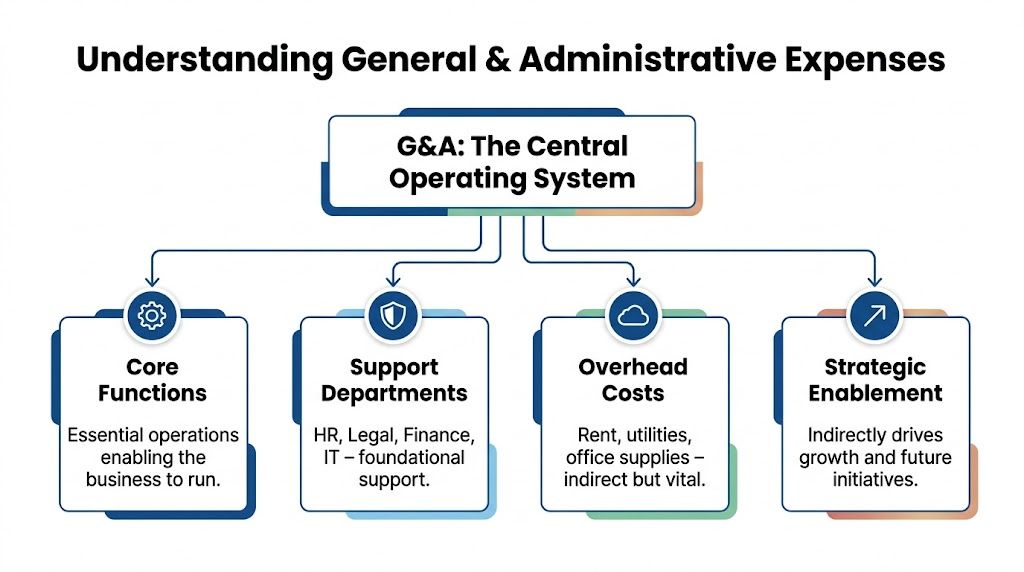
Think of G&A as your business’s central command. Clients don’t buy it directly, and it doesn’t sit inside a billable deliverable, but the company can’t function without it. It keeps the lights on, the books closed, payroll processed, legal matters handled, and the internal team supported.
That “indirect but essential” idea is where most readers get confused. If an expense helps the business, shouldn’t it count as part of making the service? Not always. Accounting separates costs based on their role, not just their usefulness.
What belongs in G&A
A clean G&A structure usually includes these categories:
- Personnel costs for internal leadership and support functions such as executive pay, HR, finance, legal, and administrative staff
- Occupancy costs like rent, utilities, and maintenance
- Professional services such as legal, accounting, audit, and consulting fees
- Office costs including supplies, postage, and certain equipment
- Technology costs tied to administrative systems and IT support
A helpful reference is this overview of what G&A means in business, especially if you’re trying to sort out where shared expenses belong.
One important detail often gets missed. In service sectors, personnel can make up 50% to 70% of G&A according to Fyle’s breakdown of general and administrative expenses. That’s why payroll coding matters so much. A single payroll mapping issue can distort your G&A reports for months.
What G&A is trying to show you
G&A isn’t just a dumping ground for “everything else.” It tells you how much it costs to support the company itself.
Here are a few plain-language examples:
| Expense | Likely G&A treatment | Why |
|---|---|---|
| Internal bookkeeper salary | G&A | Supports the business overall |
| Office lease | G&A | Shared company overhead |
| HR software for onboarding and admin records | G&A | Supports internal operations |
| External legal review of contracts | G&A | Administrative and compliance support |
Where owners often hesitate
People Advisory is a good example. Owners often ask whether internal HR support, onboarding systems, or compensation planning are just overhead. Sometimes they are. Sometimes they’re better understood as strategic G&A. They don’t generate revenue directly, but they make hiring cleaner, retention stronger, and leadership less reactive.
G&A is not “wasted spend” by definition. It’s the infrastructure that lets revenue happen without the business becoming fragile.
That distinction matters. If you label every internal support cost as dead weight, you’ll cut systems that reduce mistakes, improve retention, and make scaling less painful.
G&A vs COGS A Critical Distinction for Profitability
The most common classification mistake isn’t inside G&A itself. It’s the line between G&A and COGS.
For a service business, COGS usually means the direct cost of delivering the service. G&A means the cost of running the company behind the scenes. If you mix the two, gross profit becomes unreliable. Once gross profit is unreliable, pricing decisions start drifting.
A simple way to think about it
Ask one question: Would this cost still exist if you paused client delivery tomorrow but kept the company operating?
If yes, it may belong in G&A.
If no, and it’s tied to producing or delivering client work, it’s more likely COGS.
That test isn’t perfect, but it’s a strong starting point.
Expense Categorization for a Service Business
| Expense Type | Example | Category | Reason |
|---|---|---|---|
| Delivery labor | Project manager working on client accounts | COGS | Directly tied to service delivery |
| Internal finance labor | In-house bookkeeper handling company books | G&A | Supports internal operations |
| Sales effort | Business development rep compensation | Sales and Marketing | Drives revenue generation, not company administration |
| Client software tool | Platform used specifically to deliver service to clients | COGS | Required for the service itself |
| Payroll platform for internal team | Gusto used for internal payroll and benefits admin | G&A | Administrative support function |
| Office rent | Headquarters or shared office space | G&A | Overhead for the business as a whole |
| Proposal software | Tool used by sales team to win work | Sales and Marketing | Selling expense, not administrative |
| Tax return preparation | CPA fees for business compliance | G&A | Administrative and compliance support |
Why the distinction matters
Let’s say your team codes a client-facing project management salary into G&A instead of COGS. Gross margin looks better than it really is. That can lead an owner to think delivery is efficient and overhead is bloated, when the opposite may be true.
The reverse mistake causes a different problem. If you push too much internal admin payroll into COGS, your gross margin looks weak and your delivery model seems less scalable than it is.
Clean categorization protects two things at once. It preserves the truth about delivery economics, and it preserves the truth about overhead.
A practical checkpoint
Review these accounts first if your P&L feels off:
- Payroll by employee or role because that’s where the largest reclassifications usually sit
- Software subscriptions because admin, sales, and delivery tools often get blended together
- Contractors and consultants because one vendor can support multiple functions
- Travel and meals because the purpose of the spend determines the category
This isn’t bookkeeping trivia. It’s how you protect your pricing model, your margin analysis, and your confidence in what the business is earning.
Building Your Chart of Accounts for Flawless G&A Tracking
A clean Chart of Accounts is what turns G&A from a vague idea into a usable management tool. If your accounts are too broad, every month-end review becomes detective work. If they’re too detailed without structure, your reports become cluttered and hard to scan.
The answer is a Chart of Accounts that is simple at the top and specific underneath.
Start with parent accounts and smart sub-accounts
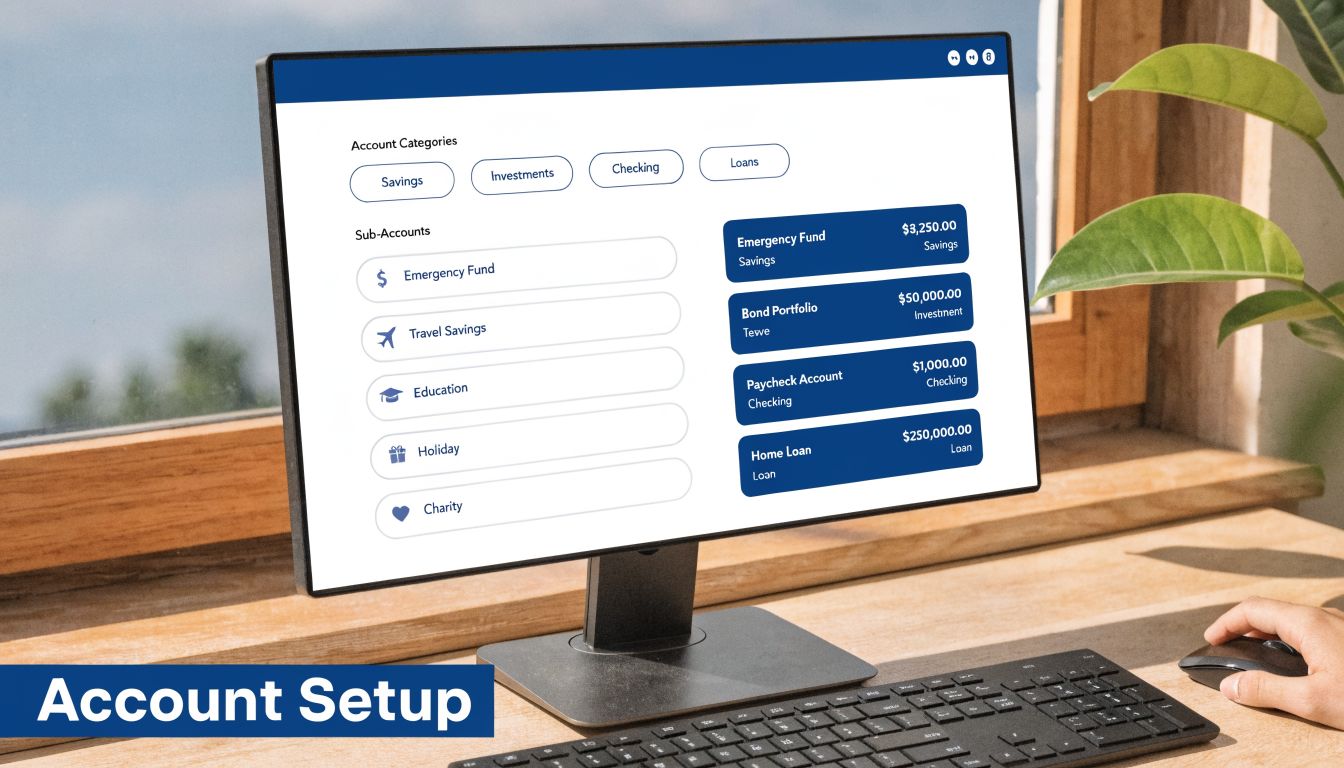
In QuickBooks, don’t throw every admin expense into a single bucket called Administrative Expense. Build parent accounts and sub-accounts that match how you manage the business.
A practical guide to creating a chart of accounts can help if you’re rebuilding from a messy file.
A service business might use a structure like this:
- General & Administrative
- Salaries and Wages Admin
- Payroll Taxes Admin
- Employee Benefits Admin
- Rent
- Utilities
- Insurance
- Professional Fees Accounting
- Professional Fees Legal
- Office Supplies
- Technology Admin
- Bank Charges
- Licenses and Permits
This setup does two useful things. First, it gives leadership a clean top-line G&A view. Second, it gives the finance team enough detail to spot where changes are happening.
Keep payroll mapping separate and intentional
Payroll is where many historical messes begin. The problem isn’t just the payroll run. It’s how wages, taxes, and benefits flow into the ledger.
If your payroll system feeds QuickBooks automatically, review:
- Which wage items hit G&A accounts
- Which employer taxes map with those wage items
- Whether benefits are grouped too broadly
- Whether owners and executives are separated from service delivery staff
If all payroll lands in one salaries account, your P&L may look tidy while hiding major classification issues.
A simple double-entry example
Suppose the business pays office rent from its bank account.
The transaction would generally look like this:
- Debit Rent Expense
- Credit Cash
That entry matters because it records both sides of the event. The expense increases. Cash decreases. Every G&A transaction should follow that same logic. The category tells you what happened economically. The offset tells you where the value came from or went.
How to clean up inherited books
Historical books usually need cleanup for one of three reasons:
| Problem in the books | What it causes | Better approach |
|---|---|---|
| Too many vague accounts | Reports become noisy | Merge overlapping accounts |
| Too few accounts | No visibility into drivers | Add meaningful sub-accounts |
| Inconsistent coding | Trends become unreliable | Apply rules and reclassify prior periods where needed |
A good cleanup process usually starts with the last several months of transactions, payroll mappings, and recurring vendors. You identify patterns first. Then you redesign the Chart of Accounts around how the business operates now, not how someone set it up years ago.
A strong Chart of Accounts should answer management questions without forcing you to open every transaction.
That’s the standard worth aiming for.
Benchmarking and Allocating G&A in a Service Business
Tracking G&A is useful. Benchmarking it is where it starts to shape decisions.
Owners often ask, “Is our overhead too high?” That’s not really a yes-or-no question. The better question is, high relative to what? Revenue, operating structure, service model, and internal complexity all matter.

Why benchmarking matters
A large service sector example makes the point well. In the U.S. hospital sector, administrative and general expenses average 17.0% of total operating costs according to this hospital-sector administrative cost analysis. That’s not a target for your business. Hospitals operate differently from most service firms. But it shows that complex service organizations pay close attention to this category because the scale is too large to ignore.
Benchmarking gives context. Without context, every overhead number feels arbitrary.
Ratios tell more than raw dollars
If rent went up and software spend rose, that doesn’t automatically mean the business became inefficient. Revenue may have grown faster. Or the company may have intentionally invested in infrastructure to support expansion.
Good benchmarking usually asks:
- What is G&A relative to revenue
- How has that ratio moved over time
- Which categories are driving the change
- Are those changes temporary, structural, or strategic
That last question matters. A one-time legal cost tells a different story than a persistent rise in internal payroll.
Allocation helps you see real profitability
Businesses with multiple service lines often have another challenge. Shared G&A clouds the profitability of each line.
Suppose one division uses more executive attention, more internal support, and more recruiting effort than another. If you don’t allocate shared administrative costs thoughtfully, one service line may look highly profitable while leaning heavily on resources used by the whole company.
A sensible allocation approach can use drivers such as:
- Headcount for HR and internal people operations
- Revenue share for broader company overhead
- Usage or licenses for software and admin tools
- Time involvement for leadership or finance support
What owners should watch for
Here are the warning signs that benchmarking and allocation need attention:
| Sign | What it may mean |
|---|---|
| Overhead rises but no one can explain the driver | Accounts are too broad or coding is inconsistent |
| One service line looks unusually profitable | Shared costs may not be allocated fairly |
| Monthly reports are accurate but not useful | Transactions are booked, but not organized for decision-making |
| Budget reviews feel argumentative | The business lacks a shared definition of what belongs in G&A |
The point of allocation isn’t to create accounting theater. It’s to help leaders see which parts of the business are carrying their weight and which parts rely on support costs that aren’t obvious at first glance.
Actionable Strategies for Controlling G&A Expenses
Controlling G&A doesn’t mean cutting everything that isn’t client-facing. It means deciding which costs are waste, which are necessary support, and which are investments that make the company stronger.
That distinction matters because many owners cut too fast in the wrong places. They remove useful systems, delay finance support, or underinvest in internal people operations. Then reporting gets worse, decisions slow down, and managers spend more time patching problems by hand.

Cut friction before you cut muscle
Start with the costs that create drag without much return.
- Audit subscriptions. Many service firms carry software that no one fully owns, rarely reviews, and renews.
- Review duplicate tools. Different teams often buy overlapping apps for communication, file storage, or workflow.
- Renegotiate recurring vendors. Insurance, outsourced support, and administrative tools deserve periodic review.
- Tighten approval paths for unusual or discretionary admin spending.
If labor is the largest driver of overhead in your business, this guide on how to reduce labor costs is useful because it focuses on process improvement and automation rather than blunt headcount cuts.
Use automation where it removes repetitive admin work
Emerging tools are changing the math on administrative work. AI tools can cut certain G&A costs by up to 30%, and 2025 data noted that AI-powered spend management cut utilities and software subscription costs by 25% for SMBs, based on CAQH’s discussion of administrative cost differences.
That doesn’t mean every AI product deserves a line in your budget. It means repetitive review, coding, routing, and spend-monitoring tasks are becoming easier to streamline.
Good candidates for automation include:
- Receipt capture and expense review
- Subscription monitoring
- Invoice routing and approvals
- Basic variance tracking
- Duplicate charge detection
Treat some G&A as a growth asset
Many service firms need a mindset shift.
People operations, onboarding systems, compensation frameworks, payroll accuracy, and timely month-end reporting often sit inside G&A. They can look like “overhead” on paper. But if they reduce turnover, clarify accountability, and improve forecasting, they support growth in a very real way.
Don’t ask only, “Can we cut this?” Ask, “What breaks if we cut this, and what improves if we manage it better?”
That question separates smart cost control from reactive trimming.
A practical framework for cost reduction strategies can help leaders focus on efficiency gains instead of random expense cuts.
Here’s a useful training resource for teams thinking through spend discipline and efficiency:
A better review rhythm
Many businesses review G&A only when cash feels tight. That’s late.
A healthier rhythm is:
- Monthly review of major G&A accounts and new recurring vendors
- Quarterly review of payroll mapping, software stack, and insurance or contractor spend
- Annual redesign of account structure and admin workflows if reporting has become cluttered
That process keeps the business from drifting into a bloated, confusing overhead model.
Essential G&A Reports and KPIs for Smart Decisions
Once G&A is categorized cleanly, reporting becomes much more useful. The key is to stop staring at isolated expense totals and start watching relationships and trends.
The most important relationship is the G&A expense ratio.
The KPI every owner should know
The formula is straightforward:
G&A Expense Ratio = (G&A Expenses / Revenue) × 100
According to HiBob’s guide to general and administrative expenses, service and tech companies often average a G&A ratio of 15% to 25%, and monitoring this quarterly trend can directly affect EBITDA margins by 10% to 15%.
That number is useful because it puts overhead in context. A growing business can carry more absolute G&A dollars while still becoming more efficient if revenue rises faster.
What a rising or falling ratio means
A ratio by itself isn’t good or bad. The trend and the reason behind it matter.
| Trend | Possible meaning | Question to ask |
|---|---|---|
| Ratio rises | Overhead is growing faster than revenue, or costs were reclassified | Which accounts caused the change |
| Ratio falls | Revenue is scaling well, or admin costs are being controlled effectively | Is the improvement sustainable |
| Ratio is flat | Structure may be stable | Are we getting enough leverage from current systems |
If the ratio rises after hiring internal support staff, that may be acceptable if those hires solve bottlenecks. If it rises because payroll was coded poorly or unused software stayed active for months, that’s a different story.
Reports worth reviewing every month
In QuickBooks, owners should regularly look at:
- Profit and Loss by month to spot trend movement instead of one-period noise
- Account detail for G&A sub-accounts to catch miscoding and duplicate vendors
- Payroll detail by class, department, or role if available
- Budget versus actual reports for major administrative categories
A common mistake is reviewing only the top-line P&L. That’s like checking your car’s speed without looking at fuel, engine temperature, or warning lights.
Good G&A reporting doesn’t just tell you what you spent. It tells you whether the business is becoming easier or harder to scale.
How to use the ratio in real decisions
The G&A ratio becomes practical when leadership ties it to decisions such as:
- hiring internal admin support
- adjusting pricing
- replacing manual systems
- consolidating vendors
- deciding whether certain support functions should stay in-house or be outsourced
If your monthly close is late, your payroll mapping is muddy, and your ratio keeps drifting up, the business isn’t just spending money. It’s losing clarity. And clarity is what lets owners move quickly without guessing.
Frequently Asked Questions About G&A
Are general and administrative expenses tax deductible
Many general and administrative expenses are commonly treated as ordinary business costs, but tax treatment depends on the nature of the expense and your facts. The safest approach is to classify expenses correctly in the books first, then review deductibility with your tax preparer rather than assuming every admin cost is treated the same way for tax purposes.
Does a remote business still have G&A if it has no office
Yes. A remote company may have little or no office rent, but it still has administrative infrastructure. Payroll processing, insurance, finance support, legal work, internal software, and people operations don’t disappear just because the team works from home.
Is G&A always fixed
No. Some G&A costs are relatively steady, such as certain software subscriptions or ongoing insurance policies. Others change with management decisions, hiring, vendors, or systems. That’s why owners should avoid treating all overhead as untouchable or all overhead as waste.
What’s the first step if inherited books are a mess
Start by identifying the accounts that affect decision-making most. Usually that’s payroll, software, professional fees, and broad admin buckets like Miscellaneous or Office Expense. Then review recurring transactions and payroll mappings before trying to clean every historical entry at once.
Where should People Advisory or HR support go
Usually in G&A if the work supports the internal team and business operations rather than direct sales or client delivery. The harder question isn’t where it belongs. The harder question is whether leadership understands it as a support cost, a strategic investment, or both.
If your QuickBooks file, payroll setup, or monthly reports aren’t giving you clean visibility into general and administrative expenses, Steingard Financial can help you straighten out the chart of accounts, clean up historical books, and build reporting that makes the numbers easier to trust.