 Skip to content

A structured onboarding process is the strategic journey of integrating a new employee into your culture, systems, and role so they can become productive and stay. When companies do it well, they see a 50% improvement in first-year retention and a 54% increase in new hire productivity.
If you’re a service business owner, you probably know the feeling. You hire someone because the workload is piling up, clients need faster responses, and your current team is stretched thin. Then the new employee shows up on day one and nobody’s quite sure who owns what. Payroll forms are half-done. Their laptop login doesn’t work. Their manager is stuck in client meetings. By Friday, the new hire has learned one thing clearly: this company may be good at serving clients, but it’s not yet good at bringing people in.
That’s where onboarding matters.
When people ask what is onboarding process, they often mean, “What should happen after I hire someone so they don’t feel lost?” The practical answer is this: onboarding is the full process of helping a new employee settle in, get set up, learn the job, understand expectations, and start contributing with confidence.
That’s very different from orientation. Orientation is usually a one-time event. It covers basics like forms, policies, and introductions. Onboarding is broader. It starts before day one, continues through the first weeks and months, and affects operations, client service, payroll accuracy, manager time, and ultimately your profit margin.
For service firms, the analogy is simple. You wouldn’t bring on a new client with no kickoff call, no scoped deliverables, no systems access, and no account owner. You’d expect confusion, rework, and a shaky relationship. Employee onboarding works the same way. The difference is that poor employee onboarding damages your internal capacity before it shows up in client work.
From Welcome Email to Valued Team Member
A chaotic first day usually looks harmless from the inside. Someone says, “We’re a little behind, but we’ll get you everything soon.” The new hire smiles, nods, and spends hours waiting. They don’t know where to start, who to ask, or what success looks like.
A planned first day feels different. The welcome email arrives before they start. Their schedule is clear. Their system access works. Payroll and compliance forms are ready. Their manager has blocked time. A teammate checks in. By lunch, they understand the basics of the business and the role they were hired to do.

Onboarding is a process, not a packet
The clearest way to define onboarding is this: it’s the structured process of turning a candidate into a functioning team member.
That process usually includes:
- Pre-start preparation: paperwork, equipment, payroll setup, and schedules
- Early role clarity: what the employee owns, who they report to, and how work flows
- Cultural integration: how the company communicates, serves clients, and makes decisions
- Training and support: tools, workflows, standards, and early feedback
- Performance ramp-up: moving from observation to independent contribution
Orientation sits inside onboarding, but it doesn’t replace it. Filling out tax and identity documents matters, including understanding employment verification steps like the I-9 form requirements. Still, paperwork alone doesn’t help a new account manager run a client call, or help a payroll specialist follow your approval workflow.
Simple test: If your process ends after day one, you probably have orientation, not onboarding.
Why service businesses feel onboarding gaps faster
In a product company, a weak start may stay hidden for a while. In a service business, it shows up quickly. Missed handoffs affect client deadlines. Poor training leads to inconsistent delivery. Delayed software access wastes billable time. Managers stop doing strategic work because they’re constantly answering basic questions.
That’s why a good onboarding process isn’t just “nice for culture.” It’s part of your operating model.
A receptionist, bookkeeper, project coordinator, or client success hire becomes valuable when they can handle work reliably without constant rescue. Onboarding is the bridge between hiring them and trusting them.
Why Onboarding Is a Financial Strategy Not Just an HR Task
A new hire starts on Monday. By Friday, they still do not have full system access, the manager has answered the same process question four times, and client work is waiting because no one clarified who approves what. HR may have completed the paperwork, but the business is already paying for delays.
Onboarding affects labor efficiency, service quality, and retention from day one. For a service business, that means it shows up in the P&L quickly. Hours that should go to client work get pulled into troubleshooting, rework, and supervision. Revenue does not disappear in one dramatic moment. It leaks out in small, expensive pieces.
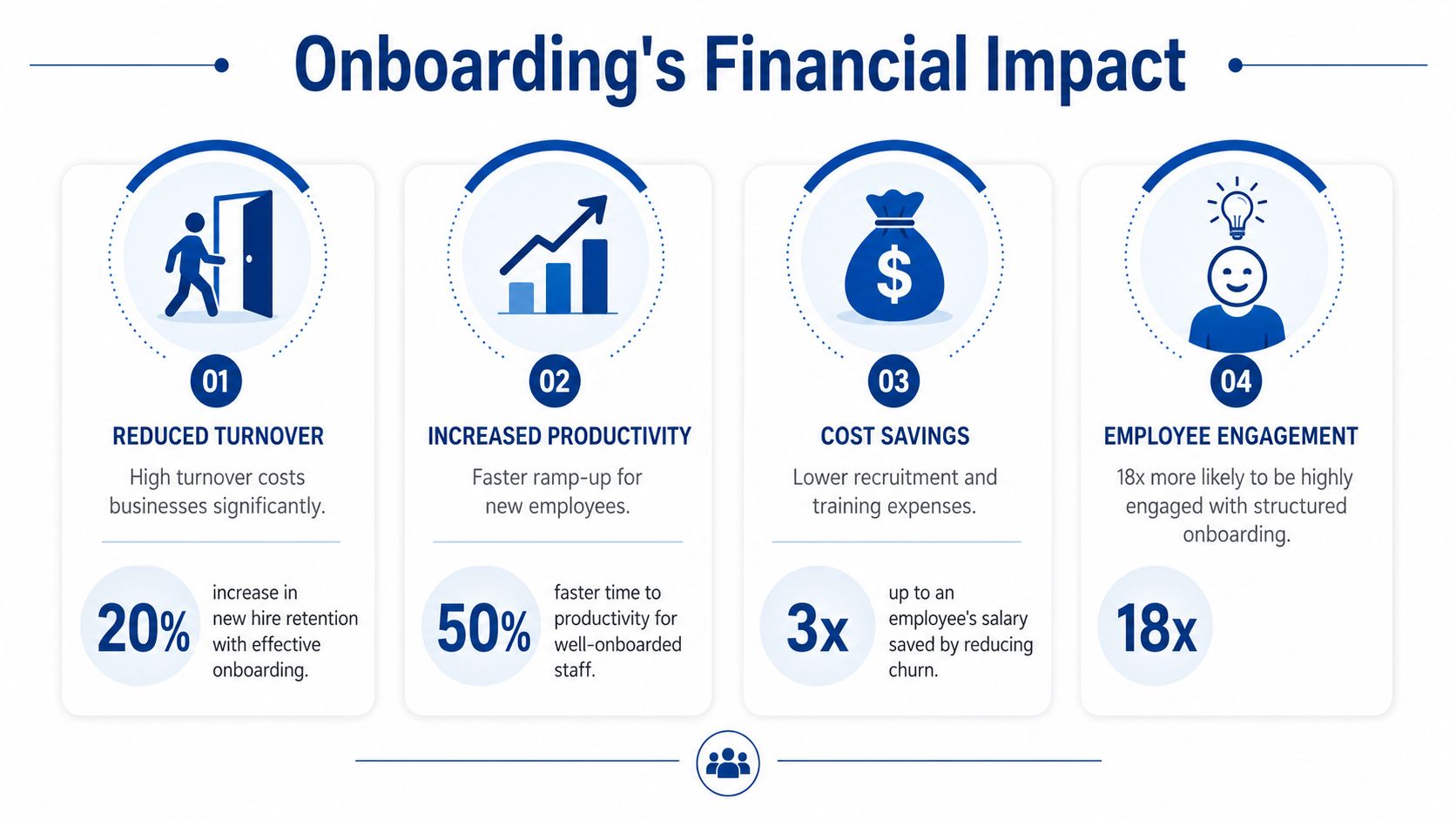
The P&L view of onboarding
Owners often budget for recruiting and compensation, then treat onboarding as a soft activity around the edges. In practice, onboarding works like client implementation. You invest time and money upfront, set expectations, transfer knowledge, and aim for a predictable ramp to full value. If that process is messy, the return on the hire becomes harder to predict.
The costs arrive early. Manager training time. Payroll setup. Software licenses. Lower output while the employee learns your standards and workflow. If the person leaves before they are fully productive, you do not just lose momentum. You repeat the spending cycle with the next hire.
That is why onboarding and retention belong in the same conversation. If you are trying to reduce churn and protect the value of each hire, this guide on how to improve employee retention is a useful companion.
Training quality matters here too. A service firm cannot rely on tribal knowledge and hope people pick things up as they go. Clear role training, documented workflows, and a realistic ramp plan give new hires a fair chance to contribute. If your managers need help formalizing that structure, MEDIAL’s corporate training resources offer practical examples for building a training plan.
Where poor onboarding shows up in operations
Poor onboarding rarely announces itself as an onboarding problem. It usually appears as operational drag.
You can spot it in places like these:
- Manager capacity: supervisors spend too much time answering repeat questions instead of reviewing judgment calls or coaching performance
- Client delivery: deadlines slip because the new hire does not understand handoffs, priorities, or service standards
- System access: work stalls while employees wait for logins, permissions, or the right templates
- Rework: tasks come back for correction because success was never defined clearly
- Early turnover: employees lose confidence when the company feels disorganized or unsupported
A short explainer is useful here if you want a quick visual overview before redesigning your process.
Good onboarding protects margin in the same way good project scoping protects margin. Both reduce avoidable waste, clarify expectations, and help people do the work right the first time.
For service firms, the waste usually looks ordinary. Ten minutes lost chasing access. An hour of partner time spent fixing a preventable mistake. A delayed invoice because a handoff was missed. One awkward client email that needs cleanup. Added together, those small misses become a real operating cost.
The Four Key Phases of an Effective Onboarding Process
Most companies know they should onboard. Fewer can describe what should happen when. Breaking it into phases helps because each phase solves a different problem.
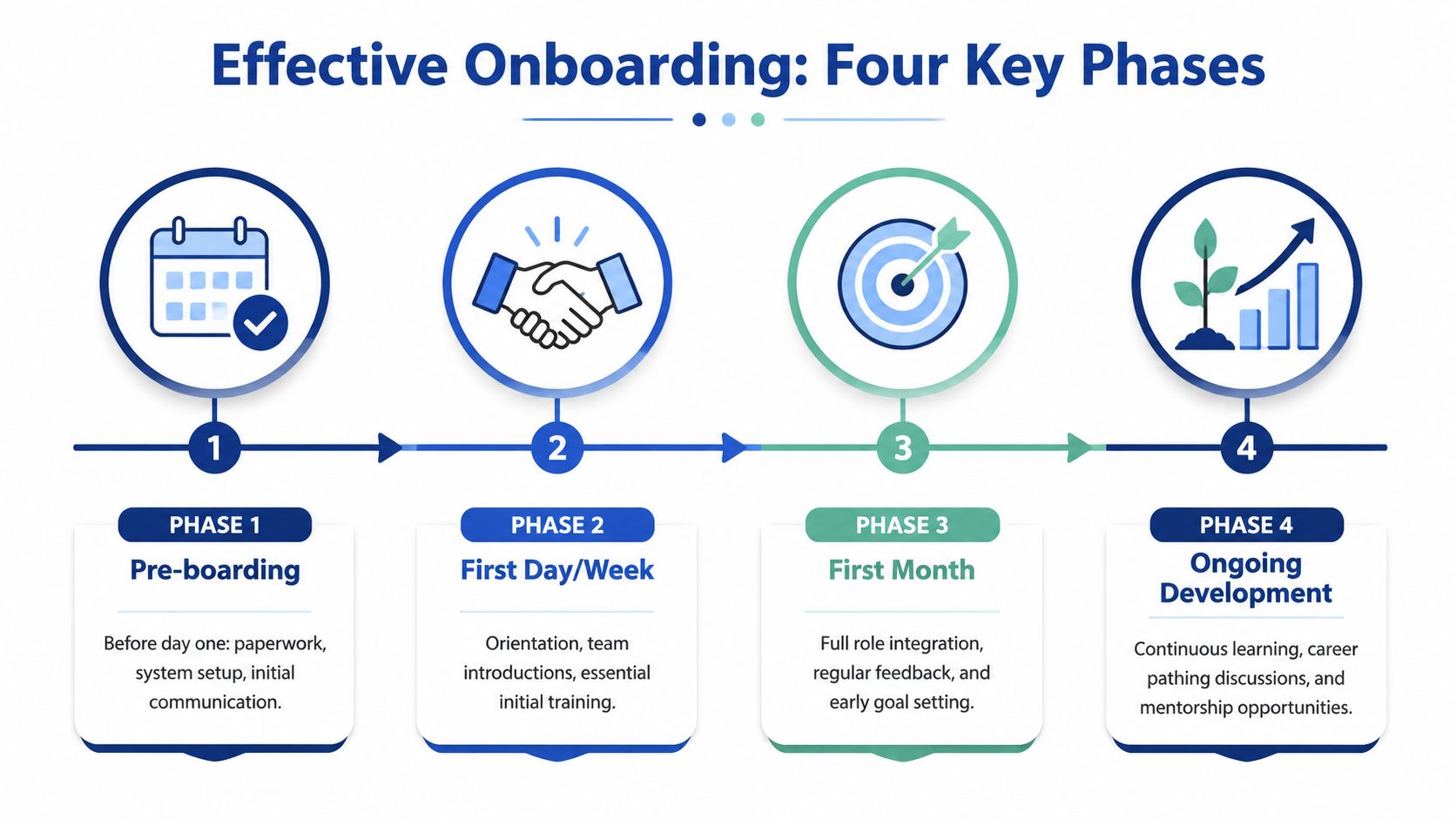
Phase one preboarding
Preboarding starts after the candidate accepts the offer and continues until day one. It’s where companies either create confidence or create anxiety.
Handled well, preboarding can reduce first-week anxiety by 30% and improve day-one readiness. A structured 30-60-90 day plan also helps employees reach independent contribution 50% faster, based on AIHR’s onboarding guidance.
For a service business, preboarding usually includes:
- Practical setup: laptop, email, payroll profile, calendar invites, and core software access
- Clear communication: first-day agenda, office or remote logistics, dress norms, and who they’ll meet
- Document collection: signed forms, policy acknowledgments, and role documents
- Early context: a short overview of your services, clients, and team structure
If your managers need help formalizing the learning path after hire, MEDIAL’s corporate training resources offer a useful way to think about role-based training plans and sequencing.
Phase two first day and first week
In this phase, many businesses overload the new hire. They try to teach everything at once because they want to be helpful. The result is often the opposite.
A better first week has a narrow purpose: help the employee feel oriented, welcomed, and capable of completing basic tasks.
A strong first week often includes a mix of conversation, observation, and simple wins:
- Meet the right people. Not everyone. Just the people they’ll work with most.
- Learn the workflow. Show how work enters the business, gets assigned, reviewed, and delivered.
- Complete one real task. A small success builds confidence faster than another slide deck.
- Set communication norms. Explain where questions go, how urgent requests are flagged, and how updates are shared.
A good first week should end with fewer unknowns, not more documents.
Phase three integration through the first 90 days
Onboarding transitions into performance management in a healthy form. The employee should move from learning to doing, with expectations that tighten over time.
The 30-60-90 model works well because it mirrors how people learn roles:
| Timeframe | Main focus | Example in a service business |
|---|---|---|
| First 30 days | Learn the business, tools, and team | Shadow client calls, learn file structure, understand approval flow |
| Days 31 to 60 | Execute role-specific work with support | Draft reports, process transactions, manage portions of client work |
| Days 61 to 90 | Contribute more independently | Own recurring tasks, communicate with clients appropriately, hit defined standards |
The key is measurable clarity. “Get up to speed” isn’t a useful goal. “Prepare the weekly client dashboard with one review round” is.
Phase four ongoing development
Onboarding doesn’t end when someone can do the minimum. Long-term value comes from turning a new hire into a stronger contributor over time.
That means continued feedback, training refreshers, mentoring, and career conversations. In a growing service business, this phase matters because yesterday’s new coordinator may become tomorrow’s team lead.
Role-Based Onboarding Checklists for Service Businesses
A common mistake is assuming onboarding belongs to HR alone. In practice, it’s shared work. HR or People Ops handles process and compliance. The direct manager handles role clarity and training. Finance and payroll handle the parts that affect pay accuracy, benefits, and reporting.
That division matters because new hires notice gaps immediately. If the manager is ready but payroll isn’t, trust drops. If payroll is ready but the manager has no plan, productivity stalls.
Who owns what
For service firms, the easiest approach is to assign tasks by function and deadline, much like a client implementation checklist. Every task should have an owner, a due date, and a proof point that it’s done.
If you also serve clients through a repeatable intake process, you may find it helpful to compare your employee workflow with Coachful client onboarding resources. The structure is different, but the logic is similar: clear ownership, clear milestones, no guessing.
A more detailed process review can also help if you’re refining internal systems using practical employee onboarding best practices.
Onboarding responsibilities checklist
| Task | HR / People Ops | Direct Manager | Finance / Payroll |
|---|---|---|---|
| Send offer follow-up and first-day agenda | Owns communication and schedule | Reviews role-specific schedule | Confirms payroll deadlines that affect start date |
| Collect and store hiring documents | Owns collection and recordkeeping | Provides role documents if needed | Verifies tax, payroll, and benefits inputs |
| Prepare workstation and software access | Coordinates with IT or ops | Confirms tools needed for the role | Confirms access to timekeeping or expense tools if relevant |
| Introduce company policies and handbook | Leads review and acknowledgments | Reinforces practical expectations in team context | Explains payroll timing, reimbursement rules, and benefits deductions |
| Define first-week priorities | Shares process milestones | Owns task plan and expected outcomes | Flags any finance deadlines the employee must follow |
| Introduce team and reporting lines | Coordinates welcome touchpoints | Explains day-to-day collaboration | Clarifies who handles payroll or expense questions |
| Set 30-60-90 day goals | Documents framework if used company-wide | Owns goals and review cadence | Adds any role-specific financial controls or approval steps |
| Schedule check-ins | Tracks onboarding milestones | Runs recurring one-on-ones | Resolves pay or benefits issues quickly |
| Train on compliance-sensitive workflows | Covers required HR policies | Teaches role-level procedures | Trains on timesheets, expense coding, or payroll cutoffs |
| Confirm onboarding completion | Audits checklist and collects feedback | Signs off on role readiness | Confirms employee is correctly set up in payroll and reporting systems |
What owners often miss
Three tasks are often under-owned:
- Pay setup accuracy: If hours, salary, reimbursement rules, or deductions are wrong, trust erodes fast.
- Approval workflow training: New hires need to know who approves what before they submit work.
- First real assignment: Without this, training stays abstract and the employee can’t build momentum.
The best checklist is the one people actually use every time. Short, visible, assigned, and reviewed.
How to Measure Onboarding Success with the Right KPIs
A new hire can feel busy from day one and still be far from productive. They attended meetings, finished forms, and completed training videos. None of that answers the business question owners care about. Are they adding value at a level that justifies the cost of hiring, training, and manager time?
That is why onboarding KPIs matter.
You are measuring more than whether the experience felt organized. You are measuring whether the company is turning recruiting spend into useful work, stable retention, and fewer operational errors. For a service business, that shows up in client response times, billable capacity, rework, payroll accuracy, and manager hours spent fixing preventable mistakes.
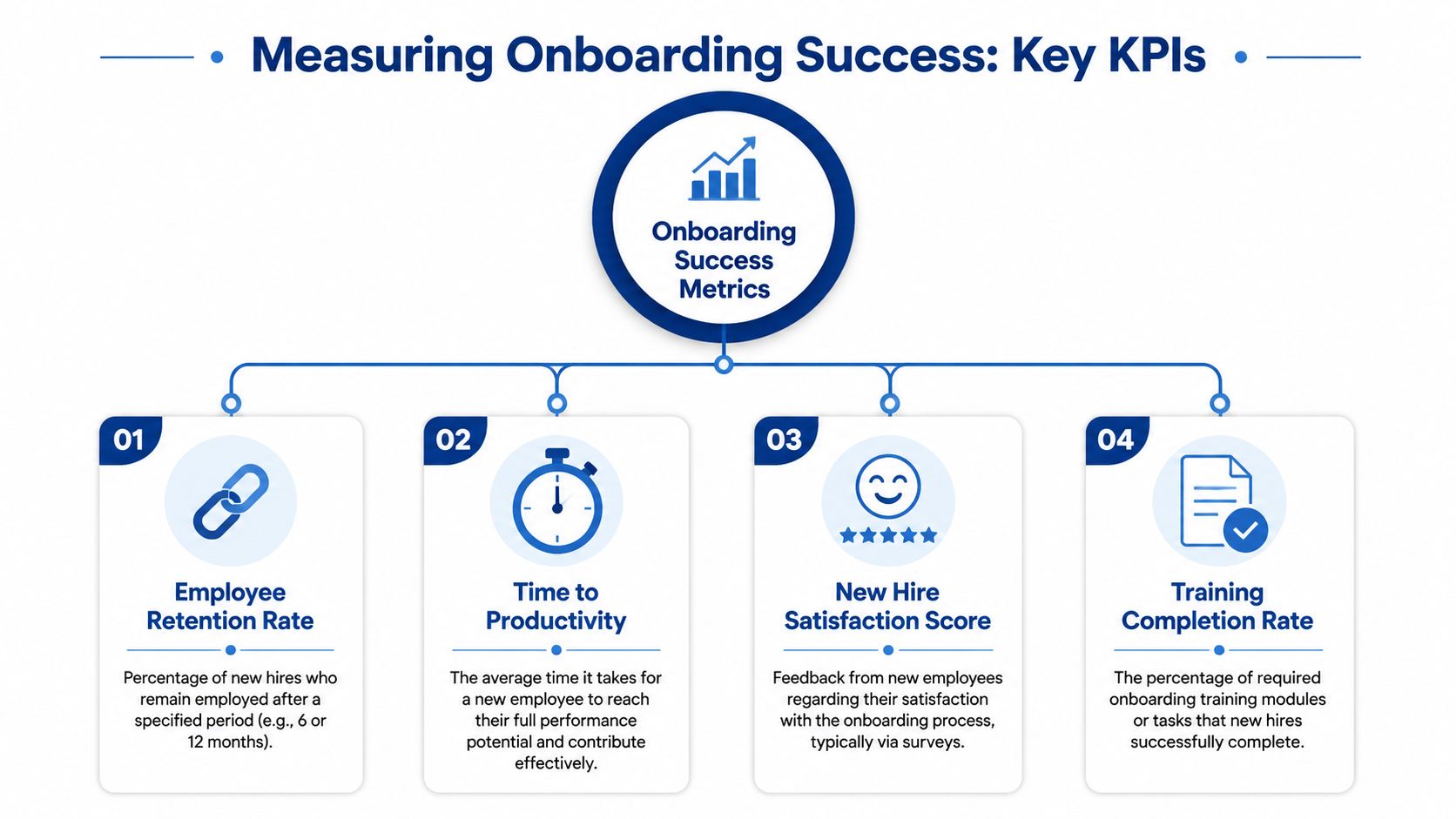
Four KPIs that matter
A small scorecard is usually enough. Start with four measures that connect onboarding to business performance:
- Retention: Do new hires stay through the early ramp period and into stable contribution?
- Time to productivity: How long does it take before they can do the core parts of the job with normal oversight?
- Training completion: Did they finish the systems setup, required policies, and role training needed to work correctly?
- New hire feedback: Where did the process feel clear, confusing, slow, or overloaded?
Time to productivity deserves special attention because it affects the P&L fast. Every extra week of ramp time means salary is going out before full output is coming in. In a law firm, agency, accounting practice, or other service business, slow ramp time also ties up senior staff who should be serving clients or developing business.
How to make these KPIs useful
The mistake is tracking these metrics in vague terms. “Doing well” is not a metric. “Settling in nicely” is not a metric either.
Define each KPI the same way you would define good client work. Make it observable. Make it specific. Make it tied to a decision.
| KPI | Better question to ask |
|---|---|
| Retention | Did the employee stay long enough to become a dependable contributor? |
| Time to productivity | On what date could the manager stop reviewing every small task? |
| Training completion | Were all required systems, policies, and workflows covered and confirmed? |
| New hire feedback | What caused confusion, delay, or repeated questions? |
Here is what that looks like in practice. A payroll coordinator may be productive when they can run a standard process accurately with routine review. A client service employee may be productive when they can handle ordinary client communication without needing approval on every message. A bookkeeper may be productive when they can code common transactions correctly and follow the approval path without reminders.
The benchmark should be set before the employee starts. If you wait until week four to decide what “productive” means, the measurement becomes subjective.
Where to track it
You likely already have the systems needed to track these KPIs:
- HR platform: forms, milestones, policy acknowledgments
- Project management software: task ownership and due dates
- Timekeeping or billing systems: signs of independent output
- Manager check-ins: structured observations at 30, 60, and 90 days
A simple rule helps here. If a metric does not lead to an action, it is noise.
If time to productivity is slower than expected, review the training sequence and manager handoff. If early turnover is high, check role clarity, workload, and first-month support. If feedback shows repeated confusion, simplify the process or spread information across a longer ramp period.
Good onboarding measurement works like job costing. You are comparing input to outcome. The clearer that comparison is, the easier it becomes to improve hiring returns, protect manager capacity, and build a team that contributes faster.
Common Onboarding Pitfalls and How to Avoid Them
Most onboarding failures aren’t dramatic. They look like small oversights. Too many documents on day one. A mentor assignment made in a rush. Preboarding tasks that drift into gray legal territory. These problems feel minor until they affect retention, fairness, or compliance.
Pitfall one information overload
Many companies confuse completeness with clarity. They try to share everything in the first few days because they don’t want the new hire to miss anything.
That approach often backfires. 81% of new hires report feeling overwhelmed by information during onboarding, and only 12% of employees strongly believe their organization does a great job of onboarding, according to AIHR’s employee onboarding statistics.
The fix is sequencing. Put urgent information first, useful information next, and reference material where employees can find it later.
A simple rule works well:
- Day one: essentials only
- First week: workflow and team norms
- First month: deeper systems, edge cases, and broader context
Pitfall two weak mentor matching
A buddy or mentor can make onboarding easier, but only if the match is thoughtful. Random pairings often fail because the mentor is too busy, lacks coaching ability, or doesn’t share enough context with the new hire.
This is also an equity issue. Work for Good reports that 68% of HR leaders have no formal process to assess mentor compatibility beyond seniority, and notes that poor matching can undermine engagement and retention for underrepresented hires in particular, as discussed in its piece on onboarding tactics for engagement, equity, and retention.
Better mentor pairing usually includes:
- Role relevance: choose someone who understands the actual work
- Capacity: don’t assign the busiest person by default
- Compatibility: consider communication style and working habits
- Expectations: define how often they should connect and what the mentor owns
Don’t treat mentorship as a courtesy assignment. Treat it as part of retention design.
Pitfall three risky preboarding
Preboarding helps, but it has boundaries. Some employers unintentionally turn early engagement into unpaid work by assigning training or job tasks before the legal employment relationship is fully in place.
SHRM-related guidance highlighted in the verified research notes a specific gap here. A cautious approach is to begin preboarding only after a signed offer letter and keep activities brief and administrative, especially when you’re handling setup, welcome materials, or introductions rather than productive work, as outlined in the SHRM onboarding topic area.
That means:
- Use preboarding for readiness, not production
- Avoid assigning substantive job tasks before start
- Keep HR, payroll, and manager communication aligned
- Document what is optional versus required
For service firms, this matters because eager managers often want a new hire to “just review a few files” before day one. That can create unnecessary risk.
Putting It All Together Your Next Steps
A strong onboarding process helps a new employee become useful faster, stay longer, and create fewer operational headaches along the way. For a service business, that makes onboarding part of financial management, not just people management.
If you want to improve yours, start small and stay concrete.
A practical three-step start
Audit your current reality
Write down what happens from signed offer to the end of the first month. Not what you hope happens.Assign owners for every key task
Separate HR, manager, and finance or payroll responsibilities so nothing sits in a gray area.Improve one phase this quarter
Start with preboarding, first-week scheduling, or 30-60-90 role planning. One clean phase is better than a vague full redesign.
If you train distributed teams, short internal videos can also reduce repetitive explanations. Tools for video creation for businesses can help managers turn recurring walkthroughs into reusable onboarding support.
One practical option for firms that want outside help is Steingard Financial, which provides People Advisory and HR support alongside bookkeeping and payroll workflows using tools such as Gusto and QuickBooks. That kind of setup can help keep onboarding tied to payroll accuracy, reporting, and operating discipline rather than treating it as a separate admin activity.
If your business needs cleaner payroll setup, stronger people processes, and onboarding that supports both compliance and profitability, Steingard Financial can help you build a more reliable back office with bookkeeping, payroll, and People Advisory support.