 Skip to content
You’re probably in a spot that feels oddly successful and uncomfortable at the same time.
Revenue is coming in. Clients are paying. Your bookkeeping may even be accurate. But the hard questions keep piling up. Can you afford to hire ahead of demand? Why does cash feel tight even when sales look healthy? Which service lines truly carry the business? If you want to raise capital, open a second location, or stop making money decisions from your gut, your books alone won’t get you there.
That’s where many owners start asking, what is a Fractional CFO, and do I need one?
The short answer is simple. A fractional CFO is a senior finance leader who works with your business part time instead of joining as a full-time executive. The role is strategic, not clerical. Think of a bookkeeper as the team keeping the score accurate. A fractional CFO helps you decide how to win the next quarter, the next year, and the next major move.
Beyond Bookkeeping The Rise of the Strategic Finance Partner
A lot of service business owners hit the same wall. They have a profit and loss statement. They have a balance sheet. They may even get monthly reports on time. But when they sit down to make a big decision, the numbers still don’t answer the actual question.
Should you hire now or wait?
Can you survive a slow quarter?
Is pricing too low?
Are you funding growth from profit, debt, or owner stress?
That gap is the difference between operational finance and strategic finance.
Keeping score versus calling the plays
Bookkeeping records what already happened. It categorizes transactions, reconciles accounts, and keeps the financial record clean. That work is essential. Without it, everything else collapses.
A fractional CFO uses that clean history to guide future decisions. They forecast cash, pressure test plans, build budgets, prepare for lenders or investors, and help leadership understand the financial consequences of each path.
Good bookkeeping tells you where the business has been. A fractional CFO helps you decide where it should go next.
Structurally, a fractional CFO is a senior finance executive engaged on a part-time retainer, usually working 10 to 20 hours per week rather than serving as a permanent executive, according to 2Go Advisory Group’s explanation of the fractional CFO model. That arrangement gives growing companies access to executive financial leadership without the fixed cost of a full-time hire.
Why this role is showing up more often
Many businesses outgrow basic accounting before they’re ready for a full internal finance department. That’s especially true for service firms with uneven cash cycles, growing payroll, and founder-led decision making.
A fractional CFO fits that middle stage. They’re not there to enter bills or reconcile bank accounts. They’re there to turn your financial data into a map. If bookkeeping is the dashboard, the fractional CFO is the navigator.
For owners who are still building the finance foundation, clean reporting often starts with reliable outsourced accounting for small business. Once the data is timely and trustworthy, strategic finance becomes useful instead of theoretical.
The Fractional CFO Scope Responsibilities and Deliverables
The phrase “strategic finance” can sound vague until you see the actual work. A fractional CFO doesn’t just offer opinions in meetings. They usually produce specific outputs that help owners make decisions with more confidence.
What they typically own
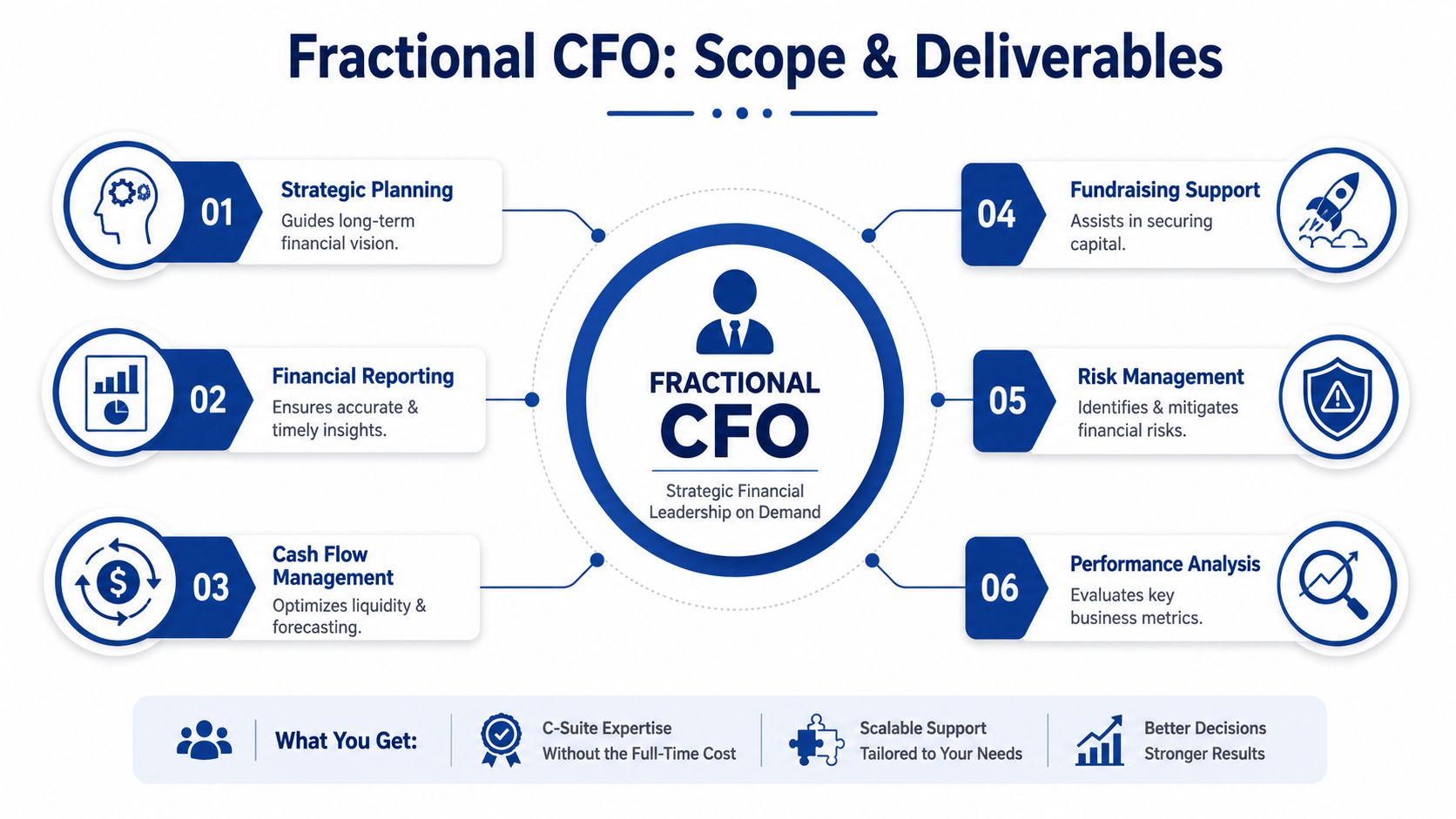
A fractional CFO usually handles high-impact finance work such as cash flow management, forecasting, budgeting, KPI reporting, and fundraising support, while a fractional controller focuses more on financial accuracy and reporting preparation. They commonly serve clients for 20 to 40 hours monthly, based on Dark Horse CPA’s description of the role.
That broad scope becomes easier to understand when you break it into deliverables:
- Cash flow forecasting: A rolling cash forecast that helps you see upcoming pressure before it turns into a crisis.
- Budgeting and reforecasting: A financial plan tied to hiring, revenue expectations, software spend, and seasonal changes.
- KPI dashboards: Reports that show what matters most for your business model, such as utilization, gross margin by service line, or revenue per employee.
- Fundraising and lender materials: Financial narratives, forecast models, and supporting schedules for outside stakeholders.
- Board or leadership reporting: Clear monthly packages that translate accounting data into decisions.
- Planning support for major moves: Expansion, debt, pricing changes, compensation changes, or acquisition preparation.
What that looks like in practice
A service firm owner might ask, “Can we hire two account managers this quarter?” A bookkeeper can report current payroll. A fractional CFO can model what those hires mean for cash, margins, and breakeven timing.
A founder might ask, “Why are we busy but still short on cash?” The answer may involve invoicing speed, project mix, payment timing, and payroll structure. A fractional CFO pulls those pieces together instead of treating them as isolated reports.
Here’s a simple way to think about the work:
| Business question | Fractional CFO deliverable |
|---|---|
| Can we afford this hire? | Hiring impact model and cash forecast |
| Which services make money? | Margin analysis and KPI reporting |
| Are we ready to borrow or raise? | Forecast package and stakeholder reporting |
| Why does growth feel chaotic? | Budget, forecast cadence, and decision framework |
Practical rule: If a finance partner can’t show you what documents, models, or reporting they’ll produce, the engagement may stay too abstract to be useful.
For businesses that need scenario planning, a strong example is a 3 statement financial model. It ties your income statement, balance sheet, and cash flow together so one decision, like adding staff or changing pricing, flows through the entire business picture.
The Financial Leadership Spectrum Fractional CFO vs Full-Time vs Controller
Most owners don’t choose between “finance help” and “no finance help.” They choose between several different kinds of help, and that’s where confusion starts.
A controller, a full-time CFO, and a fractional CFO can all be valuable. They just solve different problems.
The easiest way to separate the roles
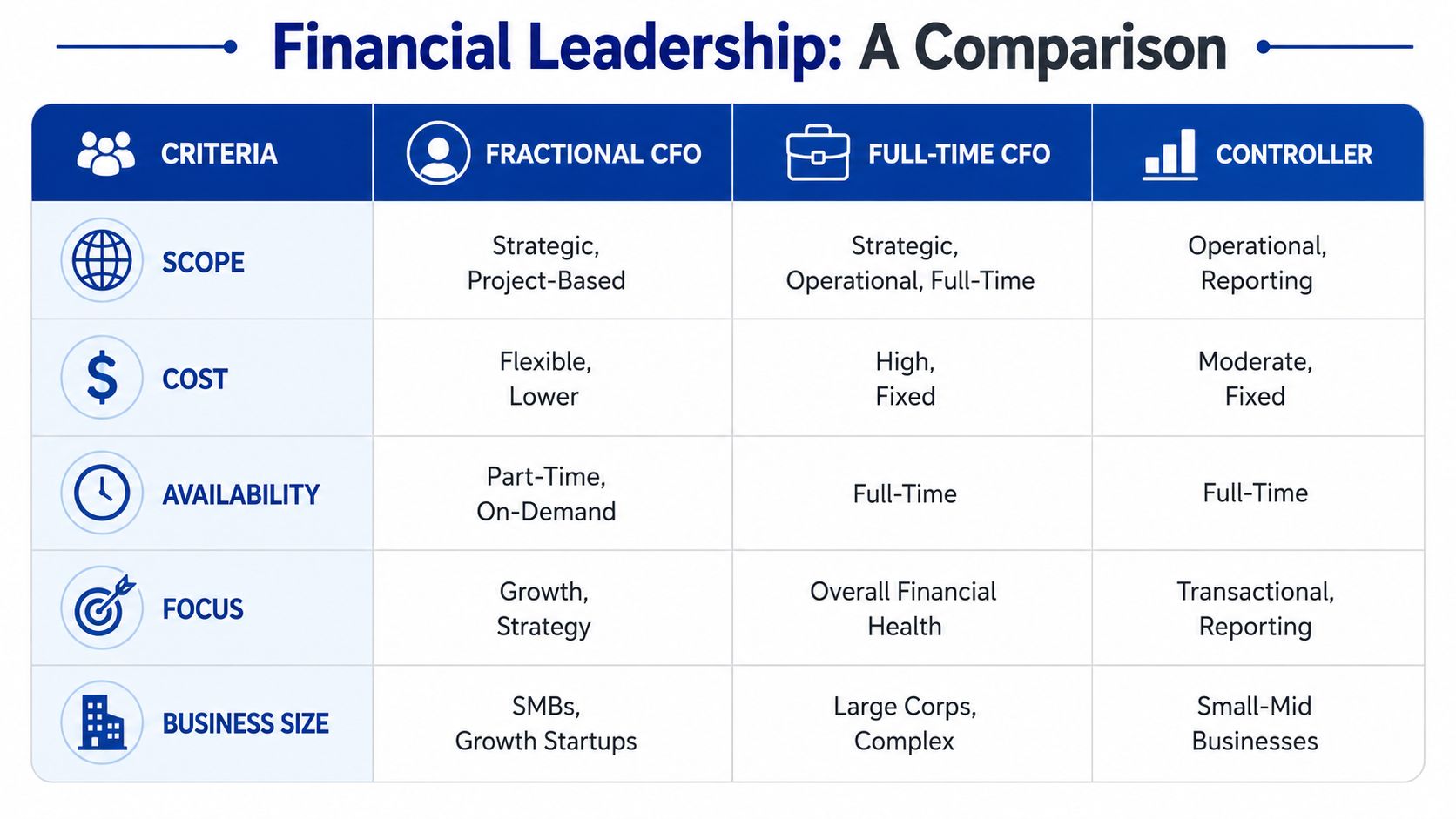
A controller protects accuracy and reporting discipline.
A fractional CFO drives strategy and decision support.
A full-time CFO does both at a larger scale and stays embedded every day.
That distinction matters because owners often ask a controller to answer strategy questions that sit outside the controller role. Controllers are indispensable, but their job is usually grounded in reporting, controls, and accounting operations. They make sure the numbers are right.
A CFO asks what those numbers mean next.
Side-by-side comparison
| Role | Primary focus | Time model | Best fit |
|---|---|---|---|
| Controller | Reporting accuracy, close process, controls | Ongoing operational role | Businesses needing stronger accounting discipline |
| Fractional CFO | Strategy, forecasting, cash planning, stakeholder support | Part-time, retainer-based | Growing companies needing executive guidance without a full-time hire |
| Full-time CFO | Executive leadership across finance and operations | Permanent, full-time | Larger or more complex businesses with constant CFO-level workload |
The financial difference is often what makes the decision clearer. A full-time CFO typically costs $220,000 to $350,000 annually, while a fractional engagement providing comparable strategic oversight costs $36,000 to $96,000 annually, which can reduce cost by 60% to 72% when benefits and recruitment fees are included, according to Fractional C-Suite’s cost analysis.
When each option makes sense
A full-time CFO makes sense when your business needs daily executive finance leadership, has enough complexity to justify it, and can absorb the fixed cost.
A controller makes sense when your biggest pain is accounting consistency. Maybe reporting is late, reconciliations are messy, or month-end closes drag on. You need a tighter engine before you need more strategy.
A fractional CFO makes sense in the middle. You need senior judgment, but not every day. You need decision support, not another fixed executive salary.
That’s also why the role fits modern work patterns well. Business owners are more open to flexible executive talent, just as experienced operators are more open to fully remote leadership opportunities that let them support companies without relocating or joining as full-time employees.
Hiring the wrong finance role is expensive in a quiet way. You still spend money, but the business problem stays unsolved.
Is Your Business Ready Key Signs You Need a Fractional CFO
Some companies need a fractional CFO right now. Others need cleaner books, better reporting cadence, or stronger operational discipline first. The challenge is telling the difference.
One useful benchmark is company size. A fractional CFO is often most effective for businesses generating $3 million to $15 million in annual revenue, with typical monthly retainers of $3,000 to $8,000, according to Eagle Rock CFO’s industry research. That range tends to describe businesses large enough to need strategic financial guidance, but not large enough to justify a permanent CFO.
A quick visual can help you spot the pattern.
Common signs the role fits
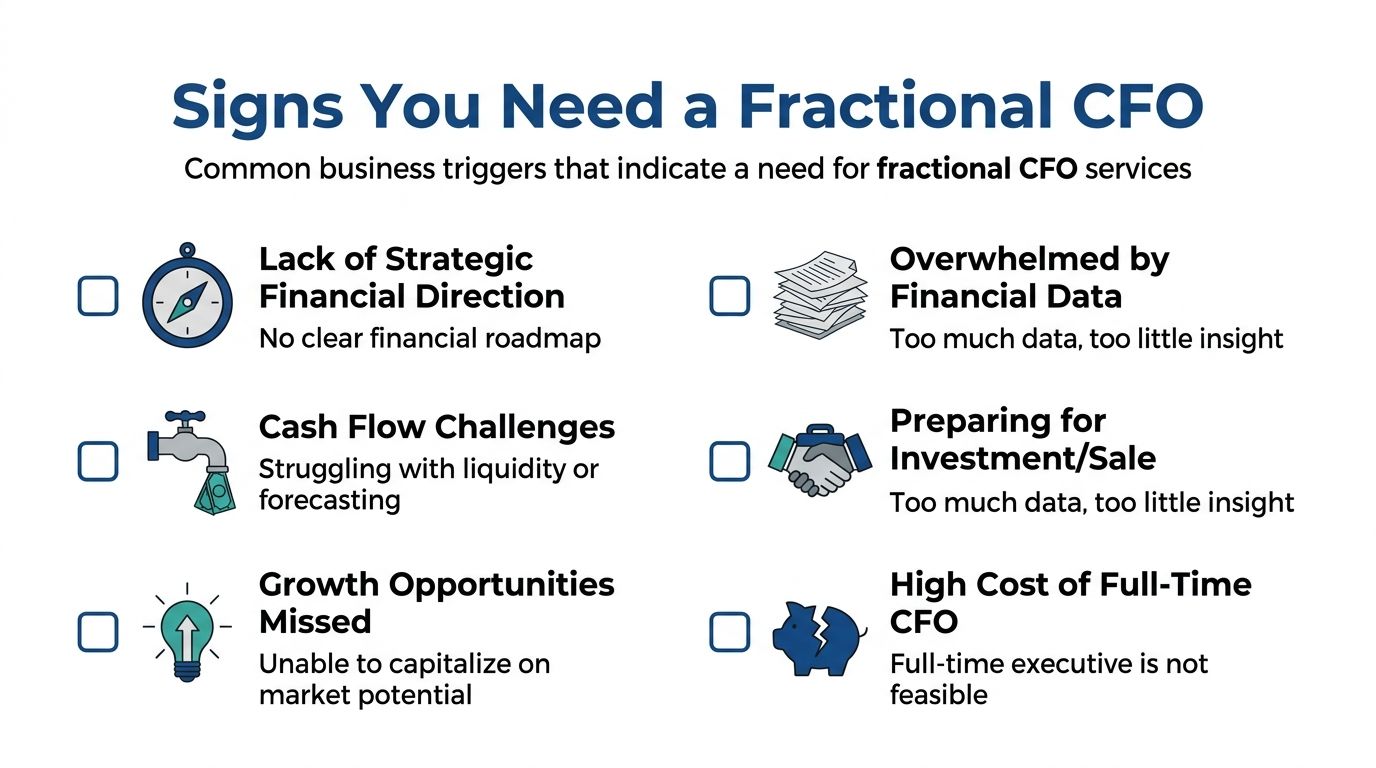
You may be ready for a fractional CFO if several of these feel familiar:
- You have reports but not answers: Your P&L arrives, yet you still can’t tell which decisions are safe.
- Cash surprises keep happening: Revenue looks fine, but payroll weeks or tax deadlines create stress.
- Growth is exposing weak planning: Hiring, pricing, and delivery all feel connected, but nobody is modeling the tradeoffs.
- Outside stakeholders want more sophistication: A lender, investor, or board wants clearer forecasts and cleaner narratives.
- You’re preparing for a major event: Fundraising, expansion, a sale process, or an acquisition creates financial demands beyond basic accounting.
- You’re still acting as the finance strategist yourself: If the owner is carrying all major financial judgment, the business becomes fragile.
This video offers another practical view of when owners start looking for this kind of help:
A useful self-check
Ask yourself these questions:
- Do I trust our monthly numbers enough to make hiring decisions from them?
- Can I see cash risk before it becomes urgent?
- Do I know which parts of the business drive margin?
- Could I explain our financial story clearly to a lender or investor?
- Do I know what happens financially if sales dip or payroll rises?
If those questions feel hard to answer, strategic finance may be overdue.
For startups in particular, capital pressure often shows up before the books tell a clean story. Founders trying to separate temporary strain from a real financing problem may find this guide on signs your startup is underfunded useful alongside CFO readiness thinking.
How Fractional Engagements Work The Foundational Layer
Most fractional CFO relationships run on a monthly retainer. The CFO commits a defined amount of time, usually spread across recurring meetings, reporting review, planning work, and support for specific initiatives. Some engagements are ongoing. Others are built around a transaction, fundraising process, or period of operational change.
The mechanics are usually straightforward. Onboarding often includes a review of your financial statements, chart of accounts, cash position, reporting process, payroll structure, and business goals. From there, the CFO sets a rhythm for meetings, reporting, forecasts, and decision support.
The part many companies miss
A fractional CFO can only be as useful as the data they’re given.
If your bookkeeping is late, inconsistent, or full of cleanup issues, the strategy layer becomes shaky fast. Forecasts built on unreliable numbers don’t create confidence. They create polished confusion.
That’s why one of the most important readiness checks has nothing to do with sophistication. It has to do with financial visibility. If a business doesn’t have consistent and timely reporting, such as a monthly close within 30 days, hiring a fractional CFO is ineffective. The first priority should be building accounting infrastructure with a dependable bookkeeper, according to Inflection CFO’s diagnostic on readiness.
A CFO can interpret the map. They can’t draw a reliable route from broken coordinates.
What the foundational layer includes
Before strategic finance works, you need clean operating finance:
- Accurate transaction coding: Expenses, revenue, payroll, and owner activity have to land in the right places.
- Reconciled accounts: Bank and credit card balances should match the books.
- Timely month-end close: Financials need to arrive while they’re still useful.
- Clear chart of accounts: Reports should reflect how the business runs.
- Consistent AP and AR process: Cash visibility depends on disciplined billing and payment tracking.
This same logic applies across other functions. A company can hire strategic specialists in finance, HR, or operations, but the underlying systems have to support the advice. That’s one reason broader guides to strategic HR leadership guidance often sound familiar to finance owners too. Strategy only works when the operational base is stable.
Vetting Your Options Questions to Ask a Potential Fractional CFO
Not every experienced finance professional is a strong fractional CFO. Technical skill matters, but so do communication, scope discipline, and the ability to work from the reality of your business instead of a generic playbook.
Questions that reveal strategic depth
Ask practical questions that force the candidate to explain how they think:
- How do you build a forecast from scratch? Listen for a process, not buzzwords.
- What do you need from our bookkeeping and close process before strategy work starts? A serious operator will care about data quality immediately.
- How do you decide which KPIs matter for a service business? Their answer should connect metrics to decisions.
- What would your first 60 days look like here? Good candidates can describe priorities in plain language.
- How do you present financial tradeoffs to non-finance leaders? If they can’t simplify, they won’t be useful in live decisions.
- How do you work with bookkeepers, controllers, and outside tax advisors? Fractional leadership should strengthen the team around it, not create confusion.
Questions that test fit
Technical ability is only part of the decision. You also need working chemistry.
| Ask this | Why it matters |
|---|---|
| How many clients do you support at one time? | Reveals capacity and responsiveness |
| What do you own versus what stays with us? | Prevents role confusion |
| How do you handle bad or incomplete data? | Shows realism and judgment |
| What meetings would you attend regularly? | Clarifies operating rhythm |
If a candidate talks only about “strategy” and never asks about your close process, reporting lag, or bookkeeping quality, that’s a warning sign.
A useful complement to this interview process is making sure your accounting base is already organized. If you’re still tightening that layer, accounting services for small businesses can help create the reporting discipline a CFO will need to do meaningful work.
Partnering for Success How Steingard Supports Your Financial Strategy
A fractional CFO can be a sharp tool for a growing business. They bring forecasting, planning, decision support, and financial leadership without the commitment of a permanent executive. But the role only works when the underlying numbers are dependable.
That’s the overlooked truth behind most successful engagements. Strategy sits on top of bookkeeping. If the bookkeeping is messy, strategy becomes guesswork with a slide deck attached.

For service businesses, that foundation usually means accurate transaction categorization, reconciled accounts, timely month-end closes, dependable AP and AR workflows, and reporting that reflects how the company operates. That’s where a bookkeeping and payroll partner becomes central to the whole finance stack.
Steingard Financial provides that foundational layer through bookkeeping, payroll, reporting, cleanup, and back-office support for service businesses. In practical terms, that means a fractional CFO can walk into a cleaner environment and spend time on forecasting, margin analysis, and planning instead of untangling old errors.
The partnership works in both directions. Business owners get books that support higher-level strategy. Fractional CFOs get a reliable accounting engine that keeps reports timely and usable.
If you’ve been asking what is a fractional CFO, the better follow-up question may be this: Is my business ready to make one effective?
If you want financial strategy to rest on solid numbers instead of assumptions, explore Steingard Financial. Their bookkeeping, payroll, reporting, and cleanup work can create the clean financial foundation that owners, controllers, and fractional CFOs all rely on to make better decisions.