 Skip to content
Your calendar is full. Clients need answers. Employees need to get paid. QuickBooks needs cleanup. Gusto needs attention. Your bookkeeper can keep transactions moving, but nobody is tying the numbers to hiring plans, cash flow, and the next stage of growth.
That’s where a lot of service business owners get stuck. You’ve outgrown DIY finance, but you’re not ready to build a full internal accounting department. You need better reporting, cleaner systems, and someone who can connect payroll, people operations, and financial decisions without creating another management headache.
Fractional accounting services sit in that middle ground. Done well, they give you a usable back office, not just a stack of reports. For a service firm, that can mean accurate books, smoother payroll, better month-end close, and a clearer picture of what each hire or client contract does to cash.
What Are Fractional Accounting Services Exactly
A shared financial department is a good analogy. Instead of hiring a full-time bookkeeper, controller, payroll specialist, and CFO one by one, you buy the portion of each role your business needs.
That’s the core idea behind fractional accounting services. You’re not paying for idle capacity. You’re getting a slice of experienced finance and operations support that matches your size, complexity, and pace of change.
More than outsourced bookkeeping
Many owners hear the word “fractional” and assume it just means outsoutsourced bookkeepingmetimes it includes bookkeeping, but the stronger model is broader than that.
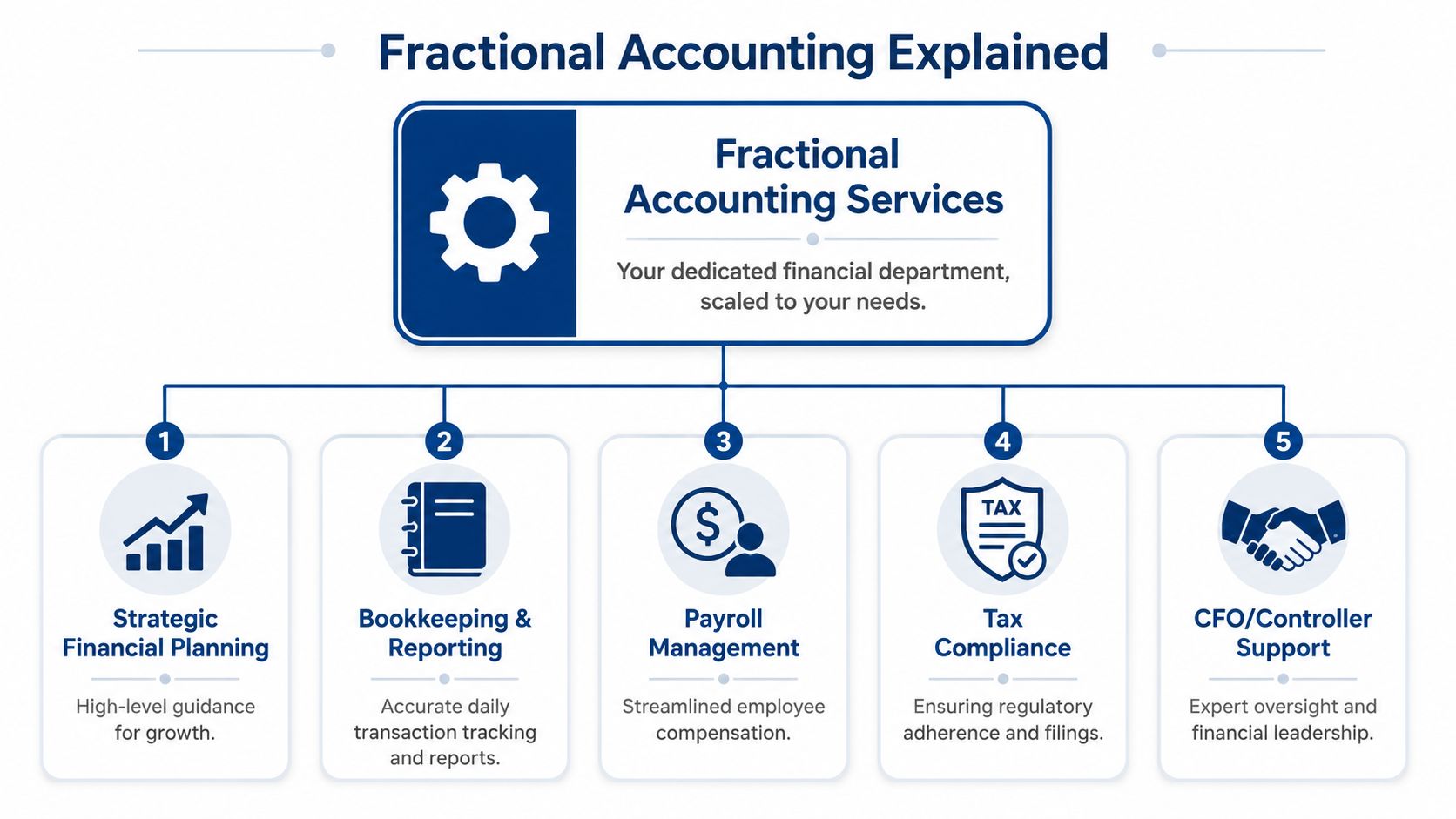
A fractional team can combine:
- Bookkeeping operations for coding transactions, reconciling accounts, and keeping QuickBooks current
- Controller oversight for month-end close, internal controls, and reporting accuracy
- Payroll and people support tied to systems like Gusto or QuickBooks Payroll
- Financial leadership when the business needs planning, forecasting, or decision support
That integrated approach matters because service businesses rarely have just a “bookkeeping problem.” More often, they have a workflow problem. A new hire gets added in payroll, but the class tracking in QuickBooks isn’t set up right. Client billing changes, but revenue reporting doesn’t reflect it. Benefits costs rise, but nobody maps that impact into cash planning.
Practical rule: If your accounting system, payroll platform, and hiring decisions don’t line up, the issue isn’t just accounting. It’s back-office design.
The market has moved in this direction quickly. The broader finance and accounting outsourcing market, which includes fractional services, reached $58.4 billion in 2025, and SMBs with under 250 employees now represent 43% of market spend, up from 29% in 2019, according to finance and accounting outsourcing market data from Stealth Agents.
Why service firms use this model
Service firms live and die on timing, utilization, payroll, and cash management. You may not need a full in-house department, but you do need dependable outputs:
- clean books
- on-time payroll
- usable reports
- fast answers to operational questions
- confidence that your systems can scale
That’s why the best way to think about fractional accounting services is simple. They give a growing business the function of a finance department, scaled to your current workload.
Typical Service Scope and Deliverables
A good fractional accounting engagement should feel less like hiring a bookkeeper and more like installing a back-office operating system.

For a service business, the work usually stretches across three connected areas. Accounting. Payroll. People operations. QuickBooks holds the financial record. Gusto holds pay, benefits, and employee changes. Your invoicing and approval tools affect both. If those systems are set up in isolation, the books may close, but the answers you get from them will be unreliable.
That is why a modern fractional team often functions as the business’s back-office engine. They are not only recording history. They are making sure hiring, payroll, billing, and reporting all flow through the same logic.
What the team usually handles
Start with the foundation. If the input is wrong, every report built on top of it is wrong too. It works like building a schedule from a calendar with the wrong dates. The structure looks organized, but the decisions based on it will still be off.
Common operating tasks include:
- Transaction coding in QuickBooks so revenue, payroll, software, contractor costs, and owner expenses land in the correct accounts, classes, or locations
- Accounts payable support including bill entry, approval workflows, and payment timing
- Accounts receivable follow-up so invoices are issued correctly and aging does not grow unchecked
- Bank and credit card reconciliations to catch missing transactions, duplicates, and coding errors
- Payroll processing through Gusto or QuickBooks Payroll with wage, tax, and benefit entries posted correctly to the general ledger
- Sales tax and compliance support if your services, locations, or filing requirements call for it
- Historical cleanup when prior months were never fully reconciled or closed
Then comes the review layer, which is where many owners feel the biggest difference. Someone checks accruals, reviews unusual balances, confirms payroll allocations, and asks whether the story in the financials matches what happened in the business.
That review step matters because service businesses run on labor. If one team member shifts departments, gets a raise, starts mid-period, or receives a bonus, the accounting has to reflect that change in the right place. Otherwise, margin by service line or team can drift without anyone noticing why.
What you should expect to receive
Deliverables should help you run the business, not just prove that tasks were completed.
A strong engagement often includes:
- Weekly or biweekly cash visibility so you can see upcoming inflows, payroll timing, bill pressure, and expected shortfalls early
- Monthly financial statements including the income statement, balance sheet, and cash flow statement
- Budget versus actual reporting that shows where labor, overhead, and revenue are ahead or behind plan
- A month-end close summary explaining key changes, unusual items, and open questions
- Payroll and benefits reporting tied to departments, managers, or client delivery teams
- Owner-ready or board-ready reporting with cleaner presentation and brief commentary on what needs attention
In larger or more mature engagements, the scope may also reach into internal controls, revenue recognition, policy setup, and higher-level reporting for leadership. The CFO services overview from EisnerAmper describes this broader package well. Senior finance support often includes forecasting, KPI reporting, cash management, and process design alongside routine accounting oversight.
The practical point is simple. Reports have to arrive early enough to change a decision. A clean P&L on the 25th is history. A clear close package in the first part of the next month can still shape hiring, pricing, and spending.
If you want a clearer picture of how these services typically expand beyond bookkeeping, this guide to outsourced accounting for small business is a helpful reference.
How this connects to people operations
People changes create accounting changes. That is especially true in service firms, where payroll is usually the biggest cost on the income statement.
A new hire affects wages, taxes, benefits, onboarding timing, laptop purchases, software seats, utilization targets, and often client capacity. A fractional team should catch that chain reaction and reflect it correctly across Gusto, QuickBooks, and your reporting structure. If they do not, you may still get payroll processed on time while losing visibility into labor cost by team or service line.
Here is a simple example. Say you move an account manager from general admin work into billable client delivery. If nobody updates payroll allocations, class tracking, and reporting categories, your admin costs look too high, client delivery margins look too strong or too weak, and your staffing decisions start from the wrong baseline.
A quick visual can help tie those moving parts together:
The best fractional teams create a repeatable operating rhythm between finance, payroll, systems, and hiring.
Is Your Service Business Ready for a Fractional Team
Some businesses hire too early. Others wait until the books are so tangled that every decision feels like a guess. The better question is whether your complexity has outgrown your current setup.
The fractional model is best suited to businesses with revenue between $2 million and $50 million, and adoption peaks at 78% in the $10 million to $25 million revenue band, according to NOW CFO’s analysis of fractional executive adoption. That doesn’t mean smaller firms can’t benefit. It means this model tends to fit best once the owner needs both capacity and oversight.
Signals that usually show up first
You may be ready if several of these feel familiar:
- You’re still the fallback person when a payroll question, billing issue, or reporting gap appears
- Month-end close drifts because nobody owns the full process from transactions to reviewed statements
- Hiring decisions feel risky because you can’t clearly see labor cost impact before you make them
- Your reports are technically available but not useful because they don’t explain margins, cash movement, or trends
- Your systems have grown unevenly with QuickBooks, payroll, and invoicing set up at different times by different people
A service business often reaches this point right after growth starts looking like success from the outside. Revenue rises. Headcount rises. But the owner feels less informed, not more.
A simple self-check
Ask yourself a few practical questions:
- Can you trust last month’s numbers without caveats?
- Can you see payroll cost in a way that matches how you manage people?
- Can your team close the books without scrambling for missing information?
- Can you prepare confidently for a lender, buyer, or investor conversation if one comes up?
If the answer is no to more than one of those, the issue isn’t just workload. It’s structure.
For business owners comparing options, this guide to outsourced accounting for small business can help frame what external support should cover.
Owner checkpoint: Readiness isn’t about being “big enough.” It’s about whether poor visibility is starting to slow decisions, hiring, or cash management.
Fractional Accounting vs In-House vs Fractional CFO
A lot of service business owners compare these three options as if they sit on the same shelf. They do not. They solve different problems, and choosing the wrong one often leaves a gap somewhere in the back office.
A simple way to sort them out is to ask one question: who is responsible for keeping the financial engine running, and who is responsible for helping you steer the company?
Financial Management Models Compared
| Attribute | In-House Accountant | Fractional Accounting Service | Fractional CFO |
|---|---|---|---|
| Primary focus | Daily accounting tasks handled internally | Ongoing accounting operations plus structured reporting and oversight | Strategic finance, planning, and executive guidance |
| Scope | Usually depends on one person’s skill set | Can span bookkeeping, controller work, payroll coordination, and reporting | Cash strategy, forecasting, fundraising support, KPI design, risk management |
| Management burden | Owner or operator often manages the employee directly | Lower day-to-day management because the provider manages the workflow | Requires clear executive alignment and focused use cases |
| Scalability | Can be hard to expand without adding headcount | Easier to scale up or down as transaction volume changes | Best for high-level needs, not routine transaction processing |
| Best fit | Stable operations with enough work for a dedicated employee | Growing service firms that need a full back-office function without building a department | Companies needing strategic finance leadership for growth, capital, or major decisions |
| Typical pricing shape | Salary and internal overhead vary by market and role | Monthly service packages based on scope and complexity | Senior support often priced hourly or on retainer |
Where the confusion usually happens
An in-house accountant is one person inside your business. If that person is strong, you can get solid day-to-day coverage. If that person leaves, gets overloaded, or only knows one part of the process, the whole system can wobble. For many growing firms, that is the hidden tradeoff. You are not just hiring accounting help. You are also taking on supervision, training, process design, and backup coverage.
A fractional accounting service is operational. It keeps transactions coded correctly, manages the close, coordinates payroll, and turns activity inside tools like QuickBooks and Gusto into reporting you can use. In a modern service business, that often means the accounting team also becomes the traffic controller for the back office, connecting invoicing, payroll changes, contractor payments, reimbursements, and month-end reporting so finance and people operations stay aligned.
A fractional CFO works at a different level. That role helps you interpret results, build forecasts, evaluate hiring plans, prepare for financing conversations, and decide what the business should do next. The CFO is less focused on whether payroll synced correctly and more focused on whether your labor model supports margin goals six months from now.
The easiest analogy is this. Fractional accounting keeps the plane maintained and on schedule. Fractional CFO support helps choose the route, fuel plan, and destination.
That distinction matters because many service businesses do not need high-level finance strategy every week. They first need a team that can keep the books accurate, make QuickBooks and payroll systems agree, and produce reports that reflect how the business is staffed and run. Once that foundation is in place, CFO support becomes far more useful because it is built on numbers leadership can trust.
How to choose the right model
Choose an in-house accountant if your workflow is steady, the volume clearly supports a full-time role, and you have someone internally who can review work, improve processes, and cover gaps when that employee is out.
Choose a fractional accounting service if you need the function of a small finance department without hiring several people. This model works especially well for service firms where bookkeeping, payroll, invoicing, and people changes all feed each other. When a raise is processed in Gusto, client billing shifts in QuickBooks, or a new manager needs department-level reporting, the value is not just cleaner books. It is a back office that works as one system.
Choose a fractional CFO when leadership needs planning support, margin analysis, financing guidance, or help with larger decisions. If you want a clearer sense of how strategic engagements are structured, this explainer on outcome-based fractional CFO services is a useful comparison point. Businesses evaluating that path can also review fractional CFO services to see how strategic finance support differs from accounting operations.
For many service firms, the best answer is layered support. Accounting handles the engine room. CFO support helps the owner make better decisions with the information that engine room produces.
Understanding Pricing and Calculating Your ROI
Pricing gets easier to understand when you stop thinking in job titles and start thinking in service layers. You’re buying outputs, review depth, and system ownership.
At the entry level, bookkeeping-only services often range from $500 to $1,500 per month for businesses with $500K to $2M in revenue. Bookkeeping-plus-reporting tiers often range from $1,500 to $3,000 per month, and that structure can deliver senior expertise at a 60-80% saving compared to a full-time hire, based on Fractional CFO School’s guide to fractional accounting service tiers.
What moves the price up or down
Two companies can have similar revenue and very different accounting needs. Pricing usually shifts based on things like:
- Transaction volume and how many accounts need review
- Payroll complexity including reimbursements, contractor payments, and employee changes
- Entity structure if there are multiple business units or legal entities
- Reporting depth such as cash flow forecasts, budget analysis, or departmental views
- Cleanup work when prior books need correction before routine work can begin
A business with straightforward invoicing and one payroll schedule usually needs less support than a firm with many client projects, multiple managers approving expenses, and frequent staffing changes.
A practical ROI lens
ROI isn’t just “Is this cheaper than a salary?” That’s part of it, but it’s not the whole picture.
Use a simple framework:
- Direct savings from avoiding a full internal hire when you don’t need full-time capacity
- Owner time recovered from not chasing payroll issues, reconciliations, and report corrections
- Decision quality improvement because you’re using cleaner numbers
- Operational stability from smoother close, fewer surprises, and less rework
Here’s the plain-English version. If a service frees you from back-office fire drills, shortens the time between activity and insight, and helps you make better staffing and cash decisions, the return shows up in more than one place.
A useful test: If the service cost feels visible but the cost of bad data feels invisible, you’re probably underestimating ROI.
Your Guide to Hiring and Onboarding a Fractional Team
The hiring process works best when you treat it like selecting an operating partner, not just a vendor. The right team should understand accounting, yes. But they should also understand your tech stack, reporting rhythm, and how people changes affect the numbers.
That matters even more when your business runs on tools like QuickBooks and Gusto. Integration problems don’t always look dramatic at first. They show up as duplicate payroll entries, wrong account mappings, delayed close, or managers questioning numbers they should be able to trust.
What to ask before you sign
Start with questions that reveal how the provider works in real life.
- Who owns the close process? You want one clear point of accountability.
- How do they handle payroll integration? Ask specifically about Gusto, QuickBooks Payroll, journal entries, and account mapping.
- What does communication look like? Monthly reports are not enough if issues can sit unanswered.
- How do they handle cleanup work? A provider should be able to explain whether they fix historical issues before or during the recurring engagement.
- What security and access process do they use? You’re sharing payroll, banking, and employee data.
- Can they support people operations too? That includes onboarding flow, compensation structure, and handoffs between HR and accounting.
One underappreciated issue is system fit. Hidden operational costs can show up when payroll and accounting platforms don’t align well. CFO Hub notes that mismatched setups, including certain versions of Gusto and QuickBooks, can delay month-end close by 3 to 5 days if the provider isn’t skilled in navigating those systems, as explained in this deep dive on fractional accounting and platform integration.
A strong onboarding process
A capable firm usually follows a sequence like this:
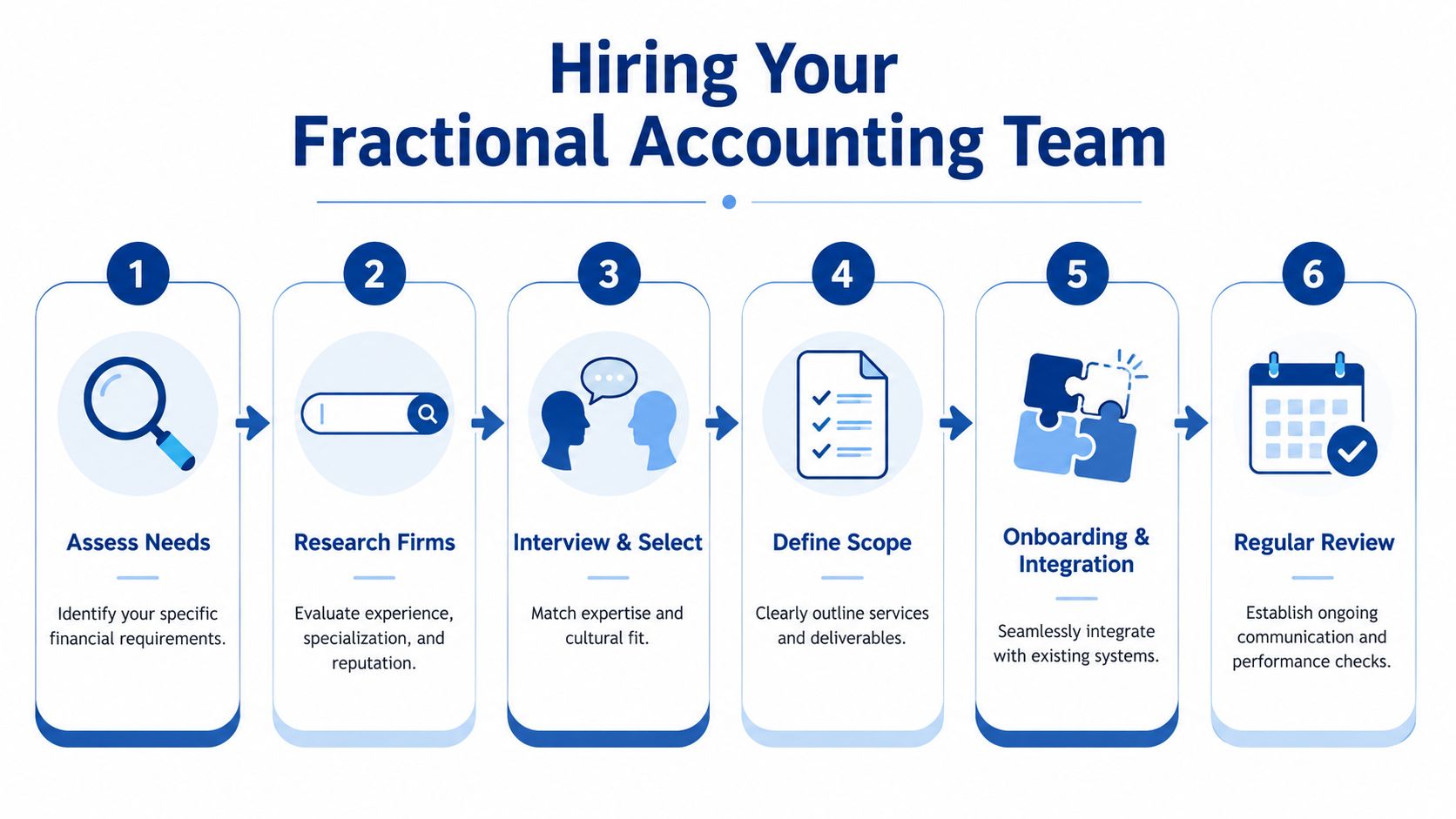
Needs assessment
They review your books, payroll setup, reporting gaps, and workflow pain points.Scope design
The team defines what they’ll own, what stays internal, and what reports will be delivered.System review
They inspect QuickBooks, Gusto, payroll mappings, permissions, and process bottlenecks.Data cleanup and integration
Historical issues get corrected, and the recurring workflow is set.Reporting rhythm launch
Weekly and monthly communication starts, along with close deadlines and review meetings.Ongoing refinement
As you hire, add services, or change reporting needs, the back office evolves with you.
Why people operations belong in the conversation
For service firms, finance and HR touch the same pressure points. Hiring plans affect cash. Compensation affects margins. Onboarding quality affects retention and payroll accuracy.
If you’re also thinking about team structure, external resources on staffing solutions for advisors can be helpful for framing hiring support outside pure accounting. And if your internal processes need tightening, these employee onboarding best practices are worth reviewing because bad onboarding often creates accounting problems later.
The cleanest books usually come from clean processes. Good onboarding, correct payroll setup, and clear ownership upstream make finance easier downstream.
A good fractional team doesn’t just “do accounting.” It becomes the connective tissue between your financial data, payroll systems, and people operations. That’s what turns the back office from a source of friction into a support system for growth.
If your service business needs cleaner books, stronger reporting, payroll support, and a back office that fits how your team works, Steingard Financial is built for that job. Their team supports service firms across the United States with bookkeeping, payroll, QuickBooks and Gusto workflows, and people advisory that helps owners make better decisions with less stress.