 Skip to content
You’re busy, the business is growing, and the numbers still feel strangely slippery.
Revenue is up. Clients are coming in. Payroll is bigger than it used to be. You’ve probably hired help, added software, maybe even expanded service lines. Yet simple questions still take too long to answer. Which clients are the most profitable? Can you afford another hire? Why does the bank balance look healthy one week and tight the next? Why do month-end reports arrive after you already needed them?
That’s the moment many service business owners start looking at fractional CFO services. Not because they suddenly want a corporate org chart, but because they want clarity. They want someone who can turn financial noise into decisions.
The catch is that strategic financial advice only works when the underlying books are clean. If bookkeeping is late, payroll is messy, or the chart of accounts doesn’t reflect how the business really operates, even the best CFO will be working with distorted signals. That’s why the smartest way to think about this topic is not just “What does a fractional CFO do?” but also “What financial foundation has to exist for that work to matter?”
From Growing Pains to Strategic Gains
A familiar pattern shows up in service businesses right after a stretch of growth.
The owner starts out close to everything. They know every client, every invoice, every contractor, every payroll run. Then the company gets larger, complexity creeps in, and the owner becomes the bottleneck for financial decisions. They still approve spending, still worry about cash, still answer profit questions, but they no longer have the time or visibility to do it well.
One week they’re reviewing proposals. The next, they’re trying to reconcile why gross profit feels thin despite strong sales. Then a tax payment, a hiring decision, and a delayed customer payment all collide at once. The business looks successful from the outside, but internally the owner feels like they’re steering through fog.
That’s where fractional CFO services enter the picture. Not as luxury overhead, but as a way to regain control without jumping straight to a full executive hire. For businesses thinking beyond this quarter, that kind of financial guidance also matters when owners start planning how to maximize your business payout in a future sale or transition.
If your current finance setup mostly answers “what happened,” you may need support that helps answer “what happens next.” Many owners first reach that conclusion after tightening their back office with outsourced accounting support for small businesses, then realizing they also need someone to interpret the data and advise on next moves.
A good finance function lowers stress before it raises valuation. It gives the owner a clearer basis for hiring, pricing, and growth decisions.
The right question isn’t whether you need fancy finance. It’s whether your business has become too important to run on delayed reports, gut feel, and a bank balance check.
What Is a Fractional CFO and How Do They Differ from a Bookkeeper
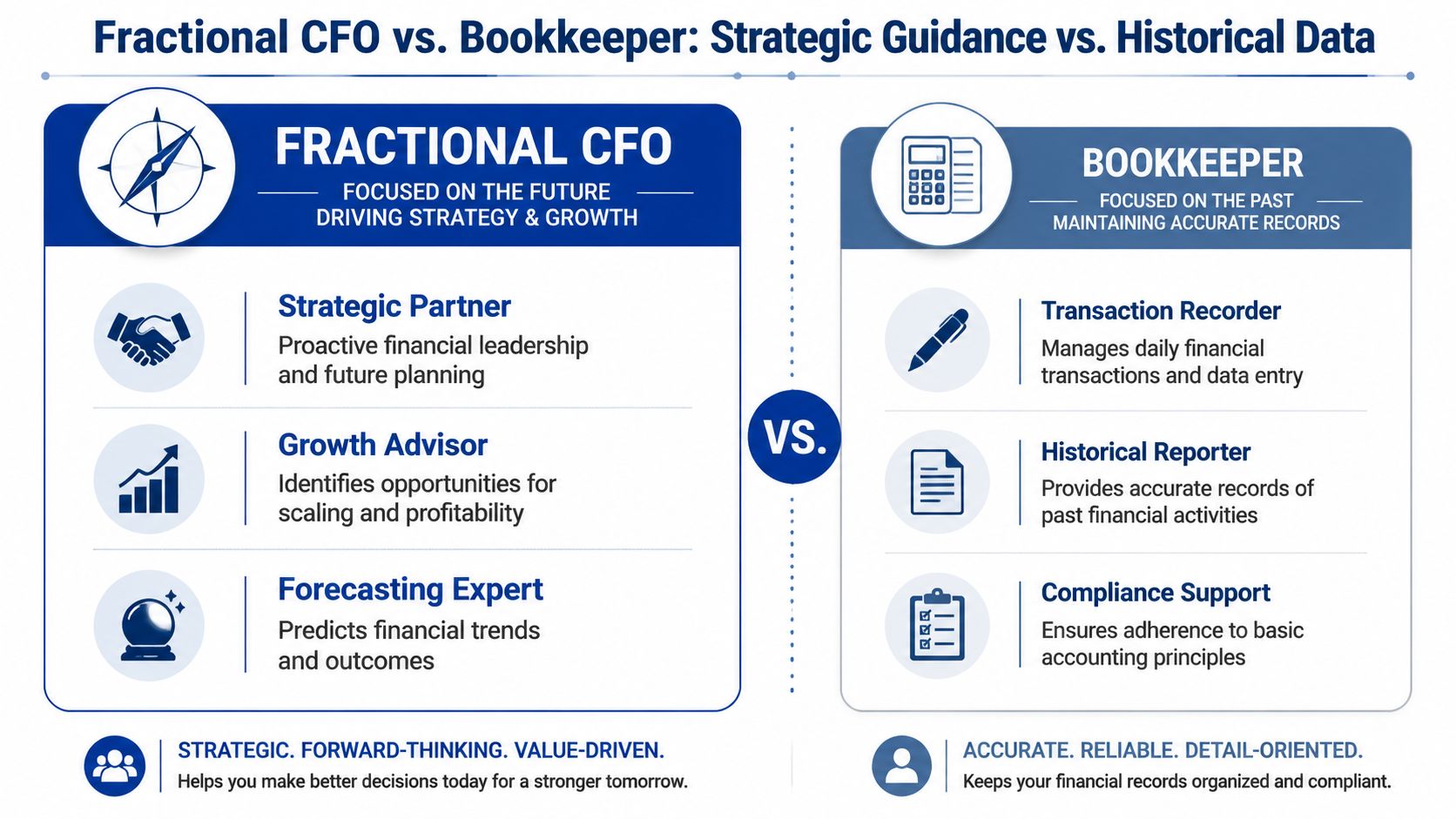
Most confusion around fractional CFO services comes from role overlap. Owners hear “outsourced finance” and assume one person can do everything from coding transactions to advising on expansion. In practice, these are different jobs.
Think of the finance team like a building
A bookkeeper lays the foundation. They record transactions, reconcile accounts, categorize activity correctly, and help make sure the records are complete.
A controller acts like the site manager. That role checks whether reports are accurate, whether processes are consistent, and whether the close is reliable.
A CFO is the architect and strategist. The CFO uses the financial structure to plan what comes next, evaluate options, and guide decisions.
That hierarchy matters because neutral guidance describes fractional CFOs as focused on planning, forecasting, decision support, and oversight rather than recording past transactions, which means their advice is limited without clean inputs from a bookkeeper, as noted by Nperspective’s explanation of fractional CFO services.
What a bookkeeper does
A strong bookkeeper helps you trust the numbers. They typically handle:
- Transaction recording: Sales, expenses, vendor bills, deposits, and transfers
- Reconciliations: Bank accounts, credit cards, loans, and other balance sheet accounts
- Monthly close support: Organizing the records so reports are timely and usable
- Payroll coordination: Making sure payroll entries, taxes, and benefits are reflected correctly
If that work isn’t clean, the reports can look polished while still being misleading. That’s one reason many owners benefit from dedicated bookkeeping services for small businesses before they layer on CFO-level strategy.
For a broader nontechnical explanation of staffing differences, Everglow’s guide to financial staffing is a useful companion.
After you’ve got the role distinction in mind, this short walkthrough helps make the concept more concrete:
What a fractional CFO does
A fractional CFO doesn’t replace bookkeeping. They use good bookkeeping to do higher-order work, such as:
- Planning ahead: Looking at future cash needs, hiring plans, and margin pressure
- Testing decisions: Modeling what happens if pricing changes, payroll grows, or collections slow down
- Creating accountability: Defining metrics and review rhythms so leadership can spot issues early
- Supporting stakeholders: Preparing cleaner financial narratives for lenders, investors, or partners
Practical rule: If your current problem is “our books are behind,” you probably need bookkeeping help first. If your problem is “our books are done, but we still don’t know what to do next,” you may be ready for a fractional CFO.
The Core Deliverables of a Fractional CFO
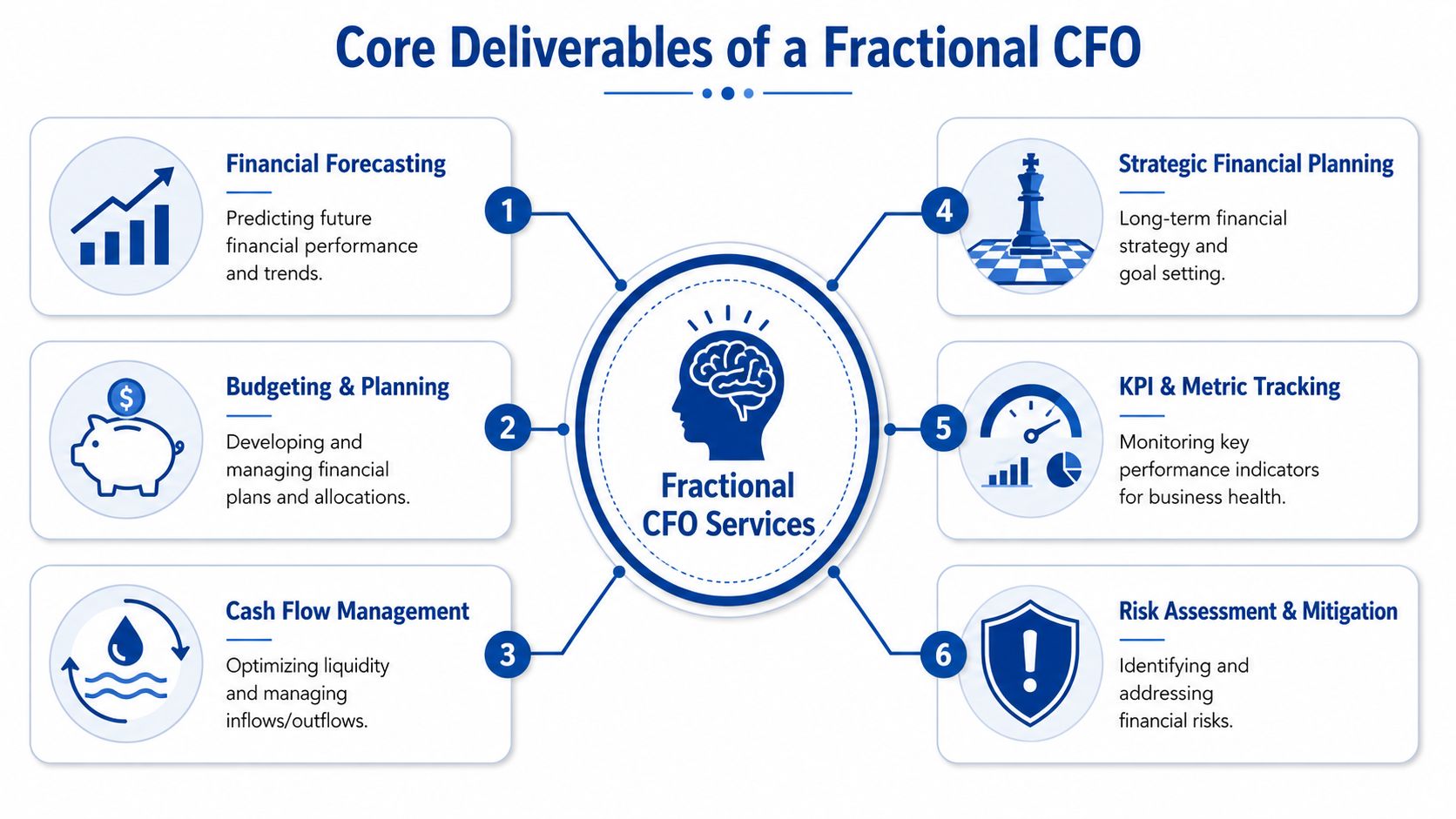
Once the books are dependable, the value of fractional CFO services becomes easier to see. The role is not abstract. It produces specific tools and routines that help owners make better decisions.
Rolling cash flow and scenario models
This is often the highest-value output. Practitioner guidance notes that a fractional CFO’s strongest technical deliverable is usually a rolling cash flow forecast plus scenario modeling that ties operating drivers to liquidity, letting leaders see how changes in hiring, pricing, or collections affect runway and capital needs, as described by Primetrics on fractional CFO services.
That matters because most owners don’t need a prettier spreadsheet. They need a way to answer real questions like:
- Can we add another account manager?
- What happens if a major client pays late?
- Can we absorb a payroll increase this quarter?
- Should we slow hiring until receivables improve?
A well-built model turns those from guesses into decision points.
Budgeting that actually guides behavior
Many businesses have a budget in name only. It may be a rough annual file created once and rarely revisited. A fractional CFO turns budgeting into a living management tool.
That usually means:
- Department-level visibility: Owners can see where spending is drifting
- Variance reviews: Leaders can compare plan versus actual and discuss why
- Updated assumptions: Budget changes reflect real operating conditions, not wishful thinking
When budgeting works, managers stop treating finance like a report card and start using it as a planning tool.
KPI dashboards and operating visibility
A dashboard is useful only if it reflects how the business really runs. A service company may need to track utilization, labor efficiency, client profitability, backlog, or cash conversion signals. A fractional CFO helps select the metrics that drive outcomes, then links them to reporting cadence.
If the dashboard is built on a broken chart of accounts or inconsistent coding, it won’t help. If the structure is sound, it becomes a management instrument.
For businesses that need custom forecasting architecture, a three-statement financial model often becomes the bridge between accounting history and strategic planning.
Support for financing, lenders, or investors
When a company approaches a lender, prepares for a capital raise, or wants to present itself more credibly, a fractional CFO often helps package the numbers into a coherent story.
That can include:
- Board or stakeholder reporting
- Financial modeling for financing conversations
- Narrative support around margins, cash needs, and growth assumptions
The real benefit isn’t that someone makes the reports look sophisticated. It’s that leadership can explain the numbers with confidence because the analysis is grounded in operations.
Understanding Fractional CFO Pricing and Engagement Models
Cost is usually the first practical filter. Owners want to know whether this is a narrow project, a recurring relationship, or a stepping stone before a full-time executive hire.
What the market range typically looks like
One pricing guide notes that a fractional CFO is often priced around $3,000 to $12,000 per month for early- to mid-stage companies, while a full-time CFO can cost roughly $225,000 to $325,000 annually before bonuses. That same guide frames the model as practical for companies that need expertise for 8 to 25 hours per month, depending on the season and complexity of the work, according to Pilot’s fractional CFO cost guide.
That range tells you something important. You’re not buying a title. You’re buying access, judgment, and specific financial output sized to the company’s current needs.
Common engagement structures
Some businesses need ongoing support. Others need focused help around a transition. The most common structures are:
- Monthly retainer: Best when cash flow review, KPI oversight, and recurring planning are needed
- Project-based scope: Useful for a budgeting redesign, forecast build, lender package, or cleanup of finance processes
- Hybrid arrangement: A heavier setup phase followed by a lighter ongoing cadence
The right structure depends on what the business is trying to solve. If leadership needs monthly planning discipline, a one-off project usually won’t stick. If the issue is a specific event, such as financing preparation, a narrower scope may be enough.
Cost Comparison Fractional CFO vs. Full-Time CFO
| Expense Category | Fractional CFO (Retainer) | Full-Time CFO (W-2 Employee) |
|---|---|---|
| Typical cost structure | Monthly retainer | Annual salary |
| Common price range | $3,000 to $12,000 per month | $225,000 to $325,000 annually before bonuses |
| Usage pattern | Often sized for 8 to 25 hours per month | Full-time executive role |
| Flexibility | Scope can expand or contract | Fixed headcount commitment |
| Best fit | Growing companies that need strategic finance without full-time overhead | Companies that need continuous executive-level finance leadership in-house |
What usually drives price
The biggest variables are not mysterious:
- Complexity of the business: Multiple entities, unusual revenue recognition, or lender pressure make the work deeper
- Urgency: Distressed cash situations require more hands-on involvement
- Reporting expectations: Board materials and detailed modeling take more effort than basic advisory check-ins
- Data quality: Messy books increase the time required before strategy can begin
If your records are unreliable, the first part of the engagement often gets spent fixing input problems instead of advising on growth. That doesn’t mean the CFO is unnecessary. It means the finance stack needs sequencing.
Key Signals It Is Time to Hire a Fractional CFO
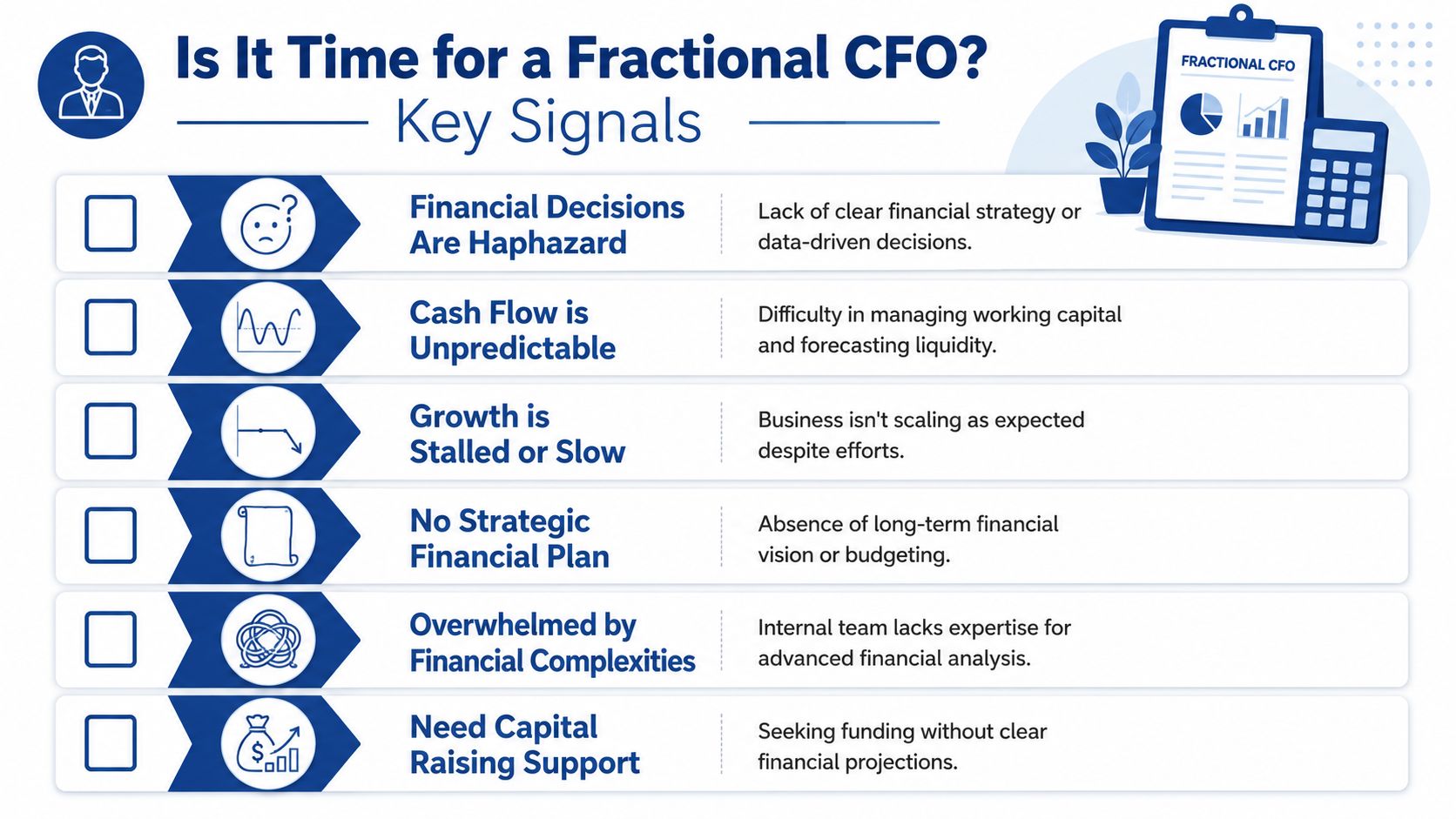
Not every growing company needs a CFO right away. Some need stronger bookkeeping, better payroll controls, or a more disciplined close before strategic finance support will pay off. But there are clear signs that the business has moved beyond basic accounting needs.
The business is producing more questions than your reports can answer
If you keep asking things like “Why are margins slipping?” or “Can we afford this next move?” and nobody can answer quickly, you’ve outgrown bookkeeping-only support.
A bookkeeper can tell you where money went. A CFO helps interpret what it means and what to do next.
Cash feels unpredictable even when sales look strong
This is common in service businesses. Work is sold, invoices go out, payroll keeps running, but timing gaps create stress. The issue may not be profitability alone. It may be collection timing, staffing mix, or spending decisions that aren’t tied to a forward-looking forecast.
When cash surprises keep showing up, owners usually need more than historical reports.
You’re approaching a high-stakes decision
These moments often expose the gap in the finance function:
- Hiring a leadership role
- Opening a new location or line of service
- Taking on debt
- Preparing for investors, lenders, or a possible sale
- Trying to understand which clients or services are driving true profit
A major industry source reports a 103% year-over-year increase in demand for fractional CFOs, with common engagement pricing of $3,000 to $15,000 per month, signaling that this has become a standard growth step for many businesses, according to NOW CFO’s overview of industry growth.
The owner is still acting as the de facto CFO
This is often the clearest signal.
If you are the one reviewing every cash concern, answering every margin question, and trying to turn QuickBooks reports into strategy late at night, the company probably needs a more mature finance layer.
If your best financial process is checking the bank balance before making a decision, the business is overdue for better planning support.
How to Hire and Onboard Your Fractional CFO
Hiring a fractional CFO doesn’t need to feel like recruiting a Fortune 500 executive. But it should be deliberate. The wrong fit creates elegant analysis that never gets used. The right fit gives the owner faster decisions, cleaner communication, and less financial uncertainty.
Start with scope, not resumes
Before interviewing anyone, get specific about what you need.
A good starting list includes questions like:
- Are we trying to improve cash visibility?
- Do we need a budget and monthly variance review?
- Are we preparing for financing or a board presentation?
- Do we need KPI design, pricing analysis, or forecast modeling?
- Is the core issue strategy, or is it that our books still aren’t dependable?
That last question is critical. If reporting is late and payroll entries are inconsistent, a fractional CFO may spend early meetings identifying accounting gaps instead of delivering strategic value.
Questions worth asking in interviews
Don’t focus only on credentials. Ask how the person works.
Good questions include:
- How do you assess the quality of a company’s bookkeeping before building forecasts?
- What reports do you expect to receive each month, and by when?
- How do you work with an existing bookkeeper or outsourced accounting team?
- What does your first ninety days usually look like?
- How do you present financial issues to non-financial owners and managers?
- What would make you say a company is not ready for CFO-level work yet?
The best candidates won’t just describe services. They’ll explain dependencies, cadence, and how they translate data into management action.
A practical onboarding checklist
Once you hire someone, early clarity matters more than speed.
Grant access carefully
Give access to accounting software, payroll systems, reporting files, prior financials, and key contracts.Clarify decision rights
Define who owns bookkeeping, who closes the books, who approves payroll, and who prepares management reports.Set a reporting calendar
Decide when monthly statements are final, when cash reviews happen, and when leadership meetings occur.Choose initial priorities
Most businesses shouldn’t try to fix everything at once. Start with one or two pressing needs, often cash forecast, KPI selection, or margin visibility.Introduce the wider team
The CFO should meet operations, payroll, and administrative leaders. Finance advice gets better when it reflects how work flows.
Watch for one early indicator
You’ll know onboarding is going well when conversations shift from “Where is the data?” to “Given the data, what should we do?”
That’s the handoff from cleanup to strategy.
The Foundation for Fractional CFO Success
The most overlooked truth in this entire topic is simple. A fractional CFO is only as good as the data they receive.
If bookkeeping is delayed, reconciliations are incomplete, payroll is posted incorrectly, or the chart of accounts is too messy to reflect the business model, the CFO can still sound smart. But the analysis won’t be dependable. Strategy built on weak accounting is still weak.

Why clean books change everything
A good CFO asks forward-looking questions. What happens to cash if collections slow? Which service lines carry the strongest margins? When should the company hire? Should pricing change?
Those questions require accurate inputs. Specifically:
- Current reconciliations: Without them, cash discussions become guesswork
- Consistent expense coding: Without it, departmental analysis breaks down
- Reliable payroll posting: Without it, labor economics look distorted
- A useful chart of accounts: Without it, reports don’t match how the business is managed
- Timely close procedures: Without them, leaders make decisions on stale information
This is why owners sometimes feel disappointed after hiring senior finance talent. The issue isn’t always the adviser. Often, the accounting foundation was never ready to support the advice.
Modern CFO work depends on a modern back office
Industry commentary increasingly describes fractional CFOs as strategic AI-data partners using AI-driven analytics and real-time insight, but that only works when the accounting stack is modern, clean, and well-managed, as discussed in Preferred CFO’s perspective on the evolving role.
That trend has a practical implication for service businesses. If your QuickBooks file is disorganized, payroll data lives outside the accounting workflow, and month-end reporting arrives late, “real-time insight” won’t be real. It will just be faster confusion.
What strong groundwork looks like
The best setup is not glamorous. It’s disciplined.
| Foundational element | Why it matters to a fractional CFO |
|---|---|
| Clean bookkeeping | Makes profit, expense, and cash analysis trustworthy |
| Accurate payroll records | Supports labor planning and true margin review |
| Reconciled accounts | Prevents false confidence from incomplete balances |
| Structured chart of accounts | Lets reporting align with departments, services, and decision needs |
| Consistent close cadence | Gives the CFO timely information to work with |
Strong finance strategy starts with ordinary accounting done well and done on time.
When those basics are in place, fractional CFO services become far more valuable. The CFO can spend time on forecasting, scenario planning, and decision support instead of untangling old entries or rebuilding reports from scratch.
Conclusion Building Your Complete Financial Engine
For a growing service business, financial maturity usually comes in two layers.
First, you need a dependable foundation. That means clean bookkeeping, accurate payroll, reconciled accounts, and reports you can trust. Then, once that foundation is in place, a fractional CFO can use that data to guide hiring, pricing, cash planning, and bigger strategic decisions.
That’s why this isn’t a choice between bookkeeping and CFO support. It’s a sequence. One creates reliable inputs. The other turns those inputs into better decisions.
If your numbers feel unclear, start by asking whether the underlying records are timely and accurate. If they are, and you still need stronger financial direction, fractional CFO services may be the right next step. If they aren’t, the smartest move is to fix the foundation first.
If you want a stronger financial foundation before bringing in CFO-level strategy, Steingard Financial helps service businesses build clean books, accurate payroll, and reporting systems you can put to good use. That gives you dependable numbers today and a much better platform for strategic finance support tomorrow.