 Skip to content
Monday starts with client work. By Thursday, you’re deep in QuickBooks, matching bank transactions, checking whether payroll ran correctly, and wondering why one customer still hasn’t paid an invoice from last month. Friday should be for reviewing pipeline, staffing, and margin. Instead, you’re fixing coding errors, answering employee questions about pay, and trying to remember if that contractor form was filed.
That pattern is common in service businesses. The work that supports growth starts competing with the work that keeps the lights on. When bookkeeping, payroll, accounts receivable, and admin tasks pile up, owners don’t just lose time. They lose visibility. And without clean numbers, even simple decisions feel riskier than they should.
From Buried in Paperwork to Focused on Growth
A lot of owners think the problem is volume. It usually isn’t. The actual problem is that the same person is trying to be operator, bookkeeper, payroll manager, and collections lead at the same time.
Take a typical agency, consulting firm, or home services company. Revenue is coming in. New hires are on the horizon. Clients expect fast answers. But behind the scenes, the back office is held together by inbox reminders, spreadsheets, and someone’s memory. QuickBooks might be set up, but the chart of accounts is messy. Payroll runs, but nobody feels fully confident that every detail is right. Invoices go out, but follow-up is inconsistent.
That kind of setup works for a while. Then growth exposes every weak point.
Back office outsourcing is the decision to move those non-client-facing but business-critical tasks to a specialist partner. Not because the work doesn’t matter. Because it matters enough to be handled with discipline, process, and the right tools.
The market shift shows this isn’t a niche move. The global back-office support segment within the BPO market was valued at USD 13,116.1 million in 2025 and is projected to reach USD 26,230.4 million by 2033, growing at a 9.1% CAGR according to Grand View Research’s back-office support market outlook.
Practical rule: If your weekly financial admin is delaying sales follow-up, hiring, or client delivery, the back office has stopped being support work and started becoming a growth constraint.
For U.S. service businesses, this isn’t about handing off random tasks. It’s about building a reliable operating layer under the business. One where QuickBooks stays current, Gusto runs cleanly, invoices move on time, and month-end reports actually help you lead.
What Is Back Office Outsourcing Really?
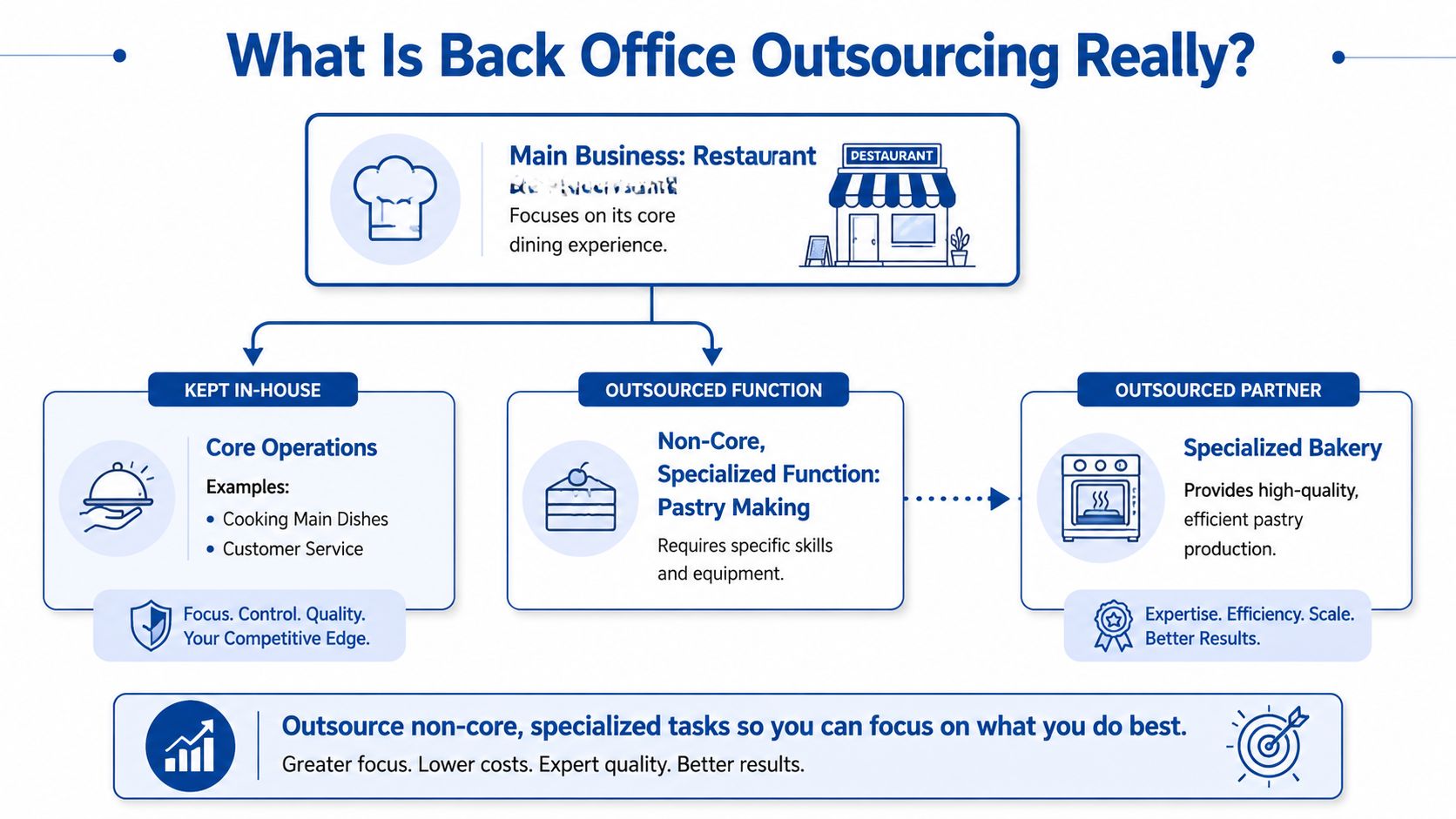
Think of a restaurant that makes great dinners but struggles with pastries. The owner can keep forcing the kitchen to do everything, or they can work with a bakery that focuses on desserts all day, every day. The restaurant still owns the customer experience. It just stops asking the wrong team to do specialized work under pressure.
That’s how back office outsourcing works.
Your business keeps the client relationship, the service delivery, and the strategic decisions. A specialist handles the behind-the-scenes processes that require consistency, technical knowledge, and repeatable workflows.
Finance and accounting sit at the center of this model. In fact, Finance and Accounting is the dominant sub-segment of the global back office outsourcing market, which is projected to grow from USD 264.75 billion in 2024 to USD 487.00 billion by 2032, as noted in Credence Research’s back office outsourcing market report.
If you want a broader overview of common service models before narrowing down your needs, this guide to back office solutions is a useful starting point.
What usually gets outsourced
For service businesses, the outsourced scope often includes a mix of accounting, payroll, and people operations.
Bookkeeping and reconciliations
This covers transaction categorization, bank and credit card reconciliations, cleanup work, and month-end close support. In plain terms, it means your books reflect reality instead of guesses.Accounts payable and accounts receivable
AP is about paying the right bills on time and keeping vendor records clean. AR is about issuing invoices, tracking open balances, and following up so cash doesn’t stall.Payroll administration
Payroll looks simple until it isn’t. A provider can manage processing, deductions, reporting, and the handoff between your time records and payroll platform.People advisory and HR support
This often includes onboarding workflows, benefits administration, compensation support, and routine employee admin through systems like Gusto.
What it looks like in a modern stack
Most U.S. service businesses don’t need a giant enterprise system. They need a stack that works reliably.
A common setup looks like this:
| Function | Common tool | What needs to happen |
|---|---|---|
| Bookkeeping | QuickBooks Online | Accurate coding, reconciliations, clean reports |
| Payroll | Gusto or QuickBooks Payroll | Timely runs, correct setup, organized records |
| Billing and collections | QuickBooks or connected apps | Invoices sent, tracked, and followed up |
| Reporting | Month-end statements and dashboards | Owners see cash flow and performance clearly |
One example of a service built around this model is outsourced bookkeeping for small business, where the work includes cleanup, categorization, reconciliations, and recurring reporting.
Good back office outsourcing doesn’t remove visibility. It creates it.
Strategic Benefits Beyond Cost Savings
The cheapest way to run a back office is often the most expensive way to run a business. When records are late, payroll questions stack up, or collections are inconsistent, leadership ends up making decisions with partial information.
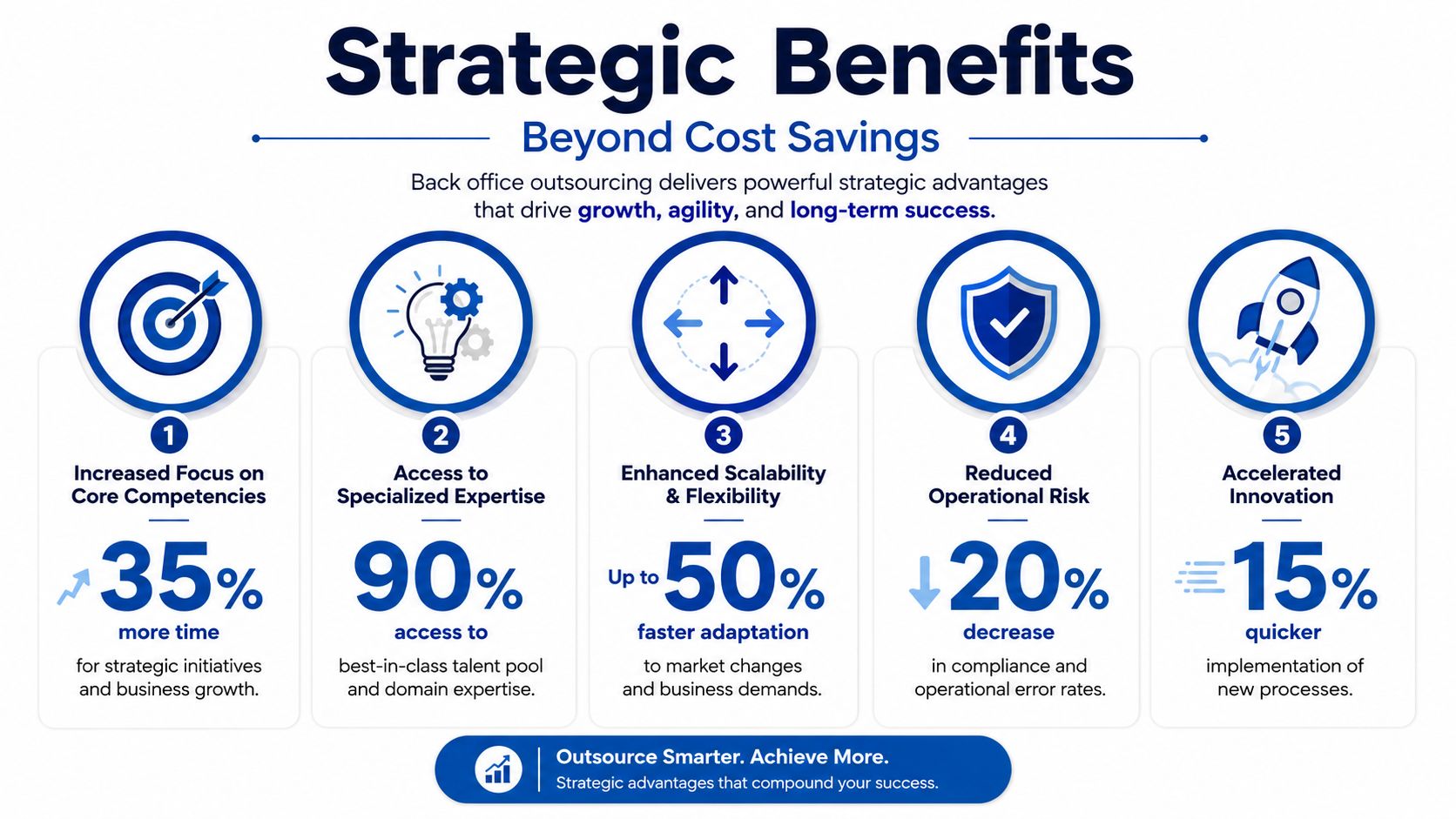
That’s why the primary value of back office outsourcing isn’t just lower overhead. It’s better operating judgment.
Better expertise where it matters
Many small and mid-sized service companies don’t need a full in-house accounting department. They do need reliable execution and a team that understands reconciliations, close processes, payroll coordination, and reporting logic.
That demand shows up even inside finance itself. The back-office outsourcing market within financial services was valued at USD 82.4 billion in 2025 and is projected to reach USD 156.7 billion by 2034, according to DataIntelo’s financial services back-office outsourcing report. When financial firms outsource operational work, it’s a strong signal that expertise and process depth matter.
More room to scale without operational drag
A service business usually grows unevenly. One quarter brings a hiring push. Another brings billing complexity. Another brings payroll changes, contractor volume, or multi-state admin headaches.
An outsourced back office can absorb those shifts more smoothly than an ad hoc internal setup. You aren’t rebuilding processes every time the business changes. You’re plugging growth into a structure that already exists.
For owners comparing support functions across the company, the logic is similar to outsourcing IT support for Central Florida businesses. Specialized partners help internal teams stay focused on work that directly drives customer outcomes.
Cleaner data leads to better decisions
This is the benefit owners feel most, even if they don’t describe it that way at first.
When books are current and payroll data is organized, you can answer practical questions faster:
- Are we pricing work correctly?
- Can we afford another hire right now?
- Which clients are slow to pay?
- Are margins slipping in one service line?
- Is payroll rising faster than revenue?
Those aren’t accounting questions. They’re leadership questions.
A service like outsourced accounting for small business supports that by turning routine accounting work into usable reporting and review.
Owner’s lens: Clean books don’t just help at tax time. They help on hiring day, pricing day, and the day a big client asks for more work.
Understanding and Mitigating the Risks
Outsourcing can solve the wrong problem the wrong way if you choose badly. The risk isn’t outsourcing itself. The risk is assuming any provider with a low price and a polished proposal can safely handle sensitive financial operations.
The hidden cost problem
Many vendors talk about labor savings. Fewer talk about what happens when bookkeeping or payroll isn’t audit-ready.
According to Global Response’s discussion of compliance risk in back office outsourcing, 42% of SMEs face financial penalties from non-compliant bookkeeping or payroll errors, 28% of outsourced payroll providers failed quarterly audit checks, and a single IRS error can cost $10,000 to $50,000.
Those numbers matter because they change the buying question. Instead of asking, “What’s the monthly fee?” ask, “What happens if this provider makes a compliance mistake?”
Four common risks and how to reduce them
Data security concerns
Financial records, payroll files, and employee data are sensitive. If a provider can’t explain how access is controlled, how documents are shared, or how systems are protected, that’s a red flag.
Ask direct questions about:
- User access and who can see what
- Document workflows for payroll and bookkeeping records
- System boundaries between your tools and theirs
- Incident response if something goes wrong
Loss of control
Owners often worry that outsourcing means flying blind. It doesn’t have to.
Control comes from structure. Define deliverables, reporting cadence, approval responsibilities, and escalation paths before work starts. If the provider can’t describe how you’ll review books, approve payroll, or monitor receivables, the engagement will feel vague fast.
A good provider should make your processes more visible than they are today, not less.
Communication gaps
This usually shows up as slow answers, unresolved exceptions, and confusion over ownership. It’s especially painful when you’re closing the month or trying to run payroll on deadline.
Reduce that risk by agreeing upfront on:
- Primary contact for daily issues
- Response expectations for urgent items
- Meeting rhythm for reviews
- Decision rights so nobody guesses
Tax and compliance misunderstandings
Payroll tax handling, contractor setup, and bookkeeping classifications all carry consequences. If you want a plain-language overview of how businesses think through these exposures, managing outsourcing tax risks offers a practical outside perspective.
The takeaway is simple. A low-cost partner who can’t support compliance documentation can become very expensive.
How to Choose the Right Outsourcing Partner
Most selection mistakes happen before any work begins. Owners compare price, skim the proposal, and assume the provider will sort out the messy details later. That’s backwards. The messy details are the job.
Start by treating partner selection like an operations decision, not a procurement exercise.
What to evaluate first
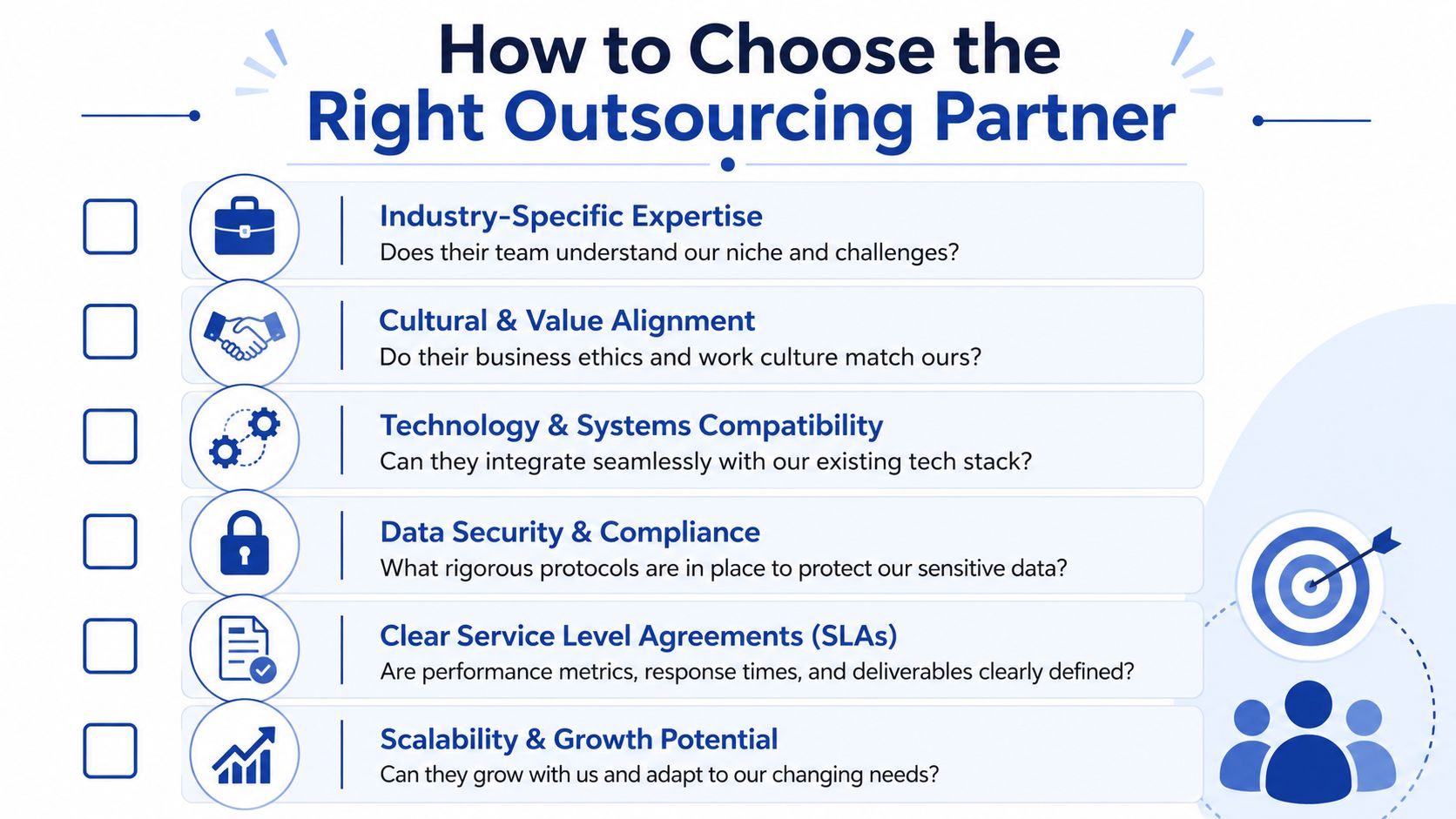
The best partner for a U.S. service business usually isn’t the biggest firm. It’s the one that can fit your workflow, your tools, and your reporting needs without forcing you into a generic model.
Here are the criteria that matter most.
Industry fit
A provider should understand how service businesses operate. Project-based billing, recurring retainers, contractor payments, reimbursable expenses, and uneven cash cycles all create bookkeeping and payroll nuances.Tool fluency
If your business runs on QuickBooks Online and Gusto, your provider should be comfortable inside both. Not just familiar with the names. They should know how data flows, where errors tend to happen, and how to keep records consistent between systems.U.S. compliance awareness
Payroll and accounting for American businesses require familiarity with U.S. requirements, reporting expectations, and documentation standards. This is especially important if you have multiple employees, contractors, or state-level complexity.
Questions worth asking in the sales process
A short conversation can reveal a lot. Ask these and listen closely to the answers.
| Question | Why it matters |
|---|---|
| How do you handle cleanup from previous providers? | Many businesses switch because the books are already messy |
| What does month-end reporting include? | You need visibility, not just data entry |
| How do you manage QuickBooks and Gusto together? | Tool integration affects payroll, coding, and reporting quality |
| Who owns communication day to day? | Slow answers create operational friction |
| How are SLAs and deliverables defined? | Vague scope leads to missed expectations |
Signs you’re talking to the right kind of partner
Some providers answer in abstractions. Others talk in workflows.
Look for specifics such as:
- Close process discipline instead of generic promises about accuracy
- Defined review cadence instead of “we’ll stay in touch”
- Platform-level familiarity with QuickBooks, Gusto, and reporting tools
- Willingness to map your current process before proposing changes
One option in this category is Steingard Financial, which supports service businesses with bookkeeping, AP/AR, payroll, reporting, and people advisory using QuickBooks and Gusto-based workflows. The point isn’t brand preference. It’s fit.
Selection shortcut: If a provider can’t explain how they would handle your current exceptions, they probably haven’t handled enough businesses like yours.
What transparent pricing should feel like
You don’t need the cheapest quote. You need a scope you can understand.
A clear proposal should spell out:
- What tasks are included
- What requires extra work or cleanup
- How communication happens
- What the reporting cycle looks like
- How changes in volume are handled
If pricing is unclear, delivery usually will be too.
Your Phased Roadmap to a Smooth Transition
A lot of owners delay outsourcing because they assume the transition will be chaotic. It doesn’t need to be. The smoother handoffs usually come from a phased rollout, not a giant one-day switch.
Early in the process, it helps to visualize the sequence.
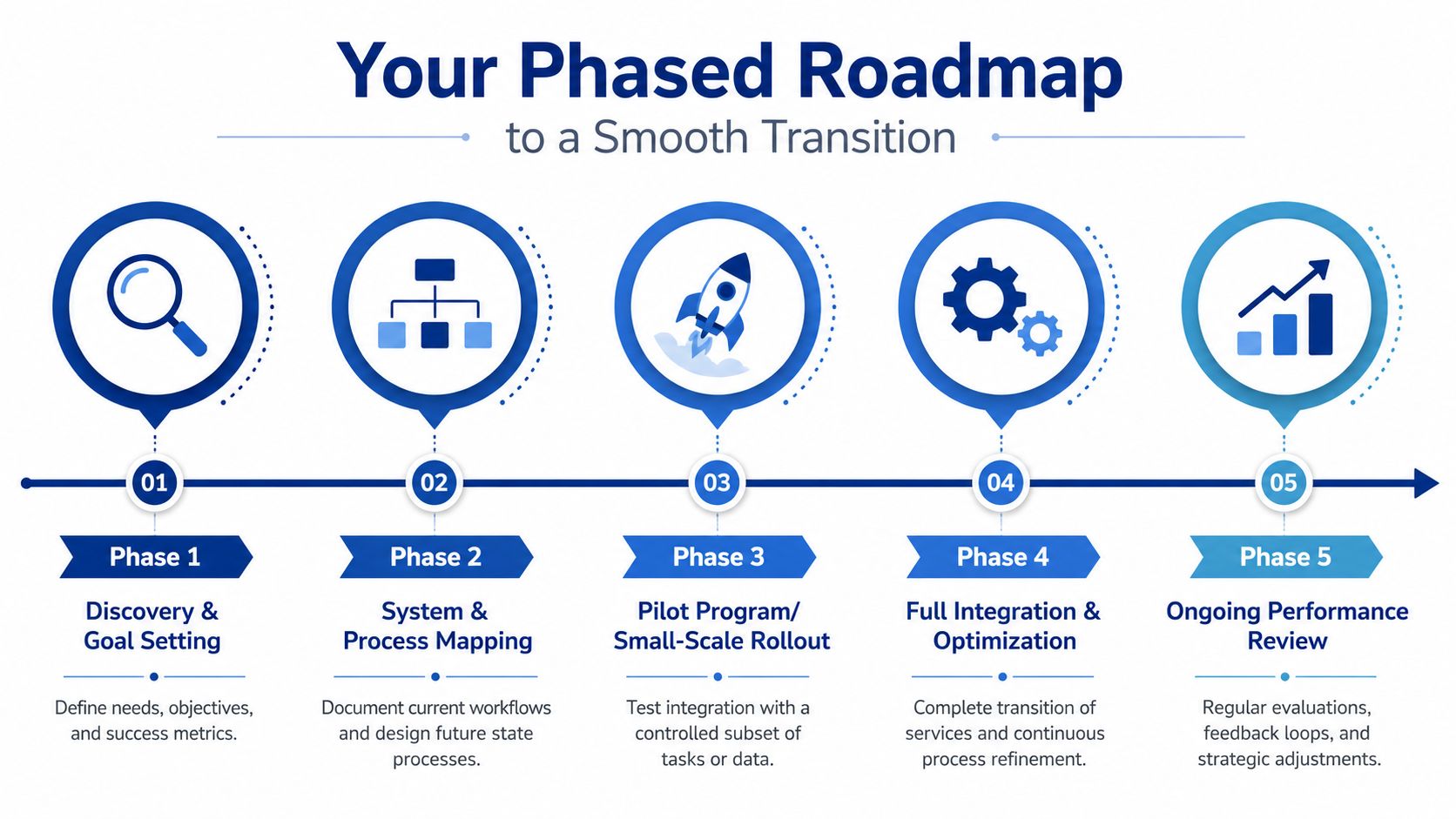
Phase one and two
Start with discovery, then move into process mapping.
Phase 1. Discovery and goal setting
Define what’s broken, what must stay the same, and what success looks like. That may include cleaner QuickBooks records, more reliable payroll through Gusto, or faster month-end reporting.
Phase 2. System and process mapping
During this phase, a provider documents how invoices move, how payroll inputs are gathered, how reconciliations are handled, and where approvals sit. If the business already has errors or historical cleanup needs, this phase surfaces them before they create confusion later.
For a business evaluating payroll support specifically, outsource payroll for small business is the kind of service category to compare during this stage, especially if payroll is your current bottleneck.
A short operational walkthrough can also help teams picture how handoffs work in practice.
Phase three through five
Once the process is mapped, don’t rush into full migration.
Phase 3. Pilot or small-scale rollout
Move a controlled set of tasks first. That might mean one payroll cycle, a single reporting workflow, or a defined AP/AR process. A pilot exposes edge cases while the stakes are lower.
Phase 4. Full integration and optimization
After the pilot works, the provider takes over the broader scope. This is where recurring rhythms matter: payroll calendars, bookkeeping close checklists, invoice follow-up, and reporting delivery dates.
Phase 5. Ongoing performance review
This is the difference between outsourcing as a handoff and outsourcing as a management system. Review output regularly, identify recurring issues, and adjust.
According to Managed Outsource’s overview of back office outsourcing performance, successful outsourcing depends on strict SLAs and measurable KPIs, with key benchmarks including reduced turnaround times and lower error rates.
The KPIs that actually matter
Don’t track everything. Track the indicators that show whether the back office is becoming easier to run.
Days to close the books
Are month-end statements arriving when you can still use them?Invoice accuracy
Are invoices going out correctly the first time?Payroll error rate
Are employees getting paid accurately and on schedule?Outstanding receivables review cadence
Is someone actively managing open invoices?Owner time spent on admin
Are you spending less time chasing paperwork and more time leading?
A smooth transition isn’t measured by how busy onboarding feels. It’s measured by whether the work becomes simpler, clearer, and more dependable after go-live.
Reclaim Your Focus and Fuel Your Growth
Back office outsourcing isn’t about stepping away from your numbers. It’s about finally getting close enough to them to lead well. When bookkeeping is current, payroll runs cleanly, and reporting arrives on time, the business gets easier to manage.
For U.S. service companies using tools like QuickBooks and Gusto, that shift is practical. You remove bottlenecks, reduce avoidable risk, and give yourself better information to make hiring, pricing, and cash flow decisions.
The back office shouldn’t be a pile of unfinished tasks sitting behind your real work. It should be the operating system that supports growth. When it’s built well, you feel the difference every week.
If your team is spending too much time cleaning up books, managing payroll questions, or chasing reporting gaps, Steingard Financial offers bookkeeping, payroll, AP/AR, reporting, and people advisory support for U.S. service businesses using tools like QuickBooks and Gusto.