 Skip to content
You’re probably feeling this in the business already.
Revenue is decent. Clients keep coming in. Your calendar is full. But growth doesn’t feel clean anymore. Projects slow down because a key employee is overloaded. A new hire takes too long to get up to speed. Good people seem tired, and your best managers spend half their week answering repeat questions, fixing handoff issues, and covering work that should’ve been handled lower in the org chart.
From the outside, it can look like a capacity problem. Inside the business, it usually feels more personal than that. You wonder whether you hired the wrong people, whether your team has lost urgency, or whether this is simply what growth feels like.
Often, it’s neither a motivation problem nor a discipline problem. It’s an investment problem. You’ve added clients, software, and overhead, but you haven’t invested in the asset that delivers the service. Your people.
When Your Team Becomes Your Biggest Bottleneck
A lot of service business owners hit the same wall.
An agency founder grows from a small, nimble team into a larger operation. Suddenly, every client deadline depends on two senior people. A bookkeeping firm lands more accounts, but month-end becomes chaotic because processes live in employees’ heads instead of in a repeatable system. A consulting company hires fast, then realizes new team members take months to contribute at the level clients expect.
None of these businesses is failing. They’re just trying to scale on top of a people system that was built for a smaller company.
What the bottleneck actually looks like
It rarely shows up as a single dramatic event. It looks more like this:
- Top performers become shock absorbers. They catch mistakes, answer questions, and protect client relationships.
- Owners stay too involved. You still approve too much, explain too much, and rescue too often.
- New hires stay “new” for too long. They’re on payroll, but they’re not yet producing at the level you need.
- Client experience gets uneven. One client gets white-glove service. Another gets delays and rework.
That’s where many owners start searching for better retention, stronger onboarding, and clearer role design. If that’s where you are, this practical guide on how to improve employee retention is a useful next read.
The team isn’t the problem. The business may simply be asking for more output than its people systems can support.
Why this is a human capital issue
In a service business, your team is the delivery engine. You don’t sell inventory sitting on a shelf. You sell judgment, responsiveness, technical skill, consistency, and trust.
That means your company’s real productive asset walks in every morning, logs in from home, joins calls, answers clients, closes books, manages projects, and solves problems. If that asset is undertrained, misaligned, burned out, or constantly replaced, growth gets expensive.
Investing in human capital means treating those people capabilities as something you build on purpose. Not just with raises or perks, but with deliberate choices about hiring, onboarding, pay design, training, management, and support.
When owners start seeing the issue this way, the conversation changes. They stop asking, “Why can’t my team keep up?” and start asking, “What have I built to help them perform well at scale?”
That’s a much more profitable question.
What Is Human Capital Really
Human capital sounds academic, which is one reason many owners tune it out. The term can feel like something meant for economists, policy people, or HR departments.
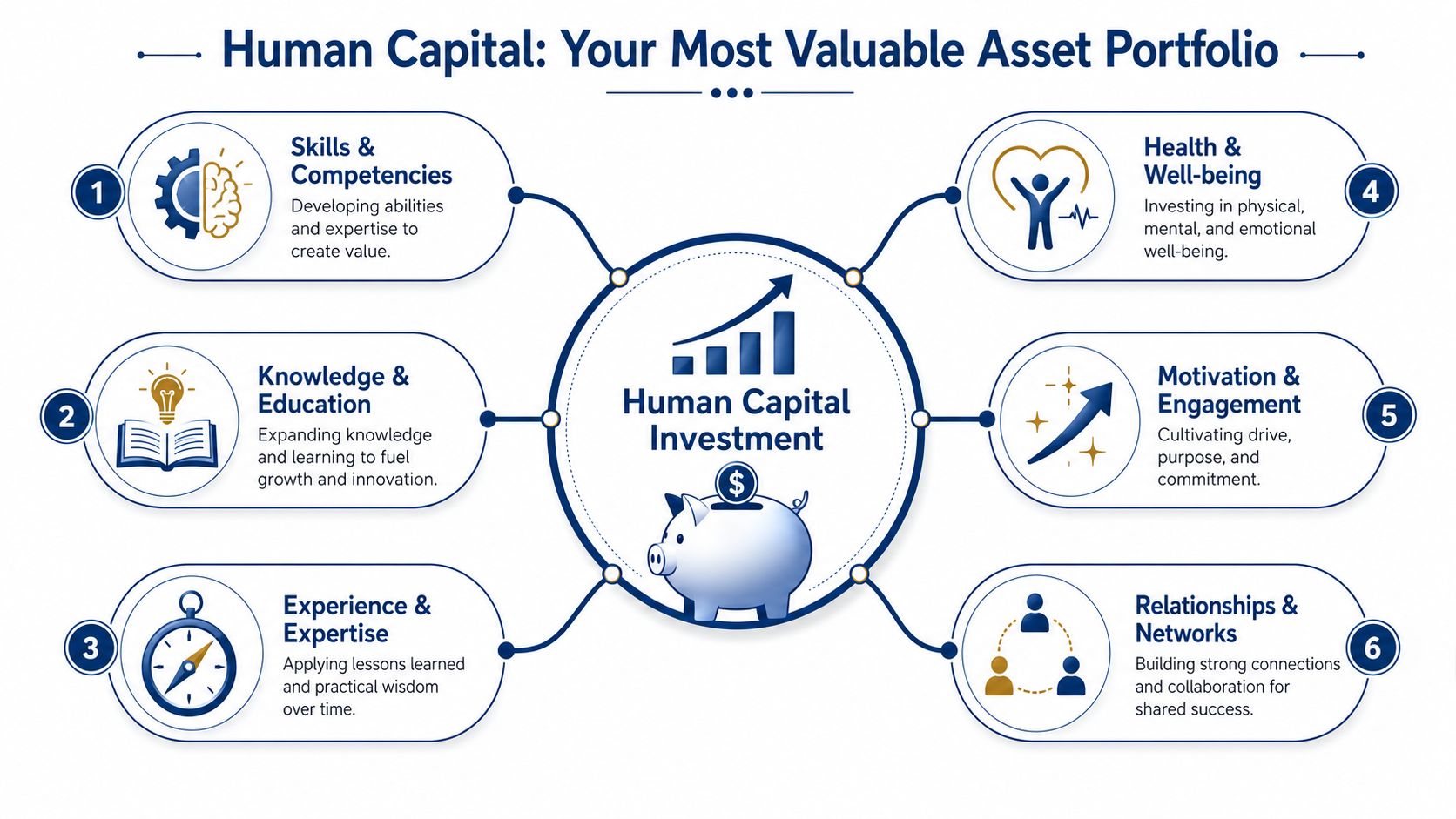
But the idea is simple. Human capital is the combined value of your team’s skills, knowledge, experience, health, motivation, and working relationships. It’s the part of your business that turns effort into results.
Think of it like an asset portfolio
A helpful way to picture human capital is to think about an investment portfolio.
You wouldn’t look at a brokerage account and say, “That’s just a cost.” You’d ask what assets are in it, how they’re performing, where the gaps are, and what additional investment could increase future returns.
Your team works the same way.
| Portfolio view | People view |
|---|---|
| Asset mix | Skills, experience, and role coverage |
| Risk exposure | Turnover, burnout, poor management, weak bench |
| Return potential | Better execution, stronger client service, higher margins |
| Reinvestment strategy | Training, coaching, onboarding, compensation, benefits |
A strong team portfolio has depth. It doesn’t depend on one person knowing everything. It doesn’t break when someone takes vacation. It doesn’t need the owner to translate every task into action.
Why it matters beyond HR language
Economists writing in the American Economic Association’s Journal of Economic Perspectives report that human capital explains at least one-third of the variation in labor earnings within countries and at least half of the variation across countries, and they conclude these investments produce high economic returns. For a business owner, the important translation is straightforward. Education, training, and skill-building are tied directly to productivity and wages.
That matters because many owners still treat people investment as optional after “real” business expenses are covered. But if your service quality depends on what your team knows and how well they apply it, then human capital isn’t a side issue. It’s operating infrastructure.
What owners usually miss
Human capital isn’t just formal training.
It also includes:
- Role clarity: People do better work when they know what good looks like.
- Manager quality: A strong manager multiplies output across the team.
- Health and stability: A burned-out employee may still be present, but won’t perform at full strength.
- Team trust: Work moves faster when handoffs are clean and people communicate openly.
Practical rule: If a problem keeps showing up in payroll hours, missed deadlines, client complaints, or owner stress, there’s a good chance you’re looking at a human capital issue wearing an operations costume.
Once you see that, the phrase stops sounding like HR jargon. It becomes a concrete business asset. One you can measure, improve, and compound over time.
The Clear Business Case for Service Businesses
For a service business, investing in human capital isn’t a cultural side project. It’s a margin strategy.
Your revenue depends on people showing up prepared, doing quality work, communicating well, and solving client problems without constant supervision. When those capabilities improve, the business usually gets better in ways owners care about immediately. Less rework. Better client retention. More confidence in delegation. Cleaner delivery. More stable profit.
Why service firms feel this more than other businesses
If you run a restaurant supply company, a manufacturer, or an ecommerce brand, people still matter. But service businesses are unusually exposed because the product and the team are so tightly connected.
Clients don’t just buy your company name. They buy the experience of working with your staff.
That shows up in several ways:
- Expertise affects pricing power. Skilled staff can handle more complex work and justify stronger fees.
- Consistency affects retention. Clients stay when service feels dependable.
- Onboarding affects cash flow. The faster new hires become productive, the faster labor spend turns into useful output.
- Morale affects client experience. Tired, disconnected teams don’t communicate with the same care or speed.
A useful example is benefits planning. Many small businesses know benefits matter, but they struggle to compare options in a practical way. This overview of Pounds Health Insurance group benefits is helpful because it frames benefits as a staffing and retention tool, not just an insurance purchase.
There’s evidence this affects performance
Irrational Capital reports that its analysis across 70,000 companies and 750 million data points found firms where employees feel recognized, aligned, and trusted outperformed, with roughly 4% annual outperformance over 14 years across sectors and company sizes, as described in this Irrational Capital discussion.
You don’t need to run a public company to use the lesson. If recognition, alignment, and trust influence retention, innovation, and customer experience, then they also influence the daily economics of a service firm.
What this looks like on the ground
A better people strategy often improves business performance through ordinary mechanics, not dramatic transformation.
A clearer compensation structure helps managers explain growth paths. Better onboarding reduces avoidable questions. Training narrows quality gaps between senior and junior staff. Better benefits make it easier to keep strong employees through stressful seasons.
Those are not “soft” outcomes. They affect utilization, hiring costs, management time, and client confidence.
A service business can survive weak systems for a while. It can’t scale that way for long.
That’s why smart owners eventually stop asking whether they can afford to invest in people. They ask where a poorly supported team is already costing them money.
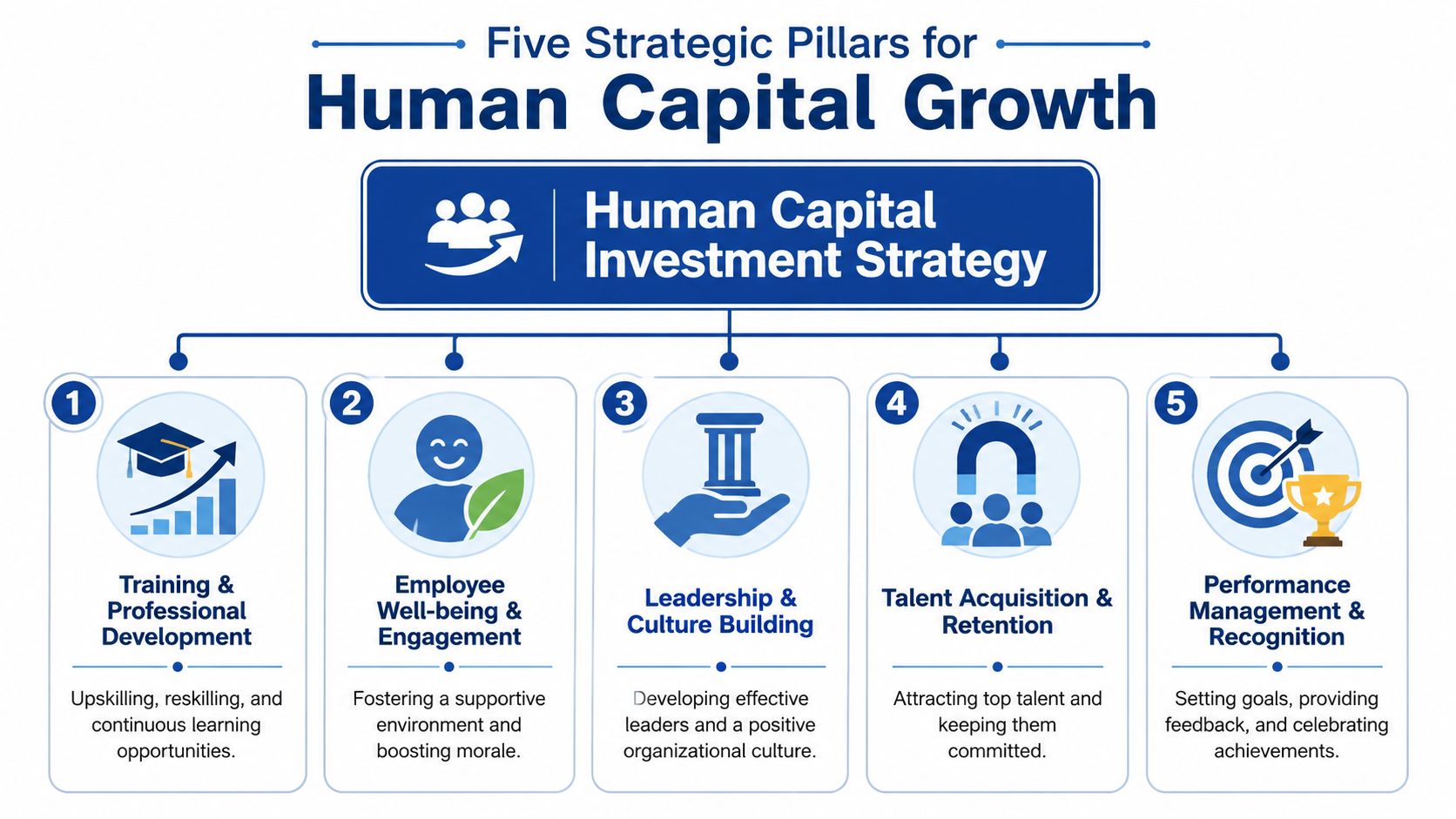
Five Strategic Areas for Your Human Capital Investment
The phrase “invest in people” is too vague to guide decisions. Most owners need a short list of areas where spending time and money will effectively change performance.
These five are the ones that usually matter most in service businesses.
Training and professional development
Training is the most obvious category, but it’s often handled loosely. Owners pay for a course, a conference, or a few internal shadowing sessions and call it development.
A stronger approach starts with the work. Where do errors happen? Which tasks bottleneck at the senior level? What knowledge is trapped in one person’s head?
Then build development around those gaps.
- Technical skill building: Teach the work that increases quality and speed.
- Role-specific playbooks: Document how your firm does recurring tasks.
- Manager coaching: Train supervisors to give feedback, not just assign work.
Wellington argues that companies should tie hiring goals to growth objectives, use analytics in recruiting, and maintain explicit development plans because transparent feedback and organizational responsiveness are associated with higher retention, lower absenteeism, improved productivity, better customer service, and stronger morale, as outlined in Wellington’s perspective on human-capital management strategies.
If you’re working through role design and hiring needs, a staffing plan template can help turn broad growth goals into specific headcount and capability decisions.
A short training resource can also help owners think more visually about the framework:
Compensation and performance frameworks
Pay sends signals. So do promotion criteria, bonus rules, and review conversations.
When compensation is inconsistent or opaque, employees invent their own stories. Usually, those stories are worse than the truth. A cleaner framework helps people understand what’s expected, how growth happens, and what the business values.
A good framework answers practical questions:
- What does success look like in this role?
- What skills justify higher pay?
- How often do we review compensation?
- Who decides, and based on what evidence?
Health and well-being support
Burnout isn’t just an emotional issue. In a service firm, it turns into missed details, delayed responses, lower patience, and weak client interactions.
That’s why health support matters. Benefits, flexibility, workload management, and realistic staffing all contribute to whether your team can sustain performance.
This doesn’t mean every company needs an elaborate wellness program. It means owners should notice where operational pressure is subtly draining output.
Onboarding and culture
Culture isn’t a slogan on a website. It’s how work feels to the people doing it.
Good onboarding is one of the fastest ways to shape that experience. It tells a new hire what matters, how decisions get made, how quality is judged, and where to get help. Without that, even capable people guess.
Retention and internal mobility
Some turnover is normal. But avoidable turnover is expensive because it breaks continuity and forces your strongest employees to carry the transition.
Retention gets stronger when employees can see a future in the company. That future doesn’t always mean a new title. Sometimes it means broader responsibility, better support, more autonomy, or a clear path to mastering the role they already have.
How Your Back Office Enables Your People Strategy
A lot of people strategy fails for a boring reason. The back office can’t support it.
Owners decide they want better compensation planning, cleaner onboarding, stronger benefits administration, or more useful reporting. Then they realize their books are behind, payroll data is messy, job cost visibility is weak, and no one has a reliable system for tracking what’s happening across the team.
Clean books make people decisions possible
If bookkeeping is inaccurate, your people strategy becomes guesswork.
You can’t confidently answer questions like:
- Can we afford another hire right now?
- Which departments are carrying the highest labor cost?
- Are overtime patterns pointing to understaffing or poor workflow?
- What budget exists for training, benefits, or manager development?
Monthly financials matter here. So do class tracking, job-level visibility, reconciliations, and consistent coding inside QuickBooks Online. Without that discipline, “invest in people” sounds good but stays vague.
Payroll systems do more than run paychecks
Modern payroll platforms like Gusto and QuickBooks Payroll are part of your operating system. They don’t just send wages. They help implement pay structures, manage benefits, standardize onboarding tasks, and create records that support consistent decisions.
When payroll is handled well, you can:
- Apply compensation rules consistently
- Track employee changes cleanly
- Reduce admin friction during onboarding
- Support benefits enrollment without scattered paperwork
If payroll has become a manual headache, the operational upside of outsourcing payroll is often bigger than owners expect. The gain isn’t just time saved. It’s better control.
Financial hygiene and people strategy are linked. If one is weak, the other usually stays reactive.
People Advisory sits between HR and finance
For many growing firms, the most pressing need for assistance arises. They don’t just need software. They need someone to connect payroll, financial data, staffing plans, compensation decisions, and retention issues into one operating picture.
That’s the practical role of People Advisory. It helps owners move from isolated tasks to coordinated decisions.
For example, if you’re hiring for an HR leadership role or trying to sharpen your internal hiring lens, these interview questions to evaluate HR are useful because they reveal whether a candidate can think beyond administration and into systems, policy, and workforce planning.
A strong back office won’t create culture by itself. But it gives you the structure to fund, execute, and sustain the people strategy you want.
Measuring the Return on Your People Investment
Owners usually don’t struggle with the idea of investing in people. They struggle with proving whether it’s working.
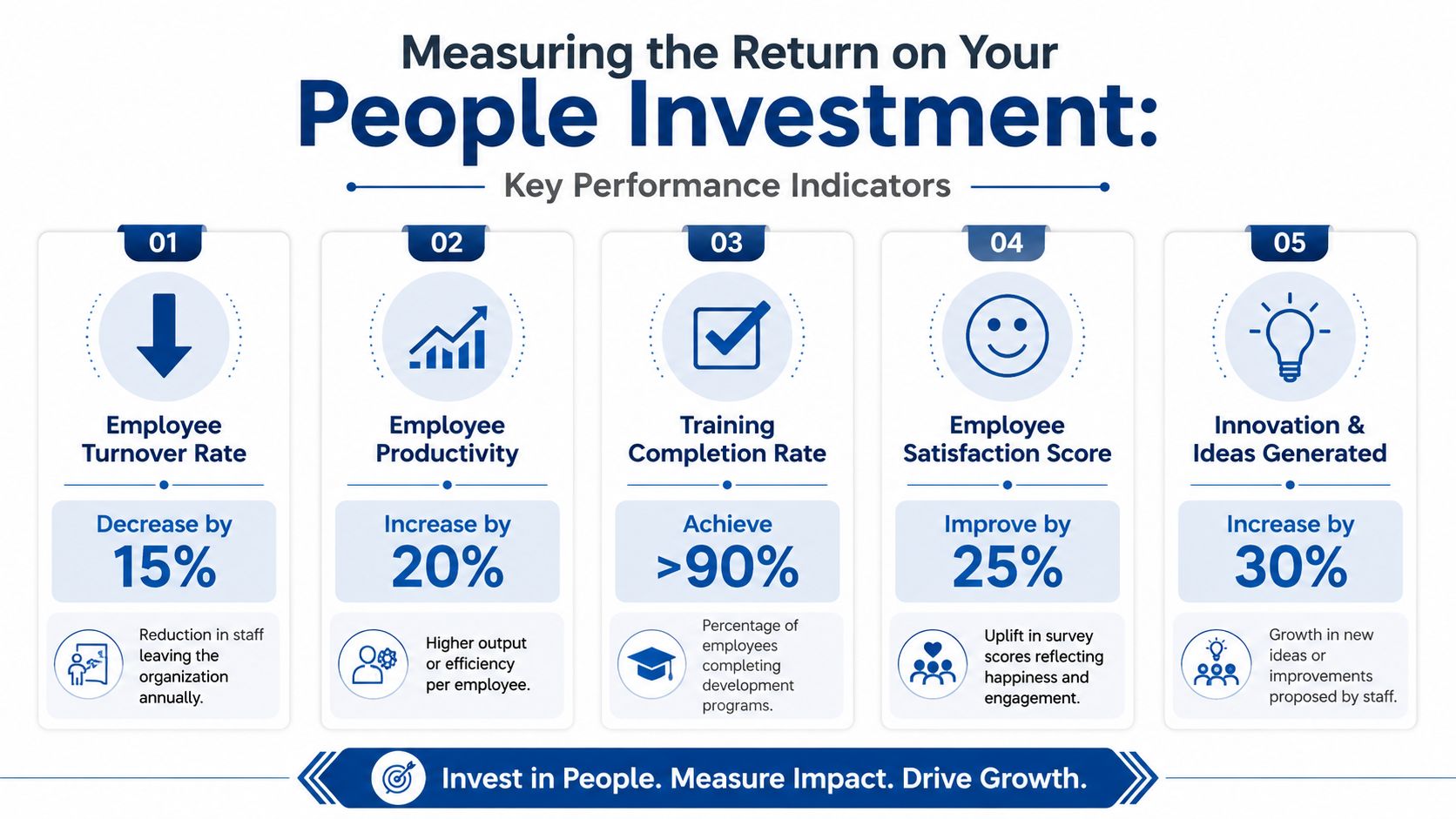
That’s fair. “We care about our team” isn’t a metric. You need indicators that connect people decisions to business outcomes.
Don’t measure training alone
The World Bank and U.S. policy analysis emphasize that the value of human capital depends not only on accumulation, such as training, but also on deployment. In other words, the question isn’t just whether people learned something. It’s whether the business enabled them to apply it productively and resiliently, as discussed in this White House human capital analysis.
That’s a useful warning for business owners. A training budget can grow while execution stays flat if roles are unclear, management is weak, or workflows block people from using what they know.
A practical scorecard for service firms
You don’t need a complicated dashboard. Start with a handful of measures you can review consistently.
- Revenue per employee: Shows whether the team’s productive capacity is rising with growth.
- Retention rate: Helps you see whether good people are staying long enough for your investment to compound.
- Time to productivity for new hires: Tracks how quickly someone becomes fully useful in the role.
- Employee lifetime value: Estimates the long-run value created by a strong hire relative to what it cost to recruit, onboard, and support them.
- Client-facing quality signals: Look at rework, missed deadlines, escalation frequency, and client complaints.
What to look for in the data
You’re not hunting for perfect precision. You’re looking for patterns.
| If this improves | It may mean |
|---|---|
| Faster ramp time | Onboarding and manager support are stronger |
| Better retention | Compensation, role fit, or team experience is improving |
| Higher revenue per employee | Skills, systems, or delegation are getting better |
| Fewer quality issues | Training and accountability are working together |
If wellness is one of your focus areas, this guide for HR on wellness ROI is a useful companion because it pushes measurement beyond good intentions and into trackable outcomes.
If you only track the cost of people investments, you’ll miss the value created when employees perform better, stay longer, and serve clients more consistently.
The best measurement systems aren’t fancy. They’re disciplined. They help you decide what to keep funding, what to redesign, and where your next people investment should go.
Your Human Capital Investment Starter Checklist
You don’t need a full HR transformation to begin. Most service businesses can make real progress by tightening a few core practices first.
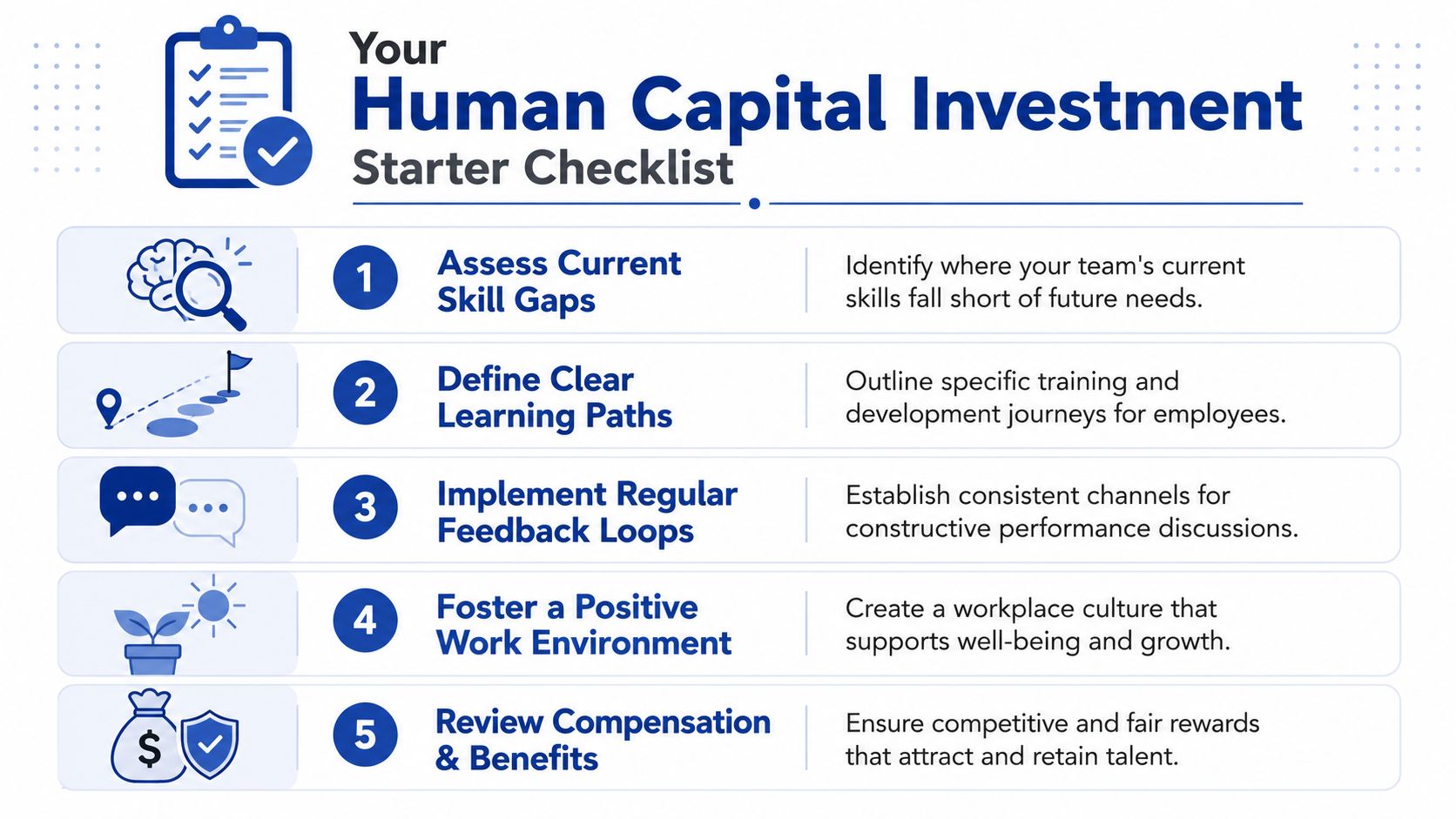
Start with these five moves
- Review one critical role. Pick the position that causes the most bottlenecks when it’s underperforming. Clarify responsibilities, success measures, and needed skills.
- Audit your onboarding. Look at what a new hire receives in the first week. Remove confusion, add checklists, and document repeat processes.
- Choose one development priority. Don’t try to train everyone on everything. Focus on the capability that would most improve client delivery or manager effectiveness.
- Check compensation logic. Make sure pay decisions follow a clear rationale, not just urgency or negotiation pressure.
- Ask your team three direct questions. What slows down your work? What skill would help you do your job better? What makes someone successful here?
Keep the first round simple
The point is to build operating habits, not create paperwork.
The formal study of human capital gained prominence with the OECD’s 1998 report and later the World Bank’s Human Capital Project, showing this isn’t a management fad but a measurable growth asset used in major policy and development frameworks worldwide, as reflected in the OECD’s work on human capital investment.
That should be encouraging to a business owner. You don’t have to invent a philosophy from scratch. You just have to apply a proven idea to your own company with discipline.
A better team doesn’t happen by accident. It’s built the same way any valuable asset is built. With attention, structure, and steady reinvestment.
If you want help turning people strategy into something operational, Steingard Financial can help you connect bookkeeping, payroll, reporting, and People Advisory into one system that supports growth. That means cleaner financial visibility, better payroll execution, and a stronger foundation for hiring, onboarding, compensation, and retention decisions.