 Skip to content

Top line revenue is the total sales income your business earns before any expenses are deducted, and the basic formula is total units sold × price per unit. If a business sells 10,000 subscriptions at $50 each, its top line revenue is $500,000.
If you’re running a service business, you probably know the feeling. The calendar is full, invoices are going out, payroll is running, and clients keep asking for more work. But when you open QuickBooks or review a monthly report, the big question is still hanging there: are we growing, or are we just busy?
That’s where what is top line revenue stops being an accounting phrase and starts becoming a management tool. It tells you the size of your sales engine before costs, taxes, and overhead cloud the picture. For a service business owner, that matters because many decisions, hiring, pricing, capacity, and forecasting, start with a clear read on revenue coming in from core operations.
Your Business’s Financial Starting Line
Many owners initially check their bank balance and treat that as the headline number. That’s understandable, but it’s also where confusion starts. Cash in the bank tells you what’s available today. Top line revenue tells you what the business sold during a period.
For a service business, this difference matters more than one might expect. You might collect a retainer in one month, deliver work across several months, and run payroll every two weeks through Gusto or QuickBooks Payroll. If you only look at cash, the business can appear stronger or weaker than it really is.
Why this number comes first
Top line revenue sits at the beginning of the financial story because it answers the first operational question: how much demand did the market show for what you sell? Before you talk about margins, efficiency, or net income, you need to know the sales number those later results came from.
Think of it as the starting line on a track. If the starting point is wrong, every later split time is wrong too.
Practical rule: If you’re unsure whether a number belongs in revenue, ask whether it came from delivering your actual service to a client. If the answer is no, it probably doesn’t belong in your top line.
Where service owners get tripped up
Service businesses often blur revenue with other inflows. Common examples include:
- Owner funding: Money you put into the business is cash, but it isn’t revenue.
- Loans or credit draws: Borrowed funds help liquidity, not sales performance.
- Reimbursements: Some pass-through client charges need careful treatment so reports stay meaningful.
- Timing issues: Cash received upfront isn’t always fully earned revenue yet.
That’s why clear bookkeeping matters. Top line revenue gives you a cleaner view of sales performance than your checking account ever will. Once you understand that, the rest of the income statement becomes much easier to read.
The Core Concept of Top Line Revenue
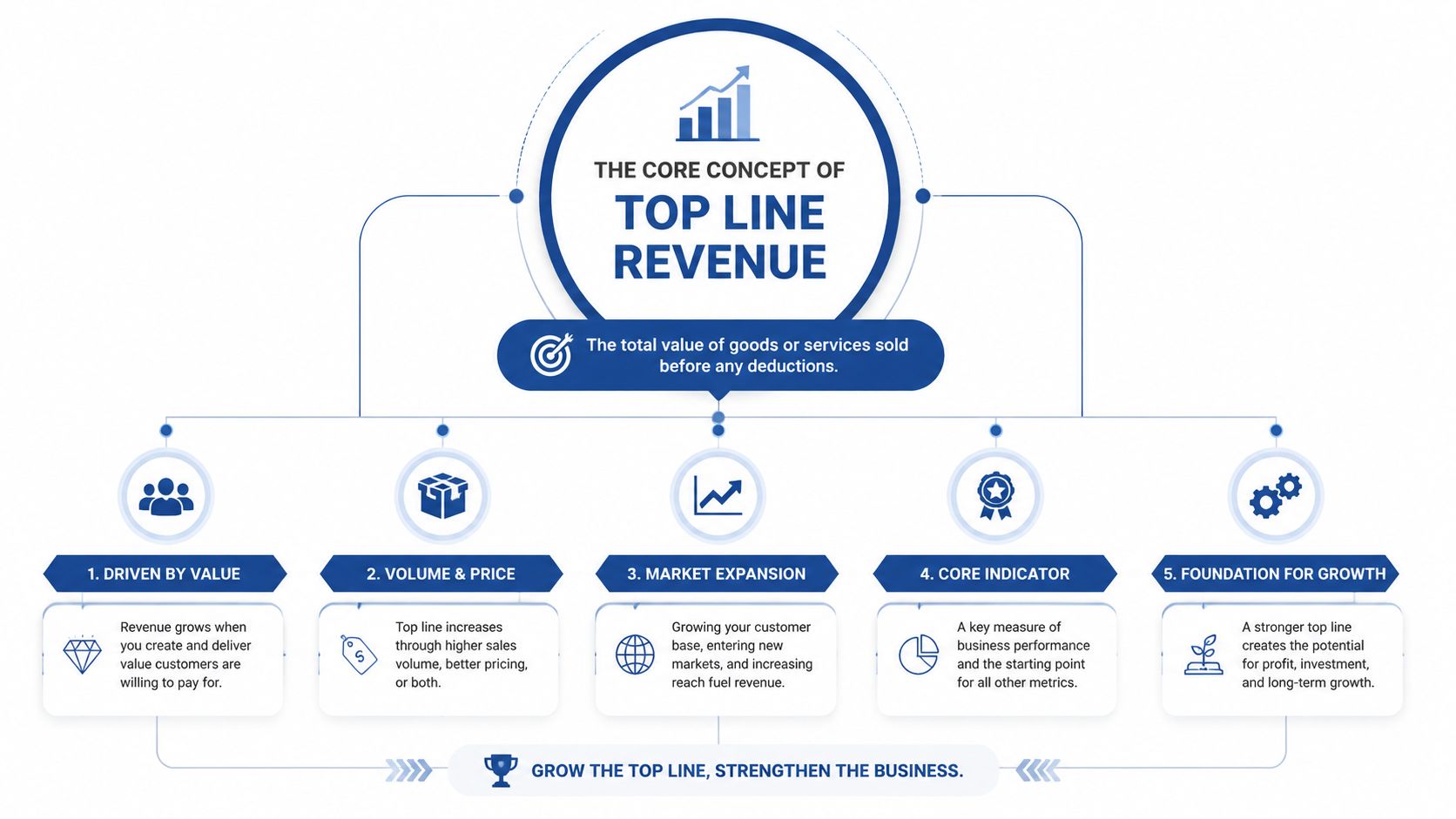
Top line revenue is a company’s total income from sales of goods or services before any deductions, and it appears as the first line on the income statement. That simple placement is why accountants and owners use the phrase “top line.” It is situated at the top. The concept became especially prominent during the 1990s dot-com boom, when companies such as Amazon emphasized revenue expansion, with reported top line growth from $148 million in 1997 to $1.64 billion in 1999 according to Ramp’s explanation of top line growth.
A useful way to think about it is a bucket filling with water. Top line revenue is the water entering the bucket. Costs, payroll, software, taxes, and interest are the holes lower down. Before you can measure what leaked out, you need to know how much flowed in.
The basic formula
The formula is straightforward:
Top line revenue = Total units sold × Price per unit
That works for products, but it also works for services if you define the “unit” clearly.
Examples for service businesses:
- Hourly firm: billable hours × hourly rate
- Monthly retainer model: number of active client retainers × monthly fee
- Project business: number of completed projects × project price
A simple example helps. A lemonade stand that sells 100 cups at $2 each has $200 in top line revenue. It doesn’t matter what lemons cost, what the stand paid for cups, or whether the owner kept any profit. The top line only answers one question: how much was sold?
What counts and what doesn’t
For service owners, the hard part usually isn’t the formula. It’s deciding what belongs in the number.
Top line revenue should reflect sales from core operations, not unrelated inflows. If you run a consulting firm, revenue comes from consulting work. If you run payroll support, bookkeeping, implementation, or advisory services, revenue comes from those earned client fees.
Revenue should describe performance, not just cash movement.
That’s also why revenue recognition matters. Accounting rules focus on earned revenue, not just money received. If a client prepays for future service, the full amount may not belong in this month’s top line yet.
If you want a cleaner picture of how this appears on your reports, this guide to formatting an income statement clearly is a useful reference point.
Top Line vs Bottom Line and Other Key Metrics
Top line revenue gets attention because it’s easy to spot and easy to celebrate. But owners can get into trouble when they stop there. A growing revenue number doesn’t automatically mean the business is healthy.
You need to know how revenue moves down the income statement.
The financial path from sales to profit
The key progression is:
Net Income = Top Line – (COGS + OpEx + Taxes + Interest)
That formula matters because every subtraction answers a different business question. Cost of goods sold tells you what it took to deliver the service. Operating expenses show what it cost to run the company. Taxes and interest reflect obligations beyond day-to-day delivery.
According to Finaloop’s overview of top line vs bottom line, for every $1M top line increase in U.S. service businesses, the bottom line typically rises by around $250K when operating expenses scale efficiently. The same source notes that high-growth SMBs achieved 18% net margins versus 8% for laggards.
From top line to bottom line
| Metric | Formula | What It Tells You |
|---|---|---|
| Top line revenue | Total sales before deductions | How much the business sold |
| Gross profit | Top line – COGS | How much remains after direct delivery costs |
| Net income or bottom line | Top line – (COGS + OpEx + Taxes + Interest) | What the business actually keeps |
For service businesses, gross profit often creates confusion. If your team delivers bookkeeping, design, legal support, marketing, or IT services, direct labor may sit close to COGS, while admin salaries, rent, and software often sit in operating expenses. If those categories are mixed up, your reports can still “balance” but become far less useful for decision-making.
Why owners mix these up
Three mistakes show up often:
- Calling revenue profit: A strong sales month can still produce weak net income if delivery costs or overhead climbed.
- Ignoring direct costs: Service businesses sometimes assume COGS doesn’t apply because they don’t sell inventory.
- Reading payroll in isolation: Payroll is essential, but where labor is classified changes what your gross margin means.
If you’re reviewing staffing costs and outsourced HR support at the same time, a practical companion resource is this PEO vs HRO guide for CFOs, especially when you’re deciding which people-related costs belong in strategic overhead versus direct delivery support.
A healthy top line tells you clients are buying. A healthy bottom line tells you the business is keeping enough of what it earns.
For a better read on the full statement, this primer on understanding profit and loss statements helps connect the revenue number to the rest of the report.
Why Top Line Revenue Is Critical for Service Businesses
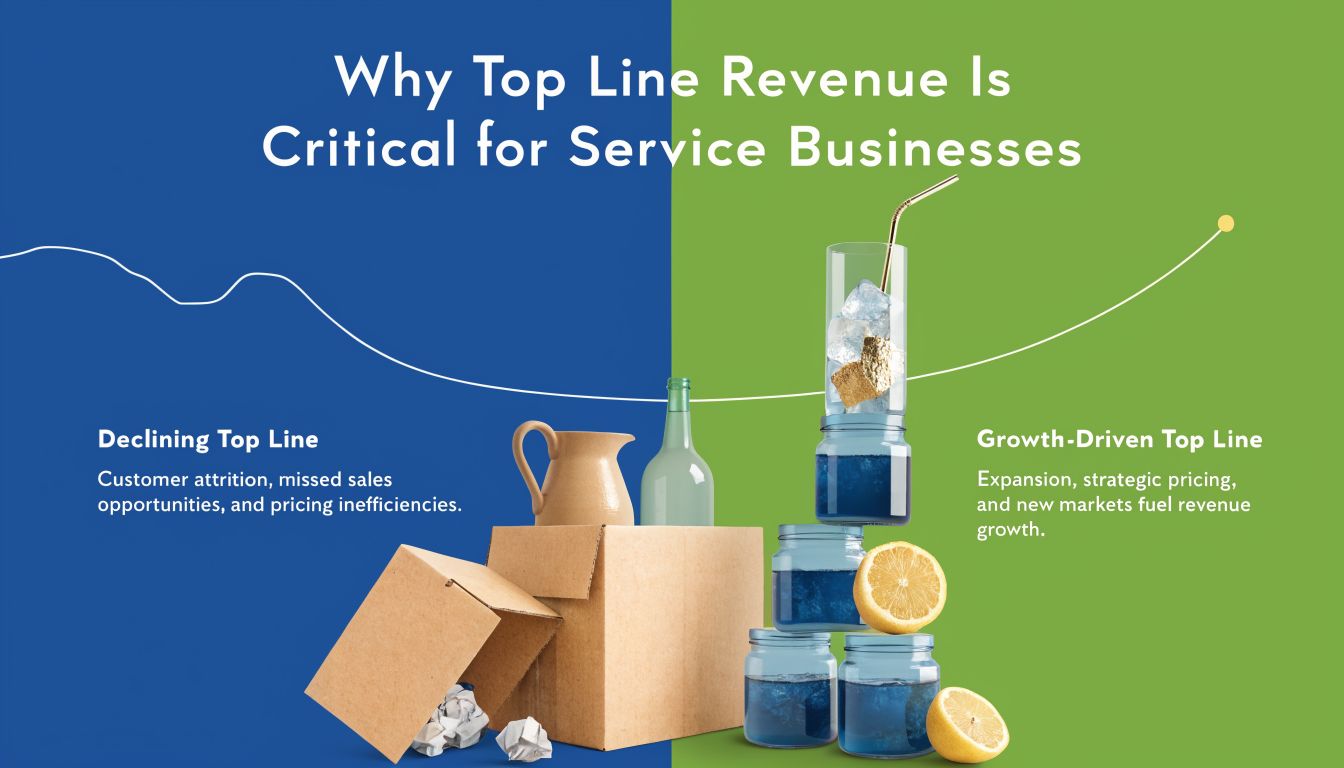
A product company can point to units on a shelf. A service company usually can’t. That’s why top line revenue matters so much in services. It’s one of the clearest ways to measure whether the market is rewarding your expertise.
If you sell advisory work, outsourced accounting, implementation, agency services, or recurring support, your top line tells you whether clients are buying your time, your systems, and your judgment at a level that supports scale.
It shows whether your offer is working
In a service business, revenue growth usually reflects a mix of things:
- Client acquisition: New customers are saying yes.
- Retention: Existing customers are staying long enough to renew or expand.
- Pricing strength: The market accepts your rates.
- Capacity utilization: Your team is converting available time into billable work.
That’s why top line revenue is often the first operational KPI I look at with owners. Before discussing margin fixes, I want to know whether the service itself has traction.
It shapes hiring decisions
Service businesses scale through people. More demand often means more staff, contractors, or management support. For firms using Gusto or QuickBooks Payroll, revenue trends help determine when hiring is justified and when it’s premature.
According to Wise’s discussion of top line revenue, 68% of SMBs with over 15% top line growth were able to achieve twice as fast hiring rates, supported by optimized financial reporting. That’s a practical reminder that clean revenue reporting doesn’t just satisfy accountants. It supports staffing timing.
It keeps you from mistaking activity for growth
A full calendar can hide weak economics. You can have lots of meetings, lots of Slack messages, and lots of work in progress while revenue remains flat because pricing is stale, invoicing is delayed, or the client mix is wrong.
Service owners should look at top line revenue when making decisions like these:
- Should we add a new service line
- Can we afford another account manager or specialist
- Are our retainers priced high enough for current demand
- Is growth coming from healthy clients or one-off projects
If your service business can’t explain where revenue comes from by client, service line, and period, it’s hard to scale with confidence.
Top line revenue won’t answer every strategic question. But for a service firm, it gives you the clearest first signal that the market wants more of what you do.
Common Reporting Pitfalls and Best Practices
Most revenue mistakes in service businesses aren’t dramatic. They’re small classification errors, timing problems, or workflow shortcuts that slowly distort the picture. QuickBooks and Gusto are strong tools, but tools don’t fix reporting logic on their own.
The result is familiar. An owner looks at a clean dashboard and still can’t trust the numbers.
Common ways top line gets misstated
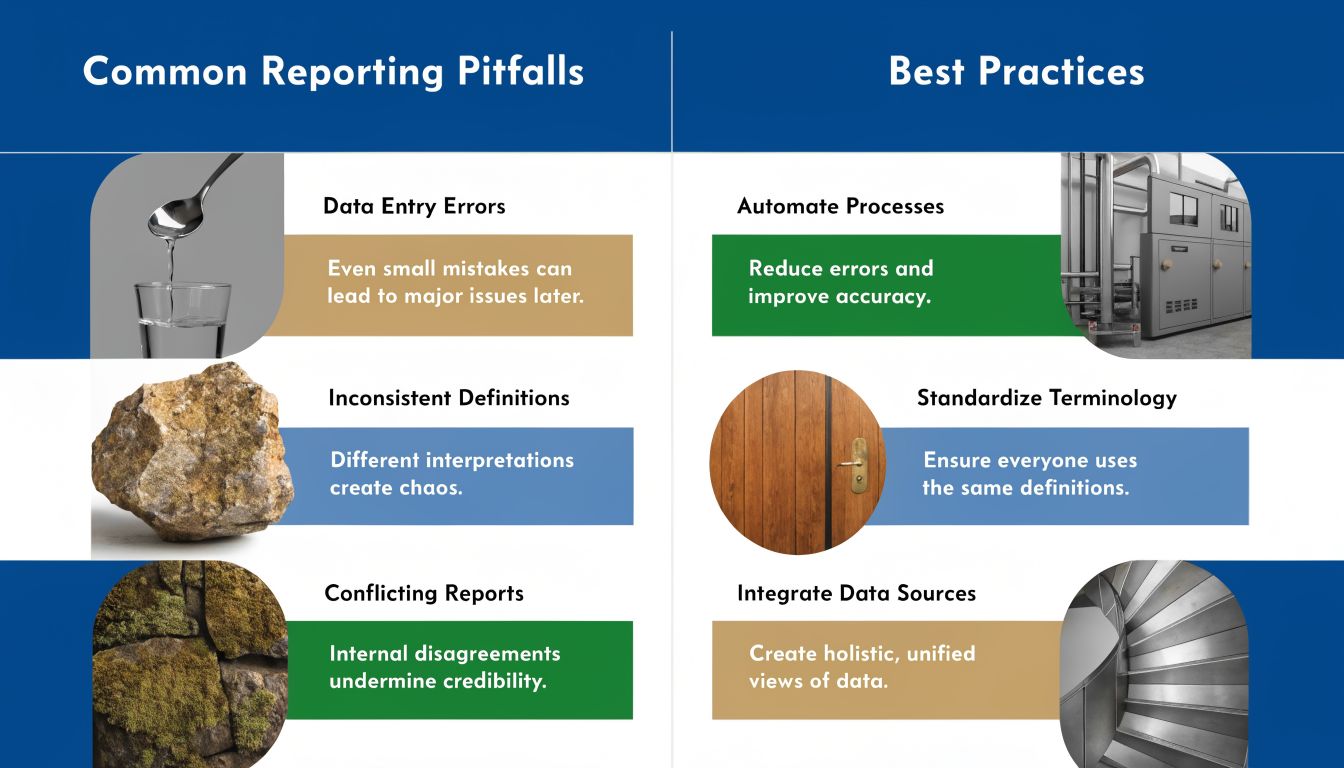
Here are the bookkeeping issues I see most often in service environments:
- Recording non-revenue inflows as sales: Owner contributions, loans, and tax refunds can inflate revenue if they land in the wrong account.
- Recognizing cash before it’s earned: Upfront retainers often need to be deferred and recognized over the service period.
- Mixing reimbursements with service income: That can make revenue look stronger while hiding true service performance.
- Poor account mapping between systems: Payroll categories from Gusto or QuickBooks Payroll can end up in the wrong expense buckets, which affects the interpretation of gross profit and operating expense trends.
Best practices that keep reports usable
The fix is usually less glamorous than people hope, but very effective.
- Set up the chart of accounts carefully: Revenue accounts should reflect actual service lines, not a catch-all sales bucket.
- Use monthly close discipline: Reconcile bank activity, AR, and deferred revenue before treating the month as final.
- Review earned revenue, not just deposits: Especially important for prepaid work and multi-month contracts.
- Have a human review forecasts: Software can model trends, but it doesn’t always understand churn, contract timing, or unusual client behavior.
A current example is AI-driven forecasting. According to Interactive Brokers’ glossary entry on revenue top line, over-reliance on AI-inflated top line forecasts led to 15% overinvestment in marketing for 2025, because those models often missed service-specific churn. That’s a projection-related warning, not a reason to avoid automation. It’s a reason to pair automation with review.
Good bookkeeping doesn’t just produce numbers. It produces numbers you can defend.
This checklist on financial reporting best practices for growing businesses is useful if you want your monthly reports to support decisions instead of just closing the books.
How to Reliably Track and Grow Your Top Line Revenue
Reliable top line reporting starts with clean inputs. Growth starts when you can trust those inputs enough to act on them. The strongest service businesses treat revenue as both an accounting output and an operational signal.
That means your billing process, contract setup, revenue recognition, payroll coding, and month-end review all need to line up.

How to track it reliably
Use a short operating routine each month:
- Separate revenue accounts by service line: If advisory, implementation, and recurring support all sit in one account, you lose pricing and demand visibility.
- Tie invoices to contracts: Billing should reflect what was earned during the period.
- Reconcile every month: Bank feeds are helpful, but they aren’t a substitute for review.
- Compare actuals to expectations: If revenue came in materially above or below plan, find out why before the next month starts.
- Review payroll coding: Especially if some labor supports delivery and some supports administration.
How to grow it without guessing
Growth usually comes from a few practical levers, not from abstract strategy talk.
Review pricing
Many service firms undercharge legacy clients while newer work is priced correctly. A pricing review often reveals where the business is busy but under-monetized.
Expand within current accounts
Existing clients already trust you. Additional advisory, compliance support, training, or recurring reporting can increase revenue without starting every sale from zero.
Tighten invoicing speed
Slow invoicing doesn’t change earned revenue, but it delays visibility and cash collection. Fast, accurate billing improves both reporting rhythm and operations.
Use marketing with a revenue lens
If you’re evaluating lead generation channels, compare them against actual revenue quality, not just lead count. For local firms that want a practical look at paid acquisition options, this guide to PPC services for local businesses gives a useful overview of one demand-generation path.
The real goal
The point isn’t to chase a bigger revenue number at any cost. The point is to build a reporting system that tells you, early and clearly, whether your service business is attracting the right clients at the right price.
Once top line revenue is accurate, your other decisions get easier. Hiring gets clearer. Forecasting gets less emotional. You stop managing from intuition alone and start managing from evidence.
If your books feel messy, your payroll data doesn’t line up cleanly with your reports, or you want sharper monthly visibility into revenue, Steingard Financial can help. Their team supports service businesses with bookkeeping, payroll, reporting, cleanup, and system design so your top line is accurate, timely, and useful for real decisions.