 Skip to content
Your firm creates valuable things every week. A consulting playbook. A custom reporting template. A reusable code component. A client onboarding workflow your team refined over years. Most owners assume the business owns all of it.
Sometimes it does. Sometimes it plainly doesn’t.
That gap usually stays hidden until a funding round, a buyer’s diligence request, a co-founder dispute, or a contractor departure forces someone to ask a simple question: who owns the work product? If the answer lives in mismatched offer letters, unsigned contractor agreements, and sloppy bookkeeping, the problem stops being legal theory and starts affecting valuation, tax treatment, and payroll operations.
Why IP Assignment Matters for Your Service Business
A service business rarely stores its value in equipment. It stores value in know-how, brand assets, software, processes, content, and client-facing systems. Those assets are portable, licensable, and often central to a sale. They’re also easy to mishandle because they don’t sit on a shelf with a serial number.
That’s why intellectual property assignment matters. It’s the mechanism that moves ownership from the person who created the asset to the company that commercializes it. If that transfer isn’t clear, the business may be operating with a hole in its chain of title.
The scale of this issue is bigger than many owners realize. According to the World Intellectual Property Organization, there were approximately 3.4 million patent applications filed worldwide in 2022, and roughly 70% of issued U.S. patents reflect at least one recorded assignment. That tells you something important. Commercially meaningful IP is often transferred to business entities rather than left with individuals (WIPO IP statistics).
Where service firms get exposed
A few common examples show up again and again:
- Agency frameworks: Your team builds a campaign methodology and uses it across clients, but a senior strategist created the core materials before your HR paperwork was tightened up.
- Software tools: A dev shop creates an internal library or SaaS feature set using a mix of employees and freelancers.
- Brand assets: A contractor designs your logo, naming architecture, or training materials, but the contract only says you paid for the work.
- Founder contributions: One founder brings in code, documents, or IP created before formation and never formally assigns it to the company.
Practical rule: If an asset materially helps you sell, deliver, or scale your services, assume ownership must be documented, not implied.
Why this reaches your books and payroll
When ownership is unclear, three business functions break at once:
| Business area | What goes wrong when assignment is unclear |
|---|---|
| Contracts | You may not have the right to reuse, modify, or sell the work |
| Accounting | Development costs and intangible assets become difficult to support |
| HR and payroll | Contractors and employees keep creating IP without a reliable ownership trail |
Legal ownership, financial reporting, and people operations need to line up. If they don’t, the company may look stronger on paper than it really is.
Understanding IP Assignment Versus Licenses and Work For Hire
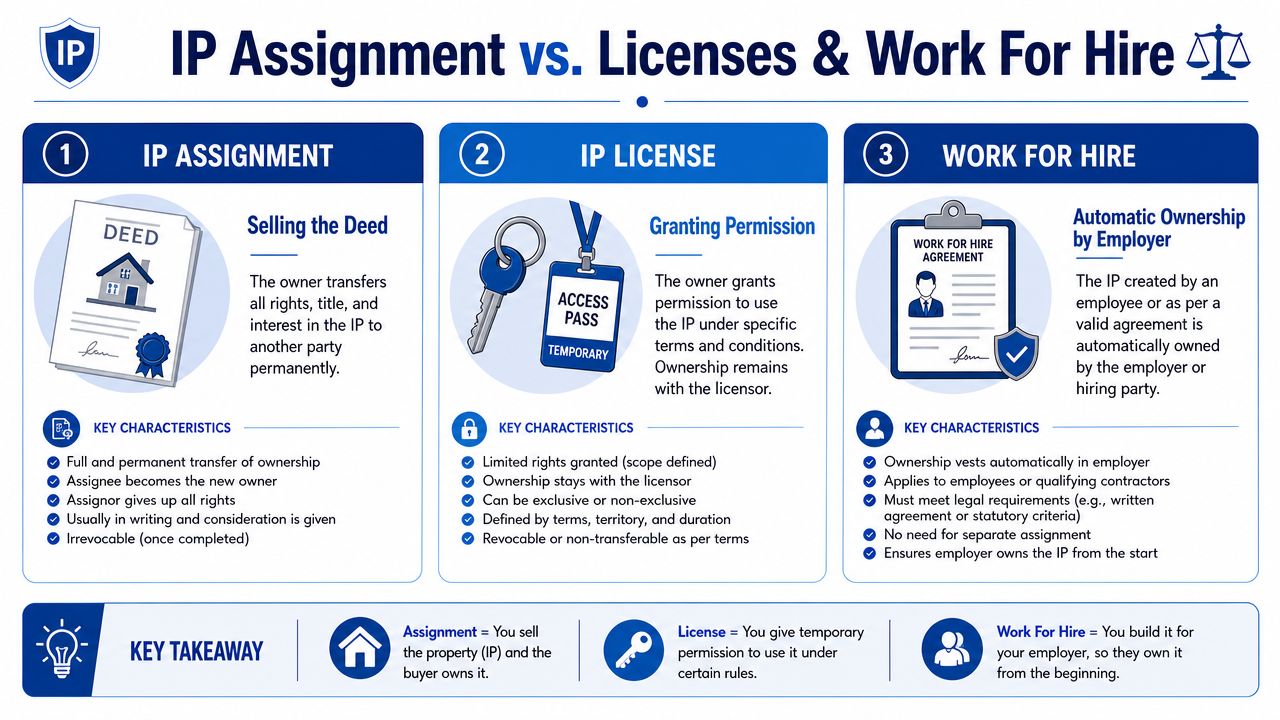
Owners often use three terms as if they mean the same thing: assignment, license, and work for hire. They don’t. If you mix them up, your contracts can say one thing while your business expects another.
Assignment means ownership changes hands
An intellectual property assignment is closest to selling the deed to a house. The assignor transfers ownership to the assignee. After that, the company typically controls use, modification, enforcement, licensing, and sale of the asset, subject to the contract language and applicable law.
For a service firm, assignment is usually the cleanest answer when the company needs to fully control deliverables, internal systems, source files, inventions, training content, or brand assets created for the business.
A license means permission, not ownership
A license is more like giving someone permission to use the house under agreed rules. The original owner keeps title, but another party gets defined usage rights. Those rights can be narrow or broad. They can be exclusive or non-exclusive. They can be revocable or perpetual, depending on the agreement.
Licenses are often the better tool when:
- Contractors bring pre-existing materials: They may keep ownership of a background template or framework and grant your company permission to use it.
- Software vendors serve multiple clients: They usually license the platform rather than assign ownership to each customer.
- You embed third-party materials: Stock content, plug-ins, or external libraries may come with use rights but not ownership.
Work for hire is narrower than many owners think
Work for hire is not a magic phrase that fixes every ownership issue. In practice, many businesses over-rely on it, especially in contractor agreements. The phrase may help in some copyright contexts, but it doesn’t replace the need for clear assignment language when ownership needs to be certain across different asset types and working relationships.
That matters because service businesses rarely create just one kind of IP. A single engagement might involve copy, visuals, software, process design, data structures, and trademarks. One clause rarely covers that entire scope safely.
| Attribute | IP Assignment | IP License | Work For Hire |
|---|---|---|---|
| Ownership | Transfers to company | Stays with creator unless otherwise stated | May vest in employer or hiring party in limited contexts |
| Duration | Usually permanent | Defined by contract | Tied to legal treatment of the work and agreement |
| Best use case | Company needs full control | Company needs usage rights only | Specific copyright situations, often with employees |
| Enforcement rights | Usually belong to owner after transfer | Depend on contract | Depend on who legally owns the work |
| Common mistake | Assuming payment alone transfers rights | Assuming broad use rights equal ownership | Assuming the phrase alone solves contractor ownership |
Paying for work doesn’t automatically mean your company owns the underlying IP.
What works in practice
For employees, use employment documents that clearly address inventions, confidential information, and assigned work product. For contractors, use two layers when appropriate: a work-for-hire clause where it fits, plus an explicit assignment clause as backup. If the contractor uses prior tools or materials, carve those out and secure a license to anything embedded in your deliverables.
That combination reflects how service firms operate. Teams remix prior templates, build on internal methods, and use outside contributors. The contract has to match that reality.
Key Elements of an Enforceable IP Assignment Agreement
A document titled “IP Assignment” isn’t enough. The wording inside decides whether ownership moved now, later, or maybe never.

Present-tense transfer language matters
One of the biggest drafting mistakes is using language that only promises a future transfer. A clause framed as “shall assign” may not operate as an immediate transfer, while “hereby assigns” is typically construed as a present assignment creating an immediate transfer of title (Ashurst on drafting effective intellectual property assignments).
That distinction matters in due diligence. If your company only has a promise that someone will assign later, counsel for an investor or buyer may ask where the actual transfer document is. If nobody can produce it, ownership becomes a clean-up project at the worst possible time.
Clauses worth reviewing closely
An enforceable agreement usually needs more than one strong sentence.
- Clear identification of parties: The person or entity transferring rights must be correctly named. Nicknames, old LLC names, or missing legal entities cause problems.
- Defined scope of IP: The agreement should say what’s being assigned. That may include inventions, software, documents, designs, trademarks, trade secrets, and related work product created within the engagement.
- Timing language: The contract should match when the transfer happens. If ownership is intended on creation, the language should reflect that.
- Consideration: There should be a real exchange, such as compensation, employment, equity, or other stated value.
- Further assurances: Include an obligation to sign additional documents if a filing office, investor, or buyer later requires them.
- Pre-existing IP carveouts: If someone brings prior material into the relationship, list it and define what rights the company receives to use it.
A practical example
This is the difference in plain English:
Weak version: “Contractor shall assign all rights in deliverables to Company.”
That may create an obligation to transfer later.
Stronger version: “Contractor hereby assigns to Company all right, title, and interest in and to the deliverables and related intellectual property created within the scope of the services.”
That language is more aligned with immediate transfer.
What owners should ask counsel to confirm
When you review your templates, ask whether the agreement does all of the following:
- Transfers rights now, not just later
- Covers the actual assets your business creates
- Addresses contractor background materials
- Works with your state law and filing strategy
- Supports diligence by a buyer or lender
If your contracts need revision, it’s worth getting targeted Kons Law for contract legal advice so the language matches how your team creates and commercializes IP.
An IP Assignment Due Diligence Checklist for Your Business
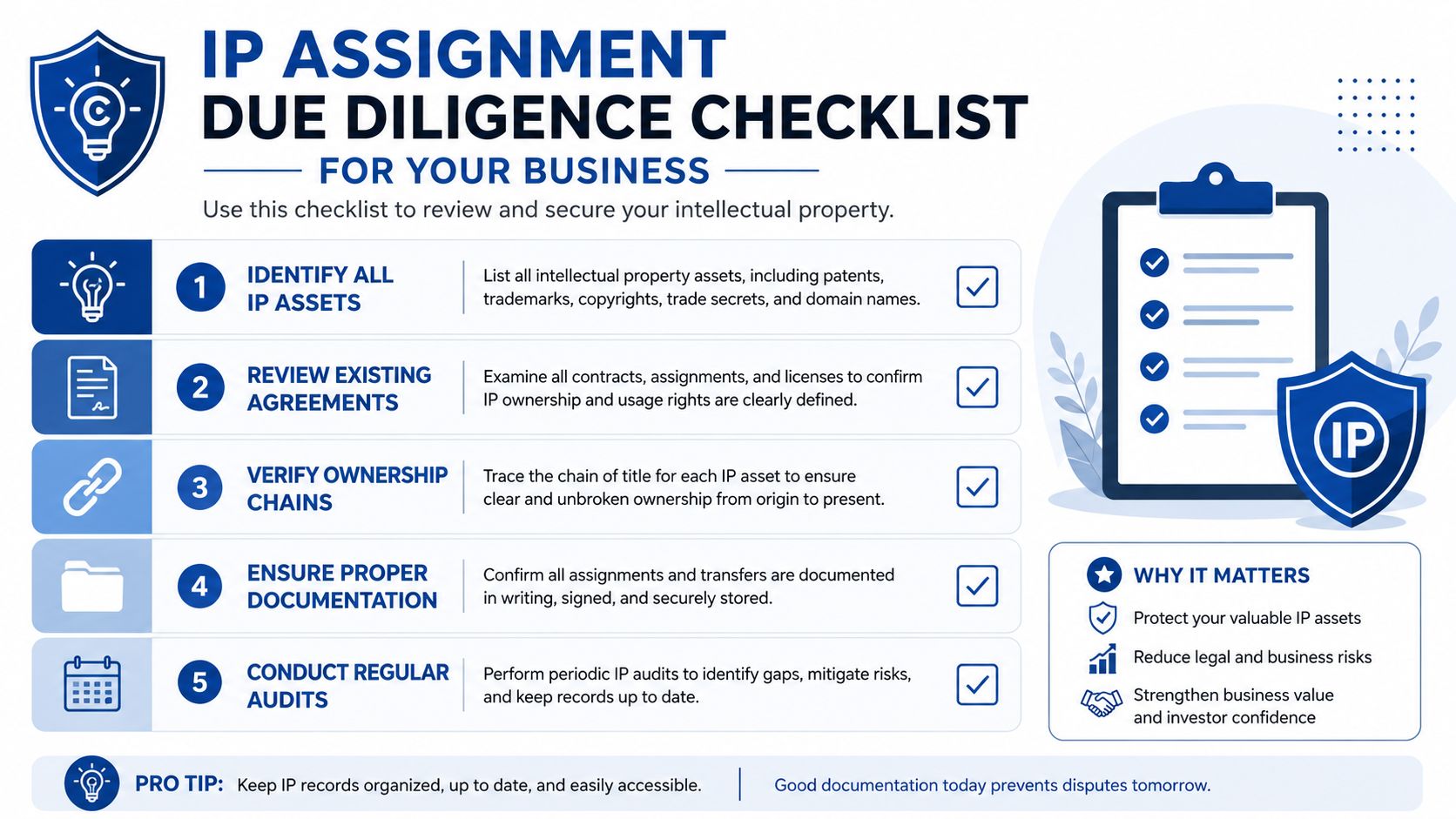
A good due diligence review doesn’t start with patents. It starts with people. Founders, employees, agencies, developers, designers, and consultants all touch assets that may become central to your firm’s value.
Founder review
Start at formation, not with current staff.
- Check what each founder contributed: If someone brought code, a domain, a brand concept, training materials, or a methodology into the company, confirm there’s a written transfer to the entity.
- Review operating documents: Ownership expectations often appear in cap tables and founder discussions but never make it into signed assignment paperwork.
- Match dates carefully: The asset creation date, company formation date, and assignment date should make sense together.
Employee review
Employees are often easier to paper properly, but only if HR stayed disciplined.
- Confirm that offer letters and onboarding packages include proprietary information and inventions language.
- Make sure promotions or role changes didn’t move someone into product creation, R&D, or brand development without updated agreements.
- Check whether employees created material before signing. If they did, you may need a separate catch-up assignment.
Contractor review
Regarding this, most service firms often have the messiest files.
| Review item | Why it matters |
|---|---|
| Signed contractor agreement | Payment records alone don’t prove ownership |
| Assignment clause | Needed when the company expects full ownership |
| Background IP language | Prevents accidental claims over the contractor’s prior tools |
| Deliverable definition | Ties ownership to actual work produced |
| Final document retention | Helps diligence teams trace chain of title |
A contractor who invoices through QuickBooks, receives regular payments, and attends team meetings still isn’t an employee just because the workflow feels internal. The contract has to handle ownership correctly.
Registration and recording review
For registered IP, don’t stop at signed contracts. Failure to record an IP assignment with the relevant office can render the new owner unable to sue for infringement in some jurisdictions, and a clean recorded assignment history is scrutinized in M&A due diligence and can positively influence valuations (European IP Helpdesk on assignment of IP).
That means you should verify:
- Patent and trademark ownership records: Public filing records should reflect the current owner.
- Name consistency: If your entity changed names or converted structure, update records accordingly.
- Post-acquisition clean-up: If you bought a business or asset set, confirm the assignments were recorded, not just signed.
Documents to assemble in one place
Create a central file, digital and searchable, with:
- Founder assignments
- Employee invention and confidentiality agreements
- Independent contractor agreements
- Schedules of pre-existing IP
- Patent and trademark assignment records
- Board or manager approvals where applicable
If you ever go through diligence, this file saves weeks of scrambling.
Accounting and Tax Considerations for Assigned IP
A signed assignment solves ownership. It doesn’t solve accounting.
That’s where many businesses get tripped up. The legal file says the company owns the software, template library, or process documentation. The general ledger says development costs are scattered across payroll, contractor spend, software subscriptions, and miscellaneous expense accounts with no clear trail.
Why the books often lag behind the contracts
A common blind spot is the interaction between assignment agreements and accounting rules. The allocation of development costs and capitalization rules under IRC §197 can turn a clear legal assignment into a messy audit target if those items aren’t properly documented and tracked in the company’s books (discussion of IP assignment mistakes and accounting blind spots).
For service businesses, this usually shows up in software and system development. A team may build internal tools or client-facing platforms using employees on payroll, overseas contractors, U.S. freelancers, and outside agencies. Legal ownership may be clear, but the financial record of how the asset was built often isn’t.
What finance needs to capture
The practical accounting question is simple: what costs relate to the IP, and how should they be treated? The answer isn’t always intuitive.
Consider the categories you may need to trace:
- Payroll costs: Wages for employees building software, content libraries, or proprietary systems
- Contractor costs: 1099 payments tied to design, code, copy, or product work
- Third-party tools: Platforms used in development that may or may not be part of the asset cost story
- Legal fees: Drafting, reviewing, and documenting ownership
- Acquired IP costs: Amounts paid to buy an asset or rights from another party
What works better than year-end reconstruction
Most clean-ups happen too late. The books close, tax prep starts, and then someone tries to recreate who built what from Slack messages, old invoices, and vague memory. That rarely ends well.
A better approach is to tag relevant spend while the work is happening. In QuickBooks Online or another ledger system, that may mean dedicated accounts, classes, locations, projects, or memo conventions for development-related activity. It also helps to align that structure with a clear amortization and capitalization policy. If you need a practical primer on that side of the books, this guide on depreciation and amortisation is a useful reference point.
Your legal file should answer who owns the asset. Your accounting file should answer what the asset cost, how it was developed, and how the company is treating it for reporting and tax purposes.
Questions worth asking your CPA or controller
- Are development costs being identified consistently?
- Are employee and contractor costs separated clearly enough to support treatment decisions?
- Does the chart of accounts reflect internally developed IP activity?
- If IP was assigned into the company, was any tax basis or acquisition value documented?
- If the business is sold, will the books support the asset story management wants to tell?
The cleaner the tracking, the easier it is to defend the numbers later.
Integrating IP Assignments into HR and Payroll Workflows
Most firms treat intellectual property assignment as a legal event. It’s better treated as an operational control.
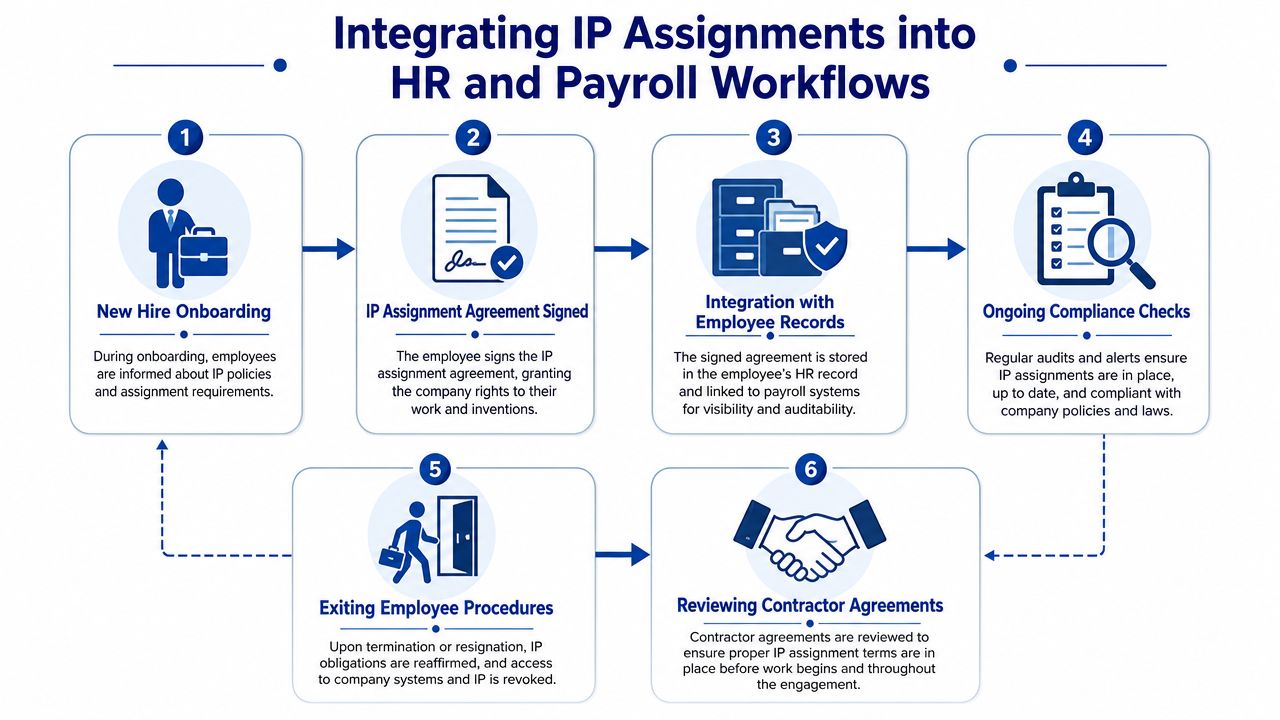
That shift matters because service businesses create IP through repeatable people processes: hiring, onboarding, role changes, contractor payments, offboarding, and vendor management. If your agreements live outside those workflows, gaps keep reopening.
Build assignment checks into the same systems that trigger payment
Most guidance focuses on one-off templates, but there’s a practical gap in how companies operationalize IP controls inside HR and payroll. That gap becomes more serious as remote work and contractor use expand the number of people creating company IP without a reliable tracking workflow (Crowley Law on intellectual property assignment agreements).
The fix is straightforward. Put ownership checks where the work relationship starts and where money moves.
- In Gusto or your HRIS, make signed invention and confidentiality paperwork a required onboarding item before activation.
- In QuickBooks or your AP workflow, flag contractor setup until a signed agreement is stored with the vendor file.
- In your contractor payment process, use a checklist so recurring payees who create content, code, design, or systems aren’t paid through habit alone.
A practical workflow for ops teams
This doesn’t need to be elaborate. It needs to be consistent.
New hire setup
Require completion of IP and confidentiality documents before the employee receives system access.Contractor onboarding
Match each new contractor record to a signed agreement. If your team issues tax forms to independent workers, this guide on how to generate 1099 for contractors fits naturally into the same onboarding control point.Role-change review
If an employee moves from account support into product, design, or engineering, review whether the existing agreement still fits the new work.Periodic audit
HR, finance, and legal should compare active workers against signed agreement logs.Offboarding check
Recover credentials, confirm return of materials, and preserve records showing what was created during the relationship.
The best IP assignment process is usually boring. It runs through onboarding, payroll, and document retention without depending on memory.
When you operationalize assignment this way, the company stops relying on heroic clean-up later.
Next Steps to Secure Your Company’s Intellectual Property
Most ownership problems don’t come from one catastrophic mistake. They come from small omissions that pile up across contracts, books, and people systems. A founder never signed an assignment. A contractor agreement lacked transfer language. Payroll kept moving, but nobody checked whether the developer on monthly invoices had signed anything current. Accounting recorded costs, but not in a way that supports the IP story.
The fix is to treat intellectual property assignment as a coordinated business process.
Start with these actions
- Pull every active agreement for founders, employees, and contractors who create valuable work product.
- Identify missing assignments and prioritize anyone tied to software, brand assets, frameworks, training content, or proprietary methods.
- Review entity documents and confirm that ownership records align with the company’s current legal structure. If your ownership or governance documents have changed over time, this resource on an amendment to LLC operating agreement helps frame the housekeeping side.
- Check public records for patents and trademarks to confirm assignments were recorded where needed.
- Map IP-related costs in the ledger so legal ownership and financial treatment support each other.
- Build onboarding controls so no employee or contractor who creates IP starts work without the right paperwork.
- Set a recurring audit cadence across HR, finance, and legal files.
If you want more practical content on business risk, documentation, and operational follow-through, you can also explore our insights for adjacent topics that affect growing companies.
Secure ownership isn’t just a legal box to check. It’s part of building a business that can scale, withstand diligence, and support a clean exit.
If your company needs help aligning contracts, bookkeeping, payroll records, and people processes around IP ownership, Steingard Financial helps service businesses build cleaner back-office systems. That includes accurate books, practical payroll workflows, and the operational discipline that keeps valuable business assets properly documented.