 Skip to content
You started the business to serve clients, manage cash flow, and grow profit. Then one day you realize you’re spending your morning fixing a payroll question, your lunch break answering a vacation request, and your afternoon chasing a missing I-9. By evening, the work that brings revenue in has barely moved.
That’s the moment many owners discover that people operations don’t stay “small” just because the company does.
For a service business, HR pressure rarely arrives all at once. It creeps in through hiring forms, overtime questions, onboarding gaps, benefit elections, and awkward employee issues no one feels qualified to handle. Soon, the people side of the business becomes a bottleneck. It slows decisions, creates stress, and introduces financial risk that doesn’t show up clearly on a profit and loss statement until something goes wrong.
Good small business HR support fixes that. It gives structure to payroll, hiring, policies, documentation, benefits, and compliance so your team can function without constant owner intervention. It also creates cleaner data, fewer manual handoffs, and better coordination between payroll and bookkeeping. That matters if you care about margins, forecasting, and staying out of trouble while you grow.
Introduction The Moment You Realize You Need HR
A common version of this story starts with a team of five or six people. The owner knows everyone well. Payroll runs with a few clicks. New hires get paperwork by email. Time-off approvals happen in text messages. Nothing feels broken.
Then the business adds people.
One employee works remotely. Another asks about benefits. A manager handles onboarding one way, while another manager does it differently. Someone raises a wage-and-hour question. Payroll and bookkeeping stop matching cleanly because employee changes weren’t documented in one place. The owner starts acting as bookkeeper, payroll clerk, recruiter, and unofficial HR manager.
That’s usually when the stress shifts from annoying to expensive.
If you’ve ever worried about what happens when an employment issue turns legal, even a narrow question like a California employer lacks workers comp can show how fast a people problem becomes a financial one. HR support exists to reduce that kind of exposure before it lands on your desk as a dispute, claim, or cleanup project.
When people issues start crowding out business decisions
Most owners don’t need “corporate HR.” They need a practical system that keeps the employee side of the business organized and defensible.
That includes things like:
- Payroll running consistently: pay rates, schedules, and records stay aligned
- New hire paperwork staying complete: onboarding doesn’t depend on memory
- Policies being applied evenly: managers stop improvising
- Employee records being easy to find: questions don’t trigger a file hunt
A useful starting point is to look at your HR process the same way you’d look at cash controls. If the workflow is informal, the risk is real. Steingard’s guide to HR compliance for small business is a helpful example of how owners can start framing HR as an operating control, not just an admin task.
Good HR support protects time first. Then it protects culture, compliance, and financial stability.
What Is Small Business HR Support Really
Think of HR as the operating system for your team.
Your business strategy is the software. Sales, service delivery, accounting, and marketing are the applications. But the operating system is what allows everything to run together without crashing. It controls access, keeps records organized, standardizes processes, and helps different parts of the company communicate in the same language.
That’s what small business HR support does.
Without it, every manager creates their own version of hiring, onboarding, performance feedback, time-off approvals, and employee communication. That may feel flexible in the short term. In practice, it creates confusion, inconsistency, and a lot of owner cleanup.
It’s not just paperwork
Many owners hear “HR” and think of handbooks, forms, and awkward employee conversations. Those are part of it, but they’re not the whole point.
A solid HR support function helps you answer practical questions like these:
| Business question | HR support answer |
|---|---|
| Who has access to employee data? | Clear permissioning and records management |
| How do new hires get set up? | Standard onboarding steps and documentation |
| What happens when someone leaves? | Defined offboarding, access changes, and record retention |
| How do pay and benefits get administered? | Connected payroll and benefits workflows |
| What if a manager handles things inconsistently? | Policies, training, and repeatable processes |
The value isn’t theoretical. It shows up in smoother payroll, fewer surprises, cleaner records, and less improvisation.
Why this matters financially
Service businesses live and die by labor management. Your team is often your largest ongoing commitment. If people systems are sloppy, the financial impact spreads fast. Payroll corrections take time. Benefits mistakes create frustration. Weak documentation makes disputes harder to resolve. Inconsistent onboarding slows productivity.
HR support creates predictability. Predictability improves planning.
That’s why I tell owners to stop viewing HR as a side office function. It’s closer to internal control. It helps you protect labor data, maintain process discipline, and support growth without adding chaos.
Practical rule: If employee changes aren’t flowing cleanly into payroll, bookkeeping, and manager workflows, you don’t have an HR system. You have a series of workarounds.
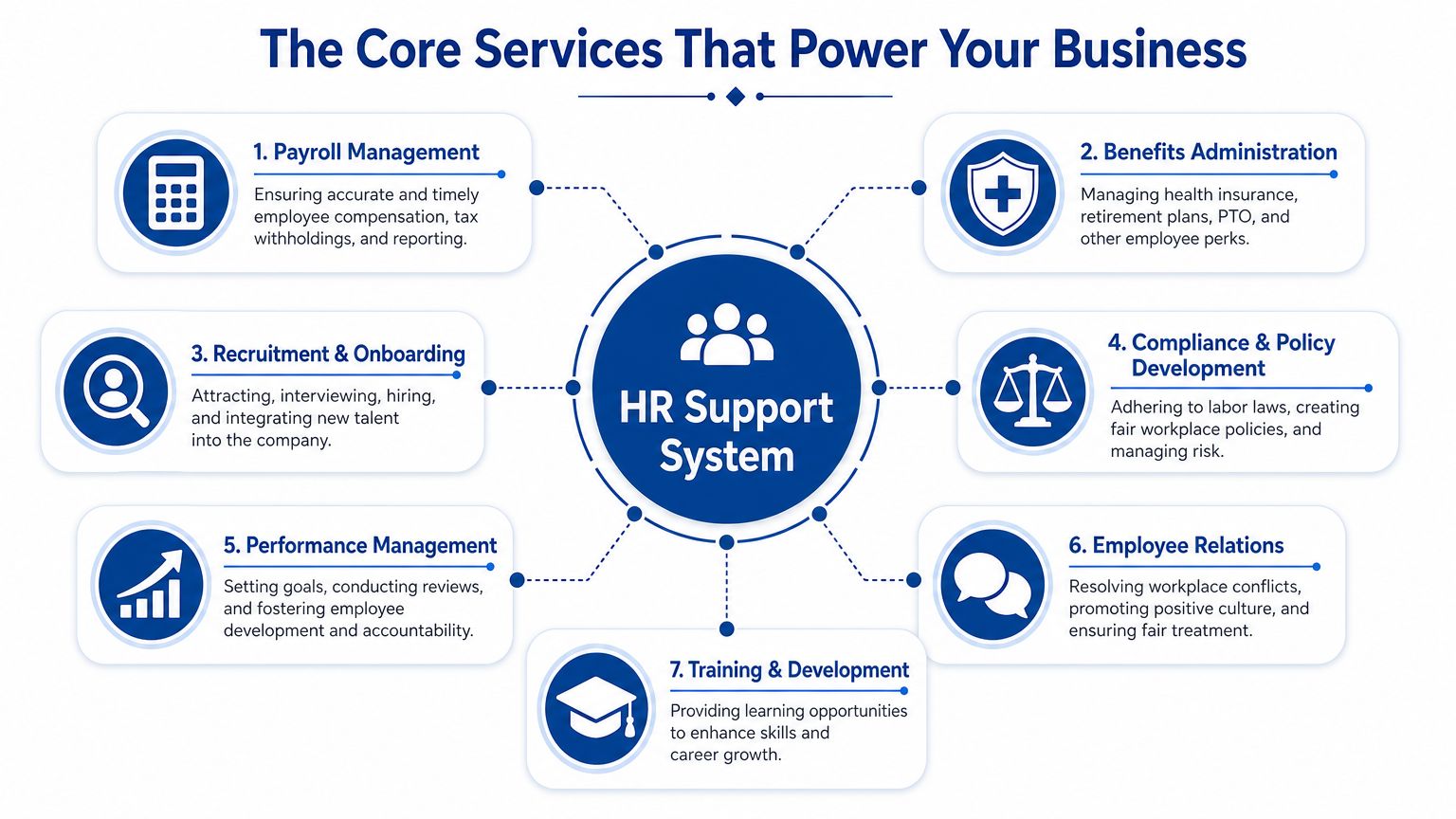
The Core Services That Power Your Business
The most useful way to understand HR support is to break it into working parts. Each one solves a different problem, but together they create a stable back office for your team.
For growing firms, a strong technical foundation often starts with software. The U.S. Chamber notes that for small businesses, the most technically defensible HR-support model is one that combines an HRIS with embedded compliance workflows, because core HR software automates payroll, onboarding, benefits administration, employee recordkeeping, and role-based access controls while also supporting integrations and add-on modules for growth. It also notes that this becomes a control layer for data quality, permissioning, and process standardization as headcount increases, and suggests planning around the next 12–24 months of growth and verifying migration of payroll records, tax documents, PTO balances, and staff data during implementation in its guidance on HRIS systems for SMBs.
Payroll and benefits
Payroll is where trust becomes visible. Employees may not notice a lot of operational improvements, but they always notice bad paychecks.
A reliable payroll process does more than calculate wages. It connects hours, pay rates, deductions, taxes, PTO, and reporting into one repeatable workflow. If your bookkeeping system receives that information cleanly, month-end becomes easier too.
Benefits administration sits right next to payroll in importance. Health coverage, retirement plans, and PTO policies shape retention, but they also create admin work. If benefits live in a separate process from payroll, errors multiply. Elections get missed. Deductions lag. Employee questions bounce between providers.
For that reason, many owners start by looking at integrated options like Gusto or QuickBooks Payroll, then add support around setup and administration. Businesses that want outside help with both payroll and HR tasks often compare those tools with a managed option such as small business payroll and HR services.
Onboarding, offboarding, and employee records
Hiring someone should not trigger a scavenger hunt.
Good onboarding means offer details, tax forms, eligibility documents, pay setup, handbook acknowledgment, and benefits enrollment move through a single process. The employee knows what to do. The manager knows what to do. The back office knows what to do.
Offboarding deserves the same discipline. Final pay, access removal, benefits changes, company property, and documentation should follow a checklist. That protects both operations and records.
Compliance, policies, and workplace boundaries
Compliance sounds abstract until it lands as a notice, dispute, or employee complaint. Then it becomes urgent and expensive.
A practical HR support setup helps owners manage overtime questions, hiring documentation, employee classifications, leave administration, and policy consistency. It also helps define workplace boundaries. For example, if your managers are considering monitoring tools, they should understand the legal and cultural implications before deploying them. A plain-English primer on understanding employee surveillance tech can help frame that discussion.
Performance, relations, and development
Some HR functions don’t feel urgent until neglect starts costing you people.
These include:
- Performance management: setting expectations, documenting feedback, and creating accountability
- Employee relations: handling complaints, conflict, and sensitive conversations consistently
- Training and development: helping people build skills so managers spend less time correcting avoidable mistakes
These areas matter because service businesses scale through people, not just software. If your team doesn’t know what good performance looks like, growth gets noisy fast.
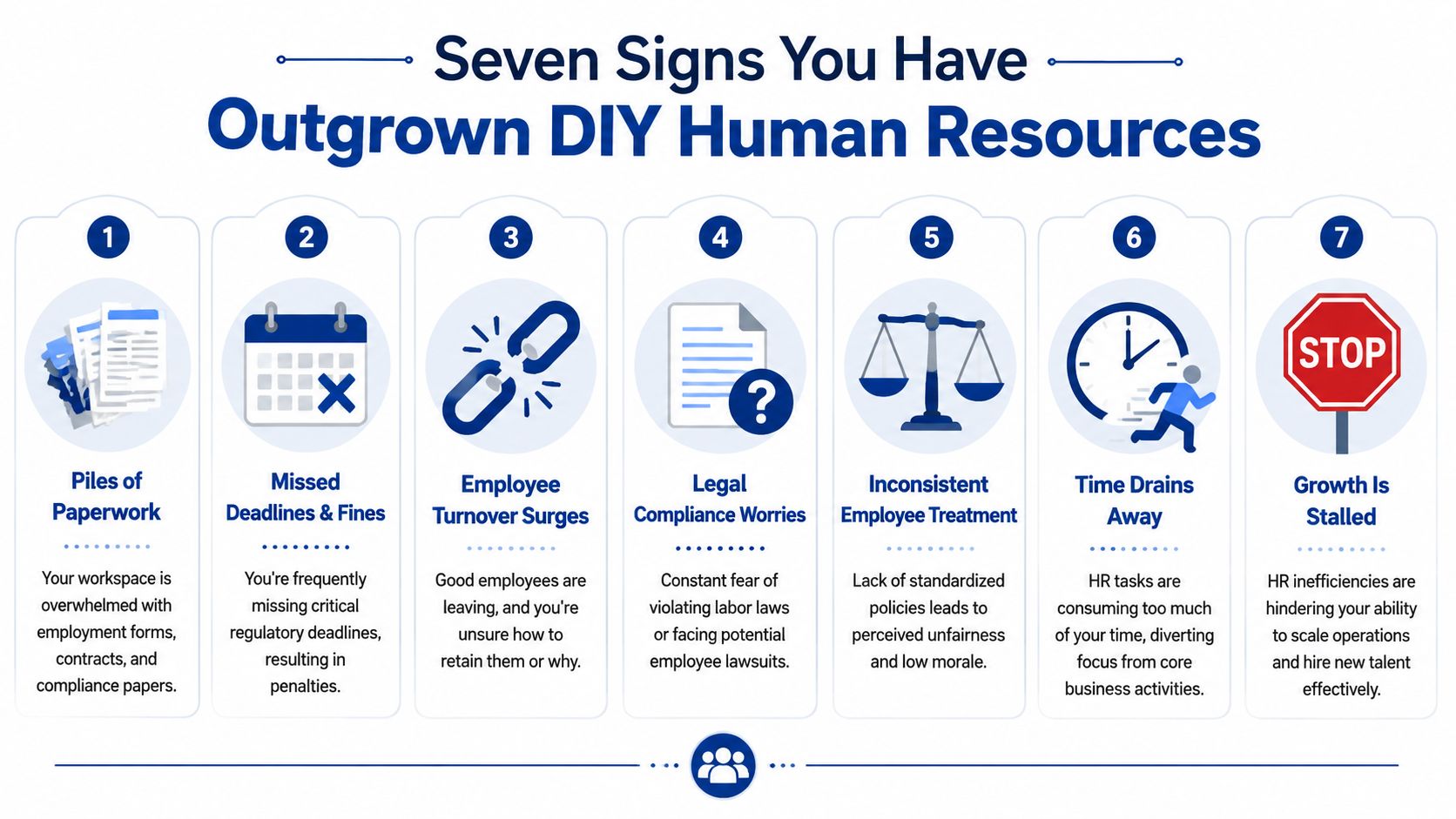
Seven Signs You Have Outgrown DIY Human Resources
You don’t need a formal HR department to know your current setup is straining. Most owners feel it first in lost time, vague worry, or repeated cleanup.
The warning signs are operational first
If any of these feel familiar, your business has probably outgrown DIY HR:
Admin work keeps hijacking owner time
You’re spending too much of the week answering employee questions, updating pay details, chasing forms, or fixing avoidable errors.You’re not confident about labor rules
Overtime, breaks, documentation, classifications, and leave issues feel fuzzy instead of defined.Hiring feels harder than it should
Candidates drop off, onboarding varies by manager, and new people don’t get productive quickly.Employee treatment depends on who manages them
One supervisor is flexible, another is strict, and no one is using the same process.
After those patterns set in, culture usually starts taking the hit.
Growth exposes weak process
The next three signs usually appear once the company is trying to expand:
- Complaints or sensitive issues have no clear path: managers escalate everything to the owner because there’s no structure.
- You’re hiring across state lines or considering it: what used to be simple now involves different tax and employment rules.
- Your team feels the drag: people wait on answers, policies seem uneven, and managers create one-off fixes.
When HR is informal, employees experience the business as inconsistent. That hurts trust before it hurts retention.
None of these issues mean your company is failing. They mean the business has reached the point where informal people management costs more than it saves.
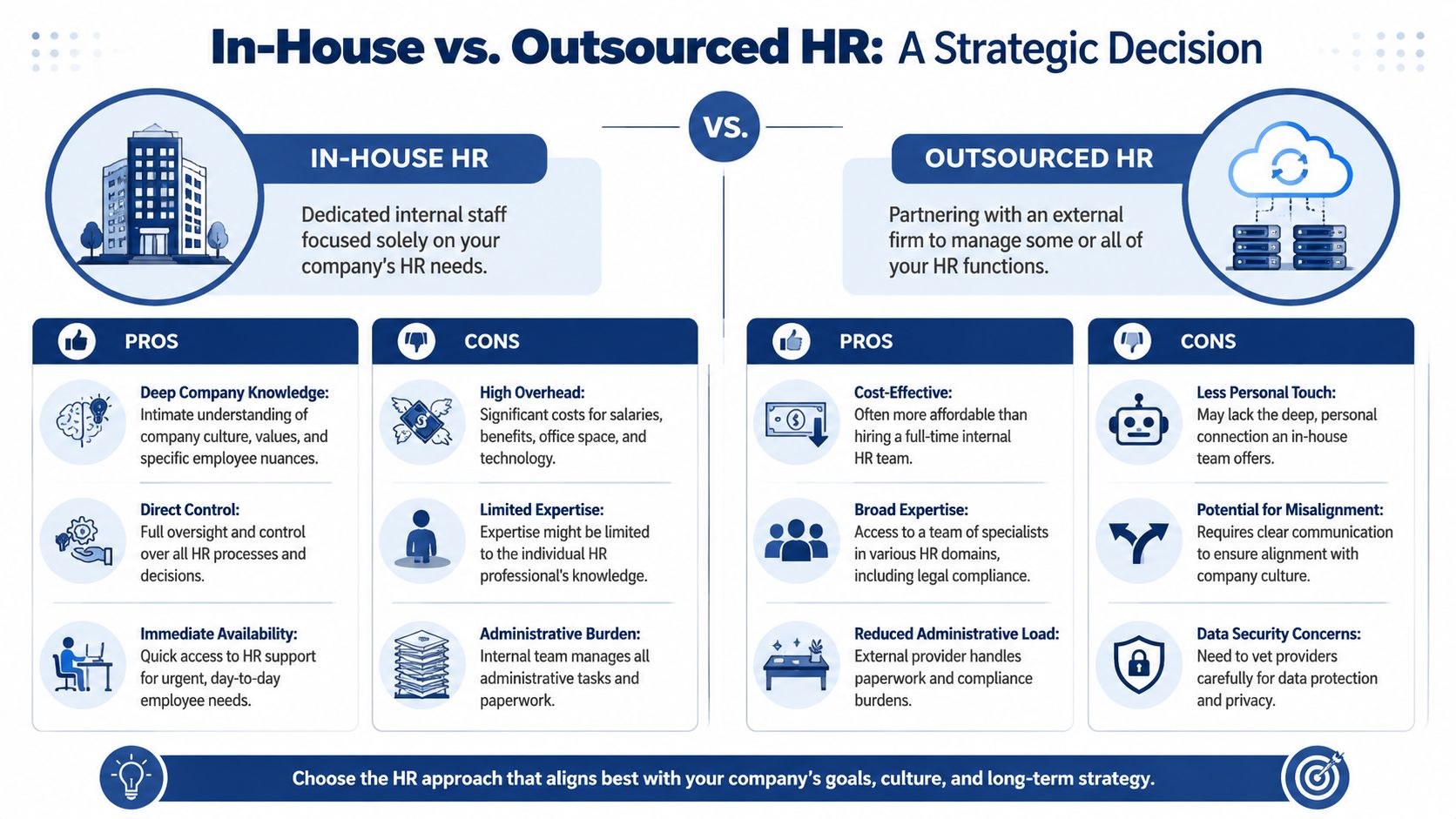
In-House vs Outsourced HR A Strategic Decision
Once you know you need support, the next question is structural. Do you hire internally, or do you outsource some or all of the function?
The answer depends less on preference and more on what kind of risk, complexity, and growth path you’re managing.
When in-house makes sense
An internal HR hire can work well if your business has enough scale to keep that person fully occupied and if your needs are heavily culture- or manager-facing.
In-house support often offers:
- Closer day-to-day context: one person sees the team dynamics up close
- Faster internal access: managers can walk over and ask a question
- More direct control: owners can shape process internally
The tradeoff is breadth. One person may be strong in recruiting, weak in compliance. Strong in employee relations, weaker in systems implementation. Small businesses often don’t need one generalist. They need several kinds of expertise at different times.
Why outsourcing often fits growing service businesses
Outsourced HR demonstrates its practical utility. According to SMB-focused HR guidance, outsourced HR models add value when they provide compliance audits, employment-claims support, and specialized consultants, because these services help surface liability before it becomes a penalty or dispute. The same guidance notes that once employees are distributed across jurisdictions, HR support has to encode state-specific tax, wage-hour, and eligibility rules into onboarding and ongoing administration rather than relying on one-size-for-all processes, as explained in this overview of HR support for small business.
That matters for service businesses with remote staff, multi-state hiring, or managers who need fast answers without becoming HR experts themselves.
A useful comparison looks like this:
| Decision factor | In-house HR | Outsourced HR |
|---|---|---|
| Company familiarity | High | Moderate, improves with onboarding |
| Specialist access | Limited to hire’s experience | Broader bench of expertise |
| Scalability | Slower to expand | Easier to add support as needs change |
| Admin load on owner | Can still remain high | Often lower if provider handles workflows |
| Multi-state compliance support | Depends on hire | Often stronger if provider specializes in it |
A practical way to decide
Ask three questions.
First, how complex is your compliance exposure? If you have employees in more than one state, contractor questions, leave issues, or frequent hiring, outside support becomes more attractive.
Second, how much owner time are people issues consuming? If too many matters still route through you, outsourced support can restore focus.
Third, where is the business headed next? If recruiting is the immediate pressure point, a founder may also want a hiring partner. In that case, a resource like this founder’s guide to hiring faster can help you think through outsourced recruiting alongside broader HR support.
Outsourcing isn’t just about handing tasks away. It’s about gaining access to process, documentation, and judgment that a small team usually doesn’t have in-house.
Your Implementation Checklist for HR Support
Once you decide to improve HR, don’t try to fix everything in one sweep. Treat implementation the way you’d treat a finance system change. Start with risk, workflow, and data integrity.
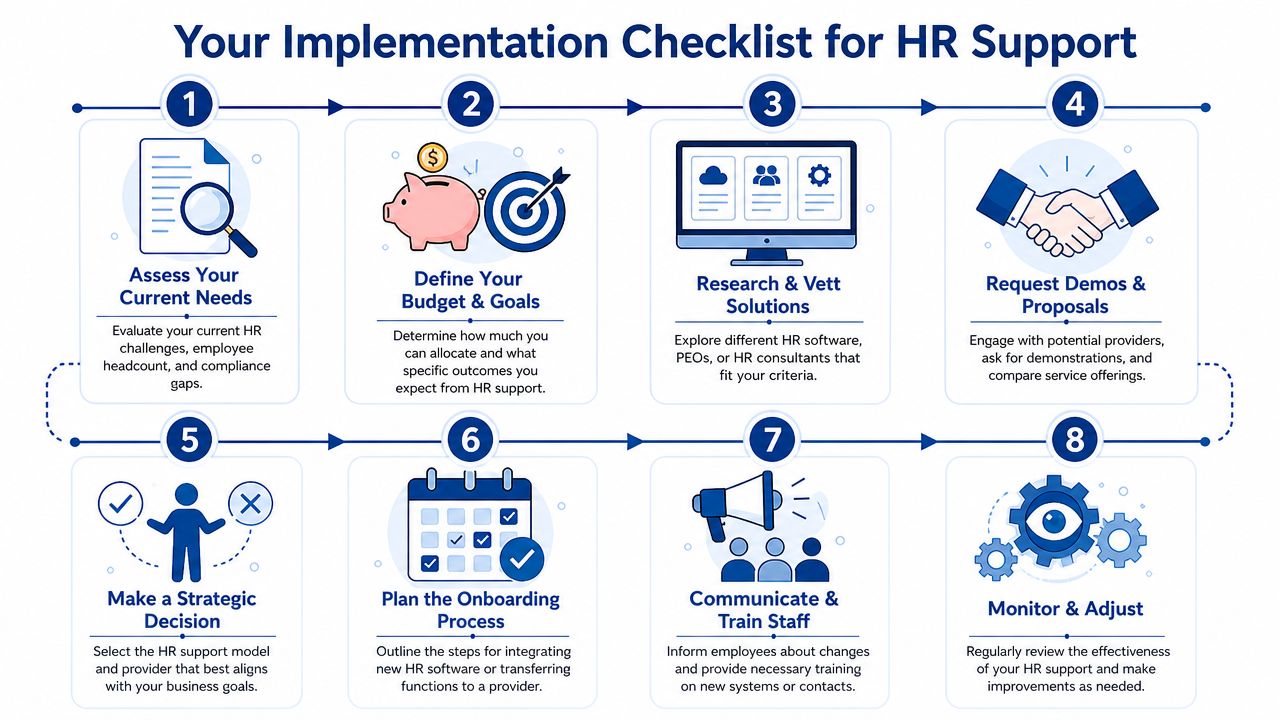
Step one through four
Assess what’s breaking now
Don’t start with software demos. Start with friction. Where are errors recurring? Which employee questions keep bouncing around? What documentation is inconsistent or hard to find?Set business goals, not just HR goals
Your goal may be fewer payroll interruptions, cleaner onboarding, better manager consistency, or stronger documentation. Tie HR support to outcomes the business experiences.Choose the right support model
Match the model to the problem. If payroll and benefits are the pain point, you may need systems plus admin support. If employee issues and compliance questions are piling up, advisory support may matter more.Vet the platform or partner carefully
Focus on integration, permissions, reporting, and migration. Ask how employee data flows into payroll, how access is controlled, and what happens to historical records during setup.
Step five through eight
Plan data migration before rollout
This phase often proves challenging for many projects. Gather payroll history, tax documents, PTO balances, job data, and employee files before switching systems or providers.Document your core workflows
Write down how hiring, onboarding, pay changes, time-off requests, and offboarding should work. If it only lives in someone’s head, it won’t scale.Communicate changes to your team
Employees need to know where to log in, who to contact, and what’s changing. Managers need clearer instructions than everyone else, because they’re usually the ones triggering HR events.Track whether the change is working
You don’t need complicated dashboards. You do need a short list of operational checks.
Use a review list like this:
- Payroll stability: Are payroll corrections decreasing?
- Onboarding consistency: Are new hires completing the same steps every time?
- Manager adoption: Are supervisors following the documented process?
- Record quality: Can you pull employee documents quickly when needed?
- Owner relief: Are fewer people issues landing directly on your desk?
Cleaner HR workflows usually show up first as fewer interruptions. That’s often the earliest sign the implementation is working.
Finding a Partner Who Integrates People and Profit
The true payoff from HR support isn’t that forms get filed faster. It’s that your business becomes easier to run.
When payroll, bookkeeping, onboarding, benefits, and employee records are disconnected, owners lose visibility. Labor costs become harder to explain. Errors take longer to trace. Managers make decisions without complete information. You feel that in cash flow, forecasting, and stress.
The right partner sees HR and finance as one operating system. That means employee changes flow into payroll correctly. Payroll flows into the books cleanly. Benefits and compensation decisions can be evaluated with current financial data. Documentation supports compliance instead of lagging behind it.
That’s why many service businesses prefer support built around modern payroll and accounting tools like Gusto and QuickBooks, with advisory help layered on top. One example is best HR software for small business, which frames software selection in terms of workflow, compliance, and business fit rather than feature overload.
A firm like Steingard Financial fits this integrated model by combining bookkeeping, payroll support, and People Advisory around the same back-office workflow. For owners, that means HR support isn’t floating off to the side. It sits where labor decisions, reporting accuracy, and growth planning already meet.
If you want a back office that connects payroll, bookkeeping, and people operations in one practical system, Steingard Financial offers support for service businesses that need cleaner records, steadier workflows, and fewer owner-side HR headaches.