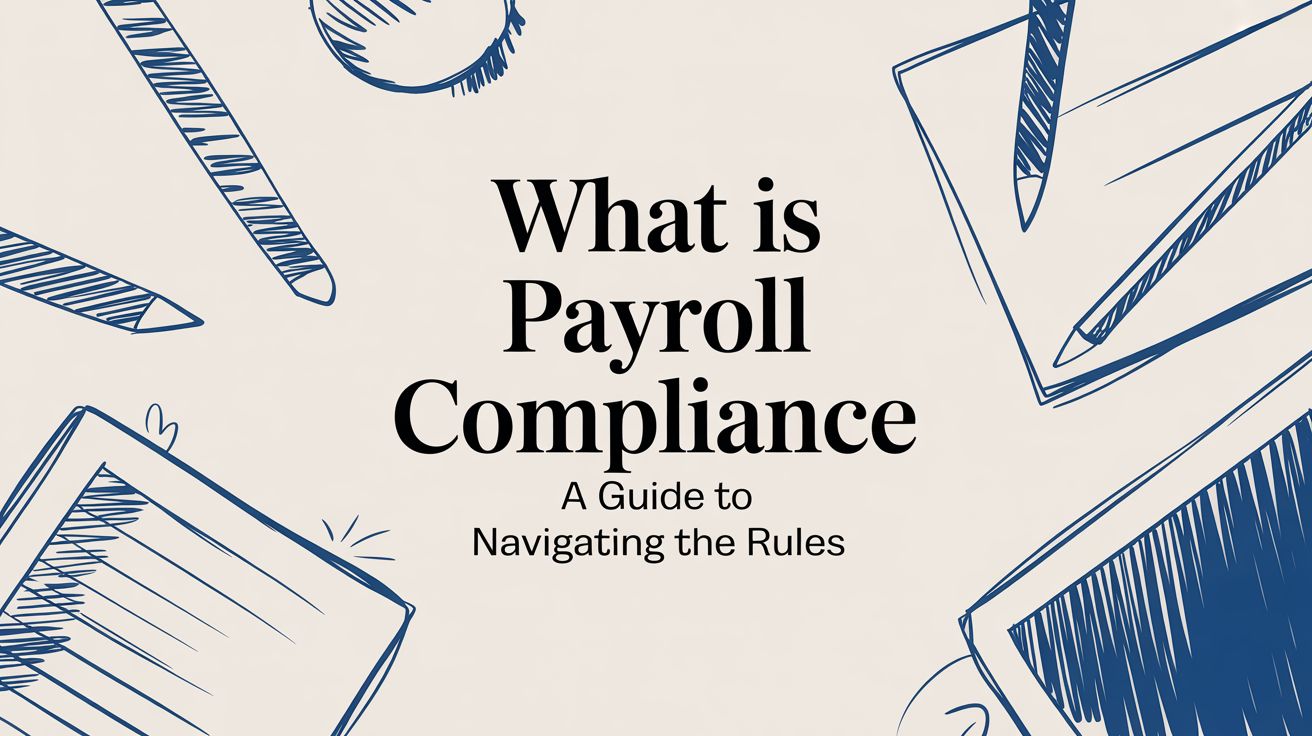
What Is Payroll Compliance A Guide to Navigating the Rules
Payroll compliance is, quite simply, the rulebook for paying your employees correctly and legally. Think of it as the non-negotiable framework for your business's payroll, covering everything from tax withholding to final paychecks. Getting this wrong can lead to steep fines, legal trouble, and a serious breakdown in employee trust. Why Payroll Compliance Matters for Your Business To really get a handle
Master Small Business Financial Reporting for Growth
Think of financial reporting as turning a mountain of raw data into a story—the story of your company's health. It’s how you take all those numbers and get real answers about your profitability, cash flow, and overall stability. It’s the only way to measure your performance against your goals and make decisions with confidence. Building a Reporting Foundation That Actually Works Before
Small Business Accounting Basics: A Practical Guide for Service Companies
For many service business owners, the word "accounting" can bring on a headache. It often conjures images of late nights wrestling with spreadsheets or that looming dread that creeps in as tax season approaches. But that’s a very narrow, and frankly, stressful way to look at it. Good accounting is really the language your business uses to tell you what’s working, what
What Is G&A in Business and How Does It Impact Profitability
When you're running a business, you hear a lot of acronyms thrown around. One of the most important is G&A, but what exactly does it cover? Think of General & Administrative (G&A) expenses as the costs of keeping the lights on—they are the essential, everyday expenses that support your entire company, but aren't directly part of making your product or
Annual Performance Review Template: 2026 Guide for Service Teams
An effective annual performance review template can provide a structured way to look at an employee’s contributions, but many traditional versions just don’t cut it for today's service-based companies. The real value isn't in a once-a-year judgment; it's in creating a continuous, forward-looking dialogue that focuses on growth. Why Old-School Reviews Don't Work for Service Teams The traditional annual review is often
Outsourced accounting for startups: Scale smarter with expert finance
Outsourced accounting isn't just about hiring someone to do your books. For a startup, it's a strategic decision to swap out those messy DIY spreadsheets or a part-time bookkeeper for a complete, expert finance team. This approach is what gets you investor-ready financials and frees you up to focus on your product and growth, not on categorizing transactions in QuickBooks. Why
What is the purpose of cash flow statement for service businesses
The cash flow statement is all about one thing: tracking the actual cash moving in and out of your business. It’s the report that shows your true liquidity. While an income statement can show "paper profits," the cash flow statement follows the real dollars, answering the most important question for any business owner: do you have enough cash to run
Build Your Own Accounts for Small Businesses Spreadsheet
For many small business owners, an accounts for small businesses spreadsheet is the perfect first step toward financial clarity. It’s an incredibly powerful, low-cost tool that gives you immediate control over your finances, helping you track every dollar without the complexity of a full-blown accounting system. Why a Spreadsheet Can Be Your Business Superpower Before you jump into complex accounting software, it's
Your Guide to Net 30 Invoicing for Service Businesses
So, you've seen the term "net 30" on invoices and contracts, but what does it actually mean for your business? In simple terms, net 30 invoicing is a payment term that gives your client 30 calendar days to pay you after you’ve sent them the bill. It's the most common form of trade credit in the B2B world, kind of
Mastering Accounts Payable Workflow Automation in 2026
Accounts payable workflow automation is about using software to take over the repetitive, manual tasks involved in paying your company's bills. It moves the entire process, from getting an invoice to sending the payment, out of the world of paper-chasing and manual data entry and into an efficient, digital system. From Chaotic Kitchen to Synchronized Assembly Line Think of a typical accounts