 Skip to content
A common trigger for an amendment to an LLC operating agreement is simple: the business outgrows the document it started with. A founder brings in a new partner, shifts profit sharing, hands day-to-day authority to a manager, or changes how major decisions get approved. The original agreement no longer matches reality, but the books, payroll setup, and bank authority often keep moving as if nothing changed.
That gap causes problems fast. Profit distributions may get recorded one way while the agreement now says something else. A promoted employee may start acting like an owner before banking access, payroll treatment, and internal approvals are updated. If a member later exits under stress, everyone suddenly discovers that the legal document, accounting records, and operational systems don’t line up.
The good news is that this is fixable when you handle it as both a legal update and an operational change. If you already use written workflows for contracts, tools discussed in FaxZen’s guide to contract solutions can help teams keep amendments, approvals, and final signed copies organized instead of scattered across inboxes.
Your Business Is Evolving and Your Operating Agreement Should Too
An LLC operating agreement isn’t a file you sign once and forget. It’s the internal contract that should reflect how the company runs today, not how it ran when the LLC was formed.
That matters most during transition points. A service business may admit a senior operator as a member. A founding team may revise voting rights after one owner steps back from daily work. A family-run company may need clearer exit rules before a transfer causes friction. In each case, the legal framework has to catch up to the business.
What an amendment is really doing
A core feature of LLC operating agreement amendments is that they keep the contract aligned with major business changes such as ownership transfers, management changes, and voting-rule updates, as explained in this practical amendment drafting guide.
That sounds legalistic, but the practical effect is straightforward. The amendment tells everyone which rule changed, when it changed, and what remains untouched.
Practical rule: If your ownership, decision rights, or economic deal changed in real life, your operating agreement should reflect that change in writing.
What happens when the agreement is outdated
An outdated agreement creates ambiguity in places where businesses need precision:
- Profit allocations get messy when owners assume verbal changes are enough.
- Management authority blurs when someone is leading operations without written authority.
- Exits become harder when no one documented how a departing member’s rights are handled.
- Back-office errors multiply when bookkeeping and payroll continue under old assumptions.
Most business owners think of the amendment as the legal task. In practice, it’s also a finance and HR control point. Once the agreement changes, your accounting, payroll, banking permissions, and internal records need to match the new legal reality.
Key Moments That Require an Amendment
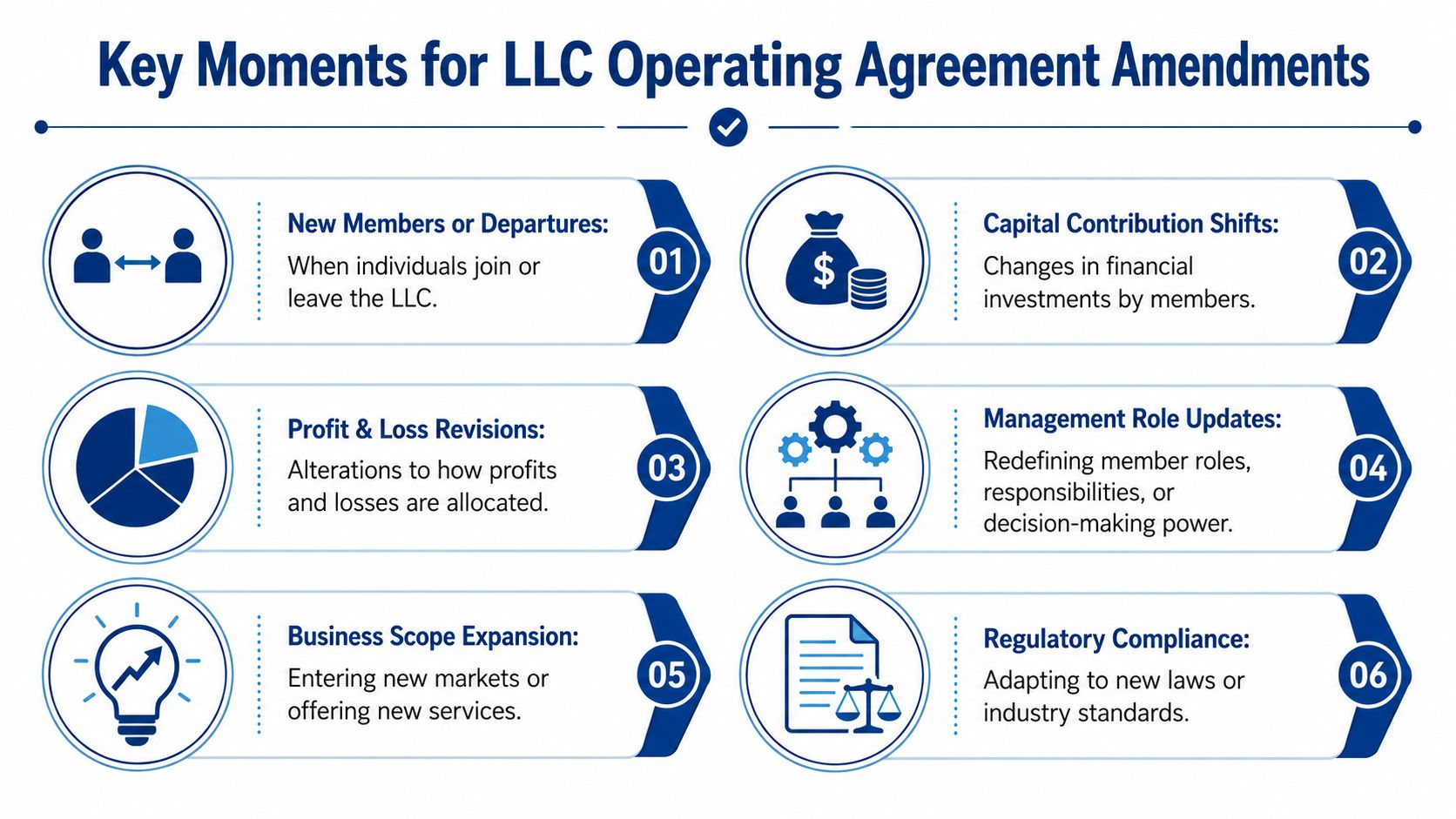
Not every business decision needs a rewrite of the operating agreement. But certain events almost always should trigger a review.
Ownership and economics changes
Some triggers are obvious because they affect who owns the business and how money flows.
- A new member joins the LLC. If someone buys in, contributes capital, or earns equity, the agreement should define that person’s ownership, rights, and economic participation. If you’re also evaluating how owners should take money out of the business, this guide on how to pay yourself from an LLC is a useful operational companion.
- A member leaves. Departure terms should match current reality, especially if the original agreement doesn’t address buyout mechanics cleanly.
- Capital contribution expectations change. If members are expected to contribute more money, less money, or under different conditions, document it.
- Profit and loss allocations are revised. This comes up when one member becomes less active, a rainmaker gets a different economic share, or the company restructures incentives.
Governance and control changes
Other amendments are less about economics and more about who gets to decide what.
- Voting rights change. The agreement may need to reflect different approval thresholds for major decisions.
- Management duties are reassigned. If the LLC moves from member-managed to manager-led in practice, the document should say so.
- Authority shifts after growth. A founder who once approved every expense may now want another member or manager to control hiring, client contracts, or daily operations.
Strategic and compliance changes
Some changes happen because the company itself has changed shape.
- The business expands into new activities. If the LLC starts offering new services, entering new markets, or operating in a way the original agreement didn’t contemplate, review the scope and governance language.
- Internal processes need modernization. Mature businesses often add cleaner approval rules, meeting procedures, or transfer restrictions after the original startup-stage agreement stops working.
- Compliance or external requirements force cleanup. Lenders, investors, insurers, or tax advisors often uncover outdated provisions that should be corrected before the next transaction.
When the business model changes but the operating agreement doesn’t, disputes usually surface later through money, control, or exit rights.
The practical test is simple. If the answer to “who owns what, who decides what, or who gets paid what” has changed, you likely need an amendment.
Navigating Member Approval and Voting Rules
The first place to look isn’t a template. It’s the amendment clause in your current operating agreement.
That clause controls the process for changing the contract. Business guidance commonly states that changing an LLC operating agreement usually requires consent from all existing members, although some agreements allow a majority-vote amendment process if the contract itself says so. That distinction matters because the amendment clause becomes the rulebook for later changes, as discussed in HRBlock’s explanation of changing an LLC operating agreement.

Unanimous consent versus majority approval
These two systems create very different power dynamics.
| Approval rule | What it usually means in practice | Main trade-off |
|---|---|---|
| Unanimous consent | Every member must agree before the amendment is valid | Strong protection for minority owners, slower decision-making |
| Majority vote | Members with enough voting power can approve the change | Faster governance, greater risk of conflict |
| Supermajority | A higher threshold applies, but not necessarily everyone | Middle ground between speed and protection |
A unanimous-consent rule reduces the chance that one faction rewrites the deal over another’s objection. But it can also freeze the business if relationships deteriorate.
A majority-vote clause gives the company more flexibility. It also creates litigation risk when control is contested.
Why contested amendments become dangerous
One underappreciated issue is the so-called retaliatory amendment. Court commentary described a dispute in which the majority amended an agreement to remove a manager and escalate capital calls. The court’s general position was that when the agreement allowed amendment by simple majority vote, that decision would generally be enforced unless it made the LLC unable to carry on its purpose, as analyzed in this discussion of retaliatory amendments in contested LLCs.
That doesn’t mean every aggressive amendment is wise. It means process and contract language can outweigh assumptions about fairness.
A member may believe a change is abusive. If the operating agreement authorizes that voting threshold and the process is followed, the amendment may still stand.
What owners should check before proposing a change
Before circulating any draft, verify these points in the current agreement:
- The required vote threshold. Unanimous, majority, or supermajority.
- Who gets notice and how. Informal side conversations aren’t enough if the agreement requires a formal process.
- Whether certain sections have special rules. Some agreements restrict amendments affecting economic rights or management authority.
- Whether member classes exist. Different classes may have different voting rights.
- How approval is documented. Written consent, meeting minutes, signatures, or a combination.
The business lesson is simple. Don’t assume ownership percentage alone tells you what can be changed. The existing agreement decides that.
How to Draft and Execute the Amendment
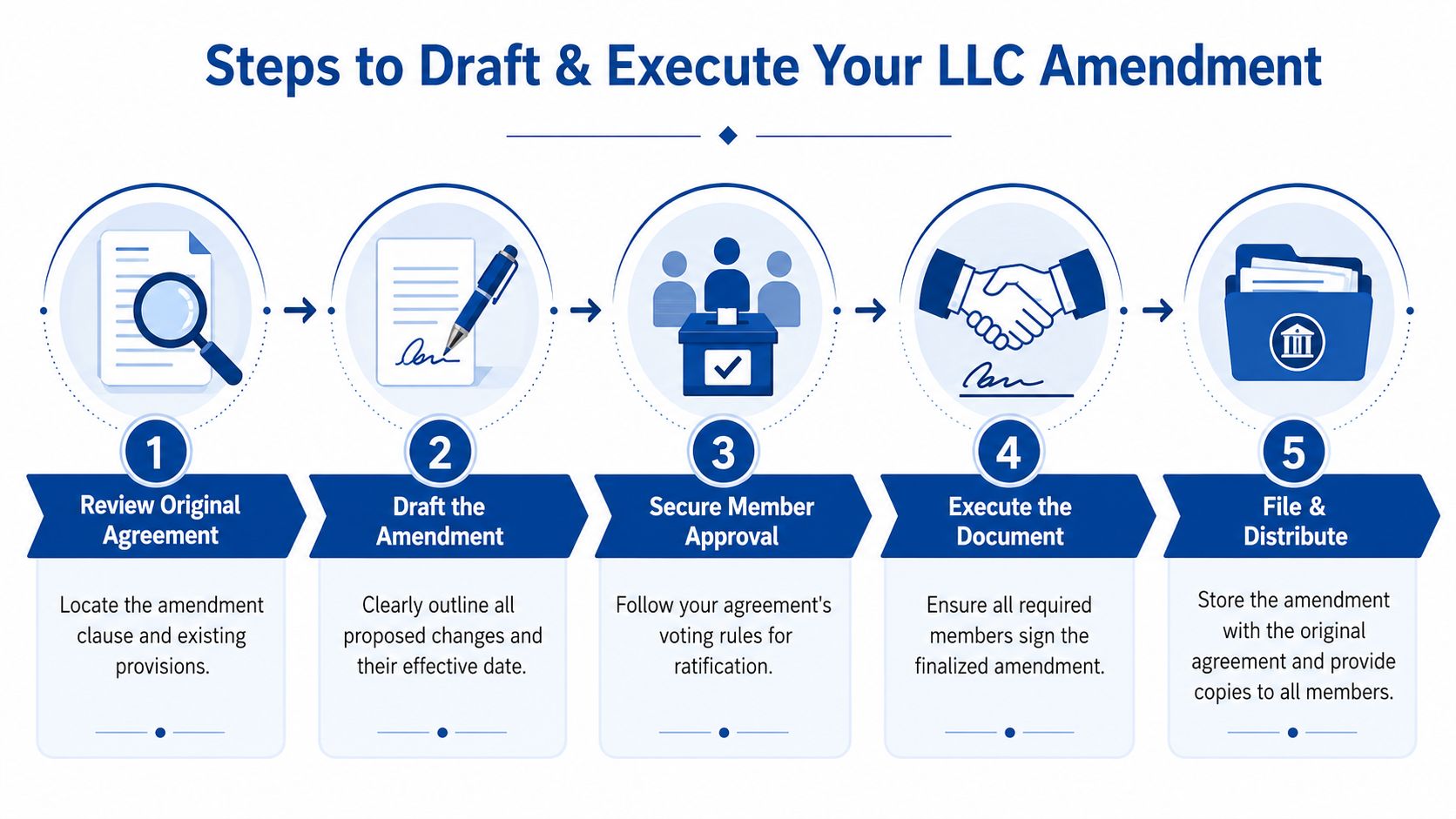
A good amendment is targeted. It doesn’t replace the whole operating agreement unless you intend a full restatement. It identifies what changed, states the new text clearly, and preserves everything else.
The core elements to include
One detailed drafting source recommends at least these key elements in an amendment: the LLC name and state, the amendment date, the section number or name being amended, the actual amendment text, a statement that all other sections remain in force, and member signatures, as outlined in this amendment template guidance.
In practice, that means your document should do the following:
- Identify the original agreement. Include the date of the operating agreement being amended.
- Name the exact section being changed. Don’t make readers guess which paragraph no longer applies.
- State the new language in full. Avoid vague statements like “profit sharing is updated as discussed.”
- Set the effective date. This helps accounting, payroll, and banking teams know when the change governs.
- Confirm the rest of the agreement stays in force. That avoids accidental arguments that the amendment replaced more than intended.
- Collect the required signatures. Use the signature standard required by the agreement.
Sample language for a common amendment
Here’s a simple example for a profit allocation change:
Section 4.2 of the Operating Agreement dated [original agreement date] is hereby amended and replaced in its entirety as follows: “Profits and losses of the Company shall be allocated among the Members as follows: Member A [percentage or stated share], Member B [percentage or stated share], effective as of [effective date].” Except as expressly amended herein, all other provisions of the Operating Agreement remain in full force and effect.
The exact language should fit your business and legal advice, but the structure matters. Clarity reduces later disputes.
A document assembly tool can help teams streamline legal contract processes when they’re coordinating versions, internal review, and final signature packets across multiple owners.
Before final signature, it helps to review the workflow visually:
Where amendments fail in real life
Most failed amendments don’t collapse because the business reason was weak. They fail because the process was sloppy.
For implementation quality control, the most common failure modes are procedural: not following the agreement’s own amendment process, inadequate notice to all members, and weak documentation of the final change set. Guidance also stresses that the amendment should identify the exact sections being replaced, the effective date, and member signatures, as noted in this legal guidance on amendment process errors.
Common breakdowns include:
- Wrong version problems. Members approve an earlier draft, but a later unsigned draft gets circulated as final.
- Missing notice. One member wasn’t properly informed under the agreement’s rules.
- Incomplete signature pages. The business assumes email agreement was enough when written execution was required.
- Vague wording. The document announces a change without replacing the old clause.
- No effective-date discipline. Finance staff post transactions under the new arrangement before the amendment is effective.
Execution insight: A clean amendment package usually includes the redline, the final clean copy, written approval evidence, and the fully signed amendment stored with the base agreement.
State Filings Versus Internal Record Keeping
Many owners assume every amendment has to be filed with the state. Usually, it doesn’t.
An operating agreement amendment is generally an internal written instrument. A proper workflow ends with archiving the signed amendment with the base agreement and keeping it with the company’s operating records, not filing it with the state unless ownership or management facts change, according to this practitioner guide on LLC amendment workflow.
A simple rule of thumb
Use this distinction:
- Internal governance change: Update the operating agreement and company records.
- Public record change: Check whether the Secretary of State or another agency needs an updated filing.
Examples of public-facing changes often include items that affect state records, such as the LLC’s legal name, registered agent, or official address. The exact filing requirement depends on the state and the nature of the change.
What to keep in your company records
Your internal file should be complete enough that a bank, lender, tax professional, auditor, or future buyer can trace what changed and when.
A clean record typically includes:
- The original operating agreement
- The signed amendment
- Member approvals or written consents
- Meeting minutes if a meeting was used
- The final clean version circulated to members
If your records are scattered, this is also a good time to improve document retention practices. Practical systems for small business record keeping make it much easier to retrieve governance documents when a bank, insurer, or advisor asks for them months later.
Your Post-Amendment Financial and HR Checklist
This is the part many owners miss. The legal document gets signed, everyone feels done, and the business keeps operating under old settings in QuickBooks, Gusto, the bank portal, and internal approvals.
That disconnect creates avoidable errors. It becomes even more sensitive when an amendment changes control, contribution duties, or exit rights during a member conflict. Commentary on contested LLCs shows that even a retaliatory amendment may still be enforceable if the agreement allows majority amendment, which highlights why operational systems must reflect the governing document once it takes effect, as discussed in this analysis of amendment disputes and litigation risk.
Finance and accounting updates
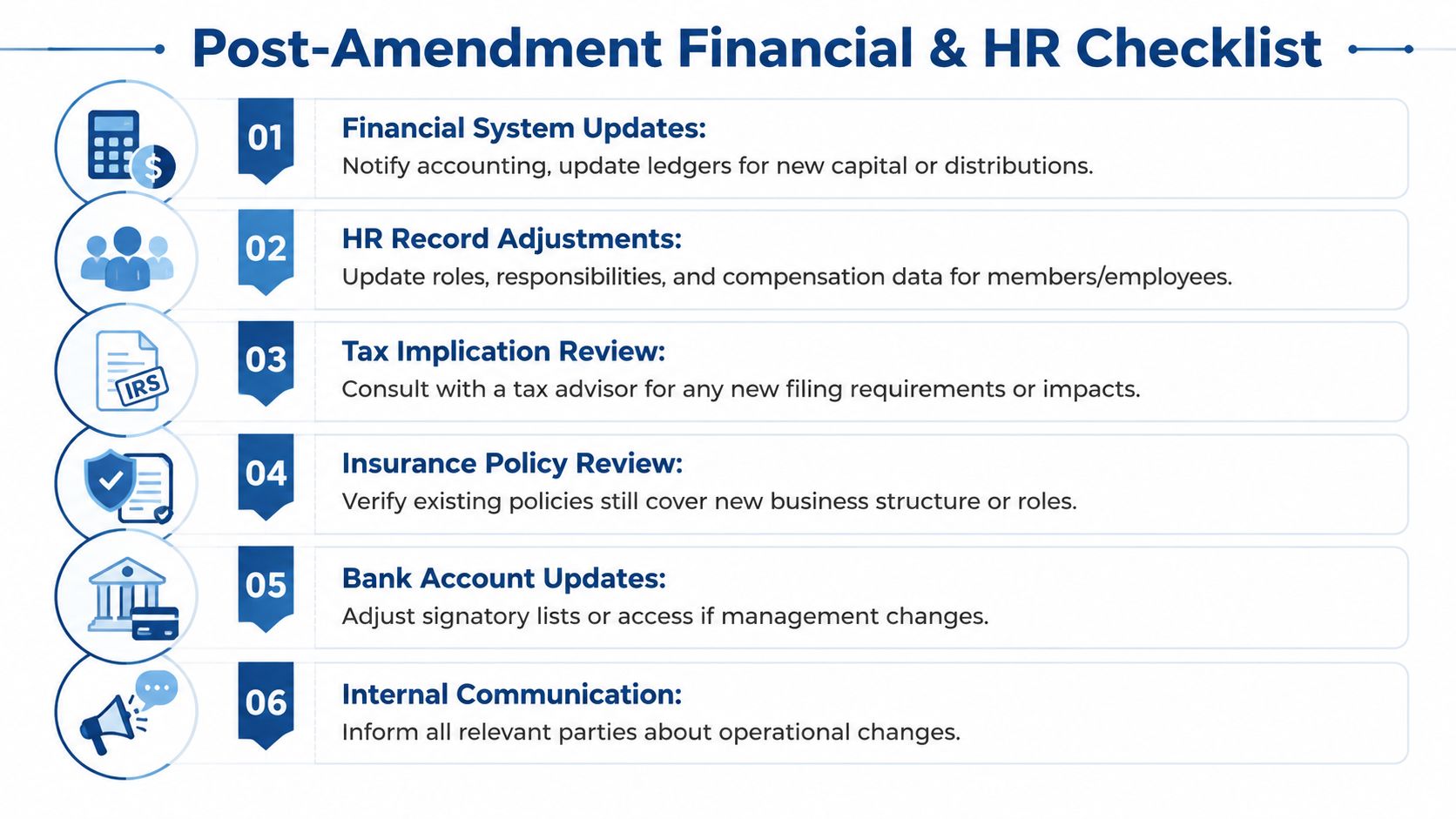
Once the amendment is effective, the books need to match it.
- Update equity and capital accounts. If ownership interests or capital obligations changed, adjust the ledger structure so contributions, distributions, and equity balances are tracked correctly.
- Revisit distribution workflows. Don’t keep paying under the old split because that’s how the recurring bank transfer was set up.
- Align management approvals. If expense approval authority changed, update who can authorize bills, reimbursements, and vendor payments.
- Check recurring journal entries. Any entry tied to owner compensation, allocations, or member reimbursements should be reviewed.
Payroll, HR, and banking changes
A member change often spills into systems outside accounting.
- Review payroll treatment. If someone moved from employee to member status, or if compensation arrangements changed, payroll setup may need to be revised.
- Update HR records and org charts. Titles, reporting lines, and approval authority should match the amended agreement.
- Revise banking access. Signers and online banking permissions should reflect current authority. If you’re adding or changing account access, this overview of opening an LLC bank account is a helpful reference point for what banks typically expect.
- Check company cards and spending platforms. Card access often lags behind governance changes.
- Review insurance and benefits administration. A new manager, owner, or role definition can affect internal administration and policy coordination.
Signed documents don’t update QuickBooks, Gusto, or your bank by themselves. Someone has to make those changes deliberately.
A practical handoff checklist
Use a short internal handoff memo after execution. It should tell your bookkeeper, payroll lead, HR contact, and banking admin:
| Team | What they need to know |
|---|---|
| Accounting | Effective date, ownership or allocation changes, new capital terms |
| Payroll | Changes to compensation structure, role classification, approval authority |
| Banking | New signers, removed signers, revised access levels |
| HR and operations | Updated titles, reporting lines, decision rights, communication plan |
When the legal file and back-office systems stay synchronized, the amendment does what it’s supposed to do. It creates clarity instead of a new layer of confusion.
If your LLC has amended its operating agreement and you want the books, payroll, and reporting to reflect that change cleanly, Steingard Financial can help. Their team supports service businesses with bookkeeping, payroll, reporting, and HR operations so ownership changes, compensation updates, and banking transitions don’t turn into accounting messes later.