 Skip to content
You’re probably looking at two proposals right now.
One provider promises fast turnaround, a low monthly fee, and “full-service” bookkeeping or payroll. The other costs more, asks better questions, and talks about reconciliations, reporting cadence, account structure, onboarding controls, and HR processes. The cheap option feels responsible. The expensive option feels annoying.
Owners often make a costly mistake. They confuse low cost with good value.
In back-office work, that mistake shows up later. It shows up in messy books, payroll corrections, tax-time panic, unclear margins, employee frustration, and decisions made from bad reports. If you run a service business, the difference between cost effective and cost efficient isn’t academic. It changes who you hire, what you outsource, and where you should spend more without apology.
Beyond Price The True Cost of Business Services
A service owner gets two bookkeeping quotes.
The first quote is lean. Transactions categorized quickly. Monthly reports delivered fast. Limited meetings. Minimal cleanup. It sounds efficient because it is. Fewer hours, lower fee, less friction.
The second quote costs more. It includes a review of the chart of accounts, reconciliations, historical cleanup, month-end close procedures, and reporting that helps the owner decide whether to hire, cut expenses, or raise prices. It sounds more expensive because it is.
The problem is that most owners compare those quotes as if they’re buying the same thing. They aren’t.
| Question | Cost-efficient service | Cost-effective service |
|---|---|---|
| What is it optimizing for? | Lower inputs | Better outcomes |
| What does it usually look like? | Faster processing, fewer touches | Accuracy, oversight, useful reporting |
| Where does it work best? | Repetitive, low-risk tasks | High-stakes, decision-driving work |
| What can go wrong? | Hidden errors, weak visibility | Higher upfront spend |
| Best use case | Standardized admin work | Finance, payroll, HR, compliance |
Cheap work often becomes expensive work
If your bookkeeper saves time by posting transactions loosely, your reports stop helping you. If your payroll provider runs checks on time but doesn’t catch classification issues or bad setup, you still pay for the mess later. If your HR support is limited to forms and checklists, you may still lose good people because no one fixed onboarding, benefits communication, or manager processes.
That’s why owners need to understand what they’re really buying when they compare operating costs. The fee is only one line item. The downstream effect is the true cost.
Restaurants deal with this constantly. A schedule that looks lean on paper can still hurt service, retention, and margins if labor is managed poorly. This breakdown of managing restaurant labor costs is useful because it shows the same principle in another setting. Lower spend isn’t automatically better if the operating result gets worse.
A low monthly fee is only a win if the work still protects accuracy, visibility, and decision quality.
That’s the core issue in cost effective vs cost efficient choices. One asks, “What is the cheapest way to get this done?” The other asks, “What outcome am I paying for, and is the result worth the spend?”
Cost Effective vs Cost Efficient A Clear Definition
Most explainers stop at slogans. That’s not enough for owners making real spending decisions.
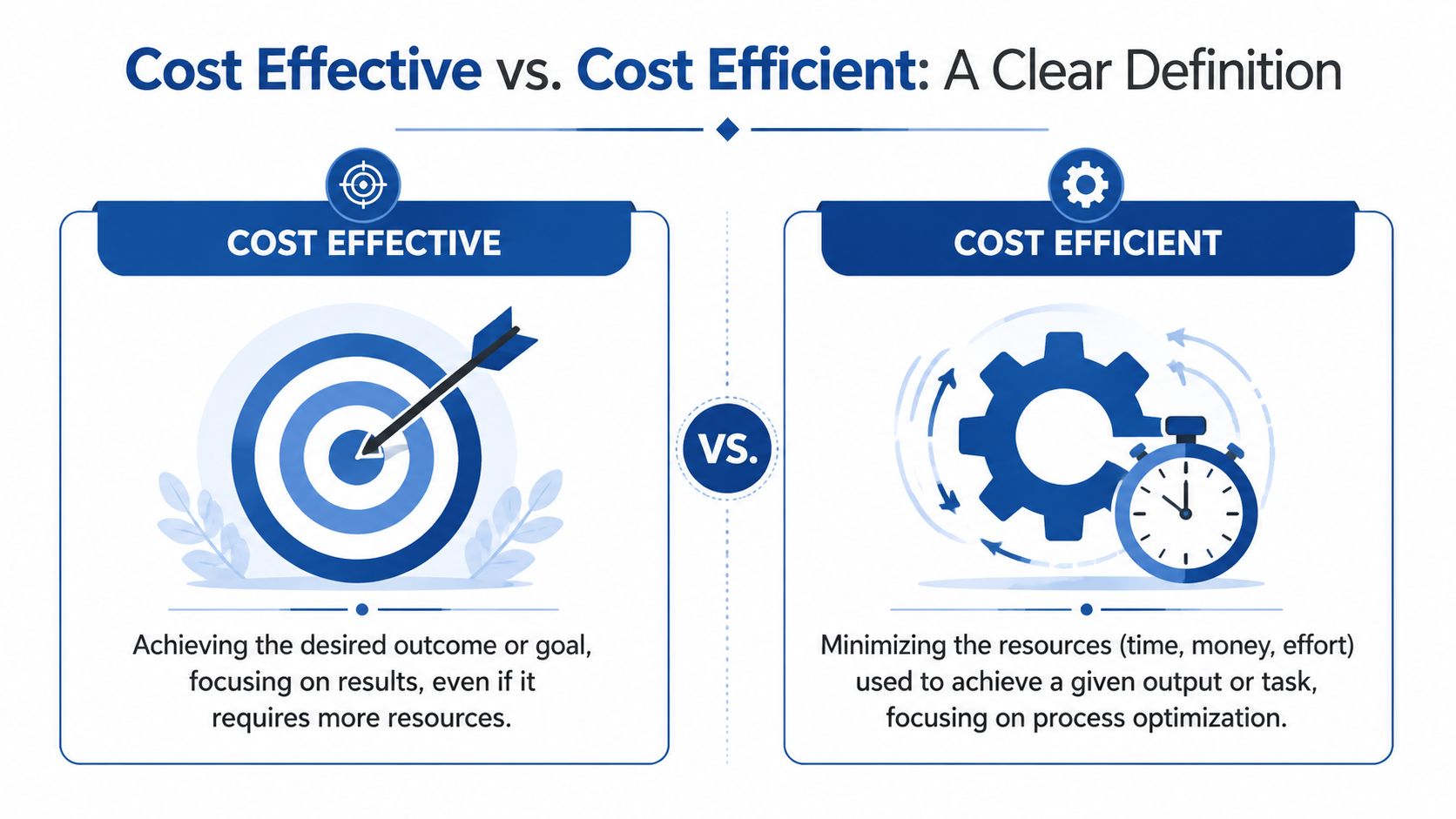
Cost efficient means using the fewest resources for a given output. Less time, less labor, less money. The focus is process optimization.
Cost effective means judging spending by the outcome achieved. The focus is not the cheapest path. The focus is whether the result justifies the cost.
The simplest way to think about it
If someone processes payroll in very little time, that’s efficient.
If someone sets up payroll so pay runs are accurate, deductions are handled correctly, onboarding is clean, and managers get reliable labor data, that’s effective.
If a bookkeeper closes the books quickly, that may be efficient.
If the close produces dependable statements you can use to price work, manage cash, and speak confidently with lenders or investors, that’s effective.
The terms overlap, but they are not interchangeable. In low-risk tasks, efficiency can be enough. In high-stakes tasks, efficiency alone can be dangerous.
Practical rule: If the work affects compliance, reporting quality, employee trust, or management decisions, judge it by outcomes first and price second.
Why owners get this wrong
Owners often buy back-office services the same way they buy office supplies. They compare line-item cost, assume the scope is similar, and pick the lower quote. That’s a mistake because services aren’t commodities when quality changes the business result.
A helpful framing from Better Evaluation’s explanation of cost-effectiveness analysis is that cost-effectiveness compares costs and outcomes in a common framework. That matters because it forces the right question. Not “Which option is cheaper?” but “Which option gets the result that matters at a reasonable cost?”
The decision test that matters
Use this quick filter when comparing providers:
- If the output is standardized: favor efficiency. Basic data entry, routine document collection, and repetitive admin work should be made more efficient.
- If the outcome quality changes the business: favor effectiveness. Financial reporting, payroll setup, account structure, and HR support should be judged by accuracy and usefulness.
- If fixing mistakes is expensive: pay more upfront. Cleanup work almost always costs more than doing it right the first time.
- If leadership relies on the result: don’t buy the bare minimum. Reports that guide hiring, pricing, and cash planning need to be right.
Cost effective vs cost efficient becomes clear once you stop treating all back-office tasks as equal. They aren’t. Some tasks are processing work. Others are decision infrastructure.
How This Plays Out in Bookkeeping Payroll and HR
The distinction gets obvious when you look at real back-office work instead of dictionary definitions.
Bookkeeping
A cost-efficient bookkeeping provider usually optimizes for speed. Transactions are categorized quickly. Reconciliations may be limited. The monthly close happens fast enough to send reports and move on.
That can work for a very simple business, but many service firms aren’t simple. They have owner draws, contractor payments, software subscriptions, client deposits, reimbursable expenses, payroll allocations, and debt activity. When those entries are rushed, the books may still look “done” while the reports are effectively useless.
A cost-effective bookkeeping approach is slower where it needs to be slower. Bank and credit card reconciliations are taken seriously. The chart of accounts is built for management visibility, not just tax prep. Questions get raised when something looks off. Reports arrive with context.
Here’s the difference in plain English:
- Efficient bookkeeping: “Your transactions are categorized.”
- Effective bookkeeping: “Your books support pricing, cash decisions, tax coordination, and performance review.”
Payroll
Payroll is another place where owners confuse completion with quality.
A cost-efficient payroll setup focuses on getting payroll processed with minimal labor. Hours go in. payroll runs. Employees get paid. On the surface, job done.
But payroll quality includes far more than pressing submit. It includes onboarding setup, earnings and deduction mapping, benefits coordination, tax setup, worker classification, PTO handling, and clear reporting. If those pieces are weak, you don’t just have a payroll problem. You have an employee trust problem and an operations problem.
If you’re comparing providers, this guide on the cost of outsourcing payroll is useful because it highlights what owners should look for beyond the base fee.
Payroll isn’t successful because money moved on time. It’s successful when the system works cleanly, repeatedly, and without creating downstream corrections.
HR and people support
HR gets underbought all the time because owners think of it as paperwork.
A cost-efficient HR service handles forms, onboarding checklists, and maybe benefits administration. It covers the minimum.
A cost-effective HR function helps the business operate better. It supports hiring plans, compensation structure, manager consistency, retention conversations, and employee experience. In a service firm, that matters because your people are the product. Weak HR systems don’t stay in the back office. They show up in turnover, client inconsistency, and owner distraction.
The hidden pattern
Across bookkeeping, payroll, and HR, the cheapest option often narrows the work to the easiest measurable output. Categorized transactions. Processed payroll. Completed forms.
The better option improves the business outcome. Cleaner books. Better decisions. Fewer payroll issues. Stronger team retention. Less owner time wasted untangling preventable problems.
That’s the difference that matters. Not whether the provider moved fast, but whether the service changed the quality of the result.
Metrics That Matter How to Measure Both
A provider quotes $800 a month for bookkeeping. Another quotes $1,300. If you judge that decision on price alone, you are not measuring cost. You are guessing.
Measure the service the way a CFO would. Track what it costs to run, and track what it produces for the business. Those are different scoreboards.
What to track for efficiency
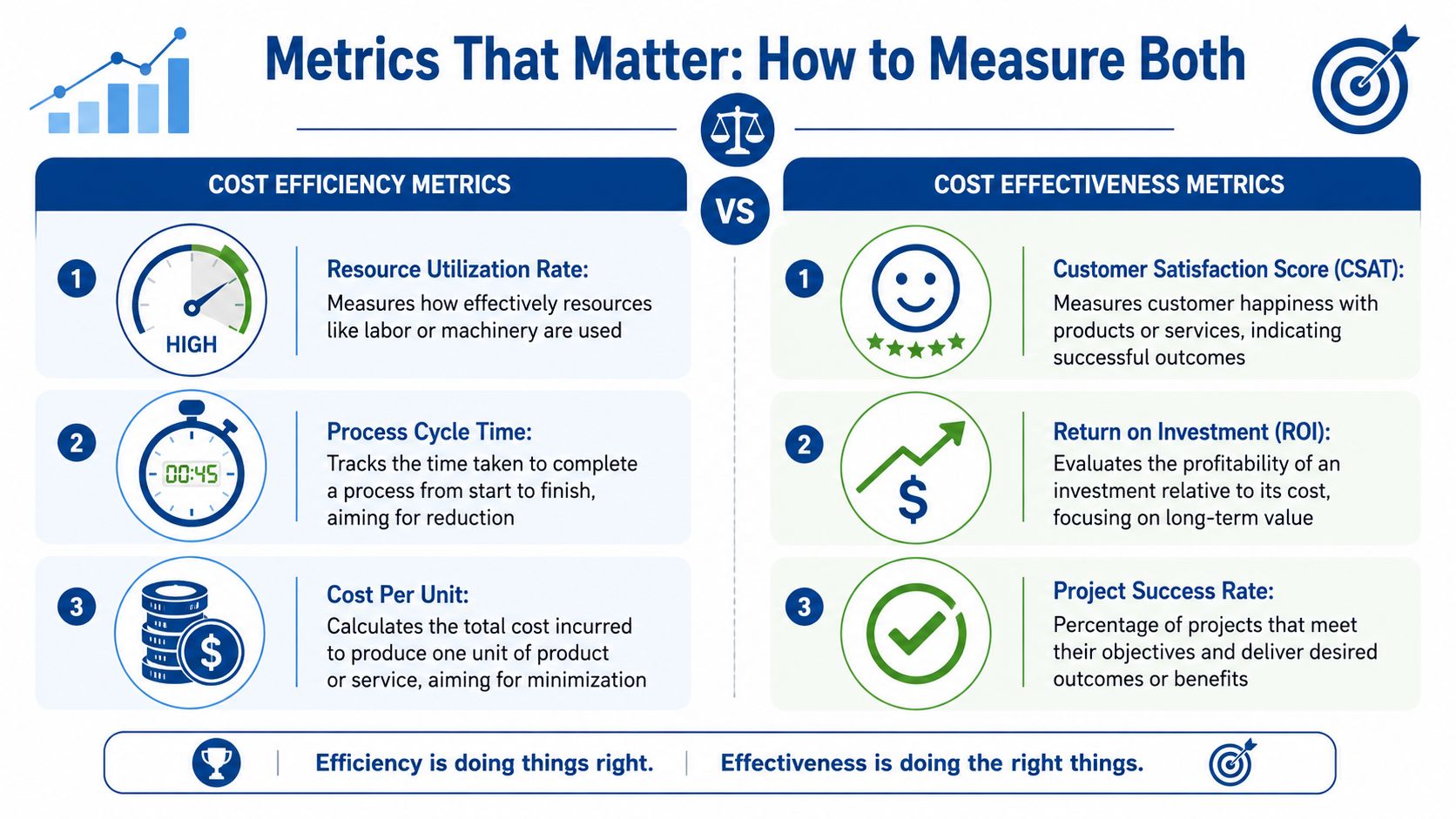
Efficiency metrics show whether the work is being done with discipline and without waste. They matter most for repeatable back-office tasks where volume, timing, and staffing are easy to measure.
Track:
- Cost per transaction: Useful for AP, AR, bookkeeping entry, or payroll administration.
- Processing time: How long month-end close, payroll runs, or issue resolution takes.
- Resource utilization: Whether staff time is being used well, especially in repetitive workflows.
- Volume handled per person: Helpful in standardized environments with routine tasks.
These numbers help you control overhead. They also miss a big part of the decision. A low-cost process that creates rework, bad reports, or payroll corrections is not cheap.
If you want outside benchmarks on process performance, this practical guide for B2B/SaaS founders gives a useful framework for tracking operating efficiency without confusing it with business value.
What to track for effectiveness
Effectiveness metrics answer the harder question. Did the service improve financial control, decision quality, employee experience, or owner time?
Track outcomes such as:
- Financial statement accuracy: Can you trust the numbers without hunting for errors?
- Exception resolution quality: Are AP, AR, payroll, or benefits issues fixed correctly the first time?
- Decision usefulness: Do the reports help you price work, plan hiring, and manage cash with confidence?
- Payroll and HR reliability: Are employees paid correctly, onboarded cleanly, and supported without constant escalation?
- Owner time recovered: How many hours are no longer spent cleaning up preventable back-office problems?
Many service businesses make bad buying decisions by measuring the vendor’s activity and ignoring the business result. In bookkeeping, that means counting reconciliations but not asking whether the month-end numbers support margin decisions. In HR, it means counting completed onboarding packets while ignoring early turnover, manager confusion, and benefit errors.
A practical scorecard
Use one simple rule. Every back-office service should have at least one efficiency metric and one effectiveness metric tied to it.
| Metric type | Good for measuring | Weakness |
|---|---|---|
| Efficiency | Speed, cost control, labor use | Can ignore quality |
| Effectiveness | Accuracy, trust, decision value | May require more judgment |
| Best approach | Track both together | Avoid using price alone |
Here is the test I recommend. If a provider saves you $500 a month but causes delayed closes, messy reports, payroll corrections, or extra owner involvement, the savings are fake. If a provider costs more but gives you cleaner financials, fewer employee issues, and better management decisions, that higher fee may be the smarter buy.
You should also tie back-office improvement to financial performance. Better reporting, cleaner payroll, and stronger people systems should show up over time in margin, cash control, and decision quality. That is why owners should know how to read profitability ratios that show whether operations are actually improving instead of stopping at the bookkeeping fee.
If a provider lowers admin cost but weakens the numbers you manage from, the service is efficient and still a bad deal.
When to Choose Efficiency vs Effectiveness
Your payroll processor is cheaper by $300 a month. Then a tax notice shows up, two employees get paid wrong, and your office manager spends half a day fixing what should have been handled correctly the first time. That is the decision test. If a lower fee creates cleanup, risk, or lost trust, you did not buy efficiency. You bought future expense.
Choose efficiency for routine, repeatable work
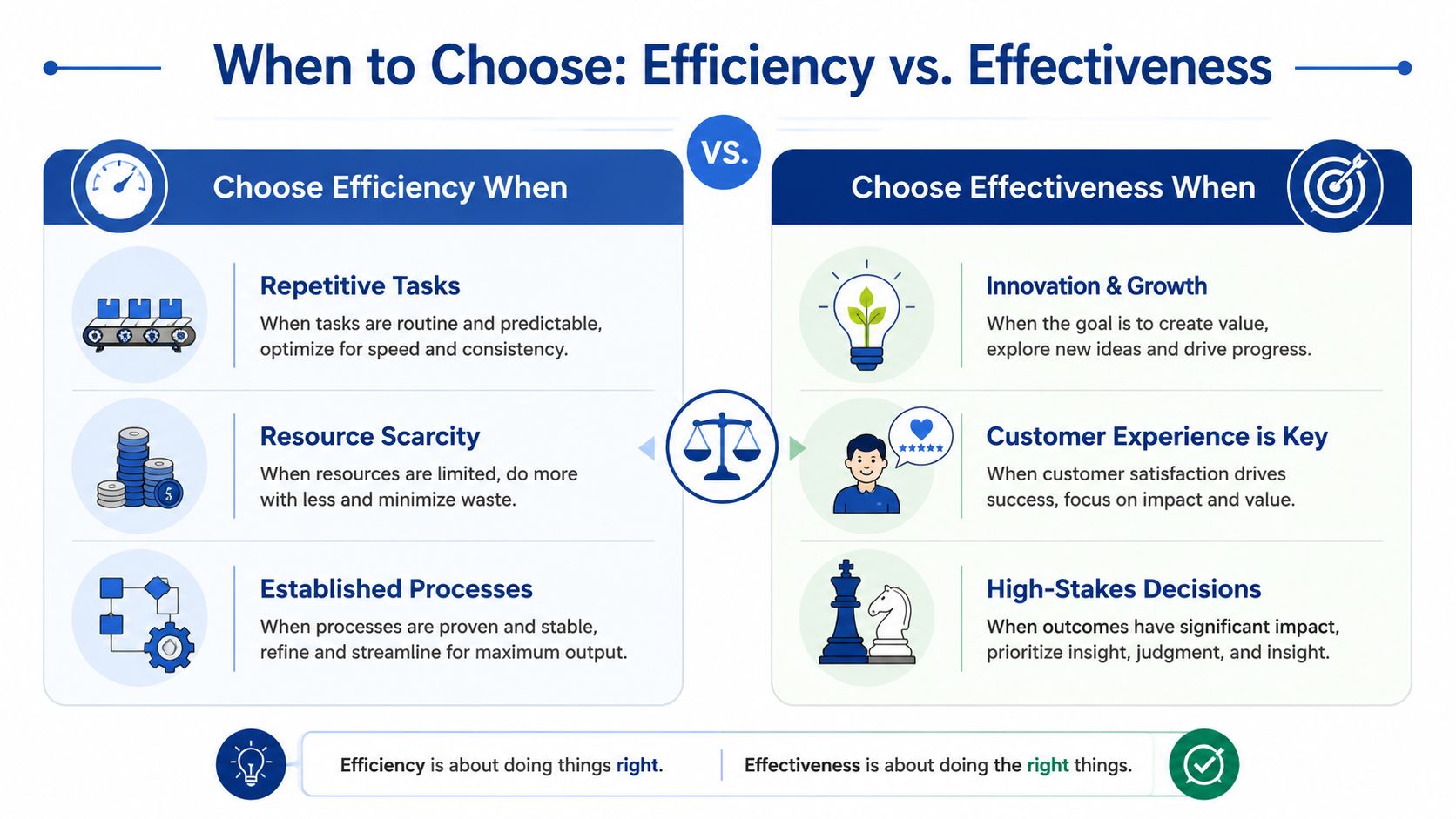
Use efficiency where the work is stable, rules-based, and easy to check.
That usually means tasks like basic transaction coding under clear rules, document collection, recurring AP entry, standard payroll inputs, and administrative follow-up. In those areas, speed and labor discipline matter because the output is predictable and the downside of an occasional mistake is limited and visible.
If you can write the process, train it quickly, and verify the result with a simple review, push for efficiency. Standardize it. Automate it. Lower the cost per task.
Choose effectiveness for work that carries financial consequences
Pay for effectiveness when the work affects decisions, compliance, employee confidence, or cash.
That includes month-end close quality, account mapping, financial reporting, payroll setup, multi-state compliance, benefits administration, hiring support, and retention-related HR work. These are not commodity tasks. A weak provider may still look fast and affordable while producing reports you cannot manage from, payroll systems that create rework, or HR support that frustrates employees and managers.
The pattern is simple. The more judgment the work requires, the more expensive bad execution becomes. In back-office services, the premium for stronger work is often small compared with the cost of corrections, owner time, penalties, and poor decisions.
Here’s a short video that helps frame the tradeoff in everyday business terms.
A decision filter you can use this week
Run each back-office task through these questions:
What is the cost of being wrong?
If the answer is minor delay or easy rework, choose efficiency. If the answer is bad reporting, payroll errors, compliance problems, or employee distrust, buy effectiveness.Is this task mostly processing or mostly judgment?
Processing should get faster and cheaper. Judgment should get better.Would I catch a mistake quickly?
Obvious errors are safer to handle with an efficiency-first model. Hidden errors inside financial statements, payroll setup, or benefits administration require stronger review and expertise.Does this output affect a business decision?
If you use it to price work, hire staff, manage cash, or forecast margins, do not shop for the lowest bidder.What happens to owner time if this provider underperforms?
This question gets ignored too often. If you or a senior manager have to audit, chase, explain, or repair the work, the service is underpriced and overpriced at the same time.
For owners weighing outsource decisions, this piece on smarter business decision making is useful because it looks at the same issue through the make-or-buy lens. The right choice depends on business impact, the cost of errors, and the value of management time.
Cheap back-office support gets expensive fast when it touches reporting, payroll, compliance, or employee trust.
Use efficiency to reduce the cost of predictable tasks. Use effectiveness to protect outcomes that matter financially. That is how service businesses make better spending decisions in bookkeeping, payroll, and HR.
Building Your Cost-Effective Back Office
A strong back office isn’t the cheapest version of bookkeeping, payroll, and HR. It’s the version that gives you reliable numbers, cleaner systems, fewer preventable errors, and better management decisions.
That usually means treating finance and people operations as infrastructure. Not overhead to squeeze blindly, but systems that support growth. If your books are inconsistent, your payroll setup is loose, or your HR process only handles forms, the business will feel that weakness everywhere else.
What a better back office includes
A cost-effective back office usually has a few traits in common:
- Accurate core records: Clean transaction categorization, reconciliations, and dependable month-end close.
- Useful reporting: Statements and dashboards that help an owner act, not just file taxes later.
- Deliberate payroll systems: Clear setup, repeatable workflows, and less time spent fixing avoidable errors.
- Real people support: Onboarding, benefits, compensation, and retention handled as operating priorities.
- Ongoing review: Someone catches issues early instead of waiting for year-end cleanup.
That combination is what turns back-office spend into amplified operational value.

Where owners should stop cutting corners
If you need to trim cost, trim complexity, duplicated tools, unclear workflows, and unnecessary manual steps.
Don’t trim the parts that protect accuracy. Don’t trim review. Don’t trim reporting clarity. Don’t trim payroll controls. Don’t trim the HR support that keeps managers and employees aligned.
Those aren’t luxuries. They are the systems that keep a service business stable enough to scale.
The right spending question isn’t, “How little can I pay?” It’s, “What level of support gives me dependable outcomes at a reasonable cost?” That’s what cost-effective buying looks like in practice.
If you want a back office that delivers accurate books, dependable payroll, stronger reporting, and practical people support, talk with Steingard Financial. Their team helps service businesses build finance and HR systems that are designed for better outcomes, not just lower fees.