 Skip to content
You know the moment. Payroll is due, month-end is slipping, your controller just gave notice, or your bookkeeper is out during the busiest close of the quarter. The books still need to reconcile, vendors still need to be paid, and leadership still expects clean numbers.
That’s when accounting temp jobs stop being an HR topic and become an operations issue.
Used well, a temp accountant, bookkeeper, AP specialist, or AR specialist can stabilize a finance function fast. Used poorly, the same hire creates new problems: bad system access, unclear ownership, weak handoff notes, payroll mistakes, and cleanup work that costs more than the original gap. The difference usually isn’t the candidate. It’s the process around the hire.
This guide is built as a practical playbook for employers. It focuses on how to decide whether temporary accounting help is the right answer, how to vet candidates, how to set them up in QuickBooks Online and Gusto, and how to keep the engagement controlled from day one.
Deciding When You Need Accounting Temp Jobs
If your team is overloaded, that alone doesn’t automatically mean you need a temp. A temporary hire works best when the work is important, time-bound, and process-driven.

The labor market is part of the reason this matters. The unemployment rate for accountants and auditors was 2.0% in Q4 2024, and projections show 124,200 openings annually according to Kogod’s hiring trends analysis. In plain terms, if you wait for the perfect permanent hire to solve an urgent accounting gap, you may wait too long.
The business triggers that justify a temp
Some situations are a strong fit for accounting temp jobs:
- Leave coverage: Your staff accountant, payroll lead, or bookkeeper is out on parental leave, medical leave, or extended vacation.
- Peak-cycle work: Tax season, year-end close, audit prep, or cleanup after a messy prior period.
- Backlog removal: AP is behind, reconciliations are stale, customer collections need attention, or historical books need cleanup.
- Growth without structure: Revenue or transaction volume increased faster than your finance team did.
- Project work: System migration support, chart of accounts cleanup, grant reporting support, or temporary reporting help during a lender request.
Those are temporary-shaped problems. A temp can own a defined lane, produce a visible output, and hand the work back in a cleaner state than they found it.
The signs you have a permanent-sized problem
A temp won’t fix a finance function with no process owner. If the same issues keep repeating, the underlying problem may be role design, not short-term capacity.
Use this quick screen:
| Situation | Temp is a fit | Temp is not enough |
|---|---|---|
| Bank reconciliations are behind | Yes, if the workflow already exists | No, if nobody understands the accounts |
| AP inbox is overloaded | Yes, with clear coding and approval rules | No, if approvals are inconsistent or undocumented |
| Month-end close is slipping | Yes, for checklist-based close support | No, if your close has no checklist at all |
| Books are messy after a prior provider | Yes, for cleanup with supervision | No, if management won’t define the target state |
Practical rule: Hire a temp for a defined bottleneck. Don’t hire a temp to invent your accounting department.
Diagnose the scope before you post the role
Start with four questions:
- What work is broken? Name the exact tasks. “We need accounting help” is too vague. “We need weekly bank reconciliations, AP coding, and vendor statement follow-up” is usable.
- What is the deadline pressure? If there’s a tax filing, audit, or board meeting involved, the role needs a faster ramp.
- What system does the person need to touch? QuickBooks Online, Gusto, bill pay tools, shared inboxes, spreadsheets, or document storage.
- Who will review the work? Even strong temps need a point person.
If you’re trying to map the role before hiring, a simple staffing plan template helps force the right discussion internally. If your broader workforce model includes contractors beyond accounting, this guide to contingent workers is also useful context for deciding where temporary talent fits operationally.
Finding and Vetting Your Candidates
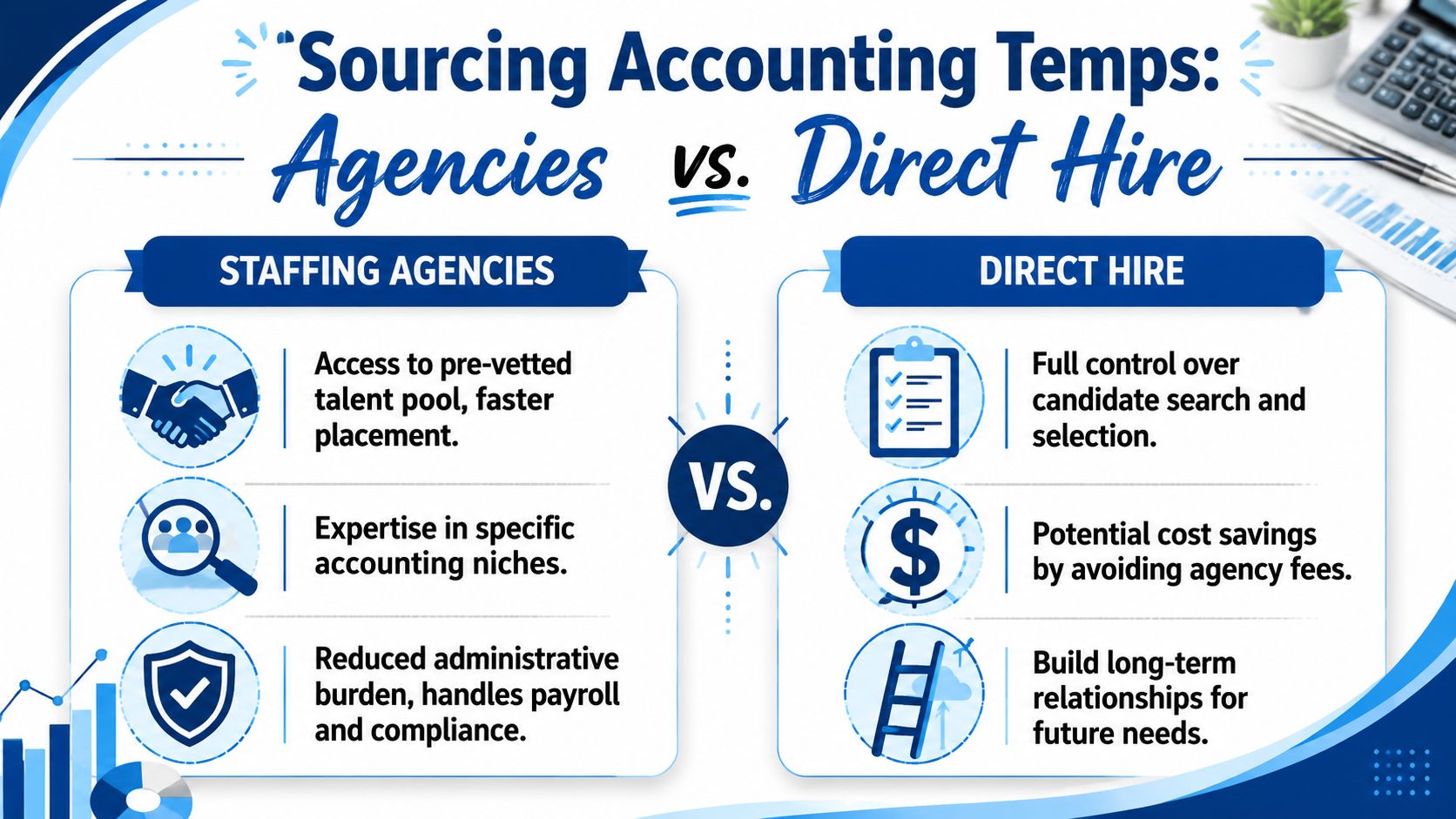
Once you know the role, the next decision is where to source it. For most businesses, the primary choice is staffing agency versus direct contractor.
Demand is active. 63% of U.S. employers plan to engage more contract talent, demand is especially high for AP and AR specialists, and the unemployment rate for bookkeepers is 1.7% according to Robert Half’s finance and accounting demand data. That means good candidates often move quickly.
Agency versus direct hire
Here’s the practical comparison:
| Criteria | Staffing agency | Direct contractor |
|---|---|---|
| Speed | Usually faster | Slower unless you already have a network |
| Screening support | Stronger | You handle it |
| Payroll and compliance admin | Often simpler | You manage more of it |
| Cost visibility | Higher total cost but clearer support model | Can be cheaper, but more internal effort |
| Niche role matching | Better for hard-to-fill accounting lanes | Better when you know exactly who you want |
Choose an agency if urgency matters, your internal team can’t screen technical candidates well, or you need coverage with less administrative drag.
Choose a direct contractor if you already know the profile, can assess accounting work confidently, and have someone who can manage onboarding, access, and compliance.
What to screen before the interview
A resume won’t tell you enough. The first filter should focus on fit for your exact stack and workload.
Look for:
- System match: QuickBooks Online, Gusto, your AP workflow, and the spreadsheet work your team uses.
- Function match: If the gap is collections, don’t get distracted by a candidate whose experience is mostly general bookkeeping.
- Environment match: Candidates who’ve worked in fast-moving service businesses usually ramp faster in similar settings.
- Availability match: Start date, expected schedule, and whether on-site or hybrid requirements are realistic.
A common hiring mistake is chasing broad accounting experience when the business really needs one narrow capability done well for a short period.
Interview for workflow, not personality alone
Ask candidates how they process work, not just what titles they held.
Useful prompts include:
- “Walk me through how you’d clear an AP backlog.”
- “What’s your process for monthly bank reconciliations in QuickBooks Online?”
- “How do you spot duplicate vendors or duplicate bills?”
- “If payroll data in Gusto doesn’t tie to the general ledger, where do you start?”
A temp accounting hire should be able to explain their sequence of work clearly. If they jump straight to “I’d look around the system,” expect a slow start.
For AP roles specifically, a strong set of accounts payable interview questions helps separate people who’ve managed invoice flow from those who’ve only touched it lightly.
Don’t skip the compliance step
Accounting temps touch sensitive data. Before making an offer, line up a lawful and consistent screening process. If your team needs a practical reference on candidate communication, this guide on how to send a compliant background check email is a good operational template.
The key is consistency. Run the same process for candidates in the same role category, document approvals, and don’t improvise after you’ve already promised a start date.
Crafting the Job Description and Skill Checks
Vague job descriptions attract vague applicants. If you want a temp who can produce useful work in the first week, the posting needs to read like an operating brief, not a generic HR ad.
The technical bar is rising. Proficiency in tools like QuickBooks Online and Gusto is a benchmark for temp-role success, and 68% of companies increasing contract talent use those systems to manage staffing plans and benefits according to Vision CPA’s analysis of the shifting accounting shortage. The same source notes that 93% of leaders report difficulty securing qualified professionals, which is why unclear job scope and weak salary positioning repel good candidates quickly.
What the job description must include
Write the posting in five parts.
Role outcome
Start with the business result, not a list of duties.
Bad version: “Seeking temporary accountant for various tasks.”
Better version: “Seeking a temporary accountant to bring AP current, complete weekly bank reconciliations in QuickBooks Online, and support month-end close for a service business.”
That tells the candidate what success looks like.
Exact responsibilities
List the actual work, in the order it matters:
- Daily processing: AP entry, customer payment posting, vendor statement review
- Weekly controls: Bank and credit card reconciliations, aging review, exception follow-up
- Close support: Journal entry prep, balance sheet support schedules, document organization
- Payroll support if applicable: Time review, payroll change coordination, ledger tie-out
Required systems
Name the tools directly. If the person needs to work in QuickBooks Online and Gusto, say so. If they need to use shared drives, bill pay software, or approval routing, include that too.
Duration and schedule
Be precise about whether the role is full-time, part-time, project-based, hybrid, or on-site. Don’t leave candidates guessing about physical presence or expected hours.
Pay framework
You don’t need a long compensation essay, but you do need clarity. If the work is senior-level and your pay target is out of step with the market, better candidates will screen themselves out.
Hiring note: Good temp candidates read a job description to decide whether the company knows what it needs. If the ad feels confused, they expect the engagement to feel confused too.
If you need help tightening the wording, this guide to crafting compelling job descriptions is a useful reference for structure and language.
Practical skill checks a non-accountant can run
You don’t need to be a CPA to test whether someone can do accounting work. You need practical exercises tied to the role.
Use short tasks like these:
Bank reconciliation review
Give the candidate a sample statement and ledger detail. Ask which items need follow-up and which are timing differences. You’re testing judgment and cleanliness of thought.AP coding exercise
Show three vendor invoices and ask where each should go in the chart of accounts. Listen for whether they ask clarifying questions. Good candidates do.Collections scenario
Present an aging report with a few past-due accounts. Ask what they would do first. A strong AR temp talks about prioritization, documentation, and communication.QuickBooks Online navigation check
Ask the candidate to explain how they would locate uncategorized transactions, run an AP aging report, or review a prior reconciliation. They should know the path, not just the concept.
A simple scorecard works better than gut feel
Use a short rubric during interviews:
| Area | What you want to hear |
|---|---|
| Systems fluency | Specific steps in QuickBooks Online or Gusto |
| Process discipline | Clear order of operations |
| Error awareness | Mentions review, tie-outs, and exceptions |
| Communication | Explains accounting work in plain English |
| Scope fit | Experience matches your actual bottleneck |
If two candidates feel similar, choose the one who understands the handoffs around the work. Temporary accounting success usually depends less on brilliance and more on clean execution inside an existing process.
Navigating Contracts Payroll and Legal Requirements
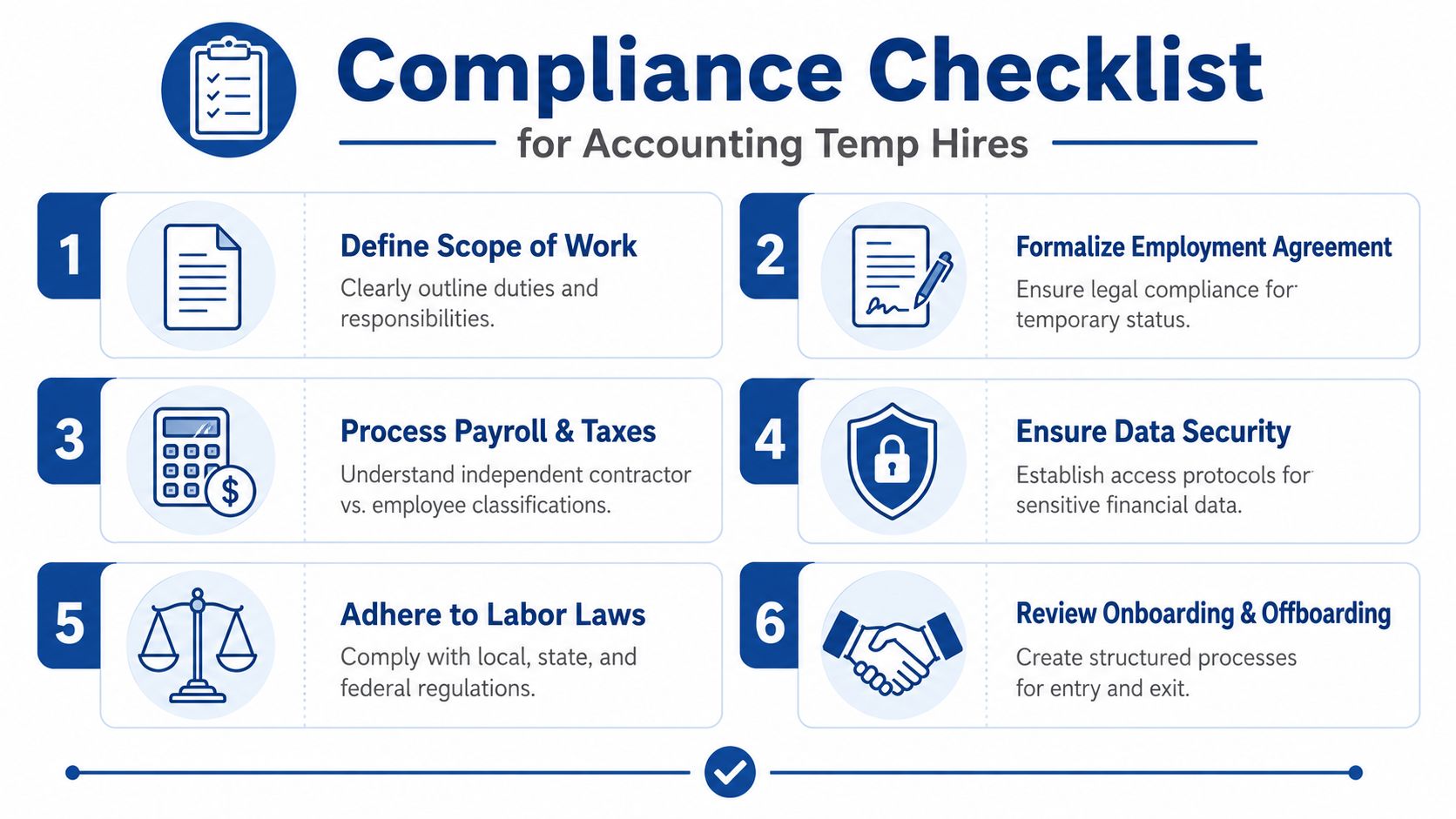
In temporary accounting, many otherwise solid hires go sideways. A temporary accounting engagement needs structure before the person touches your books, your payroll, or your banking workflow.
Compensation needs to be grounded in the market. As of July 3, 2026, the average hourly pay for accounting temp workers in the U.S. is $36.09, with most earning between $21.15 and $36.54 per hour, according to ZipRecruiter’s accounting temp salary data. The same source gives a practical example of a temporary accounting associate in a major city earning $32 per hour for a part-time, six-month project. Those numbers should shape your contract terms and budget expectations.
What belongs in the agreement
At minimum, your written agreement should define:
- Scope of work: The exact tasks the temp owns
- Duration: Start date, anticipated end date, and extension terms
- Payment terms: Hourly rate or project terms, approval process for hours, invoicing cadence if applicable
- Confidentiality: Financial records, payroll data, vendor files, customer balances, and internal reports
- Work product and records: Where files live and who owns the deliverables
- Exit process: Access removal, handoff notes, and final reconciliation of open items
If the role touches payroll, banking, grant reporting, or customer data, loose agreements are a risk multiplier.
Classification is not paperwork trivia
The distinction between an independent contractor and a temporary employee affects taxes, payroll handling, and liability. Treat classification as a legal and operational decision, not a convenience choice.
If the person will be onboarded into your team’s workflow, use your systems daily, follow your schedule closely, and work under direct supervision, stop and review the setup carefully before you decide how to classify them. If your payroll process is unclear, this overview of payroll compliance requirements is a good checkpoint.
Get classification wrong, and the cheapest temp hire becomes the most expensive admin problem in the building.
How to set them up in QuickBooks Payroll or Gusto
The software setup should follow the contract, not the other way around.
In Gusto, set the worker up with the correct worker type, confirm tax withholding treatment where applicable, restrict admin rights, and route approvals to one internal owner.
In QuickBooks Payroll, confirm pay type, earning setup, and department or class structure if you use job costing or location tracking. Then make sure payroll journal entries map correctly into the general ledger.
Before the first pay run, verify three things:
- The worker record matches the signed agreement.
- The approval path for hours or payroll changes is assigned to one manager.
- Access to payroll reports is limited to people who need it.
A clean setup protects both accuracy and confidentiality. In finance, that’s not optional.
Secure Onboarding and Performance Management
A temp should never arrive to a blank slate and broad system access. Good onboarding is controlled, documented, and narrow by design.

This matters even more in specialized environments. In some non-profit markets, 71% of non-profit accounting roles require knowledge of federal grant compliance under 2 CFR Part 200, according to Frontline Source Group job data cited here. If a temp doesn’t understand restricted fund allocation, the risk isn’t abstract. They can post transactions incorrectly and create audit problems that surface much later.
Start with access design
In QuickBooks Online, avoid the common mistake of making the temp a broad admin user because it feels faster.
Instead:
- Grant by task: If they’re reconciling accounts, they don’t need access to every payroll detail.
- Separate payroll from bookkeeping: If the temp is doing AP or bank recs, keep payroll access limited unless payroll is explicitly part of the role.
- Use shared process folders: Support schedules, approval logs, and handoff notes should live in one place.
- Document exceptions: If they need one-time access to historical data or a sensitive report, note who approved it and why.
For Gusto, apply the same logic. Give the worker only the permissions tied to their actual function, and keep benefit administration and company-level settings with your internal owner.
A first-week onboarding checklist
The first week should have a defined rhythm.
Day one
- System login setup: QuickBooks Online, Gusto if needed, document storage, and any AP inbox or reporting folders
- Role briefing: What they own, what they don’t, and who approves work
- Process map: Show the monthly close checklist, AP workflow, and any naming rules for files
Day two through three
- Shadow and sample: Have them process a limited batch of real work
- Review loop: Internal reviewer checks coding, support, and notes
- Issue log: Start a simple tracker for missing documents, unclear vendors, and unreconciled items
End of week one
- Work quality check: Review one complete cycle of their assigned tasks
- Open questions list: Capture what still needs clarification
- Next-week targets: Set specific outputs and deadlines
The best temp onboarding looks repetitive on purpose. Repetition is what prevents creative accounting in places where you want standard accounting.
Measure output, not busyness
You don’t need elaborate KPIs. You need a few clear deliverables tied to time and accuracy.
Examples of useful temp metrics:
| Role | Useful performance measure |
|---|---|
| AP temp | Invoices entered with support attached and approval status clear |
| AR temp | Past-due accounts followed up and notes documented |
| Bookkeeping temp | Reconciliations completed on schedule with exceptions flagged |
| Close support temp | Assigned schedules completed and review-ready |
Avoid vanity metrics. “Works hard” and “very responsive” don’t tell you whether the books are cleaner. Better questions are: Are reconciliations current? Are unsupported entries decreasing? Is the backlog shrinking in a controlled way?
For non-profits or grant-funded entities, add one more checkpoint. Review coding to restricted funds and grant classes early, before the temp posts a large volume of transactions. That early review is where you catch the expensive mistakes.
From Temporary Help to a Permanent Asset
A strong temp engagement often tells you something bigger about your business. Sometimes the lesson is that you needed short-term help. Sometimes the lesson is that you’ve found the right long-term operator.
The best temp-to-perm decisions don’t happen because the candidate is likable. They happen because the person proved they can work inside your systems, protect data, communicate clearly, and leave cleaner records behind them.
When to consider a permanent offer
Look at three things.
First, repeatability. Did the person build a consistent cadence in QuickBooks Online, Gusto, and your review workflow, or did they need constant rescue?
Second, judgment. Did they escalate exceptions well, ask the right questions, and avoid casual shortcuts with sensitive data?
Third, handoff quality. Good accounting people leave a trail someone else can follow. If their notes, support files, and issue logs are clean, that matters.
If those three are strong, a temp-to-perm conversation is worth having.
A practical final checklist
Use this as the operating checklist for accounting temp jobs:
- Confirm the problem shape: Temporary bottleneck or permanent capability gap
- Define the lane: AP, AR, bookkeeping, cleanup, payroll support, or close support
- Choose the channel: Agency for speed and screening, direct hire for control
- Write the role clearly: Outcome, systems, schedule, duration, and real duties
- Run skill checks: Reconciliation review, coding logic, workflow questions
- Put the agreement in writing: Scope, pay terms, confidentiality, end date, and exit process
- Set up payroll correctly: Match the worker setup to the signed arrangement
- Limit system access: Grant only what the job requires
- Review work early: Catch errors in the first week, not the first quarter
- Measure deliverables: Focus on completed reconciliations, documented exceptions, and reduced backlog
- Evaluate for permanence: Offer a long-term role only after process discipline is clear
A temporary accounting hire creates value when the business treats the role like a controlled financial process, not a staffing patch.
If you follow that model, accounting temp jobs become more than emergency coverage. They become a flexible way to protect close timelines, stabilize reporting, and test future hires under real operating conditions.
If you need help building the process around a temp hire, cleaning up books before someone new steps in, or tightening QuickBooks and Gusto workflows so a temporary accountant can succeed quickly, Steingard Financial can help you create a finance back office that’s clear, controlled, and easier to scale.