 Skip to content
A client emails at 4:42 p.m. on payroll day. Their team is asking why hours look wrong in Gusto, the owner wants an answer before close of business, and your bookkeeper is still tracing a classification issue in QuickBooks. The person handling that moment cannot rely on charm, a polished resume, or vague promises to “follow up.” They need judgment, process discipline, and enough operational fluency to protect trust while the facts are still coming together.
That is the standard for account management in a tech-forward bookkeeping and payroll firm. The role sits at the intersection of client service, financial operations, and internal coordination. Strong account managers turn messy back-office work into clear client communication. They know the difference between a routine support question and a risk point that could affect payroll accuracy, reporting confidence, or renewal probability.
Hiring for that role takes more than a generic list of interview questions. It takes a framework that tests how a candidate prioritizes, how they handle ambiguity, and whether they can speak credibly about workflows tied to QuickBooks, Gusto, AP, AR, and month-end close. It also takes discipline from the interviewer. Resume quality can hide weak ownership. Confidence can hide shallow systems knowledge.
Early screening matters here. Teams that want a better read on judgment before the formal interview loop often improve signal by improving hiring with conversational AI.
The questions below are built for firms like Steingard Financial, where client retention depends on calm communication, accurate execution, and the ability to create value beyond basic task completion. I would score candidates on three things throughout the process: client judgment, operational fluency, and scope control. That structure makes it easier to separate people who excel at owning a book of business from people who present well in interviews.
1. Tell me about your experience managing client relationships and how you’ve handled difficult situations

A client’s payroll is due tomorrow. Their prior provider left behind messy books, the numbers in QuickBooks do not tie out, and the owner wants answers now. That is the kind of pressure this question should surface.
Used well, it tells you whether a candidate can protect trust while sorting through operational risk. In a firm like Steingard Financial, hard situations rarely come from “difficult personalities” alone. They usually start with missed expectations, unclear scope, delayed reporting, historical cleanup issues, or anxiety around payroll timing in Gusto or another platform. Strong account managers know the difference.
The answer should show sequence and judgment. I want to hear how the candidate gathered facts, what they communicated first, who they pulled in internally, and how they kept the client informed while the team fixed the issue. Candidates who stay vague here usually have not owned the relationship at a meaningful level.
A solid answer often sounds like this: they inherited an upset client after month-end reporting slipped, reviewed the close status before the call, told the client exactly what was done and what was still open, set a firm update cadence, coordinated with bookkeeping, and closed the loop with a process change so the same miss did not happen again. That tells me more than any polished line about being “good under pressure.”
For client-facing roles, I also listen for tone. Good candidates do not label clients as irrational because they are frustrated about late reports, payroll errors, or cash flow confusion. They explain the business impact, own their part, and work the problem. Some of the better service recovery habits overlap with these AgentStack support insights, but in account management I still expect stronger internal coordination and more commercial judgment.
What to listen for in the answer
A credible story usually includes four parts:
- The business context. What was at risk, such as payroll timing, reporting accuracy, or client retention?
- The candidate’s role. What did they personally own versus what did operations or bookkeeping handle?
- The communication plan. How often did they update the client, and how did they reset expectations?
- The prevention step. What changed in the workflow, handoff, or review process after the issue was resolved?
One interview rule has held up for me. If a candidate describes a hard client situation and cannot name a mistake, blind spot, or process gap, keep pressing. Experienced account managers have scar tissue. They should be able to explain what they learned and what they changed.
Scoring rubric and red flags
- Strong signal: They take ownership even if another department created part of the problem.
- Strong signal: They can explain the operational details clearly enough to sound credible in a bookkeeping or payroll setting.
- Strong signal: They describe a follow-up process, such as a revised close checklist, approval timeline, or escalation path.
- Watch out: They tell a relationship story with no dates, deadlines, systems, or business stakes.
- Watch out: They rely on charm, reassurance, or “white-glove service” language without showing how the issue was resolved.
- Watch out: They blame the client for misunderstanding scope when the underlying issue was poor expectation setting.
For this role, I would score the answer across four lenses: ownership, communication discipline, internal collaboration, and judgment under pressure. The strongest candidates usually come in with several specific stories prepared, often in a STAR format, because they have handled account churn risk, inherited messy books, and worked through service failures before. That pattern matters more than polish.
2. How do you prioritize multiple client accounts, especially when competing demands arise?
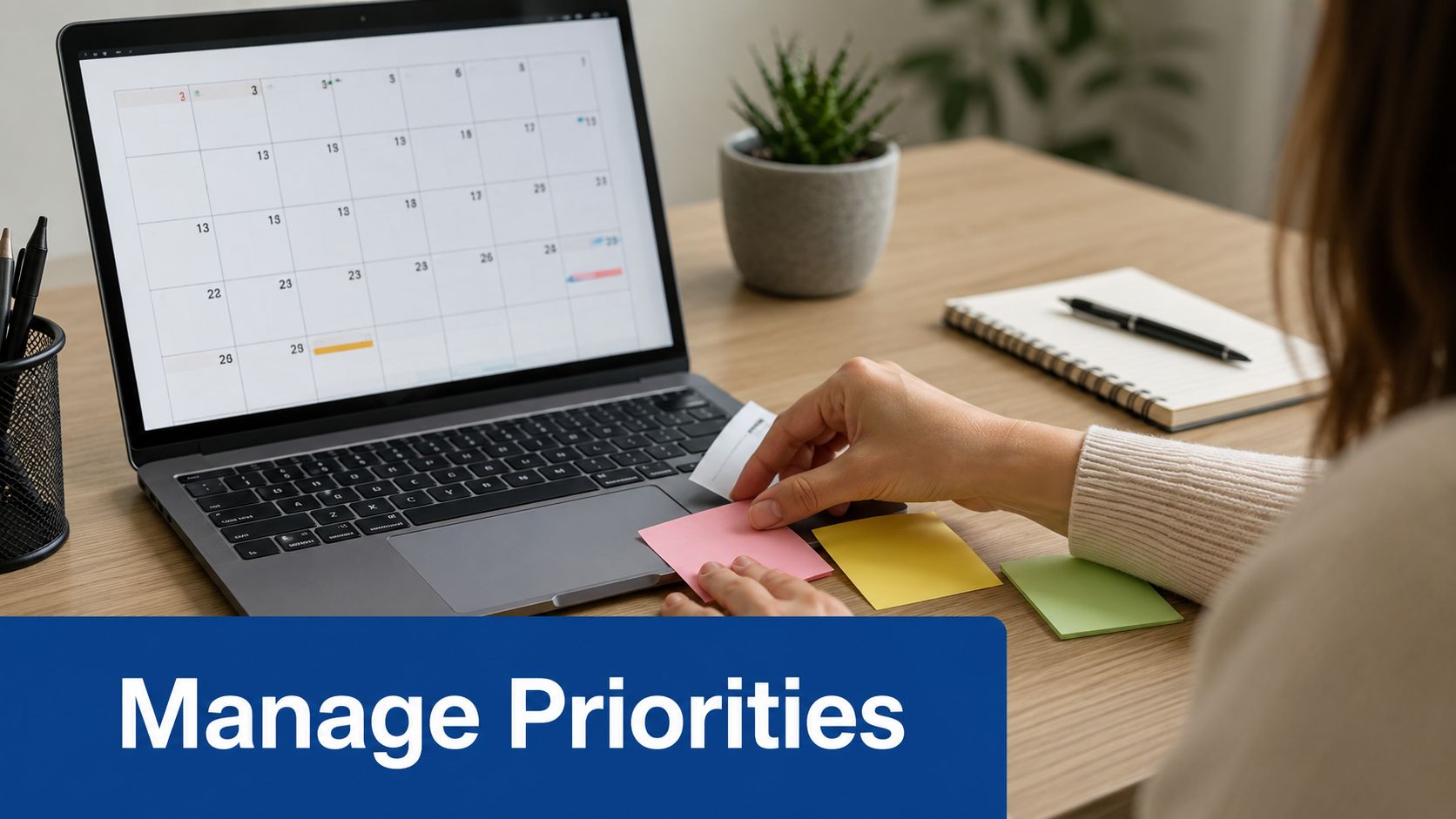
This question separates people who manage work from people who react to inboxes. In account management, especially in bookkeeping and payroll, urgency is uneven. A client asking for a dashboard tweak may feel loud. A payroll approval deadline is critical. A month-end close issue may be quiet until it suddenly isn’t.
The best candidates have a triage model. It doesn’t need fancy language, but it does need structure. They should be able to explain how they rank time-sensitive operational work, revenue-risk issues, onboarding tasks, and strategic account development without sounding chaotic.
What to listen for in the answer
A useful answer usually includes segmentation. They may divide accounts by onboarding stage, service complexity, renewal risk, or deadline sensitivity. In a Steingard-style environment, I want to hear that they understand why payroll windows, reconciliation blockers, and month-end reporting deadlines outrank lower-stakes requests.
They should also describe how they communicate prioritization. Good account managers don’t just reshuffle tasks internally. They reset expectations before the client has to chase them.
A realistic scenario: one client needs urgent payroll clarification in Gusto, another wants help understanding a QuickBooks variance before a lender conversation, and a newly signed account is waiting on onboarding documents. The strongest candidates explain who gets immediate attention, what gets delegated, what gets scheduled, and how each client is updated.
Before moving on, it’s worth seeing how candidates think about de-escalation under pressure. The tactics behind AgentStack support insights often overlap with what good account managers do when priorities collide and clients feel ignored.
Simple scoring framework
- 5 out of 5: Uses a clear system, distinguishes urgent from important, and protects deadlines without dropping communication.
- 3 out of 5: Has decent instincts but mostly works from memory or inbox order.
- 1 out of 5: Talks about multitasking, hustle, or “handling everything” with no prioritization logic.
What doesn’t work is the candidate who says every client is a priority. That sounds customer-centric. In practice, it creates service inconsistency and internal burnout.
3. Describe your understanding of bookkeeping, payroll, and AP/AR management. What’s your learning approach if these aren’t your strong suit?
This question matters because account managers in a financial services firm don’t need to be CPAs, but they do need enough fluency to ask smart questions, translate issues clearly, and avoid making promises that operations can’t support. Clients don’t separate relationship quality from technical credibility. If the account manager sounds shaky on fundamentals, trust drops fast.
I’m not looking for textbook language. I’m looking for working knowledge. Can they explain why reconciliations matter? Do they understand the difference between accounts payable and accounts receivable in day-to-day operations? Can they speak intelligently about payroll timing, approvals, and reporting dependencies in systems like QuickBooks Online and Gusto?
What a strong answer includes
The strongest candidates are honest about depth. If they’ve owned client communication around bookkeeping cleanups, payroll transitions, or reporting reviews, they should say so plainly. If they’re lighter on accounting detail, they should explain how they close that gap through training, shadowing, documentation, and repetition.
For a firm delivering fractional accounting services, the practical question is whether this person can sit in front of a service business owner and make a messy back-office issue understandable without oversimplifying it.
Here’s what I want to hear:
- Bookkeeping fluency: They understand reconciliations, categorization, chart of accounts logic, and clean month-end reporting.
- Payroll fluency: They know timing, approvals, employee changes, and the importance of accuracy.
- AP/AR fluency: They can discuss bill flow, collections, aging, and cash timing in plain English.
- Learning discipline: They mention certifications, product training, internal SOPs, or direct mentoring instead of vague claims like “I pick things up quickly.”
Candidates don’t need deep technical mastery. They do need enough command to avoid becoming a message relay between the client and the delivery team.
Red flags
A candidate who says “the specialists handle that” is telling you they haven’t learned how service businesses experience account management. Clients don’t want a switchboard operator. They want a credible guide.
Another weak pattern is overconfidence. If someone claims broad expertise but can’t explain a simple reconciliation issue or payroll dependency in plain terms, they’ll likely create rework later.
4. How would you approach onboarding a new client and ensuring a smooth transition to Steingard’s services?

Candidates’ perspectives on onboarding quickly differentiate their quality. Weak candidates describe onboarding as a welcome call plus a checklist. Strong candidates understand that onboarding is the first proof that your firm is more organized than the one the client is leaving.
For a bookkeeping and payroll firm, the transition usually carries risk. Historical books may be messy. The chart of accounts may need work. Permissions may be incomplete across QuickBooks Online, Gusto, banks, and payroll systems. The client may already be anxious because they switched providers after a bad experience.
What good onboarding sounds like
A strong answer starts with discovery, not implementation. The candidate should talk about understanding the current state, known pain points, deadlines, system access, reporting needs, and who on the client side owns decisions.
They should also mention validation. Good onboarding isn’t finished when data is migrated or access is granted. It’s finished when the client understands the process, knows what’s happening next, and sees evidence that numbers and workflows are being reviewed carefully.
A candidate who has done this well may describe a sequence like this: kickoff call, responsibility mapping, systems audit, secure access collection, transition timeline, data validation, first reporting review, then a standing communication cadence. That’s the right level of discipline.
If you want to compare their answer to what service business owners need during setup, the operational framing in this guide to small business accounting workflows is useful context.
Red flags and scorecard
- Excellent: They mention discovery, milestone ownership, communication cadence, and risk mitigation.
- Good: They have a clear process but don’t say much about validation or client anxiety.
- Weak: They jump straight to software setup and skip change management.
A smooth onboarding isn’t the absence of problems. It’s the presence of clear expectations, visible ownership, and fast communication when something slips.
I’d also ask a follow-up: “What would you do if the client expected historical cleanup faster than the team could responsibly deliver it?” Their answer usually tells you whether they can balance service and truth.
5. Tell me about a time you identified an opportunity to improve client operations or drive additional value beyond the scope of initial engagement
A modern account manager should create value before they try to expand scope. If they lead with cross-sell language too early, they’ll sound transactional. If they never spot adjacent needs, they’ll manage accounts passively and leave growth on the table.
In a bookkeeping and payroll environment, good expansion usually starts with pattern recognition. The account manager notices repeated payroll confusion, inconsistent reporting inputs, weak AP controls, hiring friction, or a mismatch between the client’s growth stage and their current back-office setup. Then they connect that issue to a practical solution.
What strong commercial judgment looks like
The best stories start with client need, not internal revenue pressure. A candidate might describe noticing that a service business owner was making hiring decisions with no reliable labor cost visibility. Instead of pushing an upgrade immediately, they worked with the team to surface better reporting, then recommended an expanded advisory layer once the client understood the gap.
That’s the right sequence. Diagnose, prove relevance, then recommend.
Another strong example would be recognizing that the client’s people issues were affecting payroll accuracy, onboarding consistency, and retention. In a Steingard-like model, that could open the door to broader People Advisory support. The important part is whether the candidate can explain why the recommendation fit the client’s actual operating pain.
What to reward and what to question
- Reward: Specific observation, thoughtful recommendation, collaborative handoff, and client-centered timing.
- Reward: A story where the client said no at first, then yes later after seeing the issue more clearly.
- Question: Anything that sounds like quota talk disconnected from service outcomes.
- Question: Upsell stories built on pressure rather than problem solving.
I also like asking, “What opportunity did you choose not to push?” Mature candidates know that not every possible expansion should happen immediately. Sometimes trust compounds better when the account manager solves the first problem thoroughly and waits.
6. Walk me through how you would handle a situation where a client disputes a charge or service quality issue
This is one of the highest-value account management interview questions because it tests emotional control, fairness, and backbone at the same time. Anyone can sound client-friendly when things are smooth. Disputes reveal whether the person can investigate carefully without becoming defensive or overly appeasing.
In financial services, service quality issues can be sensitive fast. If a client disputes a fee tied to cleanup work, late deliverables, or corrective effort after bad historical data, the account manager needs to hold two truths at once. The client deserves a real explanation. The firm also deserves an advocate who won’t casually concede fault before facts are clear.
The response pattern that works
A strong candidate usually describes a sequence like this. First, acknowledge the concern and lower the temperature. Second, gather specifics and review the timeline, scope, and internal notes. Third, involve the right internal owners. Fourth, return with a clear explanation, a resolution path, or both.
What doesn’t work is rushing to defend billing, or promising a credit before understanding the issue. Both create bigger problems. The right hire knows when to apologize for confusion, when to apologize for an actual miss, and when to stand firm because the work was in scope and properly delivered.
If the candidate can’t explain how they’d communicate during the investigation window, they probably leave clients in silence when tension rises.
Red flags you shouldn’t ignore
Candidates who blame operations teams usually struggle in cross-functional environments. So do candidates who confuse empathy with concession. In bookkeeping and payroll, that can become expensive quickly.
Ask a follow-up with more friction: “What if your internal team insists the work was correct, but the client still feels let down?” Strong candidates will talk about evidence, communication, expectations, and next steps. Weak ones pick sides too early.
7. How do you stay current with accounting software updates, regulatory changes, and industry trends?
This question is less about hobbyist curiosity and more about professional reliability. In a tech-forward bookkeeping and payroll firm, tools change, workflows change, and client expectations change with them. If the account manager isn’t learning, they become a bottleneck between what the platform can do and what the client thinks is possible.
I want candidates who have an actual habit here. Not “I read articles sometimes.” A repeatable system. That could include vendor webinars, product release notes, certification programs, internal lunch-and-learns, customer communities, or saved alerts around payroll and compliance topics.
What a mature learning system sounds like
The strongest answers connect learning to client outcomes. A candidate might explain that they track QuickBooks Online and Gusto updates so they can anticipate workflow changes, improve client communication, or flag opportunities for process improvement before confusion builds.
That’s much stronger than naming random newsletters. Learning has to feed execution.
At a senior level, this question also tests whether the candidate can translate updates into action for clients and teammates. High-performing account management teams are expected to use customized CRM dashboards, predictive analytics, and satisfaction metrics like NPS or CSAT, while also being ready to run Quarterly Business Reviews and speak to a metrics cheat sheet with 5 to 7 top indicators, according to AssessFirst’s account manager interview guidance. You don’t need every candidate to have done all of that, but senior hires should recognize the operating model.
What weak answers reveal
- Weak pattern: They only learn when something breaks.
- Weak pattern: They rely entirely on specialists to interpret product or regulatory changes.
- Weak pattern: They know names of tools but can’t explain how updates affect workflows or client conversations.
For Steingard’s model, I’d push specifically on QuickBooks Online and Gusto. Not to quiz for trivia, but to see whether the candidate thinks in systems or just in relationships.
8. Describe your experience with KPI reporting and using data to drive business decisions for clients

This question is where you find out whether the candidate can move from account coordination into actual advisory value. In a bookkeeping and payroll firm, data isn’t just a deliverable. It’s how clients decide whether to hire, cut costs, follow up on receivables, or rethink pricing.
Weak candidates talk about sending reports. Strong candidates talk about helping clients use them.
What to listen for
A strong answer should include three parts. First, which KPIs they tracked. Second, how they interpreted them in context. Third, what decision or action came next. If they stop at the dashboard, they’re a reporter, not an account manager with business judgment.
For service businesses, useful examples often involve labor costs, AR aging, cash flow timing, margin by service line, payroll trends, or utilization-adjacent operational indicators. If they can explain a moment when a client changed behavior because of a reporting insight, that’s the signal you want.
This matters even more if your firm promises reporting with operational relevance. Steingard’s approach to management reporting and MIS visibility is the right benchmark. The account manager should be able to sit with those reports and help a client understand what deserves attention now.
A candidate who’s thoughtful here will usually also know when clients need simpler interpretation tools. For owners who get overwhelmed by standard financial statements, tools that simplify financial report analysis can be useful conversation aids, but the account manager still has to provide judgment.
Strong answer markers
- Clear metric selection: They know which KPIs matter for a service business and why.
- Action orientation: They describe recommendations, not just reporting cadence.
- Business fluency: They connect accounting data to hiring, pricing, collections, and capacity decisions.
If they can’t tell you how data changed a client conversation, they probably won’t create much strategic value after the hire.
9. How have you managed scope creep or client expectations when requests fall outside your service offerings?
The wrong account manager says yes too often, then hands your delivery team a mess. The other wrong account manager says no too bluntly and makes the client feel dismissed. You need someone who can protect margin, maintain trust, and redirect requests without sounding territorial.
In a bookkeeping and payroll firm, this comes up constantly. Clients ask for tax strategy, legal structure advice, one-off finance consulting, HR decisions beyond agreed support, or operational work that doesn’t fit the engagement. None of those requests are unreasonable from the client’s perspective. The problem starts when the account manager handles them casually.
What good boundary-setting sounds like
Strong candidates explain scope in helpful language. They don’t hide behind policy. They clarify what the firm does handle, what it doesn’t, what the risk is if the client treats the team like a catch-all resource, and where the client should go instead.
The best answers include proactive expectation-setting early in the relationship. That’s mature account management. It’s much easier to reinforce boundaries later when the client heard them clearly during onboarding and ongoing reviews.
A strong example might be a client asking the bookkeeping team for tax planning advice. The right response isn’t “we don’t do that.” It’s more like, “We can absolutely prepare the reporting your tax advisor will need, and we can coordinate with them, but we shouldn’t position bookkeeping as tax strategy.” That protects the client and the firm.
Red flags
- They say yes first, then try to fix it internally later.
- They treat scope management as a sales obstacle instead of a service discipline.
- They don’t offer a referral path, alternative, or next-best step.
This question also tells you whether the candidate understands your business model. If they can’t articulate the difference between bookkeeping, payroll support, People Advisory, tax, audit, and broader consulting, they’ll blur lines with clients from day one.
10. Tell me about your experience working with service business owners and how you understand their unique challenges
This is the contextual question. Some account managers are perfectly capable in generalist roles but struggle when clients operate with labor-heavy margins, seasonal swings, cash pressure, and owner-led decision making. Service businesses have a different rhythm than product companies, and your hire should understand that before they start advising anyone.
A service business owner often experiences finance as operations. Payroll isn’t just payroll. It’s scheduling, staffing, and retention. AR isn’t just collections. It’s whether the owner can breathe next month. Reporting isn’t just bookkeeping hygiene. It’s whether they trust the numbers enough to hire or wait.
What a credible answer includes
The strongest candidates can speak about at least one service business model with confidence. Maybe they’ve worked with agencies, staffing firms, contractors, home services operators, or professional services teams. I don’t need broad industry coverage. I need signs they understand labor intensity, project timing, uneven cash flow, and the operational importance of clean reporting.
They should also understand that service business owners often want fast answers in plain English. If a candidate defaults to software features instead of business realities, they may know the tools but not the customer.
A good answer might include a situation where the candidate helped a client interpret labor costs in relation to revenue pacing, cleaned up receivables visibility so the owner could plan hiring, or reset expectations around monthly reporting because the owner was making decisions from stale data.
The best account managers for service businesses don’t just know accounting language. They know owner language.
Final evaluation lens
This is the last question I’d ask before making a decision because it ties everything together. Can the candidate manage relationships, handle pressure, work within scope, learn the tools, interpret data, and communicate with owners who are short on time and patience?
If yes, you probably have more than a polite client manager. You have someone who can become part of the client’s operating rhythm.
10 Key Account Management Interview Questions Comparison
| Question | Implementation complexity 🔄 | Resource requirements ⚡ | Expected outcomes ⭐📊 | Ideal use cases 💡 | Key advantages ⭐ |
|---|---|---|---|---|---|
| Tell me about your experience managing client relationships and handling difficult situations | Medium, behavioral+situational | Moderate, interview time, reference checks | ⭐ Demonstrates emotional intelligence; 📊 fewer churns, faster resolutions | Hiring client-facing AMs; evaluating service recovery skills | Reveals conflict-resolution style and ownership |
| How do you prioritize multiple client accounts when competing demands arise? | Medium–High, needs frameworks | Tools/ops: PM software, prioritization frameworks | ⭐ Balanced workload; 📊 fewer missed deadlines, sustained SLAs | Scaling teams; high-volume portfolios | Shows scalability and process discipline |
| Describe your understanding of bookkeeping, payroll, and AP/AR; learning approach if weak | Medium, technical + coachability | Training, platform access (QBO, Gusto), certifications | ⭐ Technical baseline or coachability; 📊 faster ramp-up | Roles needing domain fluency or quick onboarding | Identifies teachability and financial literacy |
| How would you approach onboarding a new client and ensuring smooth transition? | High, project & change management | Cross-team coordination, data migration tools, checklists | ⭐ Reduced onboarding friction; 📊 lower early churn, accurate data | New client intake; migrations from other providers | Tests structure, risk mitigation, and attention to detail |
| Tell me about a time you improved client operations or drove value beyond scope | Medium, behavioral + consultative | Knowledge of services, client history, business acumen | ⭐ Opportunity identification; 📊 upsell/adoption rates | Growth-oriented AMs; upsell/cross-sell programs | Highlights proactive consulting and revenue growth potential |
| Walk me through handling a client dispute over charge or service quality | Medium, investigative + empathetic | Access to billing/history, team support, escalation path | ⭐ Restored trust; 📊 resolution time and satisfaction | Quality incidents; regulatory or payroll errors | Reveals accountability, root-cause analysis, communication |
| How do you stay current with accounting software, regs, and trends? | Low–Medium, ongoing habit | Subscriptions, webinars, CPE, vendor communities | ⭐ Maintains compliance and platform knowledge; 📊 fewer tech-related errors | Continuous improvement roles; multi-platform environments | Shows commitment to professional development and credibility |
| Describe experience with KPI reporting and using data to drive decisions | Medium–High, analytics + storytelling | Analytics tools, access to client data, reporting templates | ⭐ Actionable insights; 📊 better cash/price/hiring decisions | Advisory-focused AMs; clients needing strategic guidance | Demonstrates analytical thinking and advisory capability |
| How have you managed scope creep or client expectations outside offerings? | Medium, boundary-setting + diplomacy | Clear contracts, escalation/referral network | ⭐ Protected margins; 📊 controlled scope and profitability | Protecting firm capacity; maintaining service quality | Tests professionalism in saying “no” and offering alternatives |
| Tell me about experience working with service business owners and their challenges | Low–Medium, domain knowledge | Industry exposure, case studies, sector references | ⭐ Faster credibility with clients; 📊 improved relevance of advice | Firms focused on service businesses (e.g., HVAC, agencies) | Confirms market fit and practical empathy for target clients |
Building Your A-Team The Final Decision
Good account management interview questions do more than fill a scorecard. They expose how a candidate behaves when delivery gets messy, priorities collide, and the client wants clarity before your team has every answer in hand. That’s the essential job in a bookkeeping and payroll firm. Not smiling through check-ins. Not just sending recaps. Translating complexity into trust.
For a firm like Steingard Financial, the right hire sits at the intersection of relationship management, operational judgment, and enough technical fluency to be credible in conversations around QuickBooks Online, Gusto, payroll timing, AP/AR workflows, and reporting. That person doesn’t need to be your lead accountant. They do need to know when a client issue is a workflow issue, a data issue, a scope issue, or a communication issue.
That’s why I’d strongly recommend scoring every interview against a consistent framework instead of relying on gut feel. Use the ten questions above, but don’t stop at the first polished answer. Probe for ownership. Ask what they would do differently now. Ask how they handled internal disagreement. Ask what they said to the client while the issue was still unresolved. Those follow-ups are where top-tier candidates separate themselves.
The strongest hiring teams also avoid overvaluing charisma. In account management, polish can hide weak execution for longer than you’d like. A candidate may sound warm and impressive, but if they can’t explain prioritization logic, speak confidently about service-business realities, or set boundaries without damaging trust, the cracks will show once they own a portfolio.
I also look for one trait that doesn’t always appear on a resume. Composure with precision. Plenty of candidates can build rapport. Fewer can do it while keeping details straight, documenting commitments, coordinating cross-functionally, and preserving credibility when something goes wrong. In financial services, that combination matters more than sales energy.
If you’re hiring at a more senior level, raise the bar further. Expert-level interviews should test whether the candidate can build a one-page account plan that includes quantified renewal or expansion pipeline in dollar values, maps stakeholder relationships, and lays out clear 90-day actions, with the expectation that a successor could run the account from that plan alone, according to 4dayweek.io’s account manager interview framework. That’s a useful standard because it reveals whether the person thinks beyond reactive account handling and into durable account ownership.
The final decision should still include cultural fit, but define that term carefully. You’re not looking for someone who feels familiar in the room. You’re looking for someone whose habits reinforce your firm’s values. At Steingard, that means transparency, responsiveness, operational clarity, and a real investment in client success.
Hire for that, and your next account manager won’t just retain accounts. They’ll make your clients feel like they finally have a partner who understands how their business operates.
If your business needs a bookkeeping and payroll partner that combines accurate financial operations with responsive account management, Steingard Financial is built for that role. The team supports service businesses across the United States with clean books, reliable payroll, KPI-focused reporting, and modern back-office systems in QuickBooks and Gusto, so you can spend less time chasing answers and more time running the business.