 Skip to content

The typical cost of a business license is $50 to $400, with a national average near $200. That’s the starting point, not the final number, because your actual cost depends on where you operate, what you do, and which permits get layered on top.
If you’re forming a business right now, this is usually the moment the confusion starts. You file the LLC, get your EIN, open your checklist, and then run into a mess of city forms, county rules, state registrations, and industry-specific permits that all sound similar but bill separately.
From a bookkeeping standpoint, that confusion causes a predictable problem. Owners treat licensing like a one-time setup fee, then get surprised later by renewals, added locations, and compliance work that keeps showing up after launch. The cost of business licenses is much easier to manage when you treat it as an operating expense from day one and budget for the full stack, not just the first form.
How Much Do Business Licenses Really Cost?
Most owners want a single number. In practice, there usually isn’t one.
Across the U.S., several sources put the typical business license cost at about $50 to $400, with a national average near $200. The reason that range is so wide is simple. Local rules and industry requirements drive the final bill, not a single national fee. You can review that baseline in this business license cost overview.
A simple service business often starts near the low end. A more regulated operation, or a business with multiple permit layers, moves up quickly. That’s why a new owner who budgets only for “the license” often underestimates the actual startup and ongoing compliance spend.
What new owners usually miss
The filing fee is only one part of the expense. The practical cost often includes:
- General business registration: The core local or state authorization to operate.
- Activity-specific permits: Home occupation, zoning, health, contractor, or professional permits depending on the work.
- Renewal costs: Many licenses don’t end with the first payment.
- Administrative time: Gathering documents, submitting forms, and following up when approvals stall.
That last item matters more than people expect. If licensing delays your launch, hiring, invoicing, or office opening, the cost is no longer just a fee. It becomes part of your operating cost structure.
Practical rule: Budget for licenses the same way you budget for software, payroll processing, or insurance. Assume they belong in your ongoing overhead unless you’ve confirmed in writing that the filing is one-time and nonrenewing.
A better way to think about the number
When a client asks what business licenses cost, the most useful answer is this: start with the common baseline, then build your real figure from your jurisdiction, service line, and renewal cycle.
That shift matters. It turns licensing from an annoying surprise into something you can model, book correctly, and revisit during expansion.
How Much Is a Business License in San Jose, California?
In San Jose, what most people call a business license is the City’s Business Tax Certificate. Anyone doing business in San José must register for one within 90 days of starting, according to the City of San José.
The tax is based on headcount, and the City counts owners and family members working in the business as employees. For the year starting July 1, 2026, the base tax for 1–2 employees is $222.89, each employee from the 3rd to the 35th adds $37.98, and a $4 state fee (SB 1186) is added each year, per the City’s business tax rates. A five-person business would owe about $341 a year.
State registrations and industry permits sit on top of that. California’s CalGold site lists the permits that apply by location and business type, and our California business license guide walks through the state and county layers.
Steingard Financial is based in San Jose and sets up the books for new businesses through QuickBooks setup and bookkeeping for startups.
Understanding the Layers of Business Licensing
Business licensing works like a trip with multiple tickets. One ticket might get you onto the train, but it won’t automatically cover the bus, the local transfer, or the final stop.
A license usually gives you legal authority to operate in a jurisdiction or profession. A permit usually approves a specific activity, location, or condition, such as occupancy, zoning, or health-related compliance. In real life, most businesses need a stack of both.
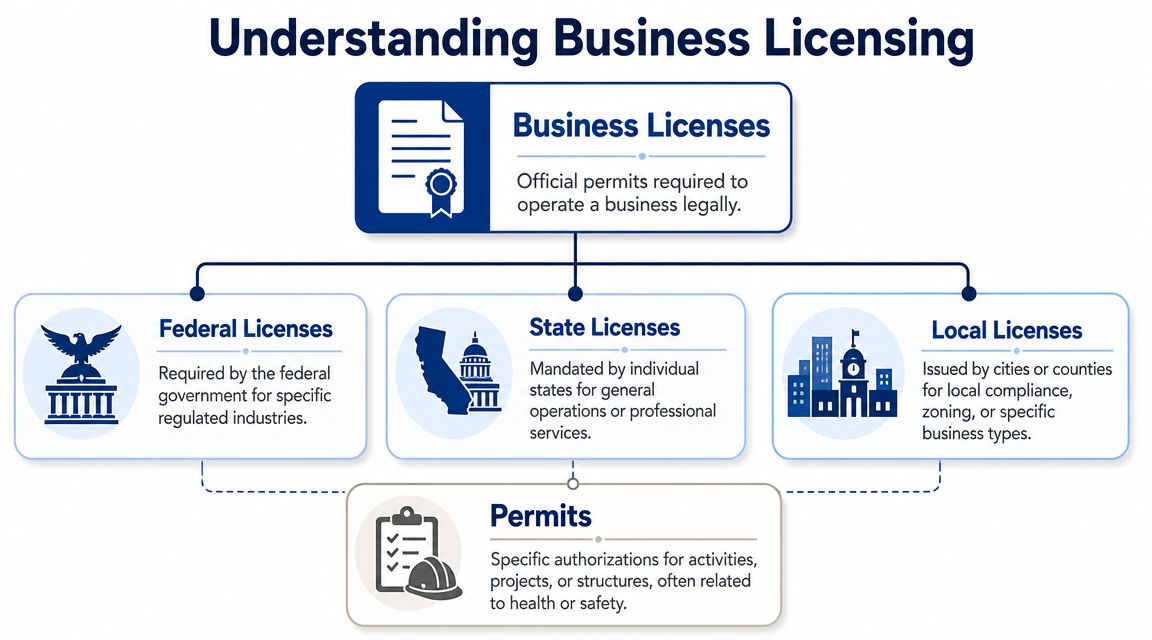
Where the layers usually come from
At the broadest level, your requirements can come from three places:
- Federal agencies: Relevant only for certain regulated activities.
- State agencies: Common for professional, occupational, or tax-related registrations.
- City or county offices: Often where service businesses encounter their first general business license.
For a straightforward consulting firm, the local layer may be the main one. For a regulated business, the state layer can add materially to cost and paperwork. In some cases, you also need supporting items such as insurance certificates or bonding before a license can be issued. If your work requires a bond in that state, resources that explain how to get bonded in Florida can help clarify what that additional compliance step looks like in practice.
Why structure changes the price
The most important cost driver at this stage is jurisdictional structure. In states without a universal statewide license, the fee stack gets fragmented fast. Mississippi is a clean example. There, the compliance burden often shifts to city or county privilege licenses in the $25 to $150+ range, plus any state-level professional licenses in the $50 to $500+ range, which creates multiple payments instead of one filing, as outlined in this Mississippi license cost breakdown.
That fragmentation affects accounting, too. You may have one fee tied to entity setup, another tied to a location, and another tied to the service you perform.
If your books don’t separate those costs clearly, renewals become harder to track and expansion gets more expensive than it needs to be.
A clean setup starts with matching each filing to the correct entity and bank activity. That’s one reason owners should get their business banking organized early, especially when licenses, deposits, and reimbursements start moving through the account. This guide to opening a LLC bank account is a useful companion step.
Key Factors That Determine Your Licensing Costs
The difference between a low-cost filing and a high recurring compliance bill usually comes down to a handful of variables. Some are obvious. Others only show up once you start operating.

Location changes everything
Two businesses doing similar work can face very different bills based solely on city rules. In major markets, licensing can scale far beyond a small startup filing. A 2020 cost-of-doing-business survey found that a medium-sized retail business in San Francisco could pay about $13,500 per year in business license fees, while a similar firm in nearby Dublin, California, might pay only about $50, based on different local formulas and fee structures in the executive summary of the survey.
That example is retail, but the lesson applies broadly. Don’t assume a nearby city has a similar fee model. Some jurisdictions charge a flat amount. Others build fees around revenue, employees, or other local formulas.
Industry determines the compliance stack
A solo consultant and a caterer may both be “small businesses,” but they won’t face the same licensing burden.
Service businesses often start lighter because they don’t always need the health, safety, or site-specific permits that regulated sectors do. Still, the moment you add a physical office, in-person operations, specialized equipment, or regulated activity, costs can climb through added filings.
A few common examples of what can increase the stack:
- Professional regulation: State boards may require separate occupational filings.
- Construction work: Licensing may tie into insurance, registration, and bonding. If your business touches project work, a plain-English guide to surety bonds for construction projects helps clarify one of the added compliance items owners often overlook.
- Food, alcohol, or client-facing premises: These businesses usually add permit layers that service firms don’t carry.
Business structure and footprint matter
Your legal entity doesn’t always set the fee by itself, but it can affect the application path, the documents you need, and how local agencies classify you. A sole proprietor working from home may face a simpler filing path than an LLC with employees and office space in a commercial zone.
The same is true when you expand. A second office or a new city can trigger another licensing set, even if the underlying business is unchanged.
Revenue formulas can create recurring surprises
This is the factor many owners miss. Some jurisdictions don’t stop at a flat filing fee. They use business tax certificate structures or gross-receipts approaches that turn licensing into a recurring annual operating cost.
That distinction changes how you budget. A low filing fee up front may still lead to a larger annual burden later if the city recalculates charges as the business grows.
Cheap to file doesn’t always mean cheap to maintain. The owner who budgets only for launch often misses the recurring cost built into the jurisdiction itself.
Cost Estimates for Common Service Businesses
Most service businesses won’t face the heavier licensing burden common in restaurants, construction, or liquor-related operations. Across broad benchmarks, most U.S. business licenses cost $50 to $400, while more regulated categories can rise sharply. Restaurant licenses often fall in the $100 to $500 range, and construction contractor licenses often land around $300 to $500, based on these state business license cost benchmarks.
That lighter compliance load is good news for consultants, agencies, and bookkeeping firms. It doesn’t mean costs are identical. It means the stack is usually smaller and easier to budget.
Three service business profiles
The table below shows practical examples for common service businesses. These aren’t universal fees. They’re budgeting profiles based on the common baseline and the kinds of filings service owners typically run into.
| Service Business Type | Potential Licenses Required | Estimated Annual Cost Range |
|---|---|---|
| Home-based freelance consultant | Local business license, possible home occupation permit | $50 to $150 |
| Small digital marketing agency with office | City business license, local occupancy or zoning-related approvals, possible county registration | $150 to $400 |
| Remote bookkeeping practice | Local business license, possible home occupation filing, state professional registration if required by jurisdiction | $50 to $150 |
How to use this table
A home-based consultant usually lands at the lower end because the business has fewer operational layers. A small agency with office space often pays more because the location itself can trigger local approvals. A remote bookkeeping practice may stay lean if it avoids a physical storefront and operates in a low-friction jurisdiction.
The mistake is treating these numbers as universal. Use them as planning ranges, then verify the exact filings for your city, county, and state before you commit to your first-year budget.
For service firms, the smartest move is to budget a small annual compliance line from the start rather than absorb each fee as an unexpected owner draw.
How to Find and Apply for Your Business Licenses
The application process is usually less difficult than the research process. Most owners get stuck because they start in the wrong place or gather documents too late.

Start with the jurisdiction, not the form
Use this order:
- Federal check first: Confirm whether your activity falls into a federally regulated category.
- State review next: Look at your Secretary of State, Department of Revenue, or professional licensing board.
- County and city search last: Many service businesses discover their actual operating license at this stage.
Search by your business activity, not just your entity type. “Marketing agency,” “bookkebookkeeping servicesnsulting,” or “home occupation” will usually produce more useful results than “LLC license.”
Gather your core information before you apply
Most agencies want the same foundation, even if the forms look different. Have these ready:
- Legal business name: Match it exactly to your formation documents.
- EIN and owner details: Keep tax registrations close by.
- Business address: Include mailing and operating addresses if they differ.
- NAICS code: Agencies often classify your activity through this code.
- Formation documents: LLC or corporation paperwork, if applicable.
- Insurance or bond documentation: Needed in some regulated situations.
A short explainer can help if you want to see a basic walkthrough before diving into local portals.
Apply in a sequence that avoids rework
A common mistake is submitting local applications before your entity details, address decisions, or tax registrations are settled. That creates mismatches across records and leads to corrections later.
A cleaner order looks like this:
- Form the entity first: Finalize the legal name and structure.
- Get tax IDs in place: This avoids inconsistent records.
- Confirm location rules: Especially important for home-based and office-based service businesses.
- Submit local and industry filings after that: Use the exact same legal details across every application.
If you’re managing this yourself, keep one folder with PDFs, receipts, issued licenses, renewal dates, and agency logins. That file becomes part of your compliance system, not just startup paperwork.
Budgeting for Licenses Renewals and Penalties
This is where bookkeeping matters most. The cost of business licenses is manageable when it’s built into your recurring overhead. It becomes frustrating when it’s treated like random admin work.
The first step is simple. Put license fees into a dedicated expense category in your chart of accounts, or at minimum into a clearly labeled compliance bucket. Don’t bury them in miscellaneous expense. If you do, you won’t see the annual pattern, and you won’t forecast renewals accurately.
Book licenses like recurring overhead
Even when a filing starts as a startup cost, many businesses end up paying related fees again through renewals, added locations, amended registrations, or expanded services.
That’s why I usually advise owners to track licensing with three pieces of information attached:
- Jurisdiction: City, county, state, or agency
- Entity or location: Which business unit or office the filing belongs to
- Renewal timing: Annual, biennial, or event-driven if the requirement changes with operations
If you already use QuickBooks Online or another accounting system, this can be handled with account naming, classes, locations, or memo conventions. The important part is consistency.
The cheapest fee can still be the most expensive choice
A low filing fee looks good until the process eats staff time, delays your opening, or forces repeated follow-up with multiple agencies. One source on Florida licensing makes the point clearly: the cheapest license fee may not lead to the lowest compliance cost, because delays, frequent renewals, and locality-specific requirements can create hidden labor costs that exceed the initial fee. That trade-off is explained in this guide to Florida business license requirements.
That’s a budgeting issue, not just a legal one. If your office manager spends hours chasing renewals, that labor belongs in the actual cost.
A missed renewal rarely shows up as just one late fee. It can also trigger rushed paperwork, management time, interrupted operations, and avoidable stress.
Set up a renewal system that actually gets used
A workable renewal system doesn’t need to be fancy. It needs ownership.
Use a calendar, task manager, or accounting-adjacent workflow and track:
- Renewal date: Don’t rely on memory or mailed reminders.
- Responsible person: One owner, manager, or outside partner should own the task.
- Required backup: Insurance certs, bond renewals, address changes, or updated business details.
- Proof of filing: Save payment receipts and issued renewals in one place.
For a straightforward checklist on timing and process, Start Right Now’s renewal guide is a helpful reference.
If your books are already cluttered, fix the tracking before the next cycle. This guide on how to keep track of business expenses is a good starting point for building that discipline into your monthly process.
What works and what doesn’t
What works:
- Separate expense tracking
- Calendar reminders set well ahead of due dates
- One owner for every filing
- A central document folder with receipts and active licenses
What doesn’t work:
- Paying from personal cards and sorting it out later
- Leaving renewals to whoever notices the email
- Using one generic misc expense account
- Assuming one city’s rules apply in the next city
Licensing is easier when it’s boring. That’s the right outcome. You want it scheduled, categorized, and funded before the invoice arrives.
If you want help turning license fees, renewals, and other compliance costs into a clean, trackable part of your books, Steingard Financial can help you build a bookkeeping system that supports growth instead of reacting to surprises. For service businesses, that usually means cleaner categorization, better cash flow visibility, and fewer last-minute compliance headaches.
Before you open the doors
A licence is a one-time cost. The books are the recurring one.
Most owners settle the licensing question first and leave the bookkeeping one to be decided by default — usually months later, once a year of receipts has piled up and the work has become a cleanup job rather than a routine. Starting from a clean set of books is considerably less work than reconstructing one. If you are weighing whether that is worth handing off yet, a short call is the quickest way to find out — including if the answer is not yet.